
Thompson now had the recipe for his journalism career, and it involved three conceptual breakthroughs.
- The story behind the story is the real story.
- The writer is now the hero of each episode.
- All this gets written in the style of a personal communication to the reader of the real, dirty inside stuff — straight, with no holds barred.
Why couldn’t you write journalism like this? In fact, a whole generation learned to do just that, mostly by imitating Hunter S. Thompson.
But it grows tired and predictable in the hands of today’s imitators — and the Gonzo King never invited either of those modifiers. Yes, blogs and Substacks are part of his legacy, formats that blur the line between diary, confession, and journalism. But he did it before all the rest, not as a desktop publisher — instead putting his life at risk on the road with total fear and loathing.
So if Substack is the grandchild of Hunter Thompson and New Journalism, it is a tame, well-behaved descendant — and nothing like its brave forebear, who kept going full speed without a helmet until the end.
Even the reader has to run to keep up.
Ted Gioia, “The Rise and Fall of Hunter Thompson (Part 2 of 3)”, The Honest Broker, 2025-09-08.
December 10, 2025
QotD: The “rules” of Gonzo journalism
August 15, 2025
Ted Gioia on Hunter S. Thompson
I must admit that I got hooked on Hunter S. Thompson’s writing very early. I read Fear and Loathing in Las Vegas in my mid-teens and it blew my mind. I couldn’t actually believe everything he wrote, but I couldn’t completely discount it either. I certainly haven’t read everything he wrote … especially his later sports commentary, but I have read most of the best-known books. On his Substack, Ted Gioia is running a three-part series on the writer and his work:
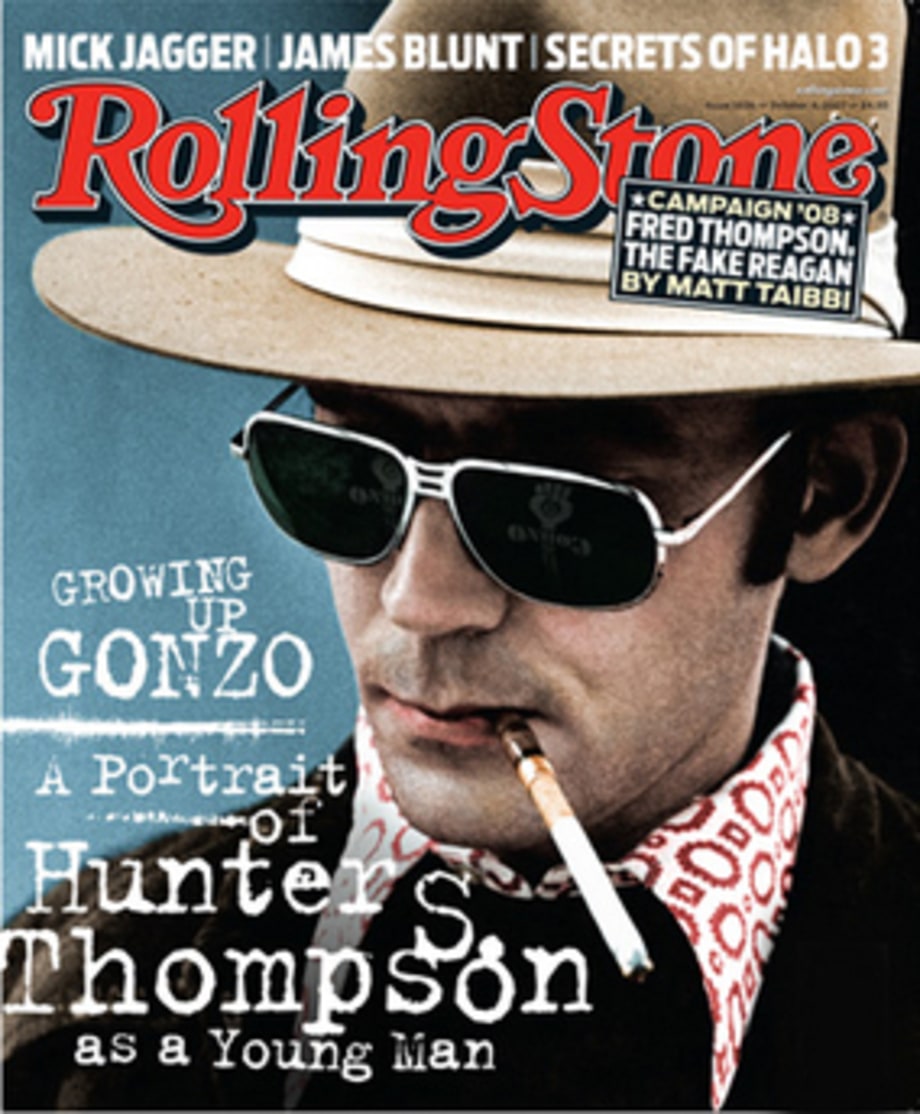
That’s Hunter Thompson. There’s always someone in control behind the wheel — even when he seems most out of control.
This hidden discipline showed up in other ways. Years later, when he ran for sheriff in Aspen or showed up in Washington, D.C. to cover an election for Rolling Stone, savvy observers soon grasped that Thompson had better instincts and organizational skills than some of the most high-powered political operatives. People rallied around him — he was always the ringleader, even going back to his rowdy childhood. And hidden behind the stoned Gonzo exterior was an ambitious strategist who could play a long term game even as he wagered extravagantly on each spin of the roulette wheel that was his life.
“I don’t think you have any idea who Hunter S. Thompson is when he drops the role of court jester,” he wrote to Kraig Juenger, a 34-year-old married woman with whom he had an affair at age 18. “First, I do not live from orgy to orgy, as I might have made you believe. I drink much less than most people think, and I think much more than most people believe.”
That wasn’t just posturing. It had to be true, merely judging by how well-read and au courant Thompson became long before his rise to fame. “His bedroom was lined with books,” later recalled his friend Ralston Steenrod, who went on to major in English at Princeton. “Where I would go home and go to sleep, Hunter would go home and read.” Another friend who went to Yale admitted that Thompson “was probably better read than any of us”.
Did he really come home from drinking binges, and open up a book? It’s hard to believe, but somehow he gave himself a world class education even while living on the bleeding edge. And in later years, Thompson proved it. When it came to literary matters, he simply knew more than most of his editors, who could boast of illustrious degrees Thompson lacked. And when covering some new subject he didn’t know, he learned fast and without slowing down a beat.
But Thompson had another unusual source of inspiration he used in creating his unique prose style. It came from writing letters, which he did constantly and crazily — sending them to friends, lovers, famous people, and total strangers. Almost from the start, he knew this was the engine room for his career; that’s why he always kept copies, even in the early days when that required messy carbon paper in the typewriter. Here in the epistolary medium he found his true authorial voice, as well as his favorite and only subject: himself.
But putting so much sound and fury into his letters came at a cost. For years, Thompson submitted articles that got rejected by newspapers and magazines — and the unhinged, brutally honest cover letters that accompanied them didn’t help. He would insult the editor, and even himself, pointing out the flaws in his own writing and character as part of his pitch.
What was he thinking? You can’t get writing gigs, or any gigs, with that kind of attitude. Except if those cover letters are so brilliant that the editor can’t put them down. And over time, his articles started resembling those feverish cover letters — a process unique in the history of literature, as far as I can tell.
When Thompson finally got his breakout job as Latin American correspondent for the National Observer (a sister publication to the Wall Street Journal in those days), he would always submit articles to editor Clifford Ridley along with a profane and unexpurgated cover letter that was often more entertaining than the story. In an extraordinary move, the newspaper actually published extracts from these cover letters as a newspaper feature.
If you’re looking for a turning point, this is it. Thompson now had the recipe, and it involved three conceptual breakthroughs:
- The story behind the story is the real story.
- The writer is now the hero of each episode.
- All this gets written in the style of a personal communication to the reader of the real, dirty inside stuff — straight, with no holds barred.
Why can’t you write journalism like this? In fact, a whole generation learned to do just that, mostly by imitating Hunter S. Thompson …
November 13, 2021
The patron saint of “Gonzo” journalism was a pretty cruddy human being
As I mentioned in an earlier post on one of Hunter S. Thompson’s famous early books, I discovered the writer at a particularly susceptible age … teenagers of my generation were generally suckers for counter-culture heroes (being too young to be actual hippies because we were in primary school when the Summer of Love flew past, and therefore feeling we’d missed out on something Big and Important and Meaningful). As a gullible teen, I believed Fear and Loathing in Las Vegas was mostly factual with some obvious-even-to-me embroideries for dramatic or comedic effect. I could easily forgive the guessed-at 10% fiction, but Thompson eventually admitted that the majority of the story was bullshit. Entertaining bullshit, but bullshit.
Which, as it happens, turns out to have been Thompson’s life-long modus operandi, as Kevin Mims repeatedly highlights in his Quillette review of David S. Wills’ biography called High White Notes: The Rise and Fall of Gonzo Journalism:
In High White Notes, his riveting new biography of Hunter S. Thompson, journalist David S. Wills describes Thompson as America’s first rock star reporter and compares him to Mick Jagger. But by the time I finished the book, I’d decided that Thompson bore a closer resemblance to Donald Trump. The two men were born nine years apart, during white American masculinity’s golden age. Both were obsessed with politics without possessing anything that could be described as a coherent political philosophy. Both men longed for some mythical American paradise of the past. Both men screwed over multiple friends and business partners. Both men would have gone broke if not for the frequent intervention of helpful patrons. Both men were egomaniacs fond of self-mythologizing and loath to share a spotlight with anyone. Both men enjoyed making disparaging remarks about women, minorities, the disabled, and other disadvantaged people. Both men were frequently disloyal to their most loyal aiders and abetters. Thompson’s endless letter writing and self-pitying 3am telephone calls to friends and colleagues were the 20th century equivalent of Trump’s late-night Twitter tantrums. Both men generally exaggerated their successes and blamed their failures on others. Both men mistreated their wives. Both men nursed a constant (and not entirely irrational) sense of grievance against perceived enemies in the government and the media. Both men had a colossal sense of entitlement …
The list could go on and on. Trump actually fares better than Thompson by various measures. For instance, Trump has never had a drug or alcohol problem, as far as I know. Thompson was a drug and alcohol problem. The first US president in living memory without a White House pet seems to have no interest in animals. Thompson enjoyed tormenting them. Rumors have circulated since 2015 that a recording exists of Trump using a racial slur but since the evidence has never surfaced, it might be fairer to conclude (at least provisionally) that this is not one of his many character failings. Thompson’s published and (especially) unpublished writings are full of such language.
All of which may lead you to conclude that High White Notes is not a favorable account of Hunter S. Thompson’s life and work. To the contrary, David S. Wills is a Thompson devotee who considers his subject to have been a great writer and, at times, a great journalist. But Wills is an honest guide, so his endlessly entertaining biography manages to be both a fan’s celebration and unsparing in its criticism of Thompson and his work.
Though impressive, the book is not without faults. Wills relies too heavily on cliché (“This book will pull no punches”; “breathing down his neck for the final manuscript”; “women threw themselves at him” etc.), and has a tendency to find profundity in unnaturally strained readings of Thompson’s prose. For instance, Wills describes a scene from a 1970 profile Thompson wrote of French skier Jean-Claude Killy, in which three young boys approach Thompson and ask if he is Killy. Thompson tells them that he is, then holds up his pipe and says, “I’m just sitting here smoking marijuana. This is what makes me ski so fast.” This sounds to me like standard Thompson misbehavior, but Wills infers something more complex: “On the surface, it appears to be comedy for the sake of comedy but in fact it is a comment on the nature of celebrity and in particular Killy’s empty figurehead status.” And when Thompson describes Killy as resembling “a teenage bank clerk with a foolproof embezzlement scheme,” Wills remarks, “Thompson has succeeded mightily not just in conveying [Killy’s] appearance but in hinting at his personality. He has placed an image in the head of his reader that will stick there permanently. It was something F. Scott Fitzgerald achieved, albeit in more words, when he had Nick Carraway describe Jay Gatsby’s smile.” (The book, by the way, takes its title from Fitzgerald, who used the phrase to describe short passages of writing so beautiful that they stand out from the larger work of which they are a part.)
[…]
Thompson’s big break as a writer came in 1965 when he was hired to write an article about the Hell’s Angels motorcycle gang for the Nation. The piece was so popular that Thompson found himself besieged by publishers who wanted him to expand it into a full-length nonfiction book. The Thompsons moved into the Haight-Ashbury district of San Francisco and Thompson set about writing Hell’s Angels, the 1967 book that would make him famous. Even in that first book, written before he had fully formulated the concept of Gonzo journalism, Thompson was already tinkering with the truth and engaging in the kind of self-mythologizing that would become a hallmark of his work. And that didn’t sit well with the Hell’s Angels themselves. According to Sonny Barger, a founding member of the Angels, Thompson “would talk himself up that he was a tough guy, when he wasn’t. When anything happened, he would run and hide.” Barger’s assessment of the book was terse: “It was junk.”
Wills notes that Thompson “tended to write about himself in ways that built his legend … to prove his machismo on paper. The back cover [of Hell’s Angels] describes him as ‘America’s most brazen and ballsy journalist’ and in the book he tells the story of first meeting the Angels and trying to impress them by shooting out the windows of his own San Francisco home. Such moments of bravado tend to enter the story very briefly and seem to serve little purpose beyond this self-mythologizing.”
But it was exactly this kind of self-mythologizing — the bragging about his drug use and general misbehavior — that editors of American magazines found so exciting about Thompson’s work, so it’s no wonder that he engaged in so much of it. It was his wild man persona that made Warren Hinckle of Scanlan’s Monthly want to unleash him among the socialites of Louisville. Still, Thompson didn’t fully emerge as a countercultural hero until he began to write for a small start-up publication in San Francisco called Rolling Stone.
March 25, 2021
Hunter S. Thompson’s Fear and Loathing in Las Vegas
I first read Thompson’s Fear and Loathing in the late 1970s and being as callow and inexperienced as most teenagers, I took it for a mostly factual exploit (along with many older readers who didn’t have my excuse for gullibility). I passed the book on to one of my friends who became mildly obsessed with “Raoul Duke” and the adventures recounted in the book. I’ve long since lost touch with him, but I’m sure he’d be horribly disappointed to discover that Thompson probably imagined 90% of it:
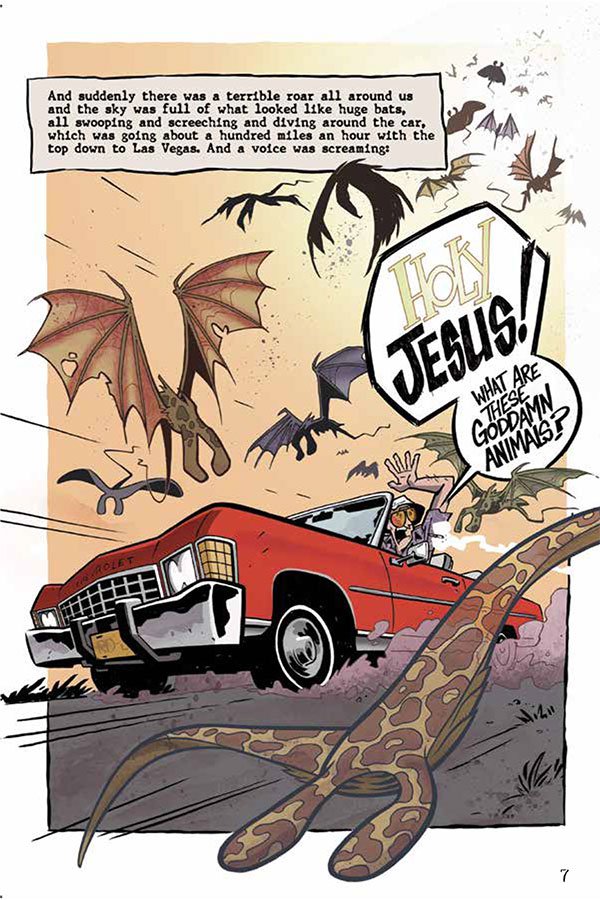
We were somewhere around Barstow on the edge of the desert when the drugs began to take hold. I remember saying something like “I feel a bit lightheaded; maybe you should drive …” And suddenly there was a terrible roar all around us and the sky was full of what looked like huge bats, all swooping and screeching and diving around the car, which was going about a hundred miles an hour with the top down to Las Vegas.
From the outset, Fear and Loathing in Las Vegas is an outrageous and darkly amusing tale of two crazed men turned loose in the world’s capital of decadence. Raoul Duke and Doctor Gonzo, clearly based upon Thompson and Acosta, are carrying a veritable pharmacopoeia in the trunk of their rented car, and throughout the novel they abuse a litany of substances as they stumble through casinos, bars, and hotels terrorising staff and patrons alike. Though Duke and Gonzo are, like the real Thompson and Acosta, tasked with covering the Mint 400, their assignment is quickly lost in the carnage. Near the end of the book, Duke admits he “didn’t even know who’d won the race.”
If you are unfamiliar with Thompson’s work, you may wonder why it matters that their efforts to complete a minor assignment ended in failure. Authors like Ernest Hemingway had mined their journalistic experience for material to incorporate into their fiction, so it is hardly unusual that Thompson would find inspiration for a novel whilst covering the Mint 400. But his approach with this book went beyond mere inspiration. Throughout Fear and Loathing, reality and imagination are blurred to the extent that no one really has much idea of what really happened on their trip.
[…]
In this letter, he made the startling confession that Fear and Loathing had not merely exaggerated the debauchery that took place in Vegas, but that there had in fact been no drugs at all. Could this really be true? Was the most notorious drug book of its era really inspired by a drug-free journey?
Before we can answer that, it is important to note the chronology of events on which the book was based. Whilst the book portrays the two men tearing apart hotels and casinos over a period of several days, there were in fact two distinct trips. First, they went to cover the Mint 400 on Mach 21st–23rd, then they returned for the National District Attorneys’ Conference on Narcotics and Dangerous Drugs on April 25th–29th. Thompson simply rolled the two events together into a single narrative. The evidence suggests that, during the first trip, Thompson and Acosta drank heavily and perhaps smoked a little pot, but certainly did no serious drug-taking. The famed pharmacopeia in the trunk of their convertible was fictitious:
The trunk of the car looked like a mobile police narcotics lab. We had two bags of grass, seventy-five pellets of mescaline, five sheets of high-powered blotter acid, a salt shaker half full of cocaine, and a whole galaxy of multi-colored uppers, downers, screamers, laughers … and also a quart of tequila, a quart of rum, a case of Budweiser, a pint of raw ether and two dozen amyls.
As tempting as it is to believe that this existed, it was a product of Thompson’s prodigious imagination. He was, however, keen to keep his readers in the dark, hence his letter to Silberman and the inclusion of his photo on the back cover. Since childhood, he had been obsessed with appearing as an outlaw, yet real outlaws never explicitly said that’s what they were. They merely hinted at it.
Of course, Thompson’s “drug-diet” did consist of various illegal substances, which made his descriptions of their effects rather convincing, but not only did he remain mostly drug-free in Vegas, he also wrote the novel with little more than beer and tobacco in his system. Back home in Colorado, he polished his story carefully through many drafts. The result was a far more intelligent and coherent work than almost anything else he published.
It was only during the second of the two trips that they began to consume drugs, but even then their indulgence was mild when compared with Duke and Gonzo’s extravagant excesses. They had marijuana, a few pills, and possibly some mescaline, but nothing else. His descriptions of LSD came from experiments several years earlier, the parts about adrenochrome were entirely fabricated, and — surprisingly — Thompson had not yet tried cocaine by 1971.
February 21, 2021
QotD: Journalism
Hunter S. Thompson, Fear and Loathing in Las Vegas, 1972.
January 17, 2021
QotD: Hunter S. Thompson
James Lileks, The Bleat, 2005-02-21
December 18, 2020
QotD: Hunter S. Thompson’s view of humanity
Colby Cosh, “Q: Where’s Cosh?”, ColbyCosh.com, 2005-02-21
September 9, 2018
Hunter S. Thompson, Jann Wenner and Rolling Stone
Darcy Gerow on the sudden rise and long, long decline of Rolling Stone:
The suffocating media bias of the 1960s was difficult to escape. A lethargic gray specter of middle-class America was distributed with cunning sterility through the generic, bogus smiles of cable news networks and traditional print. Despite the election and assassination of Kennedy and the signing of the Civil Rights Act, if you had turned on a T.V. this was still Eisenhower’s America: regimented, religious, conservative. And the cultural vacuum created by the Eisenhower years had began to suck even harder with Lyndon Baines Johnson at the helm.
American media was out of touch with this new generation. Elitist authoritarians were preaching their moral superiority stamped with stars and stripes to a generation of cynics. These kids didn’t have a fucking clue what they wanted, but they wanted no part of what they were being given. So rose Rolling Stone, a counterculture bible for babyboomers, co-founded by Jann Wenner.[…]
Things were different in the 1960s. The anti-war movement and the civil rights movement were a just cause. The catalyst for a just movement of equal rights for women and gays and minorities was free speech, of which Jann Wenner was a huge proponent. When students at U.C. Berkley marched in the streets in the 1960s, it was an attack on the elitist, authoritarians and an establishment hellbent on keeping opposing viewpoints and the ideas of personal liberty stifled. The gang of “cruel faggots” kept the official narrative running but no one under 30 was listening.
The whole goddamn world had had enough of the travesty of war in Southeast Asia. There was no ignoring the ineptitude of American politics. The only reasonable thing to do in 1969 was to drive out to Altamont for the weekend, load up on heinous chemicals, hunker down and rethink your approach to the political process.
Thompson, the then-young, liberal anti-hero, could often be found gobbling LSD and firing his guns (he was a lifetime member of the NRA) at propane bottles for a crowd of jeering burnouts or Bay area bikers at his fortified compound, Owl Farm, in Woody Creek Colorado.
It was Jann Wenner’s idea to put Hunter, with all of his fear and loathing, on to the campaign trail in 1972. Why not get the guy who wrote Hell’s Angels? Hunter was someone with a penchant for dealing with vicious thugs and sick freaks gone crazy on power, someone who could draw a parallel between Richard Nixon and Sonny Barger.
Thompson’s openly-biased, subjective and wild account of the 1972 presidential election was the red Chevy convertible of campaign coverage. ‘Sympathy for the Devil’ on repeat and at full volume, barrelling across the country at 110 miles an hour or so and in search of an honest politician. In Hunter’s eyes, the only one that even came close was George McGovern, the senator from South Dakota.
McGovern’s non-interventionist platform focused on a complete withdrawal from Vietnam, amnesty for draft evaders and a Milton Freidman-inspired, negative income tax meant to replace the bureaucratic burden of social welfare programs and a complicated tax code. Thompson’s version of events is the story of an idealistic underdog fighting against the odds only to be crushed by postmodern Americanism and the establishment incumbent, “Tricky Dick Nixon.” McGovern might have owed a White House win, in part, to Thompson’s and Rolling Stone’s relentless support had he not owed his White House loss to the mental distress of his vice-presidential pick, Thomas Eagleton.
There’s no way to properly explain how great Rolling Stone was in those early years. How well the magazine represented the anti-establishment culture, individual liberty and equality for everyone. It can’t be compared to anything else because there was nothing else, only the traditional mainstream garbage and Rolling Stone.
June 1, 2018
QotD: Travelling with a political campaign
One of the constant nightmares of traveling with politicians is the need to keep them in sight at all times. Every presidential campaign has its own fearful litany of horror stories about reporters – and, occasionally, even a key staff member – who thought they had plenty of time to “run across the street for a quick beer” instead of hanging around in the rear of some grim auditorium half-listening to the drone of a long-familiar speech, only to come back in 20 minutes to find the auditorium empty and no sign of the press bus, the candidate or anybody who can tell him where they went. These stories are invariably set in places like Butte, Buffalo or Icepick, Minnesota, on a night in the middle of March. The temperature is always below zero, there is usually a raging blizzard to keep cabs off the street, and just as the victim remembers that he has left his wallet in his overcoat on the press bus, his stomach erupts with a sudden attack of ptomaine poisoning. And then, while crawling around on his knees in some ice-covered alley and racked with fits of projectile vomiting, he is grabbed by vicious cops and whipped on the shins with a night stick, then locked in the drunk tank of the local jail and buggered all night by winos.
These stories abound, and there is just enough truth in them to make most campaign journalists so fearful of a sudden change in the schedule that they will not even go looking for a bathroom until the pain becomes unendurable and at least three reliable people have promised to fetch them back to the fold at the first sign of any movement that could signal an early departure. The closest I ever came to getting left behind was during the California primary in 1972, when I emerged from a bathroom in the Salinas railroad depot and realized that the caboose car of McGovern’s “victory train” was about 100 yards further down the tracks than it had been only three minutes earlier. George was still standing outside on the platform, waving to the crowd, but the train was moving – and as I started my sprint through the crowd, running over women, children, cripples and anything else that couldn’t get out of my way, I thought I saw a big grin on McGovern’s face as the train began picking up speed….… I am still amazed that I caught up with the goddamn thing without blowing every valve in my heart, or even missing the iron ladder when I made my last-second leap and being swept under the train and chopped in half by the wheels.
Ever since then I have not been inclined to take many risks while traveling in strange territory with politicians. Even the very few who might feel a bit guilty about leaving me behind would have to do it anyway, because they are all enslaved by their schedules, and when it comes to a choice between getting to the airport on time or waiting for a journalist who has wandered off to seek booze, they will shrug and race off to the airport.
Hunter S. Thompson, “Fear and Loathing on the Campaign Trail ’76: Third-rate romance, low-rent rendezvous — hanging with Ted Kennedy, Jimmy Carter, and a bottle of Wild Turkey”, Rolling Stone, 1976-06-03.
May 24, 2018
QotD: Hunter S. Thompson on the importance of breakfast
It is not going to be easy for those poor bastards out in San Francisco who have been waiting all day in a condition of extreme fear and anxiety for my long and finely reasoned analysis of “The Meaning of Jimmy Carter” to come roaring out of my faithful mojo wire and across 2,000 miles of telephone line to understand why I am sitting here in a Texas motel full of hookers and writing at length on The Meaning of Breakfast……. But like almost everything else worth understanding, the explanation for this is deceptively quick and basic.
After more than ten years of trying to deal with politics and politicians in a professional manner, I have finally come to the harsh understanding that there is no way at all – not even for a doctor of chemotherapy with total access to the whole spectrum of legal and illegal drugs, the physical constitution of a mule shark and a brain as rare and sharp and original as the Sloat diamond – to function as a political journalist without abandoning the whole concept of a decent breakfast. I have worked like 12 bastards for more than a decade to be able to have it both ways, but the conflict is too basic and too deeply rooted in the nature of both politics and breakfast to ever be reconciled. It is one of those very few Great Forks in The Road of Life that cannot be avoided: like a Jesuit priest who is also a practicing nudist with a $200-a-day smack habit wanting to be the first Naked Pope (or Pope Naked the First, if we want to use the language of the church)….… Or a vegetarian pacifist with a .44 magnum fetish who wants to run for president without giving up his membership in the National Rifle Association or his New York City pistol permit that allows him to wear twin six-guns on Meet the Press, Face the Nation and all of his press conferences.
There are some combinations that nobody can handle: shooting bats on the wing with a double-barreled .410 and a head full of jimson weed is one of them, and another is the idea that it is possible for a freelance writer with at least four close friends named Jones to cover a hopelessly scrambled presidential campaign better than any six-man team of career political journalists on the New York Times or the Washington Post and still eat a three-hour breakfast in the sun every morning.
Hunter S. Thompson, “Fear and Loathing on the Campaign Trail ’76: Third-rate romance, low-rent rendezvous — hanging with Ted Kennedy, Jimmy Carter, and a bottle of Wild Turkey”, Rolling Stone, 1976-06-03.
May 16, 2018
QotD: The presidency and the Supreme Court
… I also like Jerry Jeff Walker, the Scofflaw King of New Orleans and a lot of other people I don’t necessarily believe should be president of the United States. The immense concentration of power in that office is just too goddamn heavy for anybody with good sense to turn his back on. Or her back. Or its back…. At least not as long as whatever lives in the White House has the power to fill vacancies on the U.S. Supreme Court; because anybody with that kind of power can use it – like Nixon did – to pack-crowd the Court of Final Appeal in this country with the same kind of lame, vindictive yo-yos who recently voted to sustain the commonwealth of Virginia’s antisodomy statutes……. And anybody who thinks that 6-3 vote against “sodomy” is some kind of abstract legal gibberish that doesn’t really affect them had better hope they never get busted for anything the Bible or any local vice-squad cop calls an “unnatural sex act.” Because “unnatural” is defined by the laws of almost every state in the Union as anything but a quick and dutiful hump in the classic missionary position, for purposes of procreation only. Anything else is a felony crime, and people who commit felony crimes go to prison.
Hunter S. Thompson, “Fear and Loathing on the Campaign Trail ’76: Third-rate romance, low-rent rendezvous — hanging with Ted Kennedy, Jimmy Carter, and a bottle of Wild Turkey”, Rolling Stone, 1976-06-03.
May 7, 2018
QotD: Running for the presidency
One of the most difficult problems for a journalist covering a presidential campaign is getting to know the candidates well enough to make confident judgments about them, because it is just about impossible for a journalist to establish a personal relationship with any candidate who has already made the big leap from “long shot” to “serious contender.” The problem becomes more and more serious as the stakes get higher, and by the time a candidate has survived enough primaries to convince himself and his staff that they will all be eating their lunches in the White House Mess for the next four years, he is long past the point of having either the time or the inclination to treat any journalist who doesn’t already know him personally as anything but just another face in the campaign “press corps.”
There are many complex theories about the progressive stages of a presidential campaign, but for the moment let’s say there are three: Stage One is the period between the decision to run for president and the morning after the New Hampshire primary when the field is still crowded, the staff organizations are still loose and relaxed, and most candidates are still hungry for all the help they can get – especially media exposure, so they can get their names in the Gallup Poll; Stage Two is the “winnowing out,” the separating of the sheep from the goats, when the two or three survivors of the early primaries begin looking like long-distance runners with a realistic shot at the party nomination; and Stage Three begins whenever the national media, the public opinion polls and Mayor Daley of Chicago decide that a candidate has picked up enough irreversible momentum to begin looking like at least a probable nominee, and a possible next president.
This three-stage breakdown is not rooted in any special wisdom or scientific analysis, but it fits both the 1972 and 1976 Democratic campaigns well enough to make the point that any journalist who doesn’t get a pretty firm personal fix on a candidate while he’s still in Stage One might just as well go with his or her instincts all the way to Election Day in November, because once a candidate gets to Stage Two his whole lifestyle changes drastically.
At that point he becomes a public figure, a serious contender, and the demands on his time and energy begin escalating to the level of madness. He wakes up every morning to face a split-second, 18-hour-a-day schedule of meetings, airports, speeches, press conferences, motorcades and handshaking. Instead of rambling, off-the-cuff talks over a drink or two with reporters from small-town newspapers, he is suddenly flying all over the country in his own chartered jet full of syndicated columnists and network TV stars……. Cameras and microphones follow him everywhere he goes, and instead of pleading long and earnestly for the support of 15 amateur political activists gathered in some English professor’s living room in Keene, New Hampshire, he is reading the same cliché-riddled speech – often three or four times in a single day – to vast auditoriums full of people who either laugh or applaud at all the wrong times and who may or may not be supporters……. And all the fat cats, labor leaders and big-time pols who couldn’t find the time to return his phone calls when he was desperately looking for help a few months ago are now ringing his phone off the hook within minutes after his arrival in whatever Boston, Miami or Milwaukee hotel his managers have booked him into that night. But they are not calling to offer their help and support, they just want to make sure he understands that they don’t plan to help or support anybody else, until they get to know him a little better.
It is a very mean game that these high-rolling, coldhearted hustlers play. The president of the United States may no longer be “the most powerful man in the world,” but he is still close enough to be sure that nobody else in the world is going to cross him by accident. And anybody who starts looking like he might get his hands on that kind of power had better get comfortable, right from the start, with the certain knowledge that he is going to have to lean on some very mean and merciless people just to get himself elected.
Hunter S. Thompson, “Fear and Loathing on the Campaign Trail ’76: Third-rate romance, low-rent rendezvous — hanging with Ted Kennedy, Jimmy Carter, and a bottle of Wild Turkey”, Rolling Stone, 1976-06-03.
April 28, 2018
QotD: Nixon’s final days in the White House
The sudden, hellish reality of a nuclear war with either Russia or China or both was probably the only thing that could have salvaged Nixon’s presidency after the Supreme Court ruled that he had to yield up the incriminating tapes that he knew would finish him off. Would the action-starved generals at the Strategic Air Command Headquarters have ignored an emergency order from their commander-in-chief? And how long would it have taken Pat Buchanan or General Haig to realize that “The Boss” had finally flipped? Nixon spent so much time alone that nobody else in the White House would have given his absence a second thought until he failed to show up for dinner, and by that time he could have made enough phone calls to start wars all over the world.
A four-star general commandant of the U.S. Marine Corps with three wars and 35 years of fanatical devotion to duty, honor and country in his system would hack off his own feet and eat them rather than refuse to obey a direct order from the president of the United States – even if he thought the president was crazy.
The key to all military thinking is a concept that nobody who ever wore a uniform with even one stripe on it will ever forget: “You don’t salute the man, you salute the uniform.” Once you’ve learned that, you’re a soldier – and soldiers don’t disobey orders from people they have to salute. If Nixon’s tortured mind had bent far enough to let him think he could save himself by ordering a full-bore Marine/Airborne invasion of Cuba, he would not have given the Boom-Boom order to some closet-pacifist general who might be inclined to delay the invasion long enough to call Henry Kissinger for official reassurance that the president was not insane.
No West Pointer with four stars on his hat would take that kind of risk anyway. By the time word got back to the White House, or to Kissinger, that Nixon had given the order to invade Cuba, the whole Caribbean would be a sea of fire; Fidel Castro would be in a submarine on his way to Russia, and the sky above the Atlantic would be streaked from one horizon to the other with the vapor trails of a hundred panic-launched missiles.
***
Right. But it was mainly a matter of luck that Nixon’s mental disintegration was so obvious and so crippling that by the time he came face to face with his final option, he was no longer able to even recognize it. When the going got tough, the politician who worshiped toughness above all else turned into a whimpering, gin-soaked vegetable……. But it is still worth wondering how long it would have taken Haig and Kissinger to convince all those SAC generals out in Omaha to disregard a Doomsday phone call from the president of the United States because a handful of civilians in the White House said he was crazy.
Hunter S. Thompson, “Fear and Loathing on the Campaign Trail ’76: Third-rate romance, low-rent rendezvous — hanging with Ted Kennedy, Jimmy Carter, and a bottle of Wild Turkey”, Rolling Stone, 1976-06-03.
November 24, 2017
Not Guided by Policy: Hunter S. Thompson and the Birth of Gonzo Journalism
Today I Found Out
Published on 6 Nov 2017In this video:
“We were somewhere around Barstow, on the edge of the desert, when the drugs began to take hold.” This is the opening line from the highly acclaimed roman à clef Fear and Loathing in Las Vegas: A Savage Journey to the Heart of the American Dream written by Hunter S. Thompson, one of America’s most countercultural and anti-authoritarian writers. The untamed master of his own self-titled genre, “gonzo journalism,” Thompson set ablaze the American standards for journalism during the 1960s and 70s with a cornucopia of drugs, alcohol, gun toting, and most notably, his exemplary writing.
Want the text version?: http://www.todayifoundout.com/index.php/2015/07/not-guided-policy-act-gonzo/
October 30, 2016
QotD: Hunter S. Thompson’s nihilism
Of course in [Hunter S.] Thompson’s world the Big Darkness is always coming. Every day it doesn’t come means it’ll just be bigger and darker when it finally arrives. He’s the anti-rooster, bitching about the dawn: sure, it worked today, but one of these days the sun won’t come up, and then where will you be? Sitting on your nest popping out eggs like THEY want you to, completely unprepared for the Big Darkness! Which will be huge! And dark!
It would be funny if it was, well, funny, but it’s not even that. It’s just rote spew from the other side of the latter sixties. You had your Hopeful Hippies, the face-painters and daisy-strewers, convinced that human nature and human history could be irrevocably changed if we all held hands, listened to “Imagine” and realized that the war is not the answer. Regardless of the question. But the other side was the sort of dank twitchy nihilism Thompson spouts. It has no lessons, no morals, no hope. Imagine, Winston, that the future consists of a boot pressing on a face. Here’s the worst part, Winston — inside the boot is NIXON’S FOOT.
Thompson has less hope than the Islamists; at least they have an afterlife to look forward to. All we have is a country so rotten and exhausted it’s not worth defending. It never was, of course, but it’s even less defensible now than before.
He can say what he wants. Drink what he wants. Drive where he wants. Do what he wants. He’s done okay in America. And he hates this country. Hates it. This appeals to high school kids and collegiate-aged students getting that first hot eye-crossing hit from the Screw Dad pipe, but it’s rather pathetic in aged moneyed authors. And it would be irrelevant if this same spirit didn’t infect on whom Hunter S. had an immense influence. He’s the guy who made nihilism hip. He’s the guy who taught a generation that the only thing you should believe is this: don’t trust anyone who believes anything. He’s the patron saint of journalism, whether journalists know it or not.
James Lileks, Bleat, 2004-05-17.


