For starters, dispel the myth of the Old West being someplace where people walked around all the time with spurs a-jingle-jangle-jinglin’ and the big iron on their hip. While it wasn’t the network of strict gun control laws that revisionists try to paint it, nor either was it the open-carry paradise of Hollywood myth.
In mid-late 19th Century America, walking around a town or city setting with a full-size horse pistol stuffed in your belt would be seen as eccentric as it would in similar surroundings today. Perhaps more so, since 19th Century Americans didn’t grow up watching old John Wayne and Clint Eastwood movies on cable. On the other hand, guns were everywhere.
“But wait, Tam!” you say, “I thought you just said people mostly didn’t walk around with the big iron on their hip!”
Well, generally they didn’t. First, a Colt’s M1873, the Peacemaker of Hollywood lore, went for around twenty bucks over most of the time period of the Old West. They made about 175,000 of them, including military contract guns, over that period. (Smith & Wesson, by comparison, made almost twice that many of the big No.3 top-breaks, for what it’s worth.)
Twenty bucks was a lot of dough, relatively speaking. About a tenth the cost of a good saddle horse and the equivalent of a pretty nice AR-15 these days. Since cowboys and miners around the various cowtowns and mining boomtowns were overwhelmingly young, single men with fairly low-overhead lifestyles, it wouldn’t be amiss to think of the Colt Peacemaker and well-saddled Quarter Horse in 1870s Dodge City as the equivalent of a Daniel Defense carbine and Ford Raptor in 2010s Midland-Odessa. I have no idea what the 19th Century equivalent of truck nuts was, and considering that male working horses are almost uniformly geldings, I’m not sure I want to.
Meanwhile, there were literal millions of .22, .32, .38, and .41 pocket guns, rimfires and centerfires, sold over the same period. Human nature hasn’t changed much over the years, and I didn’t see no metal detectors at that saloon in Tombstone. Most every person had a gun for pocket, purse, or nightstand and, probably like most gun owners today, carried it if they felt like they were “going someplace they might need it.”
Tamara Keel, “Mouseguns, Then and Now”, View From The Porch, 2021-02-21.
June 4, 2021
QotD: Handguns in the “Wild West”
May 22, 2021
Guns in the Movies – like this S&W Model 29
Forgotten Weapons
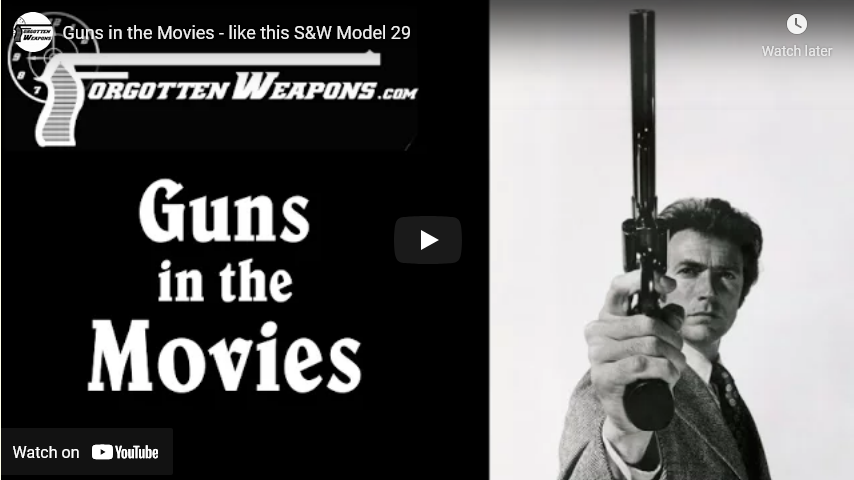
Published 10 Feb 2017Today we have not so much an examination of a specific firearms, but rather a look at how Clint Eastwood’s film portrayal of Dirty Harry Callahan drove a huge wave of popularity of the Smith & Wesson Model 29 — “the most powerful handgun in the world.”
http://www.patreon.com/ForgottenWeapons
Cool Forgotten Weapons merch! http://shop.bbtv.com/collections/forg…
If you enjoy Forgotten Weapons, check out its sister channel, InRangeTV! http://www.youtube.com/InRangeTVShow
May 21, 2021
QotD: Avoid situations that can “escalate fast”
Also, this is an answer to the question “You mean you carry a gun when you’re just doing yard work or shoveling snow?” Oh hell yes I do.
Also also, this is why I generally try and avoid getting involved in anyone else’s crazy day.
If someone’s acting up in public, I can apologize and disengage from the situation. If I really feel the need to, I can go complain about them on social media in private later and nobody’s gonna pop off and trigger a gunfight if I do.
If you carry a gun, any altercation can escalate into a gunfight. Deescalate. Avoid altercations.
Lastly, there is a problem experienced by people who haven’t been exposed to interpersonal violence of any type; they have no experience in reading the differences between bluffing and the real deal. It’s why you see these “You ain’t gonna shoot me!” situations.
People waving a gun just to let you know they have a gun is a very real phenomenon and doesn’t necessarily mean violence is imminent; they’re just letting you know that certain off-ramps from the situation are closed. Okay, you have a gun and I need to stop pushing. Cool, cool.
This guy? He was not that guy.
People say “You wouldn’t…” to people who are practically lighting off signal rockets to tell you that oh, yes the fuck they would and are, in fact, fixin’ to.
Tamara Keel, “Finding Out”, View From the Porch, 2021-02-05.
May 15, 2021
Adventures in military procurement
Back in September, Matt Gurney wrote about the generations-long travesty that is the Canadian government’s procurement system for the Canadian Armed Forces. I missed it at the time, but — this is a shock, I know — it’s still fully accurate and up-to-date, because the government hasn’t done anything to address the blatant failings of the “system”:
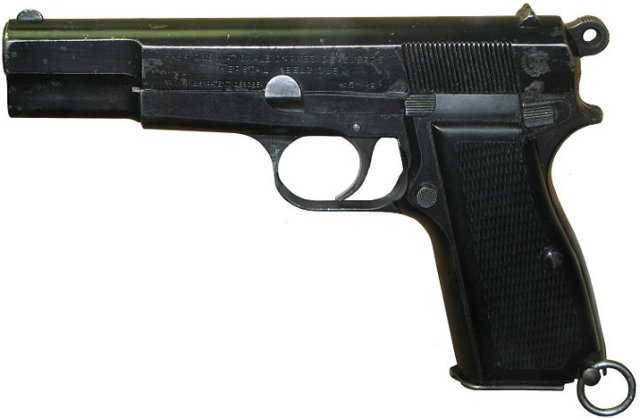
Browning High Power 9mm, the standard side-arm of the Canadian army since WW2.
Some history first: during the Second World War, Canada manufactured hundreds of thousands of Browning “Hi-Power” 9mm pistols. The pistols were originally made by Belgian manufacturer FN, but Belgium, of course, was overrun by the Nazis early in the war. The schematics and part diagrams were evacuated before the Germans arrived and the pistol saw service in numerous allied militaries. The Canadian army ended up acquiring 60,000 of them, all built in 1944 and 1945. And here’s where things get bonkers: we’ve never replaced them. Some Canadian military units have used more modern pistols, acquired in smaller batches, but the standard sidearm of the Canadian Armed Forces, today, isn’t just the same kind of pistol we used in the Second World War. It’s literally the same pistols.
Reliability issues with the pistols are a chronic problem. I mean, they’re 75 years old, and they’ve been in use continuously. Our military weapons technicians do what they can, and they’ve been stripping some pistols for spare parts to put into other pistols for decades. But the Hi-Powers are in desperate need of a replacement. They’re a generation overdue for replacement. But in keeping with the finest traditions of Canadian military procurement, we can’t get it done. It’s beyond our ability.
We’ve tried, sort of. At the start of 2017, the military began work on a replacement program that would have procured up to 25,000 new 9mm semi-automatic pistols for the Canadian Armed Forces. The military gave itself 10 years to get this accomplished and budgeted $50 million. It’s hard to overstate how crazy that is. Pistols aren’t complicated. If you have a credit card and a firearms licence, you can walk into a store and buy one. A lot of what the military needs is super complex and custom-made. Pistols are easy. There are factories all over the world that are already producing proven, reliable, affordable designs. Buying new pistols has got to be about the simplest procurement any military is ever going to face. And we still thought we’d need 10 years to do it. A decade.
The amazing thing is, by total fluke, in 2016, the British also decided they needed new pistols. And they also decided they needed 25,000 of them. This is entirely coincidental, but it’s a fantastically convenient coincidence: it’s a rare apples-to-apples comparison of two national procurement systems. And how’d it go?
Well, the Brits selected a type of pistol, purchased 25,000 of them and issued them to their military units by 2018. They wrapped the whole thing up in two years. The total cost was $15,000,000.
In Canada, we set a 10-year goal for the same thing, budgeted more than three times as much … but never got it off the ground. No progress was made.
So now, the military is trying again.
When I was in the militia in the late 1970s, we trained with the Browning, although even then we were told it was slated to be replaced within a few years. After thirty-some years of heavy use, the guns were still going strong, but definitely showing significant signs of wear and were probably already at the point they should have been retired even then.
Machine Gun Terminology Part 2: SMG, PDW, & Machine Pistol
Forgotten Weapons
Published 12 Jan 2018http://www.patreon.com/ForgottenWeapons
Cool Forgotten Weapons merch! http://shop.bbtv.com/collections/forg…
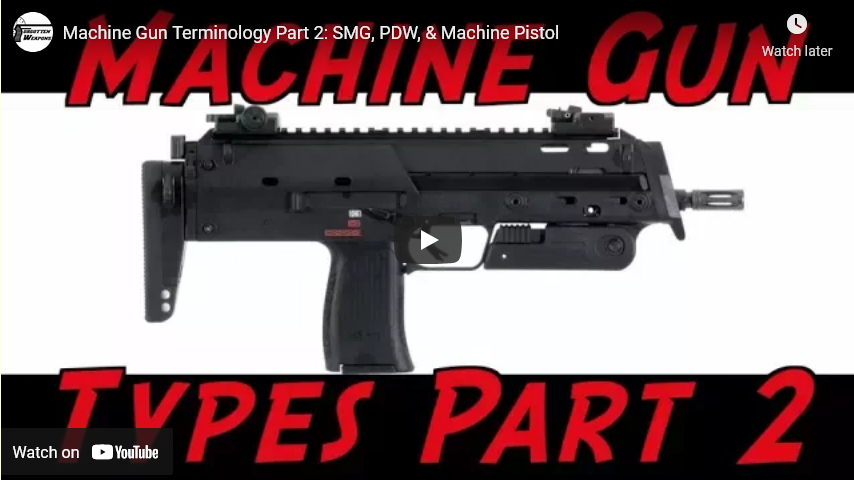
Today we have Part 2 of machine gun terminology — the small caliber guns. Specifically, submachine guns, personal defense weapons, and machine pistols. [Part 1 is here]
Submachine Gun: Pistol caliber, fully automatic, and fitted with a shoulder stock. For example, Thompson, MP40, MAS-38.
Machine pistol: Handgun form factor and fully automatic. For example, Glock 18, Mauser Schnellfeuer, Stechkin.
Automatic Rifle: Shoulder or hip fired, limited magazine capacity, minimal sustained fire capacity. Examples: M1918 BAR, Chauchat.
Personal Defense Weapon: (1) Armor-piercing or (2) holsterable submachine gun, not intended for front line combat. For example, FN P90, H&K MP7, Czech vz.61 Skorpion, Polish PM63 Rak.
If you enjoy Forgotten Weapons, check out its sister channel, InRangeTV! http://www.youtube.com/InRangeTVShow
May 11, 2021
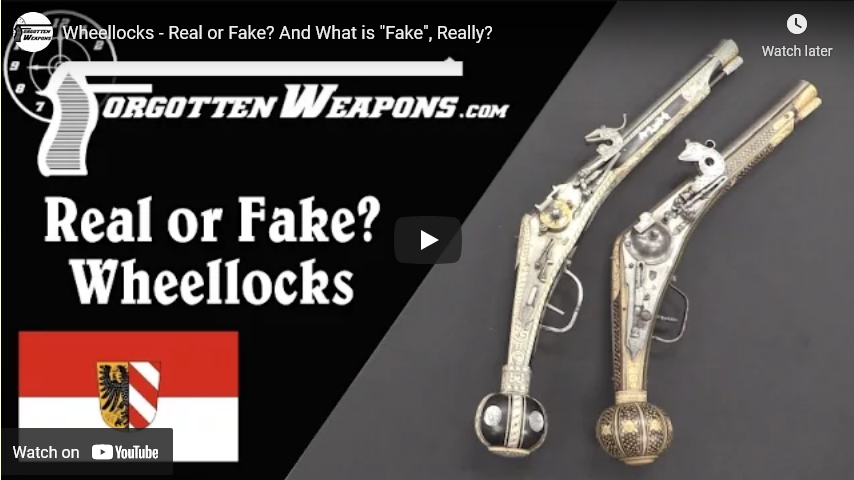
Wheellocks – Real or Fake? And What is “Fake”, Really?
Forgotten Weapons
Published 16 Aug 2016http://www.patreon.com/ForgottenWeapons
When someone makes a “fake” historical gun, they can do so with the intent to deceive or be up-front with the gun’s new manufacture. Those acknowledged reproductions are a great option to have — guns like Uberti reproduction revolvers give us an excellent opportunity to shoot antique designs without the cost of true originals and without the risk of damaging them. On the other hand, creating “antiques” fraudulently to deceive someone into believing they are actually originals is a reprehensible practice.
What about when you don’t know, though? In the Victorian era, it was popular to have fancy antique guns — like these wheellock pistols. Just like today, not everyone could afford to actually go buy a 300-year-old ornate gun, though. So, many people would commission new replicas made (and I’m sure plenty of fraudulent copies were created as well). Fast forward a hundred years or more to the present day, and we have a bit of a conundrum for the potential buyer. Is a gun 100 years old or 400? It takes some substantial experience and knowledge to be able to tell the difference — and yet an acknowledged Victorian copy is still a potentially fantastic piece of workmanship and collectible in its own right.
May 8, 2021
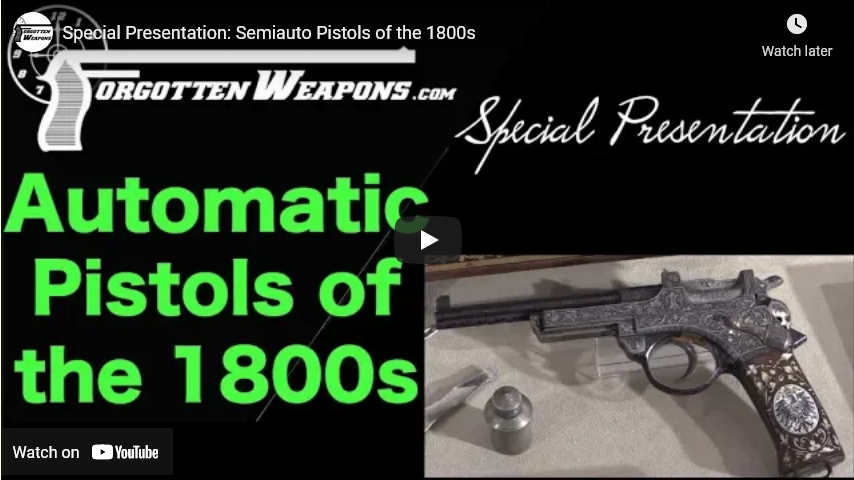
Special Presentation: Semiauto Pistols of the 1800s
Forgotten Weapons
Published 19 Sep 2018http://www.patreon.com/ForgottenWeapons
Cool Forgotten Weapons merch! http://shop.bbtv.com/collections/forg…
Today’s Special Presentation is an overview of all the semiautomatic pistols that were actually put into serial production before the year 1900. We have looked at these individually before, but I think it is worthwhile to examine them together in context, to gain a better understanding of what the automatic pistol scene was really like in the last years of the 19th century.
If you enjoy Forgotten Weapons, check out its sister channel, InRangeTV! http://www.youtube.com/InRangeTVShow
Contact:
Forgotten Weapons
6281 N Oracle #36270
Tucson, AZ 85704
From the comments:
Joseph Heschmeyer
2 years ago (edited)
“Hi guys, thanks for tuning in for another video on ForgottenWeapons.com. Today we’ll be looking at the science fair project that got me kicked out of middle school.”
April 28, 2021
How Does it Work: Short Recoil Operation
Forgotten Weapons
Published 19 Jan 2021http://www.patreon.com/ForgottenWeapons
https://www.floatplane.com/channel/Fo…
Cool Forgotten Weapons merch! http://shop.bbtv.com/collections/forg…
Correction: Browning invented the pistol slide, but not the overall short recoil system. Maxim was the first to successfully create a short recoil firearm.
Short recoil is the most common system used today in self-loading handguns, and it also used to be fairly popular in machine gun designs. The basic principle is that the bolt and barrel (in a handgun, slide and barrel) are locked together for an initial travel substantially less than the overall length of the cartridge. After typically a few millimeters of travel, the barrel stops and the bolt or slide is able to continue rearward to extract and eject the empty case. Short recoil can be paired with virtually any locking system, but today the Browning tilting barrel system is most common.
Short recoil has never been popular in shoulder rifle, as the reduction in mechanical accuracy from the moving barrel can be undesirable. In handguns and machine guns, this accuracy reduction is generally below the threshold of relevance.
Contact:
Forgotten Weapons
6281 N. Oracle #36270
Tucson, AZ 85740
February 2, 2021
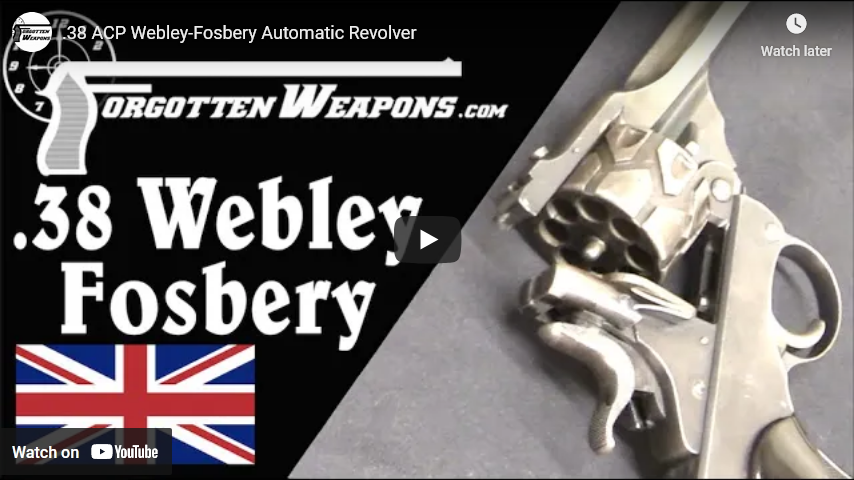
.38 ACP Webley-Fosbery Automatic Revolver
Forgotten Weapons
Published 11 Nov 2020http://www.patreon.com/ForgottenWeapons
https://www.floatplane.com/channel/Fo…
Cool Forgotten Weapons merch! http://shop.bbtv.com/collections/forg…
The rarest variation of the Webley-Fosbery automatic revolver is the .38 ACP model. Only 341 of these were made by Webley, in an attempt to compete with the new semiautomatic pistols appearing on the market — most notably the Colt Model 1900 and Model 1902. The Colt was chambered for .38 ACP, a remarkable cartridge for its time — high velocity and semi-rimmed. Webley figured that an 8-shot Fosbery-type revolver would offer the same capacity and ballistics as the new Colt, but in a revolver format familiar to the British market. The design could load cartridges individually, but also offered use of an 8-shot moon clip. Unfortunately for Webley, British legislation in 1903 hampered civilian handgun ownership and the military was not interested at all because the bore was too small. Of the 341 originally made, some were finally converted to .455 caliber after years of sitting unsold in Webley’s warehouse.
This model makes a notable appearance in Dashiell Hammett’s novel The Maltese Falcon, which quite specifically identifies it as an 8-shot, .38 caliber Webley-Fosbery. In the movie version, Humphrey Bogart mistakenly says it is an 8-shot .45, however…
Contact:
Forgotten Weapons
6281 N. Oracle #36270
Tucson, AZ 85740
January 7, 2021
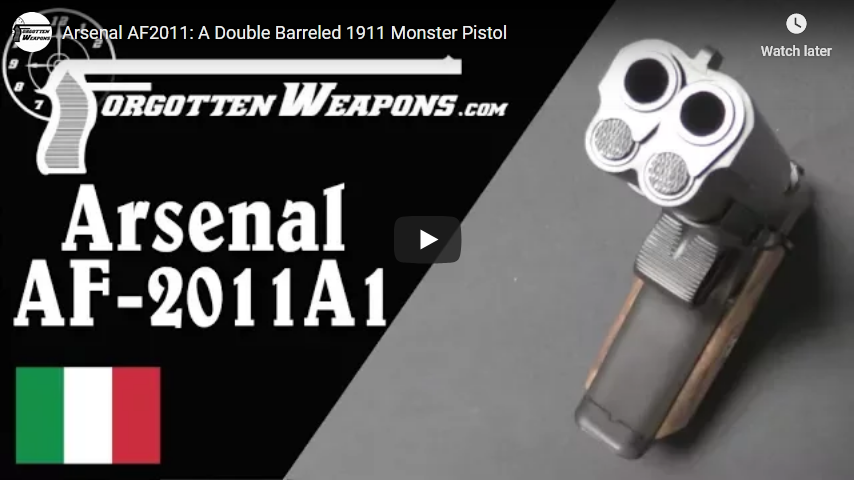
Arsenal AF2011: A Double Barreled 1911 Monster Pistol
Forgotten Weapons
Published 4 Sep 2017The Arsenal 2011 began as a manufacturing proof of concept, to showcase the technical ability of the company making it (their prior experience was largely in exquisite miniature firearms). It was introduced to the public at SHOT Show a few years ago, and garnered more purchases than had been anticipated.
The gun itself is basically two 1911 frames and slides mated together into a single gun. It has two barrels, two magazines, and two hammers attached to make a single unit. The triggers are also connected together, and pulling either one will cause both barrels to fire simultaneously.
While this sort of firearm is fun to consider (and fantastic for use by movie villains), it is rather difficult to imagine a practical use for it. Most oversized handguns are made for hunting and target competition, but the two-shots-per-trigger-pull nature of the 2011 make it rather unsuited to these uses. It is impossible to shoot a truly small group, as the bullets will always be about an inch apart and they cannot be regulated by the shooter to group together. Not that this stops people from wanting this sort of over-the-top handgun, of course.
http://www.patreon.com/ForgottenWeapons
Cool Forgotten Weapons merch! http://shop.bbtv.com/collections/forg…
If you enjoy Forgotten Weapons, check out its sister channel, InRangeTV! http://www.youtube.com/InRangeTVShow
December 11, 2020
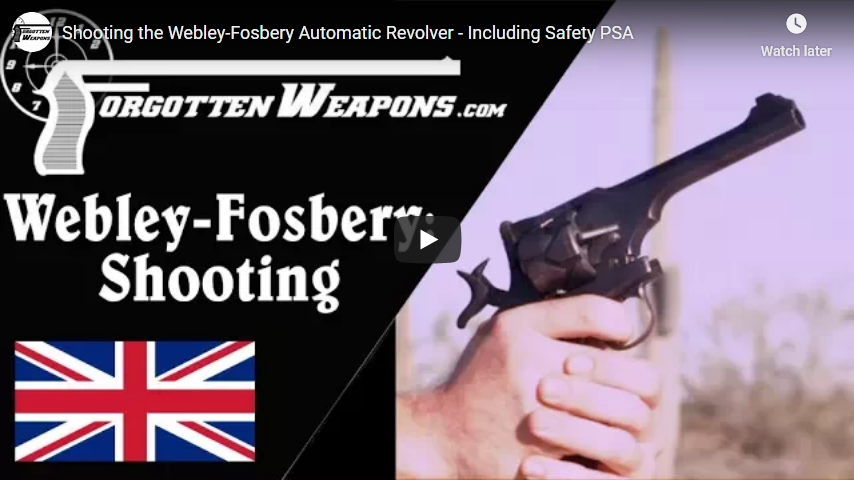
Shooting the Webley-Fosbery Automatic Revolver – Including Safety PSA
Forgotten Weapons
Published 10 Aug 2017Following up yesterday’s look at the history and mechanics of the Webley-Fosbery self-cocking revolvers [posted here], today we are out at the range to do some shooting with one.
In terms of handling, it is a comfortable gun to shoot, albeit with some exaggerated recoil because of the very high bore axis relative to the hand. It has an interesting two-part recoil sensation, because the upper assembly takes quite a long time to return forward into battery.
Most importantly, we discovered that this particular Webley-Fosbery has a worn hammer engagement, which results in the firing pin coming into contact with cartridge primers even when it is in the safety notch. In other words, it can — and will — sometimes fire when the action is closed and without any manipulation of the trigger. This is a condition that could happen to any Fosbery revolver, so owners should handle them with this possibility in mind! This is also a great example of why gun safety rules are redundant — occasionally guns do have mechanical failures, so don’t point them at anything you don’t want to shoot!
Thanks to Mike Carrick of Arms Heritage magazine for providing this Webley-Fosbery for this video! See his regular column here: https://armsheritagemagazine.com
Cool Forgotten Weapons merchandise! http://shop.bbtv.com/collections/forg…
http://www.patreon.com/ForgottenWeapons
If you enjoy Forgotten Weapons, check out its sister channel, InRangeTV! http://www.youtube.com/InRangeTVShow
November 26, 2020
“… the Liberals’ oft-stated commitment to listen to the experts and the frontline workers fizzles when said experts and workers disagree with a preferred policy”
In The Line, Matt Gurney explains why the Liberals are so in love with a set of proposed rule changes that will do almost nothing to reduce gun crime in Canada and might even end up creating criminals of previously law-abiding Canadians … but it polls well in Liberal ridings:
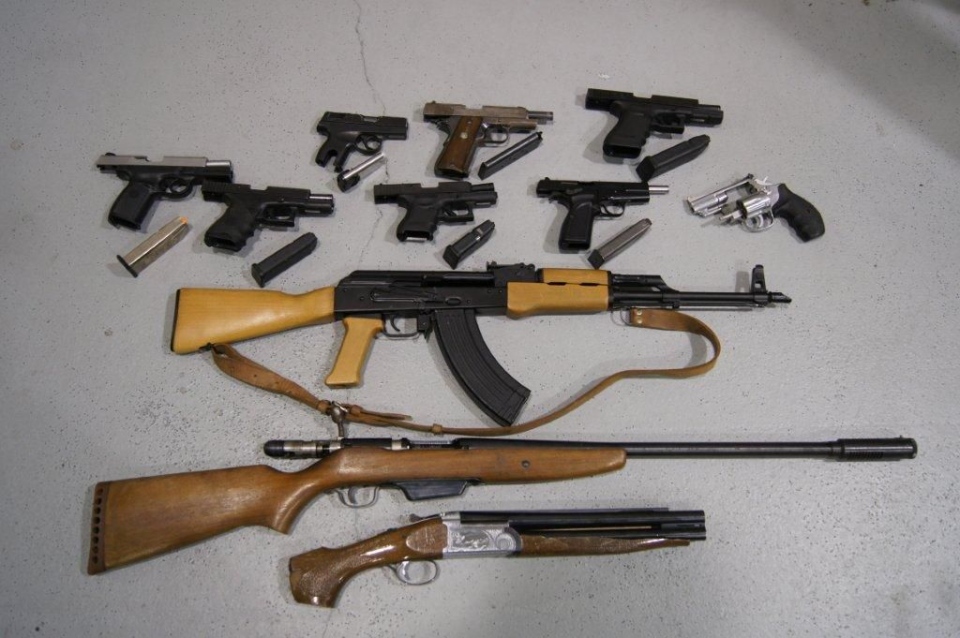
Restricted and prohibited weapons seized by Toronto police in a 2012 operation. None of the people from whom these weapons were taken was legally allowed to possess them.
Screen capture from a CTV News report.
Talking about gun policy in Canada is tricky, because the debate is highly technical. The regulation of firearms in this country, at least in theory, depends on the specifications of the firearm in question. Mode-of-operation, magazine capacity, ammunition calibre or barrel-bore width, barrel length, muzzle energy — these are all the criteria upon which a firearm is classified into one of three categories under Canadian law: prohibited, restricted or non-restricted. Any Canadian who wishes to own or borrow a firearm, or purchase ammunition, must be licenced, a process which includes mandatory safety training and daily automatic background checks.
Prohibited firearms are essentially banned in Canada; a relatively small number are held by private citizens who already possessed them when the current regulatory regime was brought in in the 1990s. The government of the day didn’t want to get into the thorny issue of confiscation, so it let existing owners keep them under strict conditions. The vast majority of guns in Canada, and all new guns sold for decades, therefore fall into the other two categories. Restricted guns are generally pistols and revolvers, but also some rifles and shotguns. Non-restricted guns are run-of-the-mill hunting rifles and shotguns, though some sports-shooting rifles (used for target practice) are also included.
The above is all somewhat theoretical, as the regulations are twisted and pulled in a variety of ways to suit political ends, leaving a system that’s tortured and confusing even for those of us who study it. But it gives you at least an idea of how the system is designed. If you know guns, of course, you knew all this already. If you don’t, I wouldn’t blame you if your eyes glazed over a bit while reading the above. Without a basic working familiarity with all the terminology and technical specs and regulations, it’s damn hard to follow the debates over gun control. This is why I have to ask you non-aficionados to take my word for it: the Liberal proposal is really bad.
Well, actually, you don’t have to take just my word for it. You can read the NPF’s position paper, which makes at least some of the case. It notes, correctly, that “military style assault weapons” aren’t actually a thing that’s defined under Canadian law; it can therefore mean whatever the government of the day wants it to mean. True military style battle weapons — fully automatic weapons with high-capacity magazines and full-sized ammunition — are already effectively banned in Canada and have been for decades. Further, the NPF notes, firearms are used in a minority of homicides in Canada, a majority of those homicides are committed with handguns, and a majority of those killings are directly linked to organized crime or gang activity.
You’re probably starting to see the problem: Going after the guns that aren’t being used in the crimes, and taking them from the people who aren’t committing them, isn’t a public-safety policy. It’s a political gift to the Liberals’ urban base, where the proposal is popular and gun literacy low (those two latter points are not unrelated).
While the ban is almost entirely a political sop, it’s probably a good political sop, alas. I’m sure the proposal will be very well received in ridings the Liberals would like to hold or flip. But it’s still a stupid policy, even if it’s popular. The Liberals are proposing to spend tons of money on this. They estimate hundreds of millions, but recall that the long-gun registry came in about 1,500 times overbudget. And all to “ban” some of the rifles used by a segment of the population — licenced and screened gun owners — that’s been found to be the several times less likely to commit murder than those without licences.
November 25, 2020
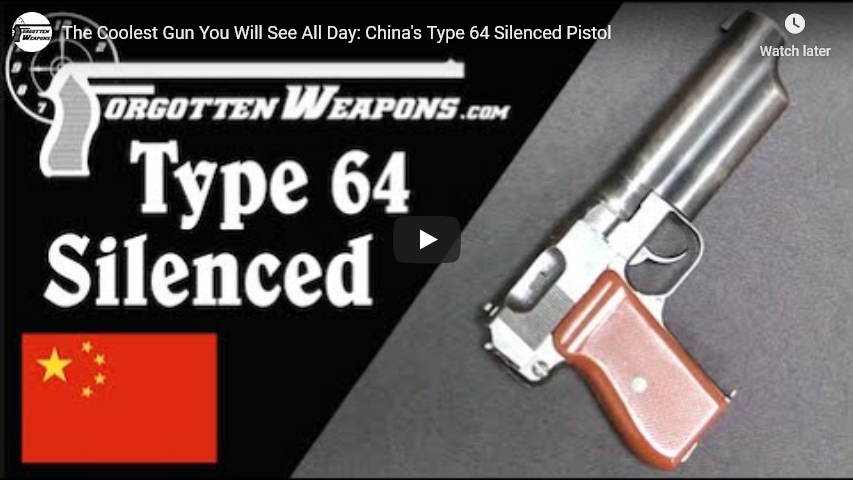
The Coolest Gun You Will See All Day: China’s Type 64 Silenced Pistol
Forgotten Weapons
Published 14 Aug 2020http://www.patreon.com/ForgottenWeapons
https://www.floatplane.com/channel/Fo…
Cool Forgotten Weapons merch! http://shop.bbtv.com/collections/forg…
The Type 64 is a dedicated suppressed pistol first introduced in 1965 and used in the Vietnam War. It uses a rimless version of the .32 ACP cartridge (7.65x17mm) in a 9-round Makarov-like magazine. Despite outward similarity to the Makarov (especially the grip), the design is wholly unique internally. It uses basically a miniaturized AK bolt to allow the shooter to select between blowback semiauto functioning and single shot manual operation. The bolt’s rotating locking lugs prevent it from cycling when locked, in a very clever alternative use of the rotating bolt system. The suppressor has two chambers, using a combination of baffles and wire mesh as suppressor elements. In addition to standard ammunition, a plastic-sabot frangible load was also developed for use in situations like airline hijackings, and this loading is why some sources reference a maximum effective range of 15 meters.
For all its technical cleverness, the Type 64 is a rather heavy pistol, at 1.8kg / 4 pounds. It was replaced in 1967 by the substantially lighter and simpler Type 67, which weighed only 1.05kg / 2.3 pounds. This particular Type 64 was originally owned by Mitch Werbell III, giving it an even more interesting history …
Contact:
Forgotten Weapons
6281 N. Oracle #36270
Tucson, AZ 85740
November 22, 2020
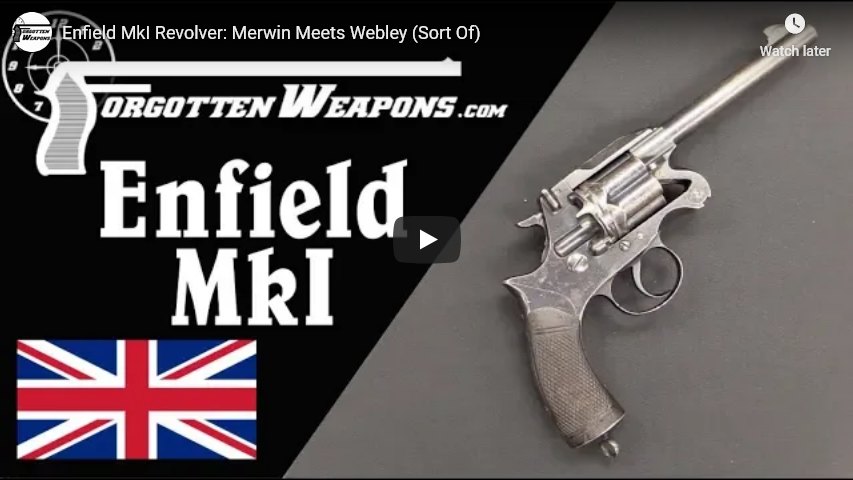
Enfield MkI Revolver: Merwin Meets Webley (Sort Of)
Forgotten Weapons
Published 23 Aug 2018http://www.patreon.com/ForgottenWeapons
Cool Forgotten Weapons merch! http://shop.bbtv.com/collections/forg…
Adopted in 1880 to replace the Adams revolver, the Enfield MkI was based on an extraction system patented in the 1870s by Owen Jones of Philadelphia. This was similar in practice to the Merwin & Hulbert, with the barrel and cylinder hinging forward while the cartridge cases were held to the back of the frame. This system allowed empty cases to drop free (except the 6 o’clock position one, which often stuck) while retaining any unfired cartridges in the cylinder. Because the extractor star was fixed to the frame, the piece had to be loaded one round at a time through a loading gate (again, like the Merwin & Hulbert).
In 1882 a number of improvements were made to the design and lockwork, including features to prevent the cylinder from rotating freely and to disconnect the hammer when the loading gate was open. This was adopted as the MkII in 1882. A further change was made in 1887, following the death of a Royal Navy sailor whose gun fell out of its holster and discharged upon hitting the hammer. A new safety mechanism was added to prevent this from happening again, and most guns in service were retrofitted with it.
The Enfield was generally not well received, as it was heavy and a bit awkward to handle. It was issued to the Army, Navy, and RCMP, but replaced by the first adopted Webley top-break revolvers in the late 1880s (Enfield MkII production ceased in 1889). Unlike the Webleys and other private-production guns, there was never a civilian version of the Enfield MkI or MkII made, and they are scarcer to find today as a result.
If you enjoy Forgotten Weapons, check out its sister channel, InRangeTV! http://www.youtube.com/InRangeTVShow
Contact:
Forgotten Weapons
6281 N Oracle #36270
Tucson, AZ 85704
November 10, 2020
WWI Pritchard Bayonet for the Webley Revolver
Forgotten Weapons
Published 23 Nov 2016Cool Forgotten Weapons Merch! http://shop.bbtv.com/collections/forg…
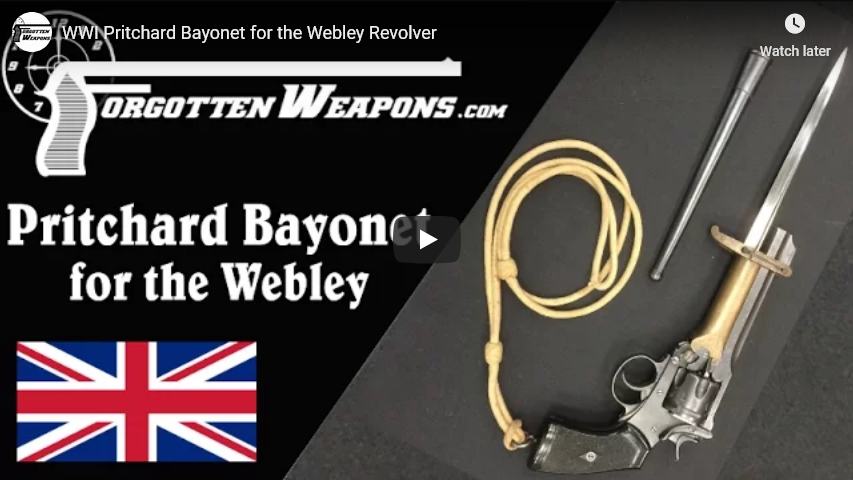
The Pritchard bayonet for the Webley revolver is one of the more photogenic and less truly practical weapons to come out of the Great War. Designed by one Captain Pritchard after he spent a year in France in 1915-1916 with the Royal Berkshire Regiment, the idea was to use the front 8 inches or so of a sword on a cast gunmetal hilt to create a bayonet mounted on a British service revolver. He first presented the idea to the Wilkinson Sword Company, but they were too busy making sabers and rifle bayonets, and suggested that having to sacrifice usable sword blades for production would make it quite the expensive endeavor.
Pritchard next took his idea to W.W. Greener, where he found a more receptive audience. Greener had a large supply of surplus French Gras bayonets, which were cheap and served as excellent donors for the Pritchard bayonets. Something like 200 were made in total — not formally adopted by the British but available for commercial sale to officers who might want them. While some may have seen service, no hard evidence has been found to prove any combat action with them.
Over the decades, a great many fake and reproduction Pritchard bayonets have been made — many times more than there are originals. As far as I can determine, this one is a legitimate original (although it may have a replacement locking lever). A few things to look for in authenticating a Pritchard are engraved patent and manufacturer marks (most reproductions have no manufacturer logo and a stamped patent number) and a quality casting. When you hold the blade and tap the handle with a hard object, it should ring bright and bell-like (which this one does).