Quotulatiousness

January 26, 2010

When politicians get too close to the sharp end, militarily speaking

Filed under: Government, Military, Politics, USA, Weapons — Tags: , — Nicholas @ 07:42

This is a good example of why it’s a bad idea to allow politicians to get too deeply involved in military acquisition and logistics:

The U.S. Army wants to use more precision “smart” weapons. To that end they have replaced unguided MLRS (227mm) rockets with a GPS guided one. There is now a very popular GPS guided 155mm artillery shell in use. Laser guided Hellfire missiles are widely used by helicopter gunships. But there’s still one unguided “dumb” weapon that the army just can’t seem to get away from; their unguided 70mm (2.75 inch) rockets. Back in 2003, the army planned to begin phasing out these rockets. But, instead, during the last five years, the army has purchased nearly a billion dollars worth of 70mm rockets. Not because they wanted to, but because the politicians from Vermont, where the rocket is manufactured, had enough clout to force the army buy over 100,000 70mm rockets they don’t want, won’t use, and will eventually have to dispose of. That last step will cost more money, unless they can find some foreign country that wants to buy them, cheap.

I guess the plant that produces them is in a district represented by a member of a powerful committee in Washington.
January 20, 2010

This has got to be a mis-communication

Filed under: Americas, Bureaucracy, Military, USA — Tags: , , — Nicholas @ 21:55

At least, I hope it’s just a miscommunication:

Food handouts were shut off Tuesday to thousands of people at a tent city here when the main U.S. aid agency said the Army should not be distributing the packages.

It was not known whether the action reflected a high-level policy decision at the U.S. Agency for International Development (USAID) or confusion in a city where dozens of entities are involved in aid efforts.

“We are not supposed to get rations unless approved by AID,” Maj. Larry Jordan said.

Jordan said that approval was revoked; water was not included in the USAID decision, so the troops continued to hand out bottles of water. The State Department and USAID did not respond to requests for comment.

Surely not even the most pig-headed rules-lawyer would have required this . . . I hope.

H/T Castle Argghhh.

Update, 21 January: For reasons of incompetence, I forgot to actually include the URL in that link to Castle Argghhh. Fixed now.

While I’m updating the post, this may be relevant:

The MRE (Meals Ready to Eat, in a pouch) are frequently used as emergency rations. The MRE has evolved from its initial introduction in 1983 (12 separate entrees) to today (24 menu entrees). The MREs change from year to year, and new entrees are added in place of others. The U.S. military has generally switched out entrees each year (apparently the notion that such a deal is a zero-sum game seems to persist, as opposed to just adding new ones). This constant evolution has done much to diminish the bad reputations MREs had early on. Back then, the MRE (officially, “Meals, Ready to Eat”) was often called “Meals Rejected by Everyone”.

The United States also has other rations, including variants for cold weather (which has a higher calorie count than the regular MRE – 1540 per meal compared to 1250 for an MRE), and a kosher/halal variant for Jewish and Moslem soldiers (both religions, for instance, forbid the consumption of pork). Vegetarian entrees are provided, as well. The United States also has developed the Humanitarian Daily Ration (HDR), which has three meals and is based on vegetarian entrees to provide a low chance of offending cultural sensibilities. Many of these HDRs were dropped over Afghanistan in late 2001. Several hundred thousand HDRs are stockpiled for disaster relief, and production can be ramped up quickly. MREs and HDRs are particularly attractive because they provide uncontaminated food that does not require refrigeration, in a compact package. The UN, and many other food aid organizations, use the HDR for situations like Haiti.

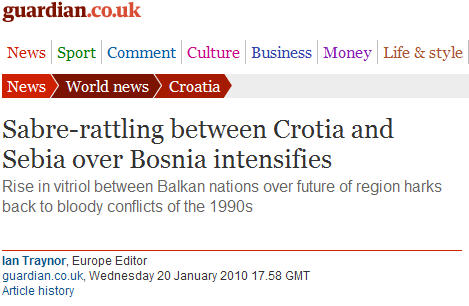
If you wonder why it’s nicknamed “The Grauniad” . . .

Filed under: Humour, Media — Tags: , — Nicholas @ 13:13

This is the sort of thing they were notorious for:

You wonder why those “Crotians” and the “Sebians” can’t get along . . .

Amusingly, they got the national names correct in the article’s URL.

January 18, 2010

Why just be shallow? Show off your shallowness for the next generation

Filed under: Media, Randomness — Tags: , — Nicholas @ 08:54

It used to be that you could show off your lack of imagination by naming your kid after sports stars. These days, it’s names from popular films that are all the rage:

According to a rather sketchy report in the Sun, some parents have inexplicably decided it’s a bright idea to name a kid Neytiri or Toruk or indeed Pandora. The latter is top choice in the US, “with UK parents set to follow”.

The Sun appears to have got the shock news from blinkbox.com, which suggested that the $1bn box office barrier acts as a trigger for movie-based sprogbranding. A spokesman offered: “Past the $100m barrier, the chances of a film’s star lending their name to a child increase.”

This remarkable and almost unbelievable fact explains, of course, why priests have in recent years been obliged to utter: “I christen thee Bilbo Dark Knight Barbossa Gollum Jack Sparrow III…”

It almost makes you sympathetic to those countries which legally restrict the names parents are allowed to select for their children . . .

January 9, 2010

QotD: The awfulness of airports

Filed under: Bureaucracy, Quotations, USA — Tags: , , , , , — Nicholas @ 00:02

Over the weekend, an idiot walked the wrong way through a secure exit for arriving passengers at Newark airport. An entire terminal was shut down so that everybody on the “sterile” side of the security barriers could be herded back out and rescreened. The entire process took just under seven hours. The cascading delays disrupted air travel worldwide. They didn’t even catch the doofus who caused the ruckus. No doubt, if they’d announced his location over the paging system, he’d have been drawn and quartered by a mob of traveling salesmen from 3M and a gaggle of middle-school girls returning from a volleyball tournament.

Now, I should back up. When I referred to the “sterile” side of the security barrier, I was using the term narrowly, to refer to folks who’d been through the metal detectors. Because to use the word “sterile” in its usual context in a sentence with “airports” — those belching Petri dishes of bathroom effluence and unidentifiable noisome miasma — would be a grotesque abrogation of journalistic trust.

According to the latest epidemiological research, airports reside somewhere between no-frills Haitian brothels and Penn State fraternity bathrooms when it comes to hygiene. USA Today recently surveyed the health-inspection records of airport restaurants and found that serious code violations were as commonplace as rat and mouse droppings; 77 percent of 35 restaurants reviewed at Reagan National Airport had at least one major violation.

I could go on, of course. The petty humiliations, the routine deceptions from airline employees desperate to rid themselves of troublesome travelers (“Oh, they can definitely help you at the gate!”), the stress-position seats, the ever-changing rules for what can and cannot be in your carry-on, being charged for food that the Red Cross would condemn if it were served at Gitmo: Air travel is the most expensive unpleasant experience in everyday life outside the realm of words ending in -oscopy.

Jonah Goldberg, “A No-Fly List? Count Me In: Flying before 9/11 was already awful, and it has only become worse”, National Review, 2010-01-08

January 4, 2010

Sony’s latest consumer mis-step

Filed under: Technology — Tags: , , , , — Nicholas @ 08:44

Dark Water Muse treated himself to a new bit of electronic kit over the holidays, a Sony Reader Touch. He wasn’t best pleased by the purchase:

The Sony Reader is an all but useless device, certainly at its current price point. Especially if you already happen to own a portable electronic device capable of rendering common document and media file formats — got a smart phone? Got a netbook or laptop? Then you’re already living the dream that is merely Sony’s Reader Touch nightmare.

DWM gives the Sony Reader Touch negative 1 out of 10. Truly impressively bad, particularly when measured on a scale of +1 to +10.

How does DWM compute negative one? Read on.

Only the newly arrived on H. G. Wells’ Time Machine could find utility in a Sony Reader. Or if you’re too proud to admit you fucked up by buying one in the first place and prefer to go to your grave, Sony Reader over your heart (trust DWM when he says, any friends you might still have after becoming a Sony Reader Touch owner, or surviving relatives, want to see it buried with you too), rather than get your money back.

DWM returned his Sony Reader Touch after making extra special efforts to try and modify his relationship to reading text with it. He wanted the Sony Reader to work. He was willing to tolerate “a little” deficit in the reading experience, if only to avoid having to slaughter one more tree to feed his hunger for crime novels. But, feeling disappointed and defeated, DWM sent his Sony Reader Touch back to from whence it had come (extruded from that great product anus behind so many retail consumer products).

I’ve got a couple of dozen books on my iPhone, but I consider them to be “emergency” reading . . . for those times when I don’t have internet access. It’s great that the iPhone can work as a small ebook display, but the key word here is “small”.

December 30, 2009

If the terrorists don’t kill off the airlines, the TSA will

Filed under: Bureaucracy, Liberty, USA — Tags: , , , , , — Nicholas @ 08:54

Radley Balko joins the chorus of protests about the latest set of how-stupid-can-you-get “security” rules from the TSA:

Seems to me that what this, Flight 93, and the Richard Reid incident have shown us is that the best line of defense against airplane-based terrorism is us. Alert, aware, informed passengers.

TSA, on the other hand, equates hassle with safety. For all the crap they put us through, this guy still got some sort of explosive material on the plane from Amsterdam. He was stopped by law-abiding passengers. So TSA responds to all of this by . . . announcing plans to hassle law-abiding U.S. passengers even more.

If you’re really cynical, you could make a good argument that they’re really only interested in the appearance of safety. They’ve simply concluded that the more difficult they make your flight, the safer you’ll feel. Never mind if any of the theatrics actually work.

After my last business flight (the day of the Shoe Bomber’s transatlantic aircraft attempt), I’ve actively avoided commercial air travel. This latest set of Security Theatre set dressings merely extends the range I’ll be willing to drive rather than putting up with the flight — actually, the flight preparation, rather than the flight itself.

Update: Don’t know why I thought it was the Shoe Bomber . . . it was the would-be liquid bomb conspiracy that happened while I was in transit through Atlanta.

December 29, 2009

Worst. Decade. Ever.

Filed under: Government, Humour, Politics, USA — Tags: , , , — Nicholas @ 18:30

Air security gone insane

Filed under: Bureaucracy, USA — Tags: , , , , , — Nicholas @ 12:58

Hard to disagree with Gulliver on this one:

In the wake of Friday’s attempted bombing of a Northwest Airlines flight from Amsterdam to Detroit, the people who run America’s airport security apparatus appear to have gone insane. Despite statements from several officials, including Janet Napolitano, the secretary of homeland security, that there is “no indication” of any broader plot against American airliners, some truly absurd security “precautions” are being implemented on US-bound flights worldwide.

The most ridiculous new rule prohibits passengers on US-bound international flights from leaving their seats or having anything on their laps—even a laptop or a pillow—during the final hour of flight. You’re probably thinking “Wait, what?” Indeed. The New York Times elaborates:

In effect, the restrictions mean that passengers on flights of 90 minutes or less would most likely not be able to leave their seats at all, since airlines do not allow passengers to walk around the cabin while a plane is climbing to its cruising altitude.

Gulliver looks forward to the barrage of lawsuits from the first people who are forced to use the bathroom in their airplane seats. This is the absolute worst sort of security theatre: inconvenient, absurd, and, crucially, ineffective.

December 22, 2009

PJTV visits Detroit

Filed under: Bureaucracy, Economics, Government, USA — Tags: , — Nicholas @ 07:53

December 15, 2009

“B+ — it’s the new FAIL”

Filed under: Humour, Politics — Tags: , , , — Nicholas @ 14:10

Frank J. has been having fun with his latest meme:

I started a Twitter meme yesterday and Ace really got it going where we listed other things we would rate a good, solid B+ based on Obama’s grading scale.

BTW, for those who still think Twitter is gay, in what non-gay things do you start a discussion of politics and Firefly and Chuck’s Adam Baldwin sometimes joins in? I think that means you’re gay.

Anyway, here’s what I came up with:

Tiger had rated his marriage so far a B+.
Charles Manson’s efforts on reforming… hmm… I’d say that’s a solid B+.
Landing of the Hindenburg is a good, solid B+. A- if it were on time.
Hitler’s relationship with the Jews: B+.
My avoiding Godwin’s Law: B+.

Heart-warming story of the day

Filed under: Britain, Law — Tags: , , , , — Nicholas @ 12:52

Jon sent me this heart-warming story, and I thought it best to share:

A millionaire businessman who fought back against a knife-wielding burglar was jailed for two-and-a-half years yesterday. But his attacker has been spared prison.

Munir Hussain, 53, and his family were tied up and told to lie on the floor by career criminal Waled Salem, who burst into his home with two other masked men.

Mr Hussain escaped and attacked Salem with a metal pole and a cricket bat. But yesterday it was the businessman who was starting a prison sentence for his ‘very violent revenge’.

Jailing him, Judge John Reddihough said some members of the public would think that 56-year-old Salem ‘deserved what happened to him’ and that Mr Hussain ‘should not have been prosecuted’.

But had he spared Mr Hussain jail, the judge said, the ‘rule of law’ would collapse.

He said: ‘If persons were permitted to take the law into their own hands and inflict their own instant and violent punishment on an apprehended offender rather than letting the criminal justice system take its course, then the rule of law and our system of criminal justice, which are hallmarks of a civilised society, would collapse.’

Salem, who has previous convictions, has already been given a non-custodial sentence despite carrying out what the judge called a ‘serious and wicked’ attack.

Well, it’s nice to know that some judges carry the best interests of “society” close to their hearts. And he’s right, you know: society would indeed collapse if the courts were forced to spend their time trying and sentencing career criminals like Salem. They’re career criminals. Custodial sentences would interfere with their careers, which would be a serious infringement of their human rights. Can’t have that.

The courts, however, are well situated to send serious messages to wanton millionaires like Hussain, who need to be regularly reminded that their wealth and privilege does not give them rights over and above those enjoyed by normal non-millionaires. I have no need to remind you that non-millionaires are not allowed to defend themselves against criminals either.

So, clearly, justice is served.

In some parallel universe, anyway.

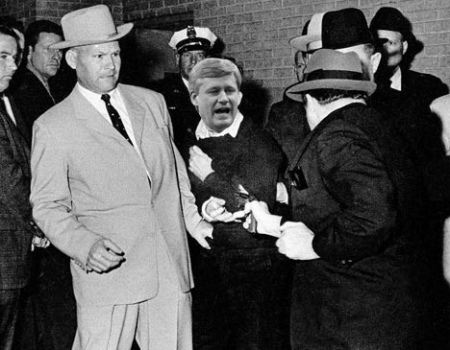
Jack Ruby rides again

Filed under: Cancon, Politics — Tags: , , , — Nicholas @ 07:56

Ezra Levant points out the contrast between media reaction to a silly Tory joke image in 2008 (a puffin pooping on Liberal leader Stephane Dion) and this:

Liberal shoot PM

Image from the Liberal Party’s website.

December 10, 2009

Russia does it again, to NATO’s benefit

Filed under: Military, Politics, Russia — Tags: , , , — Nicholas @ 09:19

Sometimes, the Russian approach to diplomacy results in exactly the opposite to the intended outcome:

In the 1990s, when enlarging NATO to take in the ex-communist countries still seemed perilous and impractical, help came from an unexpected source. Yevgeny Primakov, a steely old Soviet spook who became first head of Russia’s Foreign Intelligence Service, then foreign minister and even, briefly, prime minister, liked to say that it would be “impermissible” for the alliance to admit ex-communist states.

His remarks, and others in similar vein by leading Russian politicians, proved counterproductive. The more the Kremlin huffed and puffed about ex-captive nations deciding their own future, the harder it became to dismiss those countries’ fears: if your neighbour terms it “impermissible” for you to install a burglar alarm, people will start taking your security worries seriously. Some wags even suggested that a “Primakov prize” be established to mark the boost he had given to the cause.

But the lesson apparently was not learned:

Instead, Russia is adopting the opposite course. It habitually violates Baltic airspace. It maintains a vocal propaganda offensive (such as a report being launched in Brussels this week by a Russian-backed think-tank, which criticises Baltic language and citizenship laws). This autumn, it scandalised NATO opinion by running two big military exercises, without foreign observers, based on highly threatening scenarios (culminating in a Strategic Rocket Forces drill in which Russia “nuked” Poland). The exercises demonstrated weakness and incompetence, as well as force of numbers and nasty thinking. But they made life hard for peacemongers and strengthened the arguments of NATO hawks and the twitchy eastern Europeans.

December 9, 2009

“There is no app for that”

Filed under: History, Technology — Tags: , , , , , — Nicholas @ 13:06

Alex Tabarrok looks at the Chilean “Cybersyn” project:

Cybersyn was a project of the socialist government of Salvador Allende (1970-1973) and British cybernetic visionary Stafford Beer; its goal was to control the Chilean economy in real-time using computers and “cybernetic principles.” The military regime that overthrew Allende dropped the project and probably for this reason when the project is periodically rediscovered it is often written about in a romantic tone as a revolutionary “socialist internet,” decades ahead of its time that was “destroyed” by the military because it was “too egalitarian” or because they didn’t understand it.

Although some sources at the time said the Chilean economy was “run by computer,” the project was in reality a bit of a joke, albeit a rather expensive one, and about the only thing about it that worked were the ordinary Western Union telex machines spread around the country. The IBM 360 two computers supposedly used to run the Chilean economy were IBM 360s (or machines on that order). These machines were no doubt very impressive to politicians and visionaries eager to use their technological might to control an economy [. . .] Today, our perspective will perhaps be somewhat different when we realize that these behemoths were far less powerful than an iPhone. Run an economy with an iPhone? Sorry, there is no app for that.

Cybersyn_stage

[. . .] The control room is like the bridge of the Starship Enterprise in another respect–both are stage sets. Nothing about the room is real, even the computer displays on the wall are simply hand drawn slides projected from the other side with Kodak carousels.

« Newer PostsOlder Posts »

Powered by WordPress