
[T]he Bono Pay Up lobby, far from challenging Bono’s gobsmackingly paternalistic attitude towards Africa, is encouraging him to put his money where his mouth is. Its message is effectively: Stop talking about saving Africa and go out and actually save it! The campaign group claims that it is because of individuals like Bono, who export bits of their business overseas in order to avoid paying high taxes at home, that Africa is a mess. Some of that tax could be used for the foreign aid budget, you see. Not only is this a spectacularly naïve view of the massive structural problems facing underdeveloped nations in the Third World — as if their woes could be magically fixed by Bono and others stumping up a bit more tax — but it also suggests, explicitly, that it is up to rich white men to save downtrodden Africa.
According to Bono Pay Up, if Bono paid his taxes in a more “ethical” fashion, he could help to alleviate “suffering in the developing world”. Unless the protesters succeed in shifting Bono’s personal habits, “the poor will always be with us”, they claim. In short, all it takes for the poor to be lifted up from their empty-stomached, teary-eyed existences is for a few good men — white ones, naturally — to behave more ethically and caringly. It’s the White Tax Man’s Burden. In focusing on Bono’s alleged hypocrisy, the protesters are actually trying to bridge the gap between the Bono persona (saviour of Africa) and the Bono reality (he pays his taxes in a weird way). That is, they want him to become what he claims to be — the Moral Viceroy of Africa — and to show the Dark Continent how to reach the light. A plague on both their houses. If there are any African bands playing at Glastonbury I hope they lay into the Bono Pay Up lobby, and then use its silly placards to wallop Bono.
Brendan O’Neill, “The ‘Bono Pay Up’ protesters have achieved the remarkable feat of being even more smug than Bono”, The Telegraph, 2011-06-22
June 22, 2011
QotD: Who’s more smug than Bono? The “Bono Pay Up” protesters
June 18, 2011
June 10, 2011
Royal Navy still regrets decision to retire their aircraft carriers
With a significant portion of the Royal Navy deployed in the Mediterranean, the hasty decision to take HMS Ark Royal out of service looks even dumber now:
Just at the very moment that the decisions of the October 2010 “Strategic Defence Review” start to bite, the Royal Navy is being asked by government to do more than ever. With the crisis in Libya and the Middle East showing no signs of ending, RN warships are spread thin across the globe. A quick snapshot of the fleet shows the pace of operations. With such a tiny fleet, our naval ports are almost empty and there are few vessels able to provide reliefs should the Libya crisis continue or escalate.
RN ships involved in Operation Ellamy off Libya include HMS Ocean, HMS Albion, HMS Sutherland, HMS Liverpool, HMS Brocklesby and HMS Bangor and HMS Triumph. The RFA is playing an increasing role with RFA Fort Rosalie, RFA Wave Knight supporting them. RFA Argus, RFA Fort Victoria and RFA Cardigan Bay are ready off Yemen should UK citizens need to be evacuated. RN patrols in the Arabian Gulf continue (as they have since 1980) with HMS St Albans sailing this week to relieve HMS Iron Duke in addition to the 4 permanently deployed RN minehunters in the Gulf. HMS Richmond is involved in exercises in the Far East and HMS Edinburgh has sailed to relieve HMS York in the South Atlantic along with HMS Scott. RFA Wave Knight is in the Caribbean ready to provide relief in case of hurricanes.
That fleet is spread very thin indeed. If something else happens, the Royal Navy probably can’t provide any significant forces to address it: there aren’t any more ships to send.
May 19, 2011
May 14, 2011
“Fair trade” coffee may make you feel virtuous, but it harms poor coffee producers
Lots of people are scrupulous about selecting coffee that boasts that it’s “Fair Trade”, implying that other coffee is less ethical and more damaging to third world economies. This may be a dangerous misconception:
Saturday, on World Fair Trade Day, we have something else to feel guilty about. That fair-trade cup of coffee we savour may not only fail to ease the lot of poor farmers, it may actually help to impoverish them, according to a study out recently from Germany’s University of Hohenheim.
The study, which followed hundreds of Nicaraguan coffee farmers over a decade, concluded that farmers producing for the fair-trade market “are more often found below the absolute poverty line than conventional producers.
“Over a period of 10 years, our analysis shows that organic and organic-fair trade farmers have become poorer relative to conventional producers.”
How could an organization devoted to producing better results for poor coffee producers make their situation worse?
For starters, it discriminates against the very poorest of the world’s coffee farmers, most of whom are African, by requiring them to pay high certification fees. These fees — one of the factors that the German study cites as contributing to the farmers’ impoverishment — are especially perverse, given that the majority of Third World farmers are not only too poor to pay the certification fees, they’re also too poor to pay for the fertilizers and the pesticides that would disqualify coffee as certified organic.
Even worse, there’s also imposition of conditions on the farmers which violates local customs:
Most merchants of certified coffees are aware of these contradictions, but most won’t be aware of other problems in the certification business. For Third World farmers to qualify as fair-trade producers, and thus obtain higher prices for their coffee, farmers must join co-operatives. In some Third World societies, farmers readily accept the compromises of communal enterprise. In others, they balk. In patriarchal African societies, for example, the small coffee farm is the family business, its management a source of pride to the male head of the household. Joining a co-operative, and being told when and what and how to plant entails loss of dignity.
The cultural imperialist isn’t dead — he’s merely changed organizations.
April 15, 2011
RAF proves Eurofighter can take out stationary, unmanned, abandoned enemy tanks
In a triumph of military daring and precision bombing public relations, the Royal Air Force has demonstrated the ground-attack capability of their Eurofighter Typhoon aircraft:
The RAF has blown up two apparently abandoned Libyan tanks using a Eurofighter Typhoon jet in a move which appears to have been motivated more by Whitehall infighting than by any attempt to battle the forces of dictator Muammar Gaddafi.
[. . .]
The video appears to show a T-72 tank neatly parked, stationary and unmanned: the target was plainly not in use. The Telegraph reports that the location struck was “an abandoned tank park”. Many Libyan armoured vehicles are old and not serviceable due to lack of parts and servicing. RAF sources admitted to the paper that the jets making the strike had had to spend “a long time” searching before they could find a valid target to hit, and that the timing of the strike was “no coincidence”.
So why is the RAF not only conducting unnecessary air attacks on useless hunks of metal? The answer is not so much military as it is political:
This hasty effort by the RAF to get Typhoons into ground-attack action took place just ahead of the scheduled release by the Parliamentary Public Accounts Committee of a damning report on the Eurofighter, titled Management of the Typhoon project. This report had been expected to be highly critical of the Typhoon, and indeed it is. It says:
In 2004, the Department decided to retire the ground attack Jaguar aircraft early and to spend £119 million to install ground attack upgrades on early Typhoons to cover the resulting capability gap. These upgrades were ready for use by 2008. A year later, the Department decided to retire the air defence Tornado F3 aircraft early to save money and therefore re-prioritised Typhoon away from ground attack missions to air defence tasks. It is now not using Typhoon’s ground attack capability.
So, absent some secret plan of the Libyan army to somehow put their abandoned equipment back into immediate use, this was a PR strike to rally public opinion against parliamentary interference.
April 10, 2011
A world always at war
This is an interesting site:
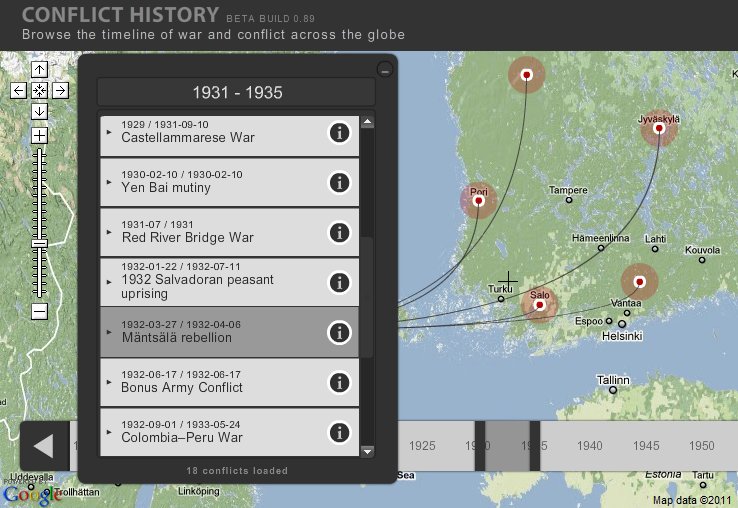
The screencap above shows the significant sites in the Mäntsälä rebellion in Finland in 1932 (no, I’d never heard of it either). Use the slider at the bottom of the screen to choose the time in history, and the map will show you the known conflicts for that period.
April 3, 2011
April 2, 2011
Why the F-22 was not deployed to Libya
I thought the answer to that question was simple: the F-22 is a pure fighter, and there’s no crying need for pure fighters to enforce the no-fly zone that can’t be met with older aircraft. Apparently, it’s a bit more complicated:
Conspicuously absent in the skies over Libya is the new American F-22. Despite modifying the F-22 to operate as a fighter-bomber, the F-22 was uniquely unsuited to operate as part of the international force assigned to stop Libya from attacking its own people. That job requires aircraft that can carry lots of smart bombs. Defeating the Libyan Air Force was not a major chore, and was easily handled by less capable (and cheaper to operate) air superiority fighters. Another problem was communications. The F-22 is not equipped to operate as part of an international aerial armada. The F-22 is a stealthy lone-wolf. Most of the time, the F-22 does not use its radio. To communicate with other F-22s, a special, short-range system is used. The F-22 does not have the full suite of communications equipment most NATO warplanes carry.
[. . .]
The 36 ton F-22 has internal bomb bays, like the F-117, to enhance stealthiness. Thus it can carry two half ton smart bombs, or eight 250 pound SDBs (ground penetrating Small Diameter Bombs) internally, in addition to a pair of air-to-air missiles. However, the F-22 is not yet modified to carry the SDB. The internal bays were originally designed to carry six air-to-air missiles, not bombs. Using the external hard points, which makes the aircraft more visible on radar, an F-22 can carry about four tons of bombs and missiles.
The F-22 has the most advanced radar and electronic warfare gear of any jet fighter. When you include the cost of research and development, each F-22 ends up costing nearly $400 million. But for pilots in certain types of combat, it’s money well spent. But not for what was needed over Libya, where most non-stealthy fighters can carry four or more tons of bombs and missiles.
March 29, 2011
RAF has only 69 qualified pilots for Typhoon fighters?
I’m not sure how an organization which recently performed brilliantly in their bureaucratic and political struggle against their arch-enemies in the Royal Navy can also be this stupid:
Since the conflict began, a squadron of 18 RAF Typhoon pilots has enforced the Libya no-fly zone from an air base in southern Italy. However, a shortage of qualified fighter pilots means the RAF may not have enough to replace all of them when the squadron has to rotate in a few weeks.
The situation is so serious that the RAF has halted the teaching of trainee Typhoon pilots so instructors can be drafted on to the front line, according to air force sources. The handful of pilots used for air shows will also be withdrawn from displays this summer.
The RAF put in a merciless performance in the recent defence review negotiations, eliminating three two aircraft carriers and downing all of the remaining Harrier jets. Perhaps their emphasis on bureaucratic and political in-fighting meant they had no time or energy to train pilots for their shiny new aircraft?
The Government’s decision to decommission HMS Ark Royal, Harrier jump jets and the Nimrod reconnaissance aircraft — all of which could have played a role in the Libya conflict — has exacerbated the problem. Serving RAF pilots contacted The Daily Telegraph to warn of the risks to the Libya operation. “We have a declining pool of pilots,” one said. “There’s less people to do twice as much work. If we are not training any more we are going to run out of personnel very soon.”
[. . .]
Out of 69 qualified RAF Typhoon pilots, including instructors, 18 are in southern Italy flying missions over Libya. Of the rest, 24 are committed to the Quick Reaction Alert protecting Britain’s air space and six are in the Falklands in a similar role. A further six are being used to train Saudi Arabian air force pilots. That leaves only 15 to replace those currently based in Italy.
Because of the intensity of flying on operations, pilots deploy for a maximum of two months at a time and the replacements for those currently enforcing the no-fly zone in Libya will be expected to deploy at the end of next month.
March 27, 2011
March 25, 2011
Libya operations do not support UK’s recent defence decisions
Lewis Page is doing an analysis of the current British involvement in Libya. He points out that many of the recent decisions by the British government are not being proven by the actual pattern of combat:
Recent combat operations by British and allied forces in Libya are beginning to tell us a lot: not so much about the future of Libya, which remains up for grabs, but about the tools one actually needs for fighting real-world wars against real-world enemy armed forces.
The vast bulk of our own armed forces are set up, equipped and focused on this type of mission — rather than the hugely more common one of battling guerillas and insurgents, as seen in Afghanistan — so the Libyan operations of the last week are very important to us at a time of shrinking budgets and worldwide turbulence. Libya is telling us how well the Coalition government did in its recent Strategic Defence and Security Review — and bluntly, it is showing that the Review was a fiasco.
Mr. Page has not been a fan of the Eurofighter, and sees the initial stages of the Libyan campaign as proving the investment is so much wasted money:
. . . highly advanced specialist air-to-air combat capability has not been necessary here. The RAF has rushed Eurofighter Typhoons to Italy — they were the first British aircraft to arrive there, in fact — but they are pure air-to-air planes at the moment (the RAF doesn’t expect to have them properly ready for use as bombers until 2018). The odds are that they will not fire a shot — and if they do it will be to swat down some rusty old MiG flown by a suicidal pilot. For this job, much cheaper fighters would have been more than adequate: say American F-18s or F-16s, or even our previous embarrassing Tornado F3, now retired.
So, point one: buying the Eurofighter remains a stupid idea on our part.
Canada’s F-18 aircraft have seen more combat in Libyan airspace than the RAF’s Eurofighters, because the F-18 has a ground-attack capability.
On the other hand, Mr. Page rejoiced at the overdue decision to scrap the Nimrod, but the ancient-but-terribly-expensive aircraft appear to have a valid role to play in Libya:
Point two: electronic warfare and AWACS planes are useful, even against the minor regimes who we might genuinely fight in the real world. The decision to keep both in the recent UK Defence Review was sensible (the Nimrod R1 Elint planes were marked for the bin — and have been temporarily been reprieved for duty in the Libyan situation — but replacement “Rivet Joint” aircraft are on order).
The use of the Tornado aircraft for very long range attacks seems like a waste of time and resources:
We are told in official announcements that some 112 Tomahawk cruise missiles were used in the initial strike at the weekend, launched from US and British warships and submarines off the Libyan coast. We are also told that “a number” of Storm Shadow shorter-ranged cruise missiles were launched from Tornado bombers. The Tornadoes had flown 3,000 miles from
KentNorfolk to do so, requiring the aid of repeated air-to-air refuelling assistance both on the way out and on the way back.We can be pretty sure what the unspecified number of Storm Shadows was, as the Tornado can carry only one Storm Shadow into combat and we are told that a total of four Tornadoes have been assigned to Operation ELLAMY, the British contribution to the Libyan fighting. Some accounts suggest that in fact only three Storm Shadows were fired in the initial long-range Tornado raid.
[. . .]
Our lesson from a shooting war against a national air force — the first we have fought since 1982 — is that you don’t suppress enemy air defences of the sort you actually meet in the real world with deep penetration bombers and clever air-launched weapons (far less with stealth planes). You do it with AWACS and Elint planes and Tomahawks launched from the sea.
And speaking of the sea . . . what about the Royal Navy contribution to the Libya campaign?
Don’t we just wish we had a carrier off Libya now? Shame we scrapped ours just months ago. Nice work, Mr Cameron
There can be little doubt that the Harrier would also have been better for Libya. The Harrier fleet actually had more aircraft modernised to drop the latest smart weaponry — it was a superior battlefield strike plane — and it was cheaper to run. Best of all, it could operate from our also-recently-axed pocket aircraft carriers right off the coast and thus reach the theatre of action in minutes rather than hours. France and the USA both have carriers operating off the Libyan coast right now, but our foolish decisions in the recent review have left us on the sidelines.
Mr. Page still thinks the Royal Navy got royally shafted by the RAF:
Point four: The decisions taken over many years to whittle down the Harrier force to the point where it was barely viable – and then finally axe it in the Review — were totally wrong. Instead the Tornado should have been scrapped. Our present-day fleet of more than 130 of these cripplingly expensive-to-run, slow, lumbering low-altitude jets, assisted by similarly costly tanker planes, has offered us an utterly pathetic capability to deliver three or four dodgy missiles into Libya and a minimalist air support capability thereafter.
Even by the time of the Review, when the Harrier fleet was down to an almost unviable 44 jets, it would have made more sense to keep them, scrap the Tornado and buy or lease some nice cheap F-18s from America to bulk up our strike forces somewhat. The RAF should be ashamed of itself for manipulating the Prime Minister into keeping Tornado; heads should roll.
Is it too late to save the Ark Royal and Invincible? Yes:
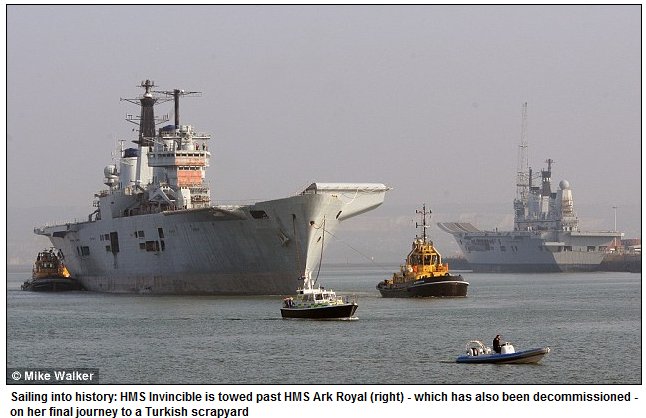
To make the situation even more pathetic:
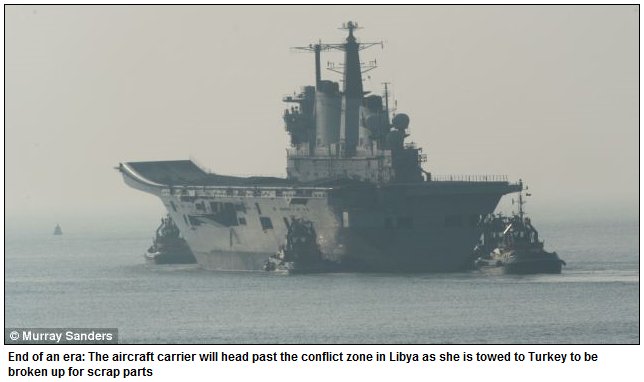
Once, this would have been a sight to strike fear into the hearts of any enemy fleet, a vivid portrait of the naval clout of this island nation.
But, today, these are two ghost ships. This depressing photograph taken yesterday is merely a reminder of the current state of the Royal Navy. Until recently, Britain had three aircraft carriers. The latest round of defence cuts means we have just one carrier — HMS Illustrious — and no planes on board. It only does choppers these days.
Invincible is bound for the Middle East. But Colonel Gaddafi need have no fears about this gallant old warhorse. In a few days’ time she will be off the coast of Libya but she won’t be stopping. She’ll be pressing straight on for Turkey where she is due to be cut up — or ‘recycled’ as an MoD spokesman insisted yesterday.
Back to Mr. Page’s conclusions (not that there should be any surprises based on the examples I’ve included):
Summing up, the lesson of Libya is that the recent Defence Review was, indeed, a dismal failure. RAF empire-preservation saddled us with the useless Tornado at the cost of our carrier capability. The army insisted on preserving pointless tanks and big guns and as a result we are not pulling our weight in Helmand — a war we more or less unilaterally started in 2005 — and we have no option to intervene on the ground in Libya seriously.
The navy made no real effort to help matters. It might have managed to preserve a carrier capability by making concessions on its pointless frigate flotilla, but this it refused to do.
[. . .]
But the chance to change things is not gone yet. So badly fudged were the Strategic Defence and Security Review’s figures that more reorganisation remains on the cards; in effect, a review of the Review is now very likely. The chance is still there to scrap the cripplingly expensive Tornado and Eurofighter altogether and replace them with cheap, excellent F-18s — so getting our carrier capability back in just a few years, as well. When the F-35C actually becomes affordable at last around 2025 we can buy some — by that point its Stealth and other new technologies might actually be becoming relevant for wars that might really happen, along the lines of Libya.
March 23, 2011
March 22, 2011
March 21, 2011
Colby Cosh: “is it quite all right for a news agency to have its own army?”
I was surprised to find that al-Jazeera’s coverage of the Egyptian uprising was of much higher quality than that of more traditional western news sources. Colby Cosh also thought al-Jazeera far exceeded the efforts of CNN and Fox News, among others:
. . . al-Jazeera seemed, for a moment, to be living up to its promise as a bridge between the Arab world and the West — if not transcending that promise and becoming something greater; a tribune of the Arab peoples and their neighbours; an influential, omnipresent witness of precisely the sort that the students in Tiananmen Square lacked; and, perhaps, one of the world’s essential institutions of news.
That potential is still there. The world is certainly a very much better place with al-Jazeera than without; it would be better still with five al-Jazeeras. But the time has come to raise a abstruse, nitpicky ethical point that reflects back on some of the Western journalists who have gone to work for al-Jazeera, and some of the Western leaders who have praised it so effusively. It’s this: is it quite all right for a news agency to have its own army?
I ask because it is a little difficult to disentangle al-Jazeera, which is owned by the Qatar Media Corporation, from the autocratic Qatari state. Sheikh Hamad bin Khalifa al-Thani is as nice as absolute dictators get — a man arguably in the tradition of the enlightened despots of Europe’s quite recent past, who shared outstanding personal qualities, a common commitment to education and equality, and a dedication to advancing liberal ideals, albeit by undemocratic means. It’s traditional, in enlightened autocracies, for the required oppression to officially be deemed temporary, and for this pretence of temporariness to be kept up at all costs. Official U.S. sources, keen on avoiding offence to an important ally, advance Qatar’s claim to already be a “constitutional monarchy”.


