
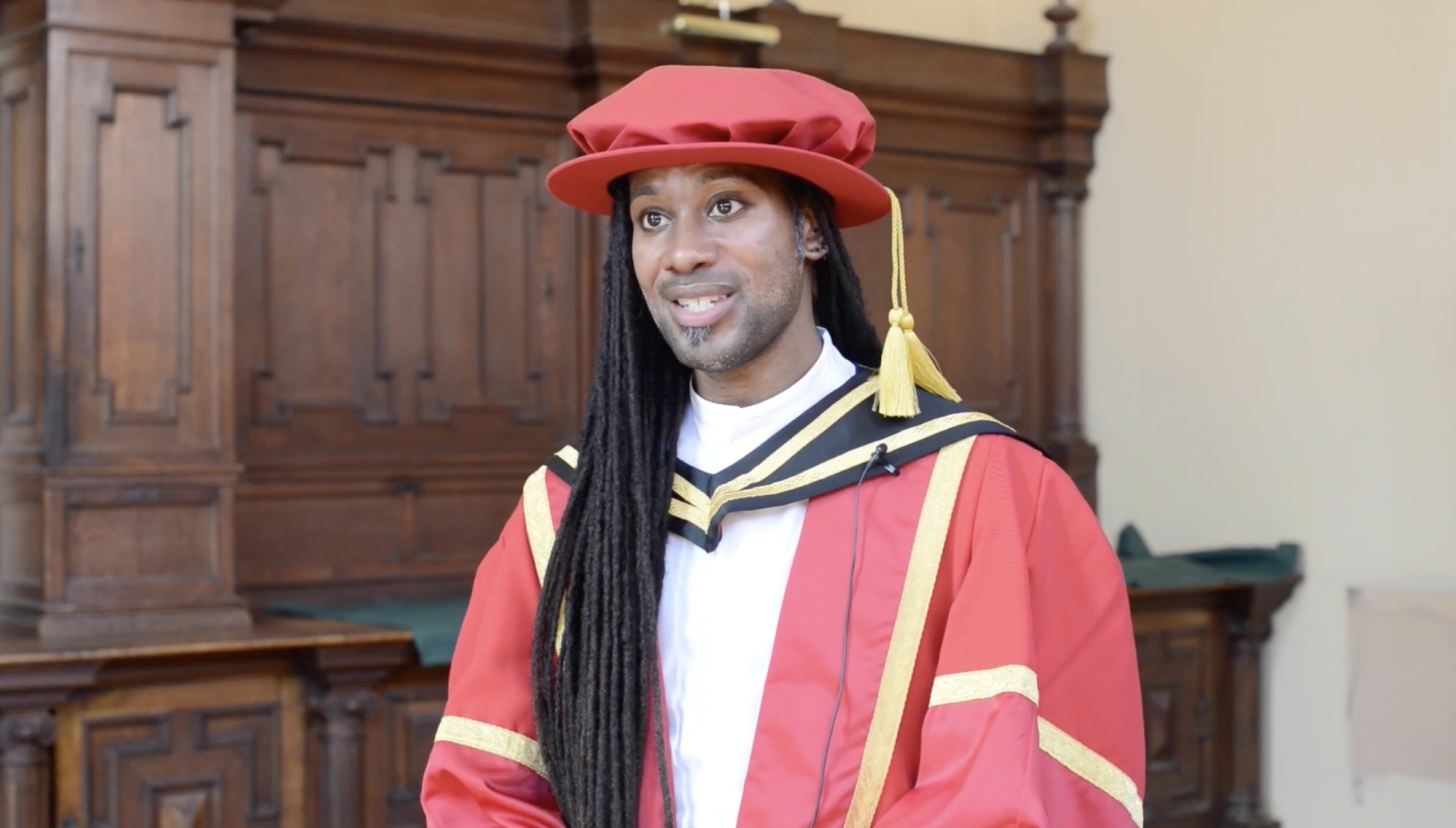
The Jason Arday affair has only just drifted into my view, but it seems utterly fascinating that a young man with such a … varied and colourful personal history … has risen to be the youngest black professor at Cambridge. His backstory is (probably) too perfectly aligned with progressive worldviews to be true:
Cambridge professor Jason Arday
Image from Andrew DoyleJason Arday’s improbable claims have turned him into a Walter Mitty for our times. As the youngest black person ever to be appointed a professor at the University of Cambridge, there are good reasons why those who have championed him are rushing to his defence. But with each passing day, new revelations of his slippery relationship with reality seem to be emerging.
As with many fabulists, it is difficult to know where the truth ends and the fiction begins. Some of Arday’s boasts are quite obviously false. For instance, nobody believes that he completed the last nine of thirty consecutive marathons with a fractured leg that had swollen “to twice its normal size”. Or that he appeared in the television series Seven Up! as a child, even though its participants were selected in 1963 and Arday was born two decades later.
Other claims might well be embellishments on kernels of reality. No doubt he has raised money for charity, but it seems highly unlikely that his vaunted sum of £5.5 million is accurate. We know that he played snooker, but his assertion that he did so professionally would carry more weight if someone on the circuit had heard of him. Few would dispute that Arday is a keen amateur athlete. But if his claim to have run six hundred miles in six days were true, that would place him among the world’s elite sportsmen.
Perhaps most serious of all are the accusations of plagiarism. Cambridge has been quick to dismiss the matter, stating that an investigation has already been conducted by Liverpool John Moores University, where Arday completed his PhD thesis, and no evidence of plagiarism was found. Many readers who have compared the relevant passages side by side have reached a different conclusion. Numerous examples have been collated by Nathan Cofnas and can be seen here.
The refusal of the authorities at Cambridge to investigate the allegations properly has naturally raised suspicions that Arday is being protected because he is the poster boy for DEI. If it is true that he was raised on a council estate, diagnosed with autism at the age of three, first spoke at the age of eleven, and learned to read and write at eighteen, then his success story is unparalleled. Yet plagiarism is an extremely grave matter for an academic, and the evidence is difficult to dismiss.
The failure to hold Arday to the same standards as anyone else is, of course, a soft form of racism …
On Substack Notes, Michael Southron says he’s getting a strong Jussie Smollet vibe from this story:
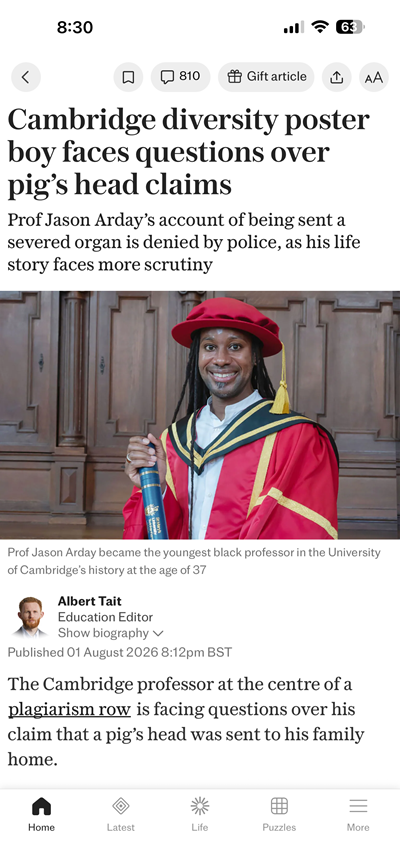
The Jason Arday affair is beginning to remind me of Jussie Smollett.
Not because we know that Arday fabricated anything. We don’t. But because of the strange self-protecting logic that surrounds allegations of racism.
Smollett’s story was initially believed because it fitted so perfectly with what many people already believed about America: a black, gay actor attacked by racist, homophobic Trump supporters. The allegation seemed almost to validate itself.
Something similar is happening with Arday.
He says a severed pig’s head was sent to his family home. Yet police can reportedly find no record of the investigation he described. The butcher he said police visited says no officers ever came. There are apparently no photographs or contemporaneous messages.
He also says a masked man twice entered his Cambridge faculty building and threatened him, on one occasion with a knife. Yet the man was apparently captured by no CCTV, seen by no colleagues, and Arday reportedly warned nobody in the building at the time.
“To be honest with you, I thought you’d just believe me,” Arday told the Guardian. “Why would I lie?”
That sentence may be the most revealing part of the whole affair.
Because questioning Arday’s claims now risks being folded into the very narrative those claims are supposed to establish.
Arday says he has been targeted because of racism. Questions are raised about the evidence for his claims. Those questions are then portrayed as part of a “vile campaign” against him — which becomes further evidence that he is being targeted.
The allegation begins to protect itself.
He is a victim of racism, therefore questioning his account may itself be racist; and because questioning his account may be racist, his claim to be a victim of racism receives less scrutiny.
It is a perfect circle.


