Quotulatiousness

January 31, 2026

“… nations are what Kurt Vonnegut would call a ‘granfalloon'”

Filed under: Economics, Europe, History — Tags: , , , , , , , — Nicholas @ 05:00

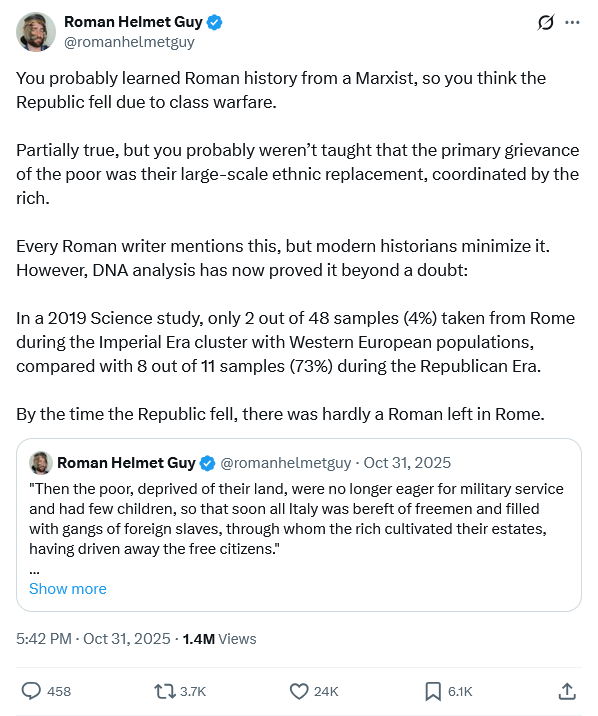
On the social media site formerly known as Twitter, Devon Eriksen responds to an older tweet about the replacement of “original” Romans during the Republic with other ethnicities over the course of the Empire:

Any time a nation allows slavery, de jure or de facto, the business owning class immediately tries to replace the working class with slaves.

If they succeed, the nation collapses and everyone dies. A nation cannot survive if it’s populated by slaves.

Why?

Because nations are what Kurt Vonnegut would call a “granfalloon” … his word for an association that only exists because people believe in it.

Now Vonnegut, who was a liberal and therefore wrong about everything important, meant to mock the concept of nations and tribes by coining this term. He believed them to be unnecessary throwbacks to humanity’s primitive past … a delusion he was able to sustain because he never had to try existing without one.

Granfalloons are indeed arbitrary — you could base them on anything — but humans cannot survive without them. Because humans are a pack animal.

If you drop your cat off somewhere in the woods at night, assuming he is a healthy and physically fit cat, he will likely survive, regardless of his unhappiness at the sudden deficiency of chin scratches and clean laundry to sleep on.

Try that experiment with your dog, and he’ll die.

Why? It’s not because cats are smarter than dogs. They’re about the same.

It’s because cats are not a pack animal. A cat doesn’t need other cats to survive. The basic unit required to execute all cat survival strategies is one cat.

Dog survival strategies work just fine, too, but they require multiple dogs. A lone dog will die because he cannot execute his survival strategies by himself.

And so it is with humans.

The great error of the classical liberal worldview is that, because history is full of tribes fighting wars over scarce resources, that it was the tribes, not the scarcity, that caused conflict.

So they decided they were going to get rids of tribes, and nations, and religions, all the granfalloons, and just glue everything together with economics. And there would somehow be world peace.

Kurt Vonnegut was a dreamer.

Unfortunately for all of us, he was not the only one.

So the experiment was carried out, and in every single place it was carried out, things got observably, obviously worse. Sometimes “gosh the boomers had it way easier than us” worse, and sometimes “what shall we do these corpses, Comrade Commissar” worse, but always worse.

Because economic incentives alone cannot hold a society together.

Economic incentives, without ethnic or cultural solidarity, get you nothing but massive robbery and fraud.

It’s why the Biden Administration let millions of third world savages into America. It’s why Proctor and Gamble sells you poison food, and why the American Heart Association takes their money to lie to you and say it’s healthy. It’s why every product you buy, from your Tesla to your laptop to your security camera system, tries to spy on you and control how you use the thing you paid for and theoretically own. It’s why you’ve never held the same job for more than three years, because they either laid you off or gave you two percent raises every year until you had to find a new company to pay you what you’re actually worth.

When there is no granfalloon, there is no incentive not to cheat. And no, fear of punishment doesn’t work. The police cannot arrest, try and convict everyone. And when there is no granfalloon, the enforcers themselves have no incentive to actually perform, instead of looking just busy enough to get paid, or taking bribes to look the other way.

An atomized group of individuals, unconnected by a granfalloon, have no morality, because morality isn’t something an individual has. It’s something a tribe has, because what the word “morality” actually means is the system of behavior that tribe members display towards each other.

A slave has no morality. He has no sense of responsibility, not only for the nation, not only for his masters, but even for his fellow slave. He is homo economicus, the man who responds purely to incentives of reward and punishment.

A slave has no granfalloon.

Kurt Vonnegut famously wrote “If you wish to examine a granfalloon, just remove the skin of a toy balloon.” By which he meant that such associations are nothing but a puff of air, and therefore unimportant.

But having been surrounded by air all his life, in abundant supply, Kurt had forgotten that air is important.

You need it for breathing.

Try removing the skin of a SCUBA tank.
A new homily from Saint Hillary

Filed under: Media, Politics, USA — Tags: , , , , , — Nicholas @ 04:00

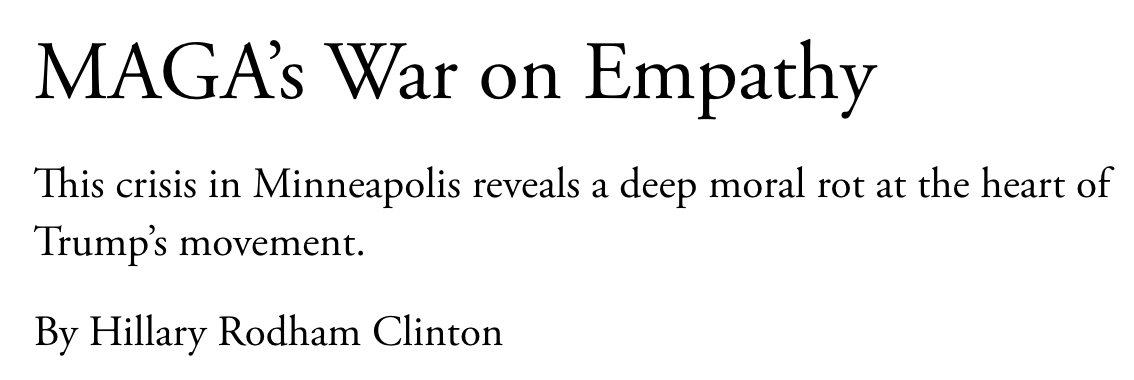
Chris Bray fondly remembers how the late Michael Kelly pin-pointed the moral character of Hillary Clinton very early in the first Bill Clinton term, where he named her “Saint Hillary”. She’s back in her bully pulpit again:

It’s a moral lecture on the true meaning of Christianity from Hilly Rodham Clinton, from Saint Hillary. All credit to Michael Kelly: Mrs. Clinton is still struggling with words. This is as dull a performance of narrative ineptitude as a human thing could possibly manage without actually turning into Tom Nichols:

    That compassion is weak and cruelty is strong has become an article of MAGA faith. Trump and his allies believe that the more inhumane the treatment, the more likely it is to spread fear. That’s the goal of surging heavily armed federal forces into blue states such as Minnesota and Maine — street theater of the most dangerous kind. Other recent presidents, including Joe Biden, Barack Obama, George W. Bush, and Bill Clinton, managed to deport millions of undocumented immigrants without turning American cities into battlegrounds or making a show of keeping children in cages.

    “The cruelty is the point,” as The Atlantic‘s Adam Serwer memorably put it during Trump’s first term. The savagery is a feature, not a bug. By contrast, as Serwer noted recently in these pages, the people of Minnesota have responded with an approach you could call “‘neighborism’ — a commitment to protecting the people around you, no matter who they are or where they came from”. To my ears, that’s as Christian a value as it gets.

First you notice the complete failure to land the facts, like the one about the way Barack Obama deported lots of people, but he didn’t make a show of keeping children in cages. The Obama administration built the cages, and this isn’t obscure. Similarly, and obviously, all those other presidents didn’t turn American cities into battlegrounds because no one fought against deportation during their terms. Nor have the Trump administration’s ICE operations turned “American cities” into battlegrounds. Dallas isn’t. Miami isn’t. The cities that are battlegrounds are cities where organized left-wing activism has manufactured a series of battles. Does Hillary Clinton notice that some cities are battlegrounds, but many cities are not? She most assuredly does not. It doesn’t help her to notice that, so her mind omits it. More box wine, and then more typing.

But since we’re talking about an argument made by Hillary Clinton, never mind about mere facts. Start with the fact that these are back-to-back paragraphs. First paragraph, assurance that previous administrations “managed to deport millions of undocumented immigrants”. Next paragraph, depiction of resistance to deportation as “a commitment to protecting the people around you, no matter who they are or where they came from”. How does one square a depiction of Clinton-era mass deportations as reasonable behavior with the placement of organized resistance to deportation under the umbrella of “neighborism”, real Christianity, and more specifically how does Hillary Clinton explain how she squares those opposing things? Short answer: She doesn’t even notice she’s done this. She doesn’t know there’s anything to square. She’s making word-sounds. She has no idea what any of it means.

Several decades ago, Michael Kelly told us that Hillary Clinton didn’t hear herself at all. And I still miss Michael Kelly. Hillary speaks, but she doesn’t listen. She half-absorbs events and the lives of other people, and coughs out a kind of instinctive Reader’s Digest annotated version, but mangles all the details as efficiently as bad AI. I could go on about this at great length, showing paragraph by paragraph how she misrepresents and misunderstands everything she discusses. Her discussions of toxic empathy and the ordo amoris show with great plainness that she doesn’t have the foggiest idea what the most basic outline of the discussion might be. But “the message of the preacher” persists, rising out of the least appropriate messenger you could ever ask for an essay on moral decency.

You have to give her credit. It can’t be easy to play a vampire for four straight decades.

Only one comment, Mr. Bray: she’s not playing.

Update, 2 February: Welcome, Instapundit readers! Have a look around at some of my other posts you may find of interest. I send out a daily summary of posts here through my Substackhttps://substack.com/@nicholasrusson that you can subscribe to if you’d like to be informed of new posts in the future.

La trahison des comédiens (The treason of the comedians)

Filed under: Britain, Media, Politics — Tags: , , , , , — Nicholas @ 03:00

In the above-the-fold portion of this post, Andrew Doyle points out that it’s the comedians who should be leading the charge to ridicule the excesses of the powerful, yet they shrink from their cultural duties and avoid offending those who most need to be taunted:

Holly Valance is an unlikely satirist. Yet the pop singer’s latest track, “Kiss Kiss (XX) My Arse”, takes aim directly at the pretence that human beings can change sex, and that a man need only declare himself a woman for it to be true. Upon its release the song immediately reached the top of the iTunes bestsellers chart, only to be swiftly deleted by Apple Music. Valance had committed the cardinal sin of ridiculing the establishment.

The song is based on Valance’s 2002 number one hit “Kiss Kiss”, now reworked with new lyrics for Pauline Hanson’s animated satire A Super Progressive Movie. This is the song’s opening verse:

    They say that I’m a he but I’m a she,
    Cos I gotta V and not a D,
    And I don’t care what people say,
    I’ll never be a him or them or they.

Unsubtle? Perhaps. But let’s not forget that its target is the least subtle ideology that has ever been birthed. This is satirical mimesis; the essence of parody. For Apple Music to delete the track (only to reinstate it after multiple news outlets drew attention to the deletion) surely proves Hannah Arendt’s point that the “greatest enemy of authority” is “contempt, and the surest way to undermine it is laughter”.

It is an indictment of the state of the comedy industry that pop singers are left to do the work of comedians. Television panel shows are now bland affairs thanks to the sheer lack of courage on display. The woke movement represents one of the most authoritarian, intolerant and illiberal developments in the recent western world. It demands conformity, peddles fantasy at the expense of truth, and punishes freethinkers. And yet most of today’s comedians are eager to prop it up rather than see it tumble.

They are called “regime comedians” for good reason. They have willingly turned themselves into cheerleaders for the powerful, bolstering those who have bullishly set the agenda, or – as the satirist Chris Morris once put it – “doing some kind of exotic display for the court”. It is a great shame that so many of Morris’s former collaborators now fall squarely into this category.

To put this cowardice into perspective, consider the example of the satirical magazine Charlie Hebdo. Just one year before he was gunned down by Islamic terrorists, the cartoonist and editor-in-chief Stéphane Charbonnier (known as “Charb”), was profiled in Le Monde. Was he not worried, the interviewer asked, about possible reprisals for drawing cartoons of Mohammed? For his answer, he paraphrased the Mexican revolutionary Emiliano Zapata: “I would rather die standing than live on my knees”.

If a man like Charb refused to back down from criticising an oppressive ideology – in spite of the death threats he received on a daily basis – why is it that so many of our comedians are too afraid to tackle the woke? These activists may talk tough online, but in real life they are about as intimidating as a sea sponge. While the impulse to preserve a mainstream career is understandable, it does suggest a lack of genuine vocation if that means ignoring the target that is most in need of skewering.

WW1: Hell in the Trenches | EP 4

Filed under: Britain, France, Germany, History, Military, WW1 — Tags: , , , — Nicholas @ 02:00

The Rest Is History
Published 4 Sept 2025

What happened at the crucial, bloody, Battle of Ypres in October 1914? How did the battle come about? Why did the Germans and the British fight each other so brutally and for so long to take Ypres? What made the fighting so particularly violent? How were the British able to repel the relentless German onslaught time after time? What was the famous “Kindermord” — “the Massacre of the Innocents” — in the German army, and how true was it? And, what would be the outcome of this almighty clash?

Join Dominic and Tom as they discuss the terrible Battle of Ypres; its significance to the First World War overall, and its consequences for the rise of Hitler in Germany later on….

0:00 – Adobe Express AD
0:49 – Intro: To the Front
3:26 – The Kindermord Myth
5:02 – Race to Ypres
11:04 – The Ypres Salient
17:07 – Crisis at Gheluvelt
23:29 – Uber & Folio Society ADs
25:43 – November Slaughter
32:05 – The Langemark Legend
44:02 – Why the War Didn’t Stop
(more…)

QotD: Liberal principles according to Karl Popper

Filed under: Government, Liberty, Quotations — Tags: — Nicholas @ 01:00

As usual when Popper addressed a meeting, his aim was to challenge and provoke thought, rather than simply endorsing the assumptions that he shared with his audience. […] It may help to start with a summary of the liberal principles that Popper spelled out in section 3. This will be helpful for a general readership (unlike the Mont Pelerin meeting) where there are likely to be many people who do not hold non-socialist liberal principles and some who are not be clear about what these principles are.

(1) The state is a necessary evil and its powers should be kept to the minimum that is necessary.

(2) A democracy is a state where the government can be changed without bloodshed.

(3) Democracy cannot confer benefits on people. “Democracy provides no more than a framework within which the citizens may act in a more or less organised and coherent way.”

(4) Democracy does not mean that the majority is right.

(5) Institutions need to be tempered and supported by traditions.

(6) There is no Liberal Utopia. There are always problems, conflicts of interests, choices to be made between the lesser of evils.

(7) Liberalism is evolutionary rather than revolutionary. It is about modifying or changing institutions and traditions rather than wholesale replacement of the existing order. The exception to this is when a tyranny is in place, that is a government that can only be changed by violence and bloodshed.

(8) The importance of the moral framework.

“Among the traditions that we must count as the most important is what we may call the ‘moral framework’ (corresponding to the institutional ‘legal framework’) of a society. This incorporates the society’s traditional sense of justice or fairness, or the degree of moral sensitivity that it has reached … Nothing is more dangerous than the destruction of this traditional framework. (Its destruction was consciously aimed at by Nazism.)”

Rafe Champion, “Summary and commentary on a paper on public opinion and liberal principles delivered by Popper to the Mont Pelerin Society”.

Powered by WordPress