
Quotulatiousness

January 28, 2026

An ADA unintended consequence in Los Angeles

Filed under: Government, Law, USA — Tags: , , , , , — Nicholas @ 05:00

I’ve heard many people refer to the Americans with Disabilities Act as the worst piece of legislation in US history, and stories like this one make it easy to agree:

Los Angeles’s streets are in notoriously bad shape. Fewer than two-thirds are considered in a state of good repair, according to the city’s Department of Public Works. Broken sidewalks have spawned years of costly litigation, and Los Angeles pays out millions of dollars each year to drivers whose cars are damaged by potholes.

Many cities would see this situation as a mandate for change. And Los Angeles has indeed made a change: last summer, the city quietly stopped repaving its streets. Not slowed. Not fell behind. Stopped completely.

The Bureau of Street Services (StreetsLA) has not repaved a single street since last June, and the city’s latest budget practically zeros out repaving for next fiscal year. StreetLA crews are still doing some road repairs, fixing potholes and patching problem areas. But the most basic form of urban maintenance — full street resurfacing — has all but disappeared in America’s second-largest city.

Why has Los Angeles stopped repaving its streets? The answer, it turns out, has to do with federal disability rules that, paradoxically, have made fixing roads legally riskier than letting them fall apart. Though well-intentioned, L.A.’s shift shows how such policies can unintentionally worsen urban quality of life.

The clearest explanation of the city’s shift comes from L.A.–based housing and transportation advocate Oren Hadar. Digging through budget documents and engineering classifications, Hadar explained in an essay from late last year that the city didn’t necessarily abandon street work so much as reclassify it out of existence.

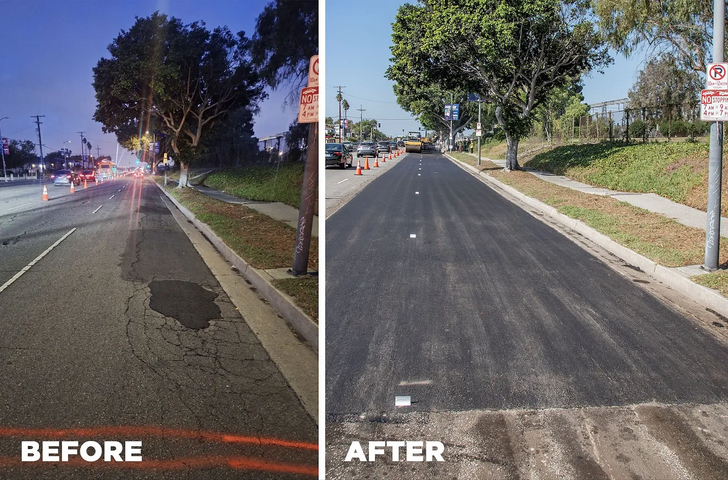
The city seems to have invented a new category of repair specifically designed to avoid triggering costly federal accessibility mandates. Instead of repaving streets, StreetsLA now performs what it calls “large asphalt repairs”. As Hadar explained, these repairs address localized damage — areas larger than a pothole but smaller than full resurfacing. Essentially, the city repaves only part of a street rather than the entire width, as shown below.

A “large asphalt repair” on L.A.’s Century Boulevard. Courtesy: StreetsLA on X

But, as Hadar wrote, “the thing about large asphalt repair is that it’s … not a real thing. It appears to be a term made up by the city some time in the last year.”

Why invent a new classification? The reason lies in federal disability law. Under regulations implementing the Americans with Disabilities Act, when a city alters a street, it must also bring associated pedestrian infrastructure into compliance. That means installing ADA-compliant curb ramps at every intersection along the way.

Repaving is considered an alteration that triggers these requirements. Maintenance activities, such as filling potholes or making minor repairs, are not. The city claims that large asphalt repairs are “pavement maintenance activity” and therefore do not require ADA upgrades.

That distinction carries enormous financial and logistical consequences. Hadar found that each curb ramp costs roughly $50,000, totaling about $200,000 per intersection. With roughly ten intersections per mile, curb ramps alone can add around $2 million per mile to the cost of repaving — a figure that often exceeds the cost of the asphalt itself. Design and construction typically take 9 to 12 months per ramp, and federal rules require the ramps to be completed by the time the street is resurfaced.
Update, 29 January: Welcome, Instapundit readers! Have a look around at some of my other posts you may find of interest. I send out a daily summary of posts here through my Substackhttps://substack.com/@nicholasrusson that you can subscribe to if you’d like to be informed of new posts in the future.

The Korean War Week 84: Inside Truman’s Diary – January 27, 1952

The Korean War by Indy Neidell
Published 27 Jan 2026

Things heat up in the Panmunjom Peace Talks, which each side arguing that the other side’s proposals violate the Geneva Convention, but by the end of the week they talks are in recess. Naval aircraft pound the North Korean infrastructure all week long, though, and US President Harry Truman has a few things to say about the Soviet Union that the world may wish to hear.

00:00 Intro
00:51 Recap
01:29 Repatriation and Parole
05:29 Airfields
07:22 Naval Aircraft Get Busy
10:36 Truman’s Diary
11:42 Summary
(more…)

Update your NewSpeak dictionaries: “digital twin”

Filed under: Media, Technology — Tags: , , — Nicholas @ 03:00

On his Substack, William M Briggs introduces us to a new coat of paint and fresh marketing polish to encourage us to feel so much more comfortable with clankers:

Cracker Barrel infamously tried changing their homey friendly warm and folksy logo to a stripped down dull almost monotone cool version. To remain “current”. They also, reports say, redid the insides of restaurants to emulate modern real estate Soviet-inspired ideas of stripping all detail and turning everything monotonous shades of suicide-inducing gray. They thought this would increase business.

Scientists, grown weary with their dull old ways, and wanting to stay hip — do they still say hip? — decided to redesign their logo, too, as it were. Only they didn’t make the same mistake Crack Barrel did. Instead of hiring some ridiculously over-priced longhoused consulting firm, they asked computer scientists to do the redesign.

Brilliant!

Computer scientists are the firm that brought us neural nets, machine learning, genetic algorithms, and, yes, artificial intelligence, which they cleverly capitalized as “AI”. What’s fantastic is all these evocative names represent the same thing! Models (basically non-linear regressions with some hard coded rules thrown in).

Used to be computer guys would trot out a new name only after they sensed the old one had lost its shine. But “AI” has not. The bubble daily swells. It still tickles imaginations. Which means computer guys hit upon a real innovation: they invented a new name while the current one still shines.

Digital Twin.

What is a Digital Twin? It is, like every new name invented by computer scientists, a model. Only now AI “creates” or “builds” the model. In other words, a Digital Twin is a model of a model.

Where might we find Digital Twins? Here’s some happy-talk hype examples.

Siemens:

    Outperform your competition with a comprehensive Digital Twin

    Leverage the comprehensive Digital Twin to design, simulate, and optimize products, machines, production, and entire plants in the digital world before taking action in the real world. This helps manufacturers to tackle industry’s biggest challenges: mastering complexity, speeding up processes, and improving sustainability overall.

IBM:

    What is a digital twin?

    A digital twin is a virtual representation of a physical object or system that uses real-time data to accurately reflect its real-world counterpart’s behavior, performance and conditions.

McKinsey:

    What is digital-twin technology?

    A digital twin is a digital replica of a physical object, person, system, or process, contextualized in a digital version of its environment. Digital twins can help many kinds of organizations simulate real situations and their outcomes, ultimately allowing them to make better decisions.

In other words, models. But how tediously banal is models? Try and sell a model. IBM: “Let us build a model of your system, which might provide useful predictions.” Doesn’t sing. Doesn’t entice. Doesn’t scream premium price. Try this instead: “Be the first to adopt our AI-designed Digital Twin which gives AI insights.” Now you can charge real money.

Digital Twin reeks of excitement. So much so, you just know academics will be getting in on it.

The Best Operational Briefcase: American 180 & Laser Sight

Filed under: History, USA, Weapons — Tags: , , — Nicholas @ 02:00

Forgotten Weapons
Published 5 Sept 2025

The “American 180 Security Briefcase” is the best execution of the operational briefcase concept that I have yet seen. The idea is simple; hide a submachine gun inside an ordinary looking briefcase so that it can be carried in the open by VIP security without arousing attention. Sometimes this is done strictly for stowage (see the Uzi coming out of a Secret Service briefcase during the attempted Reagan assassination) and sometimes it is designed to fire from within the case (see the H&K MP5 operational case). This one is meant for firing.

Unlike virtually all other such cases, this one includes a sight, a helium-neon laser. That allows the gun to be actually aimed — what an idea! The firing mechanism is also well thought out, with a manual safety switch that powers the laser and firing solenoid, then a constant-pressure switch for the laser and a pressure pad for the gun. I don’t know who made this, but it was a commercially available product … and a very cool one at that!
(more…)

QotD: 21st century generation gap

Filed under: Media, Quotations — Tags: , , — Nicholas @ 01:00

I am Gen X, which means that a whole generation separates me from Gen Z, the youth generation of today. Gen Z grew up in a world that was networked to the hilt, where everything was already on the internet, and where the “meatspace” had already begun to lose its central role in human socialization. This is a generation that has grown up facing electronic screens, to the point where eye contact is in retreat when Gen Zers actually do encounter real humans in person. Their understanding of media, and more importantly, media consumption, is very different than mine. I like to make the joke (and it’s not really a joke as it has happened to me several times) that if you ask someone from Gen Z to explain something to you in a simple fashion, they won’t respond with a one or two line description, but will instead send you a link to a 4 hour podcast that kinda-sorta touches on the subject. Gen Z is the first truly online generation.

Niccolo Soldo, “Saturday Commentary and Review #197”, Fisted by Foucault, 2025-10-25.

Powered by WordPress


