Quotulatiousness

January 19, 2026

British Islamists scare Islamic governments more than the British government

Filed under: Britain, Education, Government, Religion — Tags: , , , , , — Nicholas @ 04:00

In Spiked, Rakib Ehsan discusses the recent efforts by the governments of some Gulf states to limit potential radicalization of their own people by reducing support for students attending British universities:

Flag of the United Arab Emirates (UAE)

In yet another blow to Britain’s reputation on the global stage, the United Arab Emirates (UAE) has curbed state funding for its citizens seeking to enrol at UK universities, over concerns they will be radicalised by Islamists.

As reported in the Telegraph last week, the Gulf state has taken this drastic step because of the influence in the UK of the Muslim Brotherhood – a transnational Sunni Islamist organisation, which is a designated terror group in the UAE. It is also banned in Egypt, Saudi Arabia and Jordan. The UAE has long offered Emirati students generous grants – including rent and living allowances – for studying “priority” subjects at British universities. These scholarships have now ended because, according to a source quoted in the Telegraph, “the UAE doesn’t want its kids to be radicalised on campus”.

This is not the first time that the UK has been embarrassed for being a soft touch on Islamism by a Muslim country. In January last year, the UAE placed eight UK-based organisations on its local terror list on the grounds of their alleged connections to the Muslim Brotherhood. Most of these entities, which range from property firms to video-production outlets, are registered in London. Then, in April, the head of the Muslim World League, Saudi Arabia’s Sheikh Mohammad bin Abdulkarim al-Issa, warned that the UK should treat poor integration as a national-security issue. He said that young British Muslims had grown disillusioned because of conflicts in the Middle East, advising the UK that “a political situation outside should not interfere with integration inside”.

The UAE’s latest decision should hardly come as a surprise. Indeed, for some time, British universities have embraced the very extremism that Muslim-majority countries have long sought to root out.


Regulating the clankers

At the Foundation for Economic Education, Kevin T. Frazier and Antoine Langrée consider how artificial intelligence can be regulated by state and federal bodies:

Yes, I’m still 12

President Donald Trump’s executive order on artificial intelligence invites analysis of a question so complex that it rarely gets asked: “What exactly do states have the authority to regulate?”

The current, somewhat trite answer is, “The residuary powers reserved under the Tenth Amendment”. Omitting the legalese, that means that states can do whatever the federal government cannot.

States have the power to look out for the health, safety, and welfare of their residents. Thus, for instance, they have the power to address local concerns through zoning laws, professional certifications via licensing regimes, and ensure public safety through law enforcement. These authorities make up what’s often referred to as a state’s “police powers”.

While this generic reading of state power is not necessarily wrong, it’s imprecise. As the AI Litigation Task Force created by Trump’s EO starts its work, a more specific answer is warranted.

The task force is charged with challenging “unconstitutional, preempted, or otherwise unlawful State AI laws that harm innovation”. Reading between these lines, its mission is to contest state laws that interfere with the Administration’s vision for a national AI policy framework. This isn’t an unlimited charge, though. Federal courts reviewing state laws will only strike them down if they fail to align with the Constitution’s allocation of authority or otherwise prove unlawful.

Many stakeholders in AI debates liberally interpret the authorities afforded to states. Based on concerns of existential risk to humanity and the idea that states must protect the health of their citizens, state legislators have proposed and enacted laws that impose significant obligations on the development of AI. Some assume they must have this right, since protecting the lives of their residents is a core priority and unquestioned authority of state governments. After all, since the founding, states have been able to enforce quarantines out of a concern for public health — aren’t aggressive AI laws just extensions of such public health measures, but tailored to the threat of modern threats?

It’s not that simple. States’ police powers are reasonably broad, but not unlimited. States must respect both an upper bound — the purview of enumerated powers reserved for federal authority — and a lower bound—the rights retained by the states’ citizens. These constraints have been tested in litigation throughout our Constitution’s history, notably when state law conflicts with the federal government’s exclusive authority over interstate commerce and when states unduly limit the freedoms of their residents.

These notions are relatively blurry and highly contextual. As national regulatory policy evolves, so too does the extent of preemption. The Lochner era, for example, was a paradigm shift for state police power: as courts expansively interpreted the individual liberty to contract, states’ police power over health, labor protections, and market regulation shrank significantly — only to be restored later. Likewise, individual liberties and valid justifications for their abridgment have evolved to fit developments in civil rights law — from Brown v. Board to Dobbs and Lawrence.

Despite these significant changes in context, the constitutionality of states’ exercise of their police powers follows a bounded framework. This can be observed in the jurisprudence on public health measures — a prime example of police powers. Quarantine orders, from nineteenth-century epidemics to Covid-19, have a direct link to protecting local communities — one of the most important elements of state police powers. They respect the upper and lower bounds of police powers. First, they are geographically specific: they only affect local residents or people coming into local communities. Second, they directly reduce the risk to state residents: quarantines are known solutions to real threats to the health and safety of local communities. They infringe the individual liberties only insofar as is necessary to protect state residents’ vital interests.

King Tiger V2 – Inside The World’s Oldest Tiger II

Filed under: Germany, History, Military, Weapons, WW2 — Tags: , , — Nicholas @ 02:00

The Tank Museum
Published 26 Sept 2025

King Tiger V2. It’s the oldest surviving King Tiger in the world. And it’s also the only King Tiger that survives with the unusual pre-production turret. This has, in the past, been referred to as the “Porsche Turret”. But why? And why did they change the turret on later models?

There are many misconceptions and rumours about this tank – the most common of which that the turret was built by Porsche. It wasn’t. How did it end up on this tank? Well, that’s a bit of a confusing story, but it was basically down to Krupp and Henschel working on a winning design.

The production of King Tiger would begin with three prototypes: V1, V2 and V3 – and the V stands for Versuchs, the German word for trial. V1 was a mild steel prototype that was used for demonstrations, and V3 was used as an engine test rig. V2, however, was retained for testing by Henschel and was captured by the US Army before being handed over to the British.

V2 left Germany in one piece, but by the time it reached Bovington in 1952 a number of parts had gone astray – most notably, the gearbox! King Tiger V2 is now a star of The Tank Museum’s collection, and the team have now begun to assess whether a restoration might be possible…

00:00 | Introduction
02:37 | Is it a Porsche?
06:15 | Krupp Gets Lucky
12:52 | V2: Today and Tomorrow
17:34 | V2: The Future
(more…)

QotD: Epaminondas and the defeat of Sparta at Leuctra

Filed under: Greece, History, Military, Quotations — Tags: , , , , , — Nicholas @ 01:00

In 371 BCE, the Theban General Epaminondas did battle with Sparta at the height of its power. Sparta, having won the Peloponnesian War 33 years earlier, dominated Southern Greece and carried an invincible reputation. They were unstoppable, and they were coming. Thebes and the rest of the Boeotian city-states, led by Epaminondas, needed a way to fight back.

Epaminondas led a smaller force (some 6,000 to Sparta’s 11,000, though historians debate the exact numbers) to a field in front of a Boeotian village called Leuctra. The Battle of Leuctra would not only mark the beginning of centuries of Spartan decline, but also change the way Greek armies battled all the way through the conquests of Alexander the Great.

How did Epaminondas do it? How could he upend the mighty Spartan empire with a force barely half the size? The answer lay in resource allocation, patience, and 300 extremely important gay men.

If you had the misfortune of fighting against a Spartan army in the last few centuries BCE, you had to contend with a phalanx of hoplites. Thousands of men would align shoulder to shoulder, stick out their shields and spears, and push. You probably had a phalanx of your own, but against the Spartan line, you stood no chance.

Epaminondas didn’t have the numbers to directly contend with the Spartan phalanx, but he did have a specific elite force: the Sacred Band of Thebes. The Sacred Band was made of 300 hand-picked warriors paired off into homosexual couples. The idea was that lovers would fight more fiercely for each other.

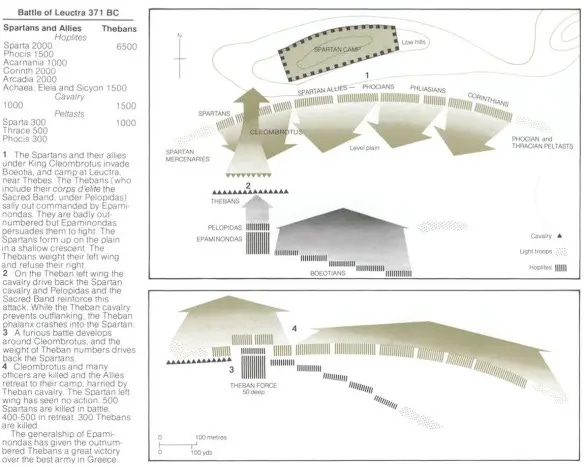
Instead of a futile effort to out-push a force half their size, the Boeotians overloaded one side. They put a majority of their force on the left side, thinning out the right. They advanced this overloaded left wing before the weaker right wing, hoping to win before the Spartans could fully engage.

The Boeotian left wing, led in part by the Sacred Band, broke through the Spartan line. With enemy forces charging the side and rear, the Spartans quickly routed. When the dust settled, Epaminondas inflicted upon the Spartans one of the most decisive blowouts in Greek history.

Diagram courtesy of WarHistory.org

Over 1,000 Spartans perished in the Battle of Leuctra, including their king and military leader Cleombrotus. The Boetians lost around a hundred, but exact estimates are hard to come by. By anyone’s estimate, their casualties paled in comparison. Sparta’s military reputation would never recover, and the next 200 years marked an era of Spartan decline.

Epaminondas didn’t invent the phalanx. In fact, it’s unclear who really did. There is evidence of a similar strategy in Sumer over 2,000 years earlier. It’s a fairly basic idea — everyone hold your shields together and push. But Epaminondas did advance the strategy. Others would continue to innovate on Epaminondas’ “oblique” advance, up to and including Alexander the Great.

Luke Brown, “Pushing Tush Is Ancient Technology”, Wide Left, 2025-10-13.

Powered by WordPress