Quotulatiousness

January 15, 2026

Having it both ways, thanks to the miraculous powers of “climate change”

Filed under: Environment, Media, Politics — Tags: , , , , , — Nicholas @ 05:00

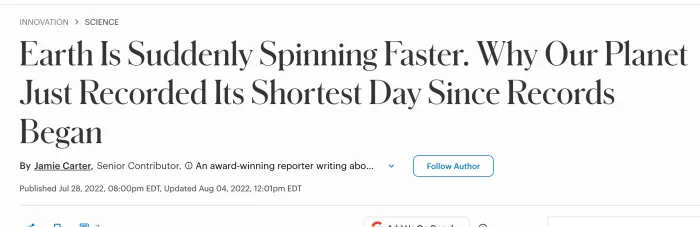
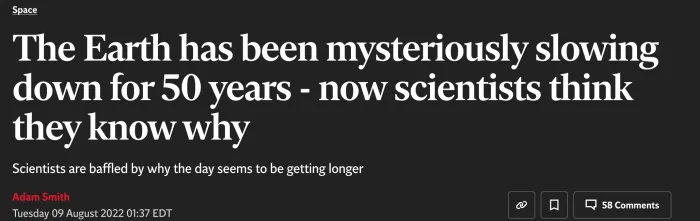
Remember those news reports from a few years back, when the media urgently informed you that your home town was “warming twice as fast as the rest of the planet”? Sure you do, because every major outlet latched on to the idea and juiced it for that local angle. In the days before the internet and social media, it would have worked, too. This is an example of the amazing powers of climate change, but far from the only one. Apparently the wonders of climate change can both speed up and slow down the rotation of the entire planet:

Here is a headline from Forbes 4 August 2022:

Here, five short days later, is a headline from The Independent 9 August 2022:

It is possible to reconcile these two messages, if you are are dedicated The Science follower who greatly fears being called a science denier.

This is how: that on or before 8 August 2022, you swear the earth is spinning faster, and you say that any who doubts this is a troglodyte MAGAtard, and that 9 August 2022 and after, you swear the earth is spinning slower, and say that any who doubts this is mouth-breathing redneck.

The Science is self-correcting in this way.

Now what is amusing about this is not the hubris and over-certainty of scientists, which because scientists are people have characteristics in them no different than in non-scientists. What matters to us are (a) the alleged causes of the changes in rotational speed, and (b) AI.

[…]

I have been trying, with little success, to explain that AI is programmed to be sycophantic, to give users a feeling that what they (the users) believe is right, and that they are right to believe whatever it is they want to believe. Press any of these AI models strongly and consistently enough, and you can get them to “admit” just about anything — that they haven’t been hard coded not to notice. DIE is still with us, even, or especially in, AI.

AI has sworn that earth is both speeding up and slowing down, promising both were true with searches I did (for the article titles) separated by less than a minute.

Now this is partly to blame on the training material, because scientists themselves are claiming the same things AI found. Which brings us to the alleged causes of both.

Climate change.

Well of course it was climate change. Climate change, as we discovered earlier, is responsible for all things on earth. All bad things, that is. Climate change simultaneously causes earth to spin both slower and faster. Climate change is therefore a branch of quantum mechanics, where outcomes both happen and don’t happen, depending on which scientist is looking.
“The logic employed to support an invasion of Greenland is purely onanistic”

Filed under: Europe, Media, Military, Politics, USA — Tags: , , , , , — Nicholas @ 04:00

Last week, I reposted part of CDR Salamander’s view of President Trump’s desire to take Greenland from Danish control. I still don’t really understand his motivation, so Kiran Pfitzner‘s take that Trump’s “perverse interest in Greenland” can only be explained as rising from a belief “that conquest, that being a conqueror, is a pleasant fantasy to indulge in”:

“InfantryDort” is not worth responding to, but the tweet is a useful frame for our discussion.

Aside from morality and legality, invading Greenland is, strategically speaking, utterly pointless. Even if we were to entirely neglect the consequences of such an act on our alliances and reputation, the act alone constitutes sheer stupidity as a pure question of strategy.

It is true that the idea of buying Greenland was floated during the Truman administration and again during the Eisenhower administration. However, a number of factors differentiate that endeavor:

  1. The offer was made secretly, so as to prevent any political or diplomatic complications over the question.
  2. The significance of Greenland was peculiar to the time — a nuclear attack on the US would have had to have come over the Arctic by Soviet bombers — technology has since starkly reduced its importance.
  3. Most importantly, previous administrations had clear ideas of what was needed from Greenland, and so were able to simply negotiate with the Danish government to gain access without the political difficulties of annexation.

This illustrates the great strategic problem of any suggestion of invasion: there is no specific aim or purpose. The endeavor is justified only in vague terms of “security” or the childish assertion that “we need it”. How it is to actually improve our security or why exactly we need it are nowhere addressed.

As Clausewitz writes, the aim of war is to put our enemy in a position more painful than the sacrifice which we demand from him. What exactly is it we want from Greenland? What have they denied us that we should seek to gain by force?

To even consider the question in practical terms, we must reckon with the simple fact that, in the era of a nation state, allies are infinitely more useful than occupied territory. Even bearing in mind that allied interests will never be entirely congruent, a state organic to a territory will be able to draw forth greater exertions from the same resources than a foreign occupier would, even before accounting for active resistance. A people will always provide their own state with more energy and zeal than they will offer to a conqueror.1 There is less “friction”.

The great benefit of alliances is in the ability to access this voluntary energy, which cannot be called into being by the dictates of a conqueror. Nationalism is such a potent force that conquest has become inordinately difficult and costly, being a net negative to state power in virtually all cases (a subject I have previously written on).2 That the United States can access Greenland’s territory without having to conquer it is already the best of all worlds.


  1. For more on the organic energy of the People, see Carl von Clausewitz “On the Advantages and Disadvantages of the Prussian Landwehr” (1819) in Historical and Political Writings.
  2. See also: Posen, Barry R. “Nationalism, the Mass Army, and Military Power”. International Security 18, no. 2 (1993): 80–124.

“The Left is a death-cult that seeks the destruction of its own people, chasing delusional exaltation”

Filed under: Europe, Government, Media, Politics, USA — Tags: , , , — Nicholas @ 03:00

At Always the Horizon, Copernican discusses the progressive mindset and its complete inability to cope with barbarians (literal and figurative):

In light of recent events, it is important to recognize that a rules-based system can exist only as long as there exists someone to enforce the rules. For a long time, White Westerners have been brow-beaten with an imagined consensus morality where those who are historically hierarchically powerful are also inherently evil. “Those misogynist White rednecks”, etc. That was, according to the rules, the acceptable position to hold.

The rules are enforced by consuming den-mothers who have built around themselves fortresses of bureaucracy and perceived cultural alignment. You have to follow the rules, or you’re a bad person.

Historically, Christianity managed these ideals through Europe and the Holy Roman Empire, where they were considered a moral standard. Enforced through the social order of the time. Having previously attacked Christianity in the late 20th century, the modern Left has proceeded to annihilate that moral grounding. Replacing it with a vague sense of moral relativism and platitudes:

“We think these behaviors and rules are good because everyone agrees, and everyone agrees because we’ve made them as these behaviors and rules are good.”

The tautology of liberal thought. Moral relativism with appeal-to-majority and appeal-to-consensus stacked atop one another. Recent events have demonstrated that even classically liberal political positions cannot be maintained without a strong underlying social and moral framework. Lacking that, liberalism (again, as recently demonstrated) defaults to meaningless tautologies and a feminine urge to “not harm” people who in many circumstances damn well need to be harmed.

The result of this social decay is, of course, a default to basics.

The Barbarians Veto

    Your village or apartment block has been put to flame. Your son is dead, your wife and daughter are being hauled off to god knows where, and a giant of a man with a bloody axe stands before you. Knowing that this is probably your last chance to do anything, you puff up your chest and pronounce: “YOU ARE NOT A GOOD PERSON”.

    The man looks at you like you’re retarded, and then messily separates your prefrontal cortex and cerebellum. The Barbarian doesn’t give a shit what you consider a “good person” to be. He couldn’t care less. What he knows is that the only thing separating the two of you is that he is strong and you are weak. The reason why it is he standing with a bloodied axe and not you, is simply a matter of prowess and luck. If you were strong, you would be doing the same thing to him.

    Do unto others before they do unto you. Do it fast. Do it first. And do it effectively.

The political Left has built its entire philosophical core on minimizing harm and playing the role of victim. The Left is thus completely blind to the barbarians veto. The Left believes there’s some inherent nobility in having your home burnt to the ground and your family murdered. That’s why they pursue with suicidal ideation the opportunity to die for their psychotic religion. Better yet, they zealously pursue the opportunity to get other people to die for their psychotic religion. Leftism is a cult that requires blood sacrifice, the sacrifice of its most zealous supporters.

They fear the strength of the Barbarian, uncompromising, not willing to sacrifice himself, but entirely willing to sacrifice hordes of his unthinking enemies. He does not see himself as a “good person”, but the barbarian sees himself as a “surviving person”. He survives by killing his enemies. His bloodline survives by impregnating his women, whether they want it or not. The Left has no answer to the barbarian, but to submit to his will, and then demand you do so as well.

That’s why they love murderers, cartels, and foreigners, but demand that their own men and sons die bloodily in self-sacrifice to their own cultural enemies. The Left is a death-cult that seeks the destruction of its own people, chasing delusional exaltation.

Update, 16 January: Welcome, Instapundit readers! Have a look around at some of my other posts you may find of interest. I send out a daily summary of posts here through my Substackhttps://substack.com/@nicholasrusson that you can subscribe to if you’d like to be informed of new posts in the future.

Pauly/Roux Pistols: The First Self-Contained Cartridges

Filed under: France, History, Technology, Weapons — Tags: , , , , , — Nicholas @ 02:00

Forgotten Weapons
Published 22 Aug 2025

Samuel Pauly is the largely unrecognized father of the modern self-contained cartridge. In 1808 he patented a cartridge with a metal base that held a priming compound and attached to a paper or metal cartridge body holding powder and projectile. He followed this with an 1812 patent for a gun to fire the cartridges. What makes Pauly’s original system particularly interesting is that he did not use mechanical percussion (ie, hammer or striker) to ignite the primer compound, but rather a “fire pump”. A spring loaded plunger compressed air on top of the primer, heating it enough to detonate the compound in the same way that a diesel engine works. This was not a commercially successful system, though, and Pauly left Paris for London in 1814.

Pauly’s shop was taken over by Henri Roux, who continued making guns under the Pauly name while also improving the cartridges. These two pistols were made around 1820 and use a Roux cartridge with a mechanical striker hitting the primer compound in a Pauly-style cartridge case.

For more information, I recommend Georg Priestel’s free book Jean Samuel Pauly, Henri Roux, and Successors – Their Inventions From 1812 to 1882 available here:
https://aaronnewcomer.com/document/je…
(more…)

QotD: Process knowledge

Filed under: Asia, Books, Business, Quotations, USA — Tags: , , — Nicholas @ 01:00

Dan Wang, in his wonderful essay on how technology grows, describes process knowledge as the sine qua non of industrial capitalism, more fundamental than the machines and factories that everybody sees:

    The tools and IP held by these firms are easy to observe. I think that the process knowledge they possess is even more important. The process knowledge can also be referred to as technical and industrial expertise; in the case of semiconductors, that includes knowledge of how to store wafers, how to enter a clean room, how much electric current should be used at different stages of the fab process, and countless other things. This kind of knowledge is won by experience. Anyone with detailed instructions but no experience actually fabricating chips is likely to make a mess.

    I believe that technology ultimately progresses because of people and the deepening of the process knowledge they possess. I see the creation of new tools and IP as certifications that we’ve accumulated process knowledge. Instead of seeing tools and IP as the ultimate ends of technological progress, I’d like to view them as milestones in the training of better scientists, engineers, and technicians.

    The accumulated process knowledge plus capital allows the semiconductor companies to continue to produce ever-more sophisticated chips. […] It’s not just about the tools, which any sufficiently-capitalized firm can buy; or the blueprints, which are hard to follow without experience of what went into codifying them.

Process knowledge lives in people, grows when people interact with other people, and spreads around when skilled individuals relocate between cities or companies. But this also means it can wither and die, can be lost forever, either when old workers shuffle off to the Big Open Plan Office in the Sky, or when an ecosystem no longer has the energy or complexity to sustain a critical mass of skilled workers in a particular vocation. Some East Asian societies have gone to extreme lengths to retain process knowledge, for instance by deliberately demolishing and rebuilding a temple every 20 years.

In fact this is far from the most extreme thing East Asian societies have done to retain the process knowledge that lives within their workers! There are some components of an ecosystem, whether natural or technological, that are especially important keystone species. In the technological case, these species can be unprofitable at the current scale of an ecosystem, or inefficient, or they might not make economic sense until one or more of their customers exist, but those customers might not be able to exist until the keystone species does. Venture capital is very practiced at solving this kind of Catch-22, but in the East Asian economic boom it was national governments that actively sheltered keystone industries until they could get their footing, thus making entire ecosystems possible. A wonderful book about this is Joe Studwell’s How Asia Works, but if you can’t read it, read Byrne Hobart’s thorough review instead.

Process knowledge is so powerful, the ecosystem it enables so vital, it can break the assumptions of Ricardo’s theory of trade. Steve Keen has a perceptive essay about how the naive Ricardian analysis treats all capital stock as fungible and neglects the existence of specialized machinery and infrastructure. But naive defenders1 of trade liberalization often make an exactly analogous error with respect to the other factor of production — labor. Workers are not an undifferentiated lump, they are people with skills, connections, and expertise locked up in their heads. When a high-skill industry moves offshore, the community of experts around it begins to break up, which can cripple adjacent industries, stymie insights and breakthroughs, and make it almost impossible to bring that industry back.

John Psmith, “REVIEW: Flying Blind by Peter Robison”, Mr. and Mrs. Psmith’s Bookshelf, 2023-02-06.


  1. Like all coastal-Americans, I am generally in favor of trade liberalization, but I’m consummate and sophisticated about it, unlike Noah Smith.

Powered by WordPress