CDR Salamander has some (guarded) thoughts on the recent operation to extract Venezuelan dictator Nicolás Maduro, which was accomplished with no significant American casualties (although some reports say a large number of Cuban troops were killed or wounded on the other side):
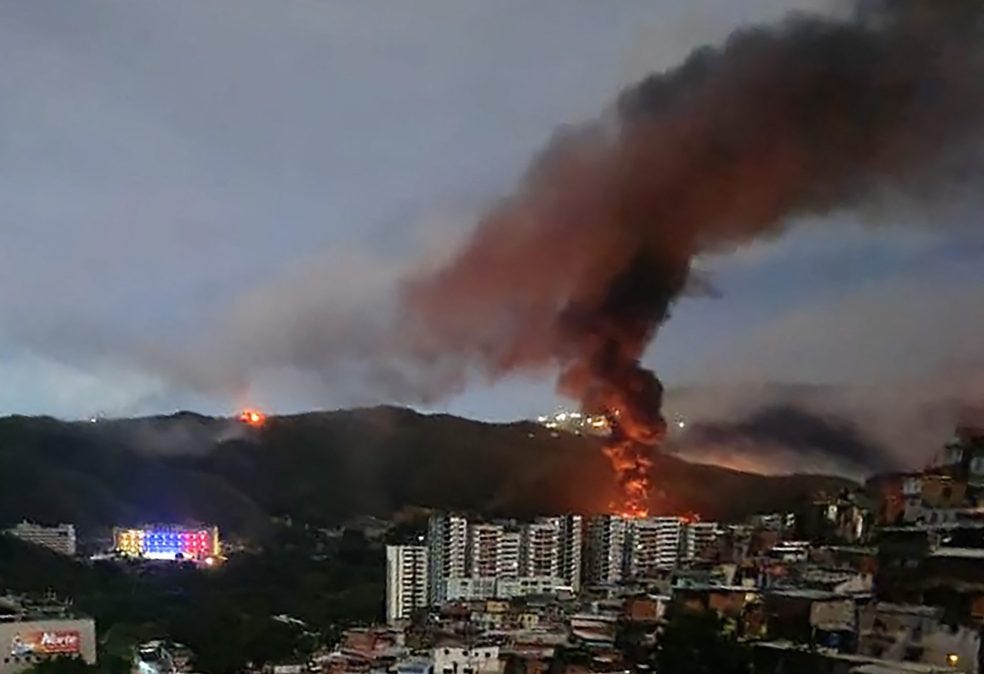
Image from CDR Salamander
If you didn’t get a chance to listen to Sunday’s Midrats Podcast with Mark and me, give it a listen to hear a broader discussion with some additional detail thrown in. Today is going to be a bit different.
We are still just ~72-hours from the events, so there is an order of magnitude more of what we don’t know than we do, but some items are breaking out from the fog.
On yesterday’s podcast, I briefly mentioned a framework for discussion that I think is helpful to flesh out here — an addendum to my comments on the podcast, so to speak.
As we stand here the Monday after the events of Friday night/Saturday morning, what are some clear items of consideration at the Tactical, Operational, Strategic, and Political levels?
Let’s do Top-3s at D+3:
Tactical:
- No other military on the planet has the Joint/Combined Arms/Interagency capability to successfully execute this mission. None. This is a unique national capability that we should carefully nurture, steward, and improve on.
- The death of rotary wing (RW) aircraft has been greatly exaggerated. As I have written often over the last two decades, one has to examine closely the lessons of small and medium sized wars, as they will inform you what will be needed in the next large war. That is the gold standard … but you have to be careful. Some lessons look to have broader implications, but they may be muted or amplified by the location and venue you are looking at. Yes, flying large groups of RW in the Ukraine theater is a questionable proposition, but that is because they are Ukrainian and Russian RW being flown by Ukrainians and Russians. American RW aircraft have training, equipment, and capabilities that others do not have. It was not by luck that none of our RW operating deep in Venezuela were shot down. Make no mistake, without a diverse, robust, and numerous RW capabilities, the Maduro Raid would not have been possible.
- Unmanned systems are A tool, not THE tool. I agree, the use and utility of unmanned systems in the Russo-Ukrainian War has expanded at an astronomical rate, but in spite of what some may be trying to sell you, the future is not “All U_V All the Time“. Unmanned systems are like aircraft, submarines, and body armor — they get added to the tool box. The more diverse the toolbox, the more capable your military. That last comment refers to a lot more than unmanned systems.
Operational:
- Sovereign Bases Matter: While we have seen other friendly nations let us use their facilities, the reanimation of Roosevelt Roads and the general Guamification of Puerto Rico over the last few months is a wake-up call to everyone. Serious policy makers need to put their accountants in the back of the room where they belong. A global power rides along support structures few see and understand at peace until they are needed at war but gone. Having a wide variety of inefficient and underutilized bases and facilities scattered around is a feature, not a bug. The future is unknown and an impatient lover. Do not test, taunt, or take her for granted. Reactivate more bases. Play hard ball with the UK about Diego Garcia. Pray for peace.
- America Must be the Dominate Maritime & Aerospace Power in Order to be a Global Power: I don’t mind saying, “I told you so“. so I will happily say, I told you so. Yes, we need land power, but most of it should be light, expeditionary and exemplary. The balance of heavy maneuver forces should be based on US territory and the balance in the Reserve and National Guard. Everyone who went feet dry in Venezuela came back home because the U.S.A. dominated the air, electromagnetic spectrum, and the sea to such a degree that any challenge to that dominance was a death sentence to the challenger.
- Few Things are More Useful Than a Large Deck Amphib: Let any person who poo-poos the USMC demanding more amphibious ships, or worse, bleats out how they are obsolete, be tarred, feathered, and run out on a rail. All hail the USS Iwo Jima (LHD-7). IYKYK.
Alexander Brown comments on the raid at Without Diminishment:
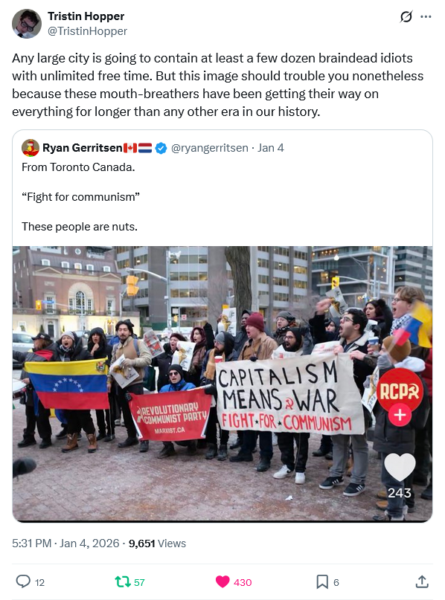
You can always find a cadre of pro-communist “fellow travellers” in any western nation … we just seem to have more of them than anyone else.
Let’s get the elephant in the room out of the way: American regime-change efforts, on occasion, tend to age like oxidized guacamole. The teenage version of this writer remembers well the empty sugar-high of “Shock and Awe”.
A powerful aphrodisiac gets released when Things Actually Happen. To ignore the impacts of tribalism and the potential for another misappropriation of neocon bloodlust would be to ignore another elephant. But enough on the family Elephantidae and the order Proboscidea.
We may be as cold as Minnesota, with its miniature Horn of Africa engulfed in a real “learing” not “learning” opportunity after years of runaway fraud, but as Canadians, we should surely be looking inward at our own failings on the home front, our lack of leadership in foreign affairs, the hate we allow to fester in our streets, and the cozy relationships we foster with the most dubious of allies. But of course, we’re not.
Nicolas Maduro, one of the world’s great monsters, was “black-bagged” and perp-walked along with his wife yesterday, following a Swiss-watch-precise Delta op that only our neighbours to the south are capable of.
Let us not stand on the false pretence of a violation of “international law”: Maduro’s tenure was defined by a series of widely condemned and fraudulent electoral processes designed to ensure his grip on power. His track record includes a 2018 presidential election, dismissed by the international community as neither free nor fair. He banned major opposition parties and jailed or exiled key opponents.
This pattern escalated during the 2024 presidential election, where, despite independent tallies showing a landslide victory for opposition candidate Edmundo González, the Maduro-controlled National Electoral Council declared Maduro the winner without the data to prove it. The 2024 process was further marred by the disqualification of popular leader María Corina Machado, the intimidation of voters by paramilitary “collectives”, and a brutal post-election crackdown, known as “Operation Tun Tun”, that resulted in over 2,000 arrests and dozens of deaths.
And yet, as Hugo Chávez’s mausoleum smoulders, hundreds of thousands continue to flood the streets to celebrate, and the experts of “experts say” journey down from ivory towers to shoot the wounded and feign retroactive understanding of an op that took most by surprise, perhaps nowhere has the oppositional-defiant kvetching been louder than inside Canada’s elite Liberal circles, so much so that you almost have to applaud the utter lack of self-awareness and the sheer selfishness of it all.