Quotulatiousness

December 31, 2025

The Royal Canadian Navy … a terrorist organization according to Iran

Filed under: Cancon, Middle East, Military — Tags: , , , — Nicholas @ 05:00

An unexpected post from True North Strategic Review, as Noah shares the details of a new announcement from the Islamic Republic of Iran about that well-known terrorist group known as His Majesty King Charles’s Royal Canadian Navy (RCN):

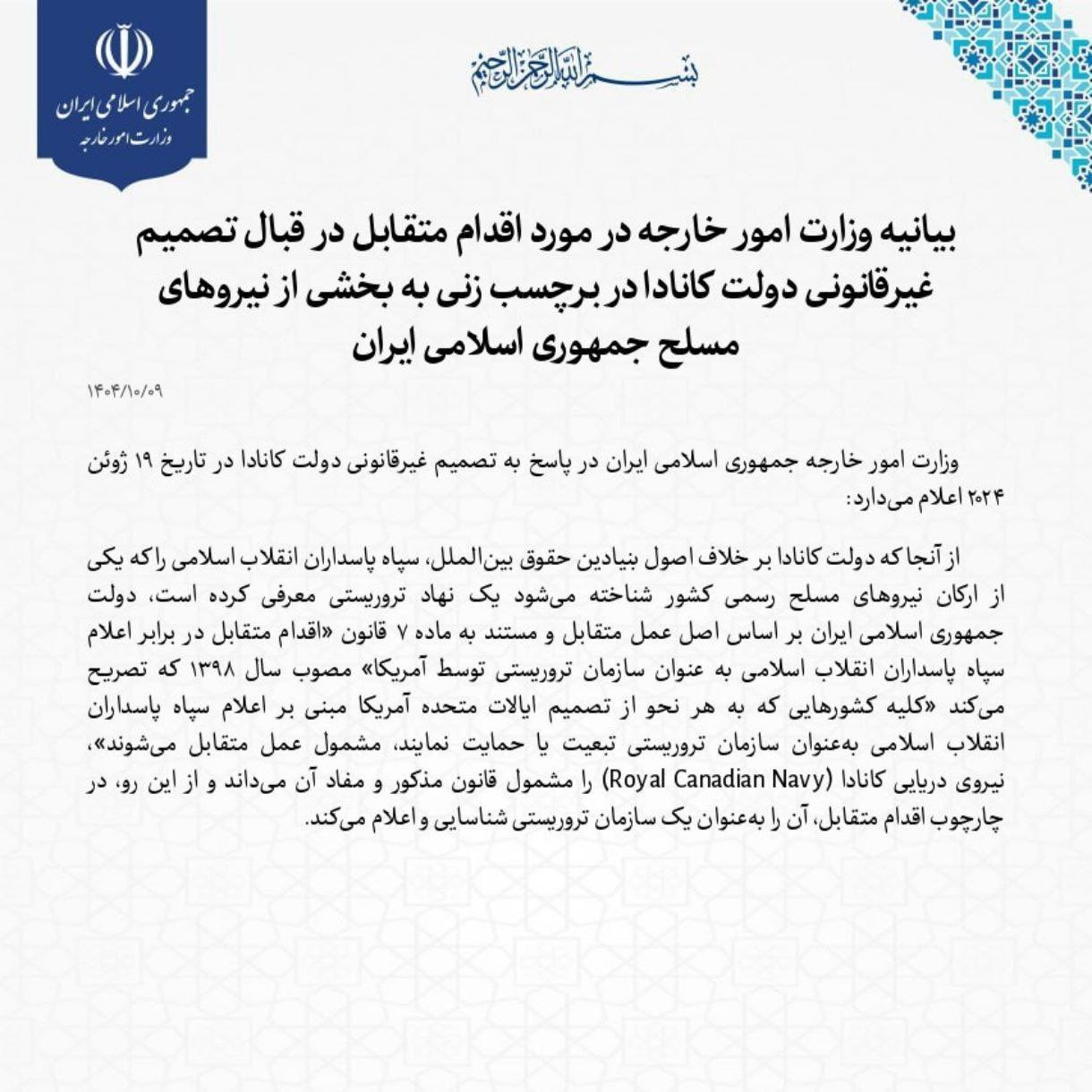
Statement from the Iranian Ministry of Foreign Affairs, via True North Strategic Review

Welp. Sometimes you wake up to the most random things imaginable. This is certainly one of them in my books.

The Iranian Ministry of Foreign Affairs has released a statement today officially designating the Royal Canadian Navy as a Terrorist Entity under the “Tit-for-Tat” trigger outlined in Article 7 of the Reciprocal Action Against the Declaration of the Islamic Revolutionary Guard Corps as a Terrorist Organization by the United States Act.

Here is the translated statement for those curious:

    Since the Canadian government has declared the Islamic Revolutionary Guard Corps, which is recognized as one of the pillars of the country’s official armed forces, a terrorist organization, contrary to the fundamental principles of international law, the government of the Islamic Republic of Iran, based on the principle of reciprocity and based on Article 7 of the “Reciprocal Action Against the Declaration of the Islamic Revolutionary Guard Corps as a Terrorist Organization by the United States” Act passed in 2019, which stipulates that “all countries that in any way comply with or support the decision of the United States of America to declare the Islamic Revolutionary Guard Corps as a terrorist organization shall be subject to reciprocity,” considers the Royal Canadian Navy to be subject to the aforementioned Act and its provisions, and therefore, within the framework of reciprocity, identifies and declares it as a terrorist organization.

For a bit of context, under the Reciprocal Action Against the Declaration of the Islamic Revolutionary Guard Corps as a Terrorist Organization by the United States Act, the Iranian government includes a clause stating that any country that supports or complies with the U.S. decision to label the IRGC as terrorists is also subject to reciprocity.

This retaliation clause is in direct response to the Canadian government’s decision last June to declare the Islamic Revolutionary Guard Corps as a terrorist entity. Although quite late to respond, the decision to designate the Royal Canadian Navy specifically is a curious one.

The likely scenario is that the choice was made based on operational proximity. The Royal Canadian Navy is the branch of the Canadian military most likely to physically encounter Iranian forces. They’re really the only branch that maintains a tangible, visible presence near Iranian territory. By designating the Navy specifically, Iran is creating a legal pretext to harass or target Canadian vessels in these international waters under the guise of Counter-Terrorism operations.

The Korean War Week 80: Empty Lines and Guerrillas: X-mas ’51 in Korea! – December 30, 1951

Filed under: Britain, China, History, Military, USA — Tags: , , , , , — Nicholas @ 04:00

The Korean War by Indy Neidell
Published 30 Dec 2025

It’s Christmas, 1951, and though peace on earth and goodwill to all men might have a general appeal, peace seems as far away as ever in Korea. There are, though, no large scale offensives being planned at the moment, as the frozen winter grips Korea and the peace talks drag on and on. However, just because the war between armies is quiet, doesn’t mean Korea is; anti-guerrilla operations claim lives by the thousands, and the general drudgery of the war also takes thousands of lives on both sides each and every month. Christmas in Korea is grim.

00:00 Intro
00:27 Recap
00:49 POW Lists
02:25 New Offensive
05:29 Fighting the Guerrillas
07:20 Casualty Numbers
09:04 Boatner and the 23rd
11:54 Inspections and China
13:27 Summary
13:59 Conclusion
(more…)

Do you want tribalism? Because this is how you get tribalism

On the social media site formerly known as Twitter, InfantryDort asks the key questions about where our “elites” are taking us:
What’s the point? No, tell me, what’s the point?

What’s the point of laws if judges reinterpret them until they protect everyone except the people who obey them?

What’s the point of defending a nation if the same system refuses to defend your family from criminals it imported on purpose?

What’s the point of paying taxes if they fund fraud, reward deception, and subsidize parallel systems that never owed this place loyalty?

What’s the point of working, building, serving, if your labor is redistributed to those who broke the rules to get here?

What’s the point of accountability if paperwork matters more than reality, and intent matters less than optics?

I’ll tell you what the point is. The point is that any human with a brain is going to retreat to whatever group rewards his values and sacrifice. If it isn’t the nation, it becomes the tribe. And when it becomes the tribe, this American experiment is over.

A warrior can endure hardship, loss, and some long odds. What he cannot endure is betrayal by design.

When a nation stops enforcing its boundaries, its laws, and its obligations to its own people, it doesn’t just lose control, IT BURNS THE VERY WILL REQUIRED TO DEFEND IT.

I want something to defend that I believe in. We all do. I take the oath deadly serious. But one begins to wonder after awhile if that makes for a patriot or a sucker.

If a Soldier can follow it and die in defense of his country, but on the other side of the coin, there is a politician who can spit on it and get rich while importing and funding pirates … it really makes one wonder: What’s it all for?

@POTUS we know what problems you face. It’s not lost on us. But we are running out of time sir.

One of the things that makes these kinds of scam viable in western culture is that we are high-trust cultures with default assumptions that most people are not trying to exploit kindness and charity. This breaks down quickly once you introduce enough people from low-trust and tribal cultures:

The fraudulent spending of taxpayer dollars we are seeing uncovered nationally all rotates around the essential goodness of the American people.

Daycare for children? Of course — we don’t want our children or parents to suffer because Mom has to work.

Foodbanks? We don’t want anyone to starve. Our nation is better than that.

Homeless shelters? Homelessness is a scourge upon the American dream. We’re better than that.

Home elder care? The generations before us deserve dignity and respect. How could anyone oppose that?


Deep down we are a charitable and giving nation unlike most others. That sense of goodness and charity has been hijacked and exploited by foreign predators for their own material gain.

We need to wise up and toughen up, and understand that not every siren song of charity is on the level, particularly when our tax dollars are involved.

(Also, this reality gives an added layer of meaning to the concept of “suicidal empathy”.)

Ian at The Bugscuffle Gazette explains that importing the third world means that you need to expect your culture will start becoming more like the third world:

It says something1 about he state of Legacy Media when a 20-something kid with an iPhone can do a better imitation of 60 Minutes than 60 Minutes can.

No, Gentle Readers, I am not — in any way — surprised that Somalian immigrants in Minnesota are happily committing fraud — remember, do, that I grew up in Africa.

One of the things that endear Americans — and Western Europeans in general — to me is the sheer naiveté displayed by same. The ability of the average American to remain convinced that the entire World is just like them is rather cute.2

Folks, fraud and bribery is the norm in the Third World. In tribal cultures fraud and bribery are not only the norm, but are the rule.

If the average American reader takes nothing else from this essay, please understand that fraud and bribery are not crimes in the Third World; that fraud and bribery are not only not crimes in tribal society, but they are expected, required, and a perfectly acceptable part of every day tribal life.

And Somalia is not only Third World, but it is excessively tribal.

So, I’m not really mad at the Somalis. You can’t get mad at a gopher for digging up your yard. Gophers got to dig, and tribal cultures got to tribal.

That by no means signals that I don’t think the fraudsters should be excused. Hell, no. Public trials, and if found guilty — maximum sentences. Those lacking in U.S. citizenship, once the full prison sentence is completed, loaded onto a C-5 Galaxy and bodily pitched off of the ramp onto a random Somalian airport tarmac.3

What has stoked my ire is the fact that the Somalis used one of the most heavily-regulated industries to commit their fraud — that should have everyone up in arms.

Childcare is the responsibility of at least one Minnesota State agency — probably more — and will have mandated State-level inspections and audits.

Let me re-state that: Minnesota government employees would be legally-required and paid to walk their happy little arses into those businesses and use their Mk1 Mod 0 Eyeballs to look around at least once a year. If you were an inspector for whichever Minnesota agency(ies) regulates child care facilities, and you never filed a “Hey, something ain’t right” report, it’s time for a Come-To-Jesus Meeting in a brightly-lit room with humour-impaired law enforcement types.

If nothing else, the fact that one of these allegedly fraudulent pre-schools not only mis-spelled “Learning” as “Learing”, but mis-spelled the name of the street in the publicly-posted address should have been a red flag to someone.4

This sheer dollar amount of fraud, over this amount of time, and using this many separate corporate entities means that multiple people in the Minnesota State government knew something stunk to high heaven.

Minnesota government employees who knew of this fraud need to do the maximum allowed felony time.


  1. Not, you know, anything good.
  2. The ability of the average American leader — who is supposed to know better — to do the same is aggravating and dangerous.
  3. Bringing the aeroplane to a full stop during this process not absolutely required.
  4. Us cynical retired law enforcement types call this a “clue”.

Baker Pattern 1800 Rifle for Napoleonic Wars Sharpshooters

Filed under: Britain, History, Military, Weapons — Tags: , , , — Nicholas @ 02:00

Forgotten Weapons
Published 11 Aug 2025

The British military decided to organize their disparate small units of riflemen into a single standardized group in 1800. The 95th Regiment – the British Rifle Corps – was founded and it was equipped with a pattern of rifle designed by one Ezekiel Baker. This was a .625 caliber rifle with a 30” long barrel and a remarkably slow 1:120” rifling twist. That rifling was deliberately chosen to balance rifle accuracy with ease of loading and it worked quite well as a compromise solution. The Baker was considered effective on individual targets to 200 yards (300 with a particular skilled marksman) and area targets out to 500 yards.

The Baker was used throughout the Napoleonic Wars and only replaced in 1838 by the Brunswick rifle. This example is one of the original 1800 pattern, modified in 1815 to replace its distinctive bayonet bar (used to fit the large short sword bayonet made for the Baker) with a typical socket bayonet lug.

BritishMuzzleLoaders playlist on the Baker: • The 1800 Baker Rifle: Two (Very) Frequent…
(more…)

QotD: The cloth trade in the ancient and medieval world

Filed under: Economics, Europe, History, Quotations — Tags: , , , , , — Nicholas @ 01:00

Fabric as a finished product is somewhat different from the other products (grain and iron) we’ve discussed in this series so far. Bulk grain is a commodity – which means that one kilogram of grain is pretty much like the next. When grain gets traded in bulk it is because of differences in supply, not generally because grain in one region or other is particularly tasty. Consequently, you only get bulk grain trading when one area is producing a surplus and another not producing enough. The same is more loosely true of iron; Iron wasn’t a perfect commodity in the pre-modern world since some ores produced better quality metal than others and some trade in high quality ores or metal (like wootz) happened. But for every-day use, local iron was generally good enough and typically available. Iron could be – and often was – treated as a commodity too.

Fabric is not like that. While the lower classes will often have had to make do with whatever sorts of cloth is produced cheaply and locally, for people who could afford to have some choices the very nature of textile production produces lots of regional differences which incentivized trade. Almost everything about textile production is subject to regional variations:

  • What fibers are being used. Major wool and linen producing regions tended to be separate, with wool (and sheep) in colder climates and uplands while (as noted) flax tended to be grown in warmer river-valleys with rich alluvial soil. Meanwhile, the cotton-and-silk producing regions generally (with some notable exceptions, mind) did not overlap with the wool and linen producing regions.
  • The nature of the local fibers. We’ll get to some specific examples in a moment but ancient and medieval writers were well aware that different growing conditions, breeds of sheep or flax, climate and so on produced fibers of subtly different qualities. Consequently, even with the exact same processes, cloth produced in one region might be different from cloth produced in another region. But the processes were almost never the same because …
  • Local variation in production processes. Again, we’ll have some examples in a moment, but the variance here could be considerable. As we’ve seen, the various tasks in cloth production are all pretty involved and give a lot of room for skill and thus for location variations in methods and patterns. One might see different weaving patterns, different spinning techniques, different chemical treatments, different growing or shearing methods and so on producing fabrics of different qualities which might thus be ideal for different purposes.
  • Dye methods and availability. And as we discussed last time, available dyestuffs (and the craft knowledge about how to use them) was also often very local, leading to certain colors or patterns of color being associated with different regions and creating a demand for those. While it was often possible to ship dyestuffs (although not all dyestuffs responded well to long-distance shipping), it was often more economical to shift dyed fabric.

Added on top of this, fabric is a great trade-good. It is relatively low bulk when wrapped around in a roll (a bolt of fabric might hold fabric anywhere from 35-91m long and 100-150cm wide. Standard English broadcloth was 24 yards x 1.75 yards; that’s a lot of fabric in both cases!) and could be very high value, especially for high quality or foreign fabrics (or fabrics dyed in rare or difficult colors). Moreover, fabric isn’t perishable, temperature sensitive (short of an actual fire) or particularly fragile, meaning that as long as it is kept reasonably dry it will keep over long distances and adverse conditions. And everyone needs it; fabrics are almost perfect stock trade goods.

Consequently, we have ample evidence to the trade of both raw fibers (that is, wool or flax rovings) and finished fabrics from some of the earliest periods of written records (spotting textile trade earlier than that is hard, since fabric is so rarely preserved in the archaeological record). Records from Presargonic Mesopotamia (c. 2400-2300) record wool trading both between Mesopotamian cities but wool being used as a trade good for merchants heading through the Persian Gulf, to Elam and appears to have been one of, if not the primary export good for Sumerian cities (W. Sallaberger in Breniquet and Michel, op. cit.). More evidence comes later, for instance, palace letters and records from the Old Babylonian Empire (1894-1595) reporting the commercialization of wool produced under the auspices of the palace or the temple (Mesopotamian economies being centralized in this way in what is sometimes termed a “redistribution economy” though this term and the model it implies is increasingly contested as it becomes clearer from our evidence that economic activity outside of the “palace economy” also existed) and being traded with other cities like Sippar (on this, note K. De Graef and C. Michel’s chapters in Breniquet and Michel, op. cit.).

Pliny the Elder, in detailing wool and linen producing regions provides some clues for the outline of the cloth trade in the Roman world. Pliny notes that the region between the Po and Ticino river (in Northern Italy) produced linen that was never bleached while linen from Faventia (modern Faenza) was always bleached and renowned for its whiteness (Pliny, NH 19.9). Linen from Spain around Tarragona was thought by Pliny to be exceptionally fine while linens from Zeola (modern Oiartzun, Spain) was particularly durable and good for making nets (Pliny, NH 19.10). Meanwhile Egyptian flax he notes is the least strong but the most fine and thus the most expensive (Pliny NH 19.14). Meanwhile on wool, Pliny notes that natural wool color varied by region; the best white wool he thought came from the Po River valley, the best black wool from the Alps, the best red wool from Asia Minor, the best brown wool from Canusium (in Apulia) and so on (Pliny, Natural History 8.188-191). He also notes different local manufacture processes producing different results, noting Gallic embroidery and felting (NH 8.192). And of course, being Pliny, he must rank them all, with wool from Tarentum and Canusium (Taranto and Canosa di Puglia) being the best, followed more generally by Italian wools and in third place wools from Miletus in Asia Minor (Pliny NH 8.190). Agreement was not quite universal, Columella gives the best wools as those from Miletus, Calabria, and Apulia, with Tarantine wool being the best, but demoting the rest of the Italian wools out of the list entirely (Col. De Re Rust. 7.2).

In medieval Europe, wool merchants were a common feature of economic activity in towns, with the Low Countries and Northern Italy in particular being hubs of trade in wool and other fabrics (Italian ports also being one of the major routes by which cottons and silks from India and China might find their way, via the Mediterranean, to European aristocrats). Wool produced in Britain (which was a major production center) would be shipped either as rovings or as undyed “broadcloths” (called “whites”) to the Low Countries for dyeing and sale abroad (though there was also quite a lot of cloth dyeing happening in Britain as well).

Bret Devereaux, “Collections: Clothing, How Did They Make It? Part IVb: Cloth Money”, A Collection of Unmitigated Pedantry, 2021-04-09.

Powered by WordPress