Quotulatiousness

December 24, 2025

Welcome to Bland World

Filed under: Media, Technology, USA — Tags: , , , , — Nicholas @ 05:00

Ted Gioia yearns for the return of the weirdo, the eccentric, and the non-conformist to spice up our bland, smooth, grey world:

“People are less weird than they used to be,” claims psychologist Adam Mastroianni. He describes this as “an epidemic of the mundane”.

The strangest thing, he believes, is absence of strangeness. Nobody wants to make waves — or even trickles. Conformity is the flavor of the month, and it tastes the same every month.

We live in a “smoothness society”, explains philosopher Byung-Chul Han. He points to the smooth, rounded contours of the iPhone as a symbol of society’s desire to remove friction. Our phone apps demonstrate the exact same thing. We scroll and swipe with such ease, and anything with complexity, nuance, or resistance is eliminated from consideration.

“The smooth is the signature of the present time”, he claims. Everything from the Brazilian wax job applied to human bodies to the wax coating put on fruits and vegetables aims at the same ideal.

Resistance is futile. Everything must be smooth. Paradise now really is that paved parking lot.

In a world without complexity or resistance, nothing ever changes. Most movies, music, books feel like stagnant rehashes of the same formulas. And that’s intentional.

For the first time in history, fashions don’t change. We don’t change.

Others have noticed this avoidance of anything new or different. Things are designed to blend in, not stand out. Jessica Stillman, writing in Inc., complains about a “blandness epidemic“. Brian Klaas calls it the “surefire mediocre“.

Everywhere you look, the system is serving up more of the same.

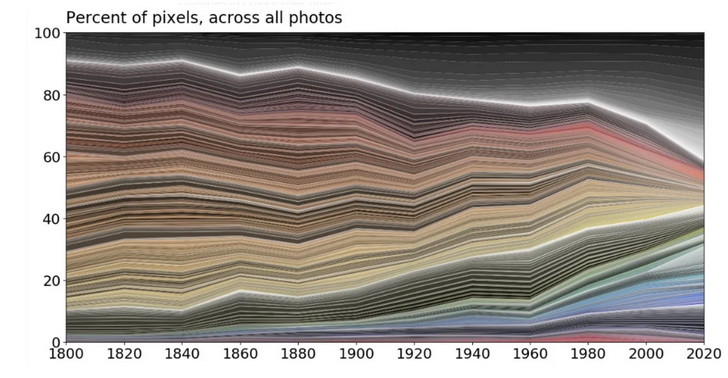
It’s not just in our imagination — the “world really is getting grayer“. A researcher recently studied photos of household items going back two centuries. An analysis of the pixels showed a scary collapse in color.

Even the Victorians — often considered as conformists — lived a more color-filled life. We have almost completely abandoned red and yellow and other bright hues in favor a boring black-and-white spectrum.

But what’s most striking is how this descent into grayness has accelerated during the last few years. The most popular color is now charcoal — and at the current rate it will soon account for half of the marketplace.

The Korean War Week 79: Soviet Technology Surpasses the USA – December 23, 1951

Filed under: China, History, Military, USA — Tags: , , , , , , , — Nicholas @ 04:00

The Korean War by Indy Neidell
Published 23 Dec 2025

Both sides finally release POW information to each other, as required by the Geneva Convention, but neither side is happy with the information, charging it either wildly incomplete or grossly mischaracterized. The Communists also refuse to allow the Red Cross in and the UN doesn’t want compulsory repatriation of POWs, but both are required under Geneva. And away from the truce tables, the Communist air power menace continues to grow, but should there be an armistice will they be allowed to rebuild air bases in North Korea?

00:00 Intro
00:38 Recap
00:58 POW Lists
05:02 Repatriation
07:52 Geoje-Do
09:01 Ambush Program
09:54 Airfields or Armistice
12:00 Communist Air Power
13:23 Summary
13:32 Conclusion
14:50 Call to Action
(more…)

The real agenda

On the social media site formerly known as Twitter, Karl Harrison makes a case for fighting against the key element of the federal government’s all-encompassing drive to control the lives of Canadians because it’s the one that will enable all the other controls to operate:

All Canadians should read this carefully:

“They are flooding Parliament with distraction bills so the public is overwhelmed and cannot see the one bill that makes the entire system possible. More than a dozen federal bills are advancing simultaneously — each attacking a different pillar of Canadian freedom but S206 is the key. They fall into clear clusters:

Bills attacking due process and court rights.
Bill S-206 — Administrative Monetary Penalties (the central pillar) enables penalties without hearings, judges, trials, or common-law protections.
Bill C-63 — Online Harms Act. Undefined “harm”, digital speech penalties, CRTC enforcement authority.
Bill C-27 — Digital Charter Act. Creates federal AI regulators empowered to issue compliance orders without court oversight.
Bill C-52 — Beneficial Ownership Transparency. Expands federal surveillance and administrative enforcement.

Bills attacking parliamentary supremacy (power shift to agencies).
Bill C-26 — Critical Cyber Systems Act. Sweeping regulation by order-in-council, bypassing Parliament.
Bill C-11 — Online Streaming Act. Gives the CRTC unprecedented control over content curation and digital reach.
Bill C-18 — Online News Act. Allows federal regulators to determine access to, and compensation for, digital journalism.

Bills attacking property rights.
Bill C-234 — Agricultural Fuel Restrictions. Expands federal control over farm operations and production.
Bill S-241 — Jane Goodall Act. Sweeping biosafety authority over wildlife, land, and private property.
Bill C-49 — Atlantic Accord Amendments. Expands federal control over offshore land, climate restrictions, and energy development.

Bills attacking freedom of speech and assembly
Bill C-63 — Online Harms Act. Criminalizes undefined “harm”, empowers bureaucrats to judge speech.
Bill C-261 — Misleading Communications Act. Penalties for “misleading” speech — undefined and discretionary.
Bill C-70 — Foreign Interference Act. Mass surveillance powers with vague thresholds.

Bill attacking religion freedom.
Bill C-9 — “Harmful Conduct” Redefinition. Allows the state to regulate spiritual beliefs and pastoral work under “harm”.

The critical pattern. Different bills, different sectors and different rights being attacked. But here is the truth: Every single one of these bills depends on ONE central enforcement pillar, and that pillar is:
Bill S-206 — The Administrative Penalty Switch

Bill S-206, the hub of the entire system, gives federal departments the power to issue penalties without:
▪︎ a hearing
▪︎ a judge
▪︎ a trial
▪︎ due process
▪︎ common-law protections
▪︎ judicial review in practice

It turns federal agencies into their own courts — investigator, prosecutor, judge, and enforcer. No democracy on Earth should tolerate this.

This is the enforcement engine behind:
▪︎ Digital ID
▪︎ CBDCs
▪︎ Carbon allowances
▪︎ Biosafety / One Health rules
▪︎ Smart-meter penalties
▪︎ Travel scoring
▪︎ Online speech controls
▪︎ Zoning & land-use mandates

Data alone cannot control a population. They need the power to punish. S-206 provides it. Remove the keystone → the arch collapses.

Why scatter us with other bills? Because if Canadians focus on S-206, the agenda dies The distraction bills serve one purpose:
▪︎ to scatter attention and exhaust the public.
▪︎ to keep citizens debating side issues
▪︎ to hide the enforcement bill under noise
▪︎ to make resistance impossible to organize
▪︎ to create outrage fatigue
This is how large control systems are built — through distraction around the edges while the core is slipped into place.

What are they building – and why S-206 is the core. Here is the architecture of the planned digital-governance system:
▪︎ Digital ID → who you are
▪︎ CBDCs → what you buy
▪︎ Carbon scoring → how you move & heat your home

The Pagan Roots of Christmas

Filed under: Britain, Europe, History, Religion — Tags: , , , — Nicholas @ 02:00

History With Hilbert
Published 23 Dec 2017

It’s Christmastime everyone, as you can tell from the name, it has a lot to do with Christ and Christianity, after all, Jesus was born on the 25th of December, right? Well, not quite. Most of what we do at Christmas time has little or nothing to do with Christianity and is rather rooted in the ancient pagan pasts of both Europe and other places. In this video I’m going to explore the aspects of Christmas that come form the traditions and beliefs of the Northern Europe Germanic or Nordic Pagans as this is what I know the most about and what interests me the most. This isn’t to say there are more explanations for where certain traditions come from or that there were other groups who contributed aspects of our modern Christmas celebrations. Things like Carol Singing, Christmas Trees, Christmas Lights, Yule Logs, Christmas Dinner, Santa Claus, the Elves, New Year’s Resolutions and Kissing under the Mistletoe can all be traced back to the pagan times of our forefathers and to various characters of Norse Myth and Legend like Odin, Freyja, Baldr and Thor.
(more…)

QotD: Moderation for the inveterate port fan at Christmas

Filed under: Britain, Food, Humour, Quotations, Wine — Tags: , — Nicholas @ 01:00

The problem with wine is that it’s all so strong these days. I had a Saint-Estèphe last year that was 15 per cent. 15 percent Bordeaux! I used to enjoy having Châteauneuf-du-Pape on Christmas day, but that can touch 16 per cent. So once again Germany is your friend here.

A nice spätburgunder, the delightful German word for pinot noir, would be a good alternative. Or perhaps an English red. They’re not easy to find or cheap but I can thoroughly recommend the 2020 pinot noirs from Gusbourne in Kent and Danbury Ridge in Essex.

With the turkey, keep the pork accessories to a minimum. Don’t sneak into the kitchen to polish off the pigs in blankets. Instead have lots of vegetables, but do not have seconds, no matter how tempting that might be. As for Christmas pudding, avoid, avoid, avoid. Maybe a crumb for appearances’ sake. But you must resist the sweet wine. I’m a sucker for a nice monbazillac but I’ve decided you don’t need port and sweet wine, and I’m going for the port. Eyes on the prize and all that.

The strategy is to reach the port and stilton course having consumed no more than the equivalent of one bottle of wine. Ideally less. If you’ve had two, that’s too much. Go for a walk.

Assuming you’ve reached this stage soberish and with a stomach that’s not rebelling, that doesn’t mean that you can suddenly channel your inner Georgian squire when the decanter comes round. Don’t be like John Mytton, one time MP for Shrewsbury, who arrived at Cambridge University with 2,000 bottles of port: unsurprisingly he didn’t graduate. He was notorious for drunken antics such as setting fire to his nightshirt in a bid to cure hiccups and once rode a bear into a dinner party for a jape. We’ve all had that urge after too much port.

It might seem heretical, but you don’t need to finish off the decanter at the table. A vintage port should be good for four or five days, whereas tawny lasts for weeks, so you can keep coming back to it. If there are only a few port fans in the family, it’s worth opening a bottle on Christmas Eve and having a glass or two. Then if you do decide to polish it off while outlining your plan for getting the British economy back on track, there won’t be quite so much in the bottle. Oh, and tiny glasses, please. Think Russell Crowe and Paul Bettany in Master and Commander.

When lunch is over, say no to coffee and find somewhere to have a nap until it’s time for a cup of tea. Try to avoid eating or drinking alcohol again for the rest of the day. But who am I kidding, I’ll probably open a bottle of Beaujolais to go with my turkey sandwich. And maybe a little port and Stilton. But nothing after nine o’clock. That is very important.

And so to bed for a good night’s sleep and awake rested, if not quite refreshed, and without an angry wife glaring at me. That’s the plan anyway.

Henry Jeffreys, “How to drink port without the storm”, The Critic, 2022-12-09.

Powered by WordPress