
Quotulatiousness

November 28, 2025

Social media isn’t completely a depressing waste of time

Filed under: Media, Politics, Technology, USA — Tags: , , , , , , — Nicholas @ 03:00

On the social media site formerly known as Twitter, Devon Eriksen reacts to a political hack who wants to impose regulations on social media that would allow him to shut down people who criticize him and other swamp creatures:
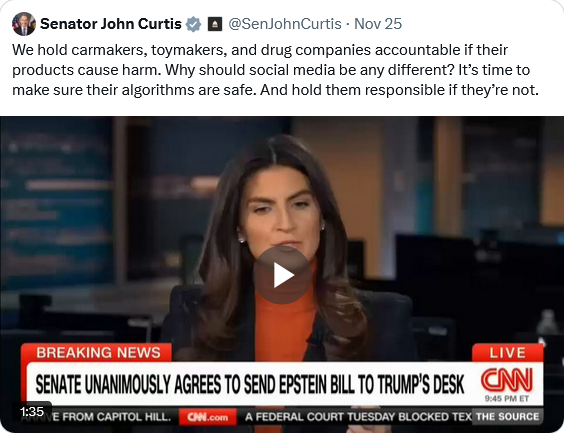
We all know what’s really going on here.

Utah senator John Curtis, and other political hacks like him, are getting their boomer asses handed to them on social media.

They long for the days of television, when they could control the narrative by having a cozy relationship with the networks, and so they could lie to you without fear of contradiction by some autist named @DataRepublican whose existence is solely defined by her full-time hobby of sniffing out lying dirtbags.

So they want to pass a bunch of laws to make the internet behave like television. To filter it all through a set of major website choke-points that they can control by threatening the corporate entities that run them.

Long, complicated, and vaguely defined liability laws are a tool to do that.

Basically what they do is allow John Curtis to put any website out of business if people say mean things about him on it, such as pointing out that he looks like some kind of deranged and malevolent goblin that just crawled out of a swamp.

The problem he has right now is that when I say stuff like that on Twitter, I’m the one who said it.

Not Twitter.

There’s nothing he can do to me. Because even if I get hit by a unmarked sedan tomorrow in a totally unrelated accident, there’s a million more people like me who are only too happy to point out that John Curtis looks like a deranged and malevolent goblin that just crawled out of a swamp.

So he wants legal tools to punish Twitter for what I said.

So how does he go about that? What is a deranged and malevolent goblin, with a “business management” degree, and a history of changing political parties when convenient, to do?

Why, muddy the waters with vague platitudes about “safety”, of course.

Except we’ve heard that song before, and we’re not interested. So let us laugh at him, remind him that he looks like a deranged and malevolent goblin that just crawled out of a swamp, and mock until he goes back to doing what he normally does, which is shilling for the “Fairness For High Skilled Immigrants Act”.

And then we can eventually replace him with someone who cares about fairness to actual fucking Americans.

Update, 29 November: Welcome, Instapundit readers! Please do have a look around at some of my other posts you may find of interest. I send out a daily summary of posts here through my Substackhttps://substack.com/@nicholasrusson that you can subscribe to if you’d like to be informed of new posts in the future.


CZ247: Experimental Swivel-Action SMG

Filed under: Europe, History, Military, Weapons — Tags: , , , , , — Nicholas @ 02:00

Forgotten Weapons
Published 16 Jul 2025

The CZ247 was developed for Czechoslovakia’s post-war submachine gun trials, where it was pitted against the ZB47. It was a simple blowback 9x19mm SMG with a number of interesting elements, most notably the ability to fire with the magazine either vertical or horizontal. In theory, this made the gun more compact for use in a jungle sort of environment (vertical) or to allow a shooter to get much lower to the ground when shooting prone (horizontal). In practice, it really isn’t very important, and requires a bit of extra complexity in the gun’s design. The CZ247 also has a neat safety mechanism for preventing unintended firing and a stripper clip guide built into the stock (both of which would be incorporated in the vz.48 SMG that was eventually adopted).

When the CZ247 failed to win the military trials, CZ got government permission to sell it on the export market. A contract for 10,000 guns was quickly obtained from Egypt, but before the guns could be shipped the export permission was cancelled by the government. Czechoslovakia opted to support Israel in its declaration of independence in 1948, and the government decided to not send weapons to Egypt which might be used against Israel. This left the guns sitting in CZ warehouses, and the basically all stayed there for a few decades. Eventually most were sold to Nigeria in 1967 and Ethiopian in 1977 — and as a result they show up occasionally in African and Middle Eastern conflict zones to this day.

Thanks to CZ for giving me the opportunity to take this example out to film and also to shoot for you!
(more…)

QotD: Life is not a race to some arbitrary “finish line”

Filed under: Books, Britain, Government, Media, Politics, Quotations — Tags: , , , , — Nicholas @ 01:00

On a friend’s Facebook page I left the following comment about the claim of the writer Abi Wilkinson (in the Guardian!) that inheritance should be confiscated by government to fund the UK’s welfare state. What could possibly go wrong?

I wrote:

    The hostility to inheritance also comes from a mistaken sense of fairness. As Robert Nozick argued in Anarchy, State and Utopia (I quote from memory), people wrongly think life resembles an athletics race, where the racers compete to hit the finishing line. As a result, those “lucky” athletes endowed by nature/god whatever with stronger muscles etc must be handicapped by having weights in their shoes, for example. Just as a child of rich parents must be deliberately held back to give poor kids a more “fair” chance of winning. But as Nozick said, life isn’t like that. It is about people exchanging goods, services and ideas with one another. There’s no fixed end-point to which we are all racing.

    Also, the idea that there is some “prize” that humans compete for implies that someone or some entity has created that “prize” in the first place. But that’s smuggling in a sort of communitarian assumption into the actions of individuals. In an open society, the prizes on offer are varied and multiply constantly.

I should add that the second section of Nozick’s renowned book dissects and ultimately rejects forced redistribution for egalitarian or other forms of “patterned” notions of justice, and he robustly defends what he calls an “entitlement” concept of justice.

One of the approaches that the late Prof. Nozick used was the thought experiment, such as the example referenced above about a fictitious athletics race in which the entrants are hampered/favoured to make the race more “even”, and then assuming that society in general should be like this. A race, held by people who know the rules and seek to abide by them, is not like an open society. “Open” is the key word here: there is no single end to which persons are heading, such as winning the race.

And yet a lot of the metaphors one comes across around discussions around equality, including equality of opportunity as well as outcome, seem to borrow, perhaps unwittingly, from this “race competition” worldview. To give another example, I remember reading some months ago about a university professor (Warwick) who suggested that when parents read stories to their children, this is a form of privilege. This also plays to the idea that life has a fixed end-measure of success, so that anyone giving a value to someone else is giving the latter an unfair “head start” on someone else. It would require a State to exercise totalitarian control of our actions from the moment we wake up to go to sleep lest our actions unfairly advantage/hamper someone in the “race” they are considered, by this worldview, to be on. (It also, by the way, shows that today’s Higher Ed. is full of certifiable fools and worse.)

Johnathan Pearce, “The assault on inheritance and the assumptions that drive it”, Samizdata, 2025-08-21.

Powered by WordPress

