
Assuming that this government or the next one follows through with current plans, the Royal Canadian Navy (RCN) will replace the four current British-built Victoria-class submarines with up to a dozen new subs based on either the German Type-212CD design or the South Korean KSS-III. There is no reason at all that these new submarines need to be built in Canada, as there is no existing shipyard with any experience in this kind of vessel and no chance that creating a domestic submarine industry would be anything more than a perpetual money-sink. Our existing shipyards can, at a stretch (and at a significant cost increase), build surface ships from small motorboats up to frigates, destroyers, and larger supply ships, but there’s always a hefty premium for building the hulls here because once the order is complete, the shipyard can rarely use that skilled workforce and their specialized expertise to build more ships for other navies, so the yards shrink, the workers move on and a decade or so later, we have to start all over again from basically nothing.
Submarines are even more specialized than the ships the RCN is likely to buy, and there’s almost zero chance an allied navy or a neutral power would choose to have submarines built in Canada. The head of the RCN, Vice-Admiral Topshee clearly recognizes this:
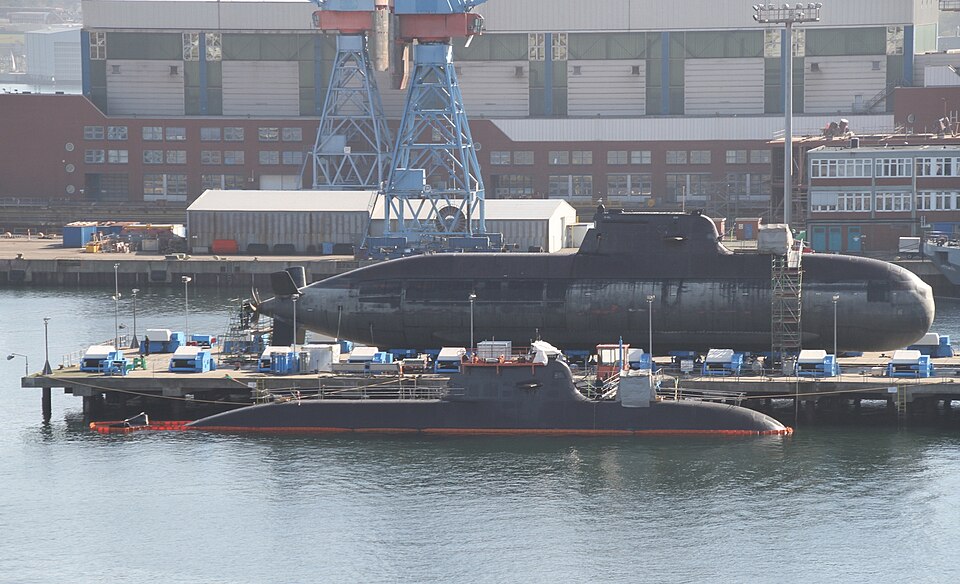
Type 212 submarines at the HDW shipyard in Kiel, Germany, 1 May 2013.
Photo by Bjoertvedt via Wikimedia Commons.
On Thursday in South Korea, Royal Canadian Navy Vice-Admiral Angus Topshee more or less kiboshed the notion of building new submarines here in Canada. He cited two major concerns: One, that we need these submarines “quickly.” And two, that our demand for submarines couldn’t possibly sustain an operation on its own.
“A submarine industry requires a consistent production line, and to be able to build enough submarines … to sustain a production line will be a real challenge,” Topshee said at the Hanwha Ocean Shipyard, where he, Defence Minister David McGuinty and Prime Minister Mark Carney tickled the periscope on one potential replacement for Canada’s aging-out Victoria-class subs.
Both Hanwha and ThyssenKrupp say it’s technically possible they could build the subs in Canada; it would just take a long time to lay down the infrastructure, and we’re in an uncommon hurry. We are assured plenty of Canadian steel and sweat will go into maintaining them.
And I suspect that won’t be very controversial, if at all. We’ve had American submarines, British submarines and German submarines in the past. Submarines are just something that are not made in Canada, like a lot of other things: jumbo jets, fighter planes, aircraft carriers, pineapples, cellular telephones, home electronics.
And we’re fine with it. Aside from the odd Avro Arrow obsessive, everyone seems to accept we’ll be buying new fighter jets off the peg from abroad — assuming we ever come to a final decision on which to buy, of course.
The question is, why isn’t that controversial? Or, why is it by contrast seen as controversial to buy surface vessels from abroad. Whoever’s fault it is, Canadian shipbuilding for the navy is a scrapyard of blown deadlines, outrageous cost overruns and sometimes outright failure. If we’re happy with South Korean or German subs, why not South Korean or German or Danish frigates and destroyers — or passenger ferries, for that matter?
Until this silly “elbows up” narrative took hold, no one seemed to care very much where our ferries were built: Marine Atlantic sails Chinese-built ferries between Cape Breton and Newfoundland with barely a whisper of controversy. But the entire political class is now essentially united against BC Ferries’ decision to buy Chinese ferries from the same shipyard. The fact that BC Ferries needs ferries almost seems like an afterthought.
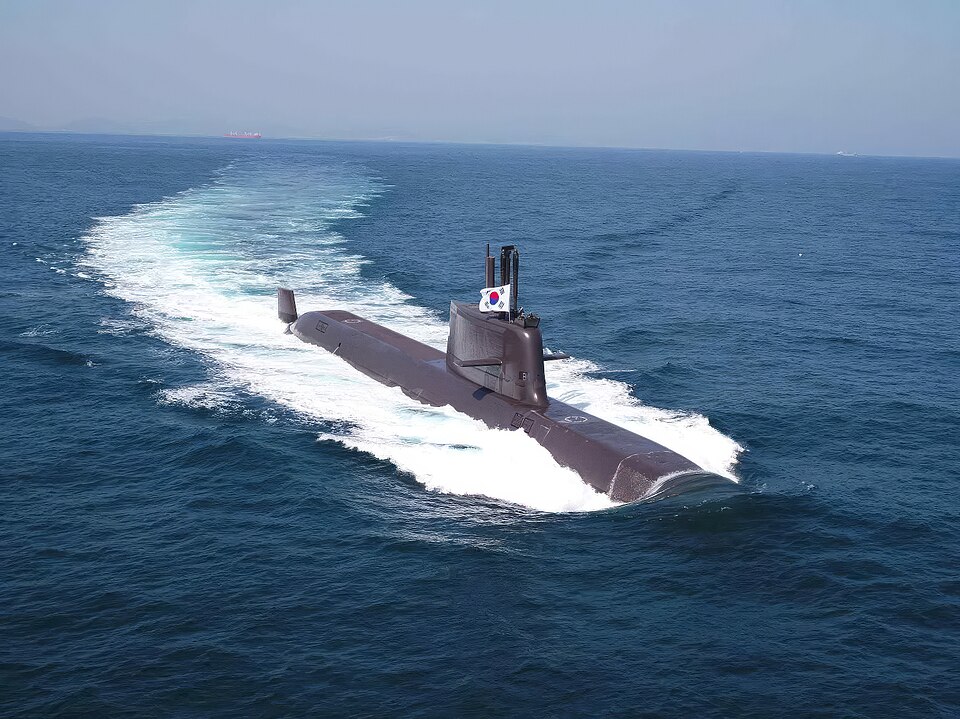
ROKS Shin Chae-ho, a KSS-III submarine at sea on 4 April, 2024.
Photo from the Defense Acquisition Program Administration (DAPA) via Wikimedia Commons.
Update: Noah posted a Q&A session with his readers that included some comparisons of the two contending designs for the Canadian Patrol Submarine Project (CPSP):
Q4. Have you had a chance to compare the AIP on the Ks III & 212CD yet with respect to Time underwater. There are different numbers floating around with new systems?
The truth is that no manufacturer is going to give you the accurate endurance. None. That is a closely guarded secret. I can say the KSS-III is higher, though out of respect for everyone and to not get myself in trouble I won’t say numbers. Both have endurance of several weeks and fit the HLMR.
I do plan to go into details about the systems themselves soon though, so I’m not leaving it alone!
Q5. The Type 212 has been described as an “ambush” submarine silently lying in wait for Russian subs. What advantages does the 212 bring to the Pacific?
Understand that both the KSS-III and Type 212CD are products of different needs and philosophies. Both focus on different strengths, in this case the 212CD puts almost all its efforts into being as stealthy and quiet as possible.
Its not just about ambush. Its about survival. The Type 212CD is designed to operate in the shallow, tight waters of the Baltic, and the littoral regions of the North Sea. That isn’t just about submarines but also being survivable against a dense field of Russian Maritime Patrol Aircraft and Anti-Submarine Helicopters.
That means a lot of effort was taken to ensure they’re as quiet and undetectable as possible. That’s where things like the Diamond-Shaped hull are supposed come into play, the use of non-magnetic stainless steel.
A lot of its value comes in what role you expect it to play. It is still an excellent asset in the littoral regions of the pacific, however it isn’t optimized for prowling around the open ocean, deep-diving nature of the Pacific. That is the domain of platforms like the KSS-III, at least in my opinion.
That doesn’t mean it can’t, but just as the KSS-III can also operate in the littoral regions of the Baltic doesn’t mean it’s optimized too. That’s the thing about CPSP. There’s a lot of requirements, a lot of different environments we expect these subs to operate in, and both [designs] focus on different priorities.
The advantages it has as a stealth-optimized platform don’t disappear. It could easily act in complement to other assets like U.S. and future Australian SSN [which] are more optimized for operations in the wider Pacific.
Strengths and weaknesses.
Update, the second: South Korea looks to be joining the nuclear-powered navy club with a new class of Korean subs to be built in Philadelphia using US navy nuclear propulsion technology.
South Korea has been wanting to get in the SSN club for a long time. Good on them for their persistence.
I’m not sure how this will work out. The Philadelphia Shipyard, even at its heyday, never built nuclear powered ships of any kind.
The South Koreans build a solid conventional submarine, the KSS-III that they offered to Canada recently, but nuclear submarines are at another level. Besides the infrastructure issues specific to nuclear shipbuilding at the shipyard that would need to be addressed, there is the fact that the U.S. nuclear workforce and hardware providers are already behind schedule with expected demands. While another yard is great, whoever is going to successfully solve those two structural issues needs superhuman abilities and one heck of a funding line.


