
Quotulatiousness

October 28, 2025

Whitechapel protest – “an unholy union of witless leftists and menacing Islamists”

Filed under: Britain, Media, Politics, Religion — Tags: , , , , , , — Nicholas @ 05:00

In Spiked, Brendan O’Neill discusses the weekend protest in the Whitechapel area of London, after the police had prevented a UKIP event in the same part of the city:
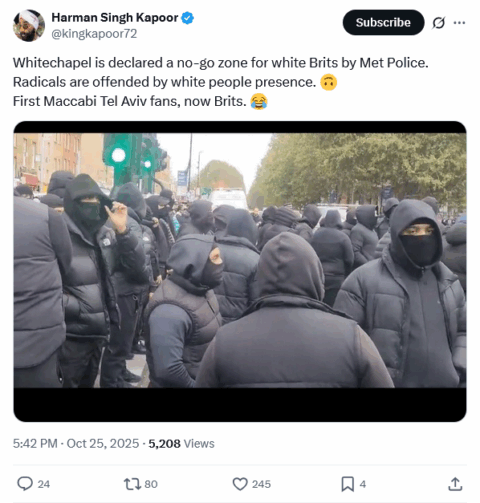
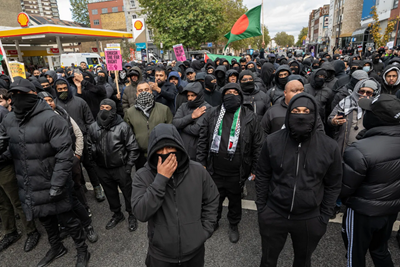
The next time someone asks what we mean when we say “Islamo-left”, I’m going to show them footage from yesterday’s protest in Whitechapel in East London. What a morally suicidal schlep that was. What an unholy union of witless leftists and menacing Islamists. “Refugees welcome here!”, cried the granola-fed grads of the limp-wristed left. “Allahu Akbar!”, barked the masked mob of religious hotheads. Rarely has the lethal idiocy of the left’s bed-hopping with Islamism been so starkly exposed.

This assembly of godless genderfluids and Koran-botherers was ostensibly a march against UKIP. That knackered old party had hoped to hold its own protest in Whitechapel yesterday. It was clearly a provocation: they targeted Whitechapel precisely because it has a large Muslim population. A Ukipper’s wet dream is to wang on about “Islamist invaders” and the need for “remigration” as Bangladeshi Brits look on with alarm. A wind-up masquerading as a march. The Metropolitan Police, fearing “serious disorder”, put the kibosh on it and told UKIP to do their wailing elsewhere.

So they went to Whitehall instead. Around 75 of them gathered outside the London Oratory with their flags and their hernias. And Whitechapel was left to the Islamo-left, to that seething mob of plummy radicals and gruff Islamists who love to scream blue murder about “Zionists”. And there you have it: in the eyes of the Met it is an offence against decency to let a handful of Ukippers traipse through Whitechapel, but it is absolutely fine to surrender those same streets to columns of black-clad fanatics raging against “Zionist scum“. The hypocrisy stinks to heaven.

The anti-UKIP counter-demo in Whitechapel was not an anti-racist march. We all know it. The dogs in the street know it. It was an orgy of intolerance dolled up as tolerance. It was a display of Islamist arrogance wearing the thin veil of “anti-racism” to fool the overeducated idiots of the bourgeois left. Well, if they’ll believe someone with a cock can be a lesbian, they’ll believe Islamist fanatics who dream of annihilating the Jewish homeland are anti-racists.

For those of us who still have a quaint attachment to the virtues of reason and secularism, it was a sickening spectacle. Mobs of men in black masks hollered Islamist slogans in a distinctly menacing manner. They denounced “Zionist scum” and darkly promised to hound them “off our streets”. They yelled “From the river to the sea” (translation: destroy the Jewish homeland) and sang the praises of “our martyrs” (translation: the Jew-killers of Hamas). And all the while, the pricks of the new left who think it’s bigotry to say “he” about a fella in a dress just stood there smiling.

Anyone who says “They were just criticising Zionism” is going to get slapped. Our crisis is too pressing for pussy-footing. When the devotees of a hardcore species of Islam take to the streets to fume about “Zionists”, we know who they mean. We know they don’t mean people like me – Gentiles who support Jewish nationhood. It’s not the likes of us they want to drive out of Britain, 1290-style. It’s them. Those Zios. The kippah people. Are we really going to do that dumb dance of saying, “Criticising Zionism is not the same thing as hating Jews”? Stop it. I’m tired.

Here’s my question: why is it racism for Ukippers to dream of expelling “Islamist invaders” from the UK, but anti-racism for Islamists and their posh simps on the left to agitate for the expulsion of “Zionists” from Britain’s streets? I agree UKIP’s chants were racist. To brand Muslims “Islamist invaders” and demand their “remigration” is vile bigotry. But why can’t the left say the same about the Zio-bashing that we all know is Jew-bashing? Far from calling that out, they snuggle up to it. They fancy themselves as the righteous enemies of racism when in truth they are the obsequious fluffers of Islamist bigotry.

Andrew Doyle on the “useful idiots” at the protest:
There is a species of leftist that is so blinded to the lack of compassion in its enemies that it sees them as friends. The Chinese even have a word – baizuo (白左) – to describe white Western liberals whose generous nature leaves them open to exploitation. I am reminded of Nietzsche’s remark in Beyond Good and Evil (1886): “There is a point in the history of society when it becomes so pathologically soft and tender that among other things it sides even with those who harm it, criminals, and does this quite seriously and honestly”. For the most egregious example of recent years, look no further than the absurdly self-defeating phenomenon of “Queers for Palestine”.

What happened at Tower Hamlets this weekend was a show of strength. The video footage makes that clear enough. Men blocked the streets to pray to Allah in public as a sign of religious dominance, while other men roamed aggressively, virtually daring anyone to object. Women were notably absent.

These chest-thumping, territorial displays followed the Metropolitan Police’s decision to ban a UKIP march through the East End under the banner of “reclaim Whitechapel from the Islamists”. With a significant Muslim population in the area – 40% in Tower Hamlets – this was always bound to provoke. Of course, protests are by their nature provocative, or they wouldn’t be protests. Islamic supremacists are likewise permitted to march peacefully, but we shouldn’t be foolish enough to ignore what this demonstration portends.

The End of European Superpowers? The Suez Crisis – W2W 050

TimeGhost History
Published 26 Oct 2025

Egypt nationalizes the Suez Canal, Israel strikes under a secret Sèvres pact, and Britain and France launch Operation Musketeer, only to meet U.S. and UN pressure that forces a ceasefire at midnight.
UN peacekeeping is born, Nasser’s stature soars, and Eden’s government collapses as Suez ends the illusion of old imperial power.
(more…)

Arguments against importing skilled workers

Filed under: Business, Cancon, Economics, Government, Media, Politics — Tags: , , , , — Nicholas @ 03:00

I’ve been against the importation of huge numbers of unskilled workers — which we have been doing at an ever-increasing rate over the last ten years — but I generally accepted the need for bringing in those immigrants with skills and talents we needed. On his Substack, Spaceman Spiff argues against even skilled immigration:

In most Western countries there is a determined campaign to normalize skilled immigration. It is not just pursued but celebrated as both enlightened and necessary for our survival.

This is so much a part of the West we overlook the observation it is rejected in most parts of the world.

Foreign people now compete with us inside our borders rather than safely outside. Individuals with whom we will typically share no history, heritage or even outlook, all needed for a stable society. In some cases, groups hostile to our way of living and unwilling to maintain it, even working to undermine it, a recipe for conflict.

When explained in plain English it clearly is an unusual thing for anyone to accept.

We need skilled workers

The importation of skilled workers is always sold as a positive. They are educated or they bring niche talents. They improve our competitiveness to help us take on the world.

The sales pitch is relentless. Even those uncomfortable with rapid demographic change parrot claims about the benefits of foreign workers who then compete with domestic workers.

We are told we are lucky to be able to attract such amazing talent as if the immigrants are choosing from a buffet of impressive options rather than fleeing poverty and corruption as is usually the case.

When all else fails, and the narratives are questioned, they trot out the classic line, that the immigrants do the work our own people won’t do. Naturally they erase the last clause in that sentence, they do the work our own people won’t do for the money offered.

Interchangeable units

We are told many of the blessings of the West would not be possible without importing talented foreigners, despite all evidence to the contrary, not the least of which is the social, economic and technological black holes many of them come from.

If they are so talented why are their homelands so disastrous?

Such obvious questions are discouraged. Instead we are encouraged to think of it as gaining access to the best from around the world, as if countries are just collections of interchangeable economic units.

We are told it is like building up a sports team. The emphasis is on the excellence of the players. The world-class performance is a consequence of being able to cast such a wide net.

But it is really more like drafting in men to play in women’s sports leagues.

AR-1 “Parasniper” – The First Armalite

Filed under: History, Military, USA, Weapons — Tags: , , , , , — Nicholas @ 02:00

Forgotten Weapons
Published 11 Jun 2025

The first rifle produced by Armalite began in 1952 as a project between the brothers-in-law, Charles Dorchester and George Sullivan (no relation to later Armalite engineer L. James Sullivan). Sullivan is the chief patent attorney for the Lockheed Aircraft Company, and the two have the idea to produce an ultra-light rifle using aircraft industry materials like fiberglass and aluminum. They create a company called SF Projects and get to work using Remington actions. They fit aluminum (and then later aluminum/steel composite) barrels and foam-filled stocks and the result is a rifle that weighs less than 6 pounds with a 4x scope fitted. The first ones are chambered in .257 Roberts, but this shortly gives way to the new .308 Winchester cartridge.

Sullivan and Dorchester make a connection with Richard Boutelle, who is very much a “gun guy” himself and also head of the Fairchild aircraft company. The idea of the rifle appeals to Boutelle, and Fairchild was looking to diversify its operations – and so Fairchild agrees to buy SF Projects, renaming it the Armalite Division of Fairchild.

The idea of the rifle was for civilian hunters who want a gun that is light to carry for long distances and also military specialists like airborne troops who need lightweight gear. The Army tests the AR-1 in 1955 and finds some fairly serious problems with it. There are reliability issues, and also accuracy shortfalls. When the composite barrel heats up, differential stresses cause the point of impact to shift. This foreshadows the catastrophic failure of a composite barrel in AR-10 testing, but that is a story for another video. Ultimately after two rounds of testing the Army rejects the rifle, and that is pretty much the end of it. Armalite moves its focus to other projects, namely combining aircraft industry materials with the self-loading rifle of their other designer, Eugene Stoner. That, of course, will become the AR-10.

Since I know folks will ask, the AR projects between 1 and 10 were thus:
AR3: Stoner-type rifle in hunting configuration
AR5: Air Force survival rifle
AR9: Shotgun
The designations 2, 4, 6, 7, and 8 were set aside to drawing board projects that never materialized.
(more…)

QotD: Pyrrhus after his bloody defeat of the Romans at Heraclea

What comes next, of course, is that Pyrrhus seemingly fails to capitalize on his victory – but I think in reality the opportunity to capitalize in the way that most folks imagine wasn’t really there.

On Pyrrhus’ side, his army had been bloodied, but was mostly intact and was almost immediately bolstered by the arrival of his Italian allies, including the Lucanians and Samnites, along with the Tarantines. On the Roman side, Laevinius’ army was battered, but still extant; he fell back to Roman-controlled Campania, eventually taking up a position at Capua, the chief city of that region. Pyrrhus then marched north, entering Campania, bypassing the Roman force at Capua (which had been reinforced with two legions pulled from Etruria) and entering Latium, apparently getting within about 60 kilometers (c. 37 miles) of Rome (Plut. Pyrrh. 17.5). And here the question students as is why not take Rome?

And there is an easy answer: because he couldn’t.

The first thing to remember here is the natural of the human-created terrain Pyrrhus has to operate in: functionally all of the cities of any significant size in third-century Italy were likely to be fortified and their populations – thanks to Rome’s recruitment system – experienced and armed. Consequently, if the locals didn’t voluntarily switch sides, Pyrrhus would have been forced to take their settlements either by siege or storm. Pyrrhus might well have hoped that the Campanians would go over to him, but here the problem is the human geography of Italy: his army is full of Samnites, whose emnity with the Campanians is what started the Samnite wars. This is a feature of Rome’s alliance system noted by M.P. Fronda in Between Rome and Carthage (2010): because Rome extended its alliance system by intervening in local rivalries, both sets of new “allies” had long-standing grudges against the other, which makes it hard to dismantle Rome’s alliance network, since any allies you peel away will push others closer to Rome.

In the case of Campania, Capua might have felt strong enough to try their luck without Rome, but that’s why Laevinius was sitting on it with a large army. But the other Campanian cities (of which there were about a dozen) might well fear exposure to Samnite raiding without Rome’s protection. Meanwhile, the Latins – the people of Latium, the region immediately to Rome’s south (technically Rome is in Latium, on its edge) – seem to have been pretty profoundly uninterested in siding against Rome either at this juncture or later when Hannibal tries to dismantle Rome’s alliance system.

So after Heraclea, Pyrrhus has fairly limited options: he can start the slow process of reducing the cities of Campania one by one to open the logistics necessary to permit him to operate long-term in Latium or he can conduct a lightning raid through Roman territory to try to maximize the psychological effect of his victory and perhaps get a favorable peace. He opts for the second choice and when the Romans opt not to take the deal – though they do consider it – he has to pull back to southern Italy (where he focuses on consolidating control, pushing out the last few Roman positions there).

Why not attack Rome directly? Well, Rome itself was fortified, of course. Moreover, the Romans had raised a fresh levy of troops for its defense (Plut. Pyrrh. 18.1), while dispatching Tiberius Corucanius with his army to reinforce Laevinius in Capua. So as Pyrrhus enters Latium, he has a well-defended fortified city in front of him and a Roman army of, conservatively, 30,000 men (Corucanius’ 20,000 men, plus whatever was left of Laevinius’ army) behind him. I don’t usually quote movie tactics, but Ridley Scott’s Saladin has the right wisdom for this problem: “One cannot maintain a siege with the enemy behind“. Had Pyrrhus stopped to besiege Rome, his supply situation would have quickly become hopeless as the Roman army behind him could have easily prevented him from foraging to feed his army during the long process setting up for an assault on the city, which might then simply fail, since the city was well-fortified and defended.

If Plutarch (Pyrrh. 18.4-5) is correct about the terms Pyrrhus offered – an alliance with Rome, a recognition of their hegemony over Italy outside of his new clients in southern Italy (who would of course, fall under Pyrrhus’ control now) – Pyrrhus may have hoped at this juncture to consolidate southern Italy and turn back towards the East or perhaps head on to Sicily. But the Romans refused the deal and so Pyrrhus seems to have set above clearing out the last Roman strongholds (Venusia and Luceria) in Apulia to consolidate his hold. The Romans responded in the following year by sending a new army, under the command of Publius Sulpicius Saverrio and Publius Decius Mus to challenge him and they met at Asculum, in northern Apulia.

Bret Devereaux, “Collections: Phalanx’s Twilight, Legion’s Triumph, Part IIIb: Pyrrhus”, A Collection of Unmitigated Pedantry, 2024-03-08.

Powered by WordPress


