
To many western liberals, an aristocratic system is a disparaged and vestigial remnant of the distant past. An echo of the “bad old days” of anti-meritocratic wealth and privilege enjoyed by the lucky descendants of ancient conquerors and oppressors. Yet among the most well-connected and powerful people in China can only be described as “princelings”, as they are literally the children and grandchildren of the leaders of the Communist Party, especially those who took part in the “Long March”:
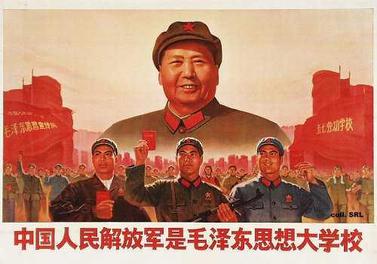
“The Chinese People’s Liberation Army is the great school of Mao Zedong Thought”, 1969.
A poster from the Cultural Revolution, featuring an image of Chairman Mao, published by the government of the People’s Republic of China.
Image via Wikimedia Commons.
In 1926, five years after becoming one of the founders of the Chinese Communist Party (CCP), Mao Zedong listed China’s enemies as “the warlords, the bureaucrats, the comprador class [businessmen dealing with foreign interests] and the reactionary section of the intelligentsia attached to them”. It is ironic that Mao would eventually create a new aristocracy, often referred to as the “princelings” (taizidang), every bit as hierarchical as that against which he had previously railed.
Perversely, when Mao Zedong came to power in China in 1949, there were not many structures of authority left to destroy. In the period of warlordism that succeeded the overthrow of the Qing dynasty by Sun Yat-sen in 2011 and ended with the consolidation of nationalist (Kuomintang) power by Chiang Kai-shek in 1936, the aristocracy of imperial China had been swept away. So too the Mandarin class, the Chinese bureaucrats selected by civil service examination, a system that started with the Sui dynasty in AD 581. As for the Chinese aristocracy, its last vestiges ended with the abolition in 1935 of the Dukedom of Yansheng which belonged to the descendants of Confucius.
So, in terms of social hierarchies, Mao inherited a clean sheet when he established the People’s Republic of China on October 1, 1949. The CCP leadership soon proved that, in the immortal words of George Orwell in his novel Animal Farm, “all animals are equal, but some animals are more equal than others”. In Beijing, Mao and China’s CCP leaders took residence in the palatial compounds located in Zhongnanhai, a waterside park established by the Yuan dynasty in the 13th century.
There is not even equality within the “red aristocracy”. Gradations are as clear-cut as if there were princes, dukes or marquises. The highest rank is accredited to the offspring of those CCP leaders who participated in the Long March. This iconic fighting retreat to a remote plateau in Shaanxi province followed the defeat of the Red Army in October 1934.
It is perhaps difficult for people in the West to understand the scale of Chinese veneration for the individuals who completed the Long March. With the possible exception of the migratory treks along the Oregon Trail, there is no comparable event in American or European history. Throughout their lives, leaders of the Long March enjoyed unparalleled prestige; it was a prestige that passed down to their children – hence the princelings.
The creation of the red aristocracy started with Mao himself. Within a few years of the establishment of the People’s Republic of China, Mao became a de facto emperor. On occasions he even referred to himself as such. He certainly lived the life of an emperor. At his commodious palace in Zhongnanhai, Mao surrounded himself with a harem of dancing girls who would occupy his bed and his swimming pool. In time-honoured fashion, China’s head of security and intelligence, Kang Sheng, procured girls for Mao as well as thousands of volumes of pornography.
[…]
My own experience of the princeling world confirmed that in China, despite its vast population a very small group of families form a governing nexus that has power far beyond its numbers. It is a group that seem to be getting stronger. The princeling proportion of the CCP central committee rose from 6 per cent in 1982 to 9 per cent in 2012. When I spoke to a princeling friend about the politburo standing committee that was elected in 2012, she told me that she personally knew five of its seven members; to her great delight three of them were princelings. It was through her that I met Deng Xiaoping’s daughters and spent a “country house” weekend with them and her princeling pals.
Here it became clear that, while most of the princelings I met were reformists in the Deng mode, there are also factions that are hard-line Maoists, like the one led by Xi Jinping. At the moment it appears that the reformist princelings have gained the upper hand. More light on Xi Jinping’s future and the outcome of this princeling tug of war may be shed at the Fourth Plenum of the 20th CCP Congress starting on October 20.


