Quotulatiousness

October 12, 2025

Restricting activism from the bench

Filed under: Britain, Government, Law, Liberty, Politics, USA — Tags: , , , , , — Nicholas @ 09:05

As we’ve seen far too many times in Canadian courts, when judges become politically active, they can produce far worse situations than the politicians who cynics might say are specialists in that discipline. British judges, however, are still well ahead of their Canadian counterparts:
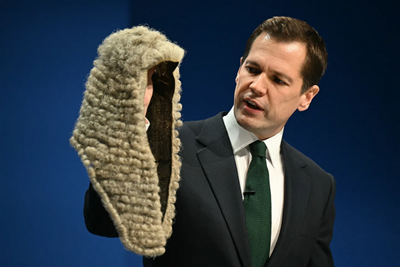
Until judges are replaced by robots, we will have to accept the reality of activist judges. Even the most august patriarch of the bench cannot wholly escape his innate human biases. And so perhaps there was something in Robert Jenrick’s speech at this week’s Conservative Party Conference, in which he announced that, if elected, the Tories would empower the Lord Chancellor to appoint judges and more carefully scrutinise their political activities.

Those who have supported the ideological capture of our major institutions were understandably furious. The New Statesman claimed that Jenrick had “declared war on the judiciary”. But then, the New Statesman is an activist publication which can make no serious claim to impartiality or sound journalistic standards. (Those in any doubt about its mendacity should take the time to read about its shameful treatment of Roger Scruton.)

The problem of an activist judiciary is currently preoccupying the White House, given that a number of federal judges have attempted to block executive policies or have issued nationwide injunctions. Trump himself was convicted on thirty-four felony counts by a judge who had made small political donations to Democratic-aligned causes. It seems clear that given these circumstances he ought to have recused himself. The entire case, of course, was an example of the law being twisted for politically partisan ends. (The best overview is by the senior legal analyst for CNN, Elie Honig, which can be read here.) Little wonder that Trump now appears to be seeking revenge through the courts.

In the UK, there have been a number of revelations of judges tied to political causes whose claim to impartiality seems shaky at best. During his speech, Jenrick spoke of those judges who have been associated with pro-immigration campaign groups and have “spent their whole careers fighting to keep illegal migrants in this country”. Many commentators have observed a generalised bias toward asylum applications, sometimes to an absurd extent. Who could possibly forget the Albanian criminal whose deportation was halted by an immigration tribunal on the grounds that his ten-year-old son did not like foreign chicken nuggets?

Leaving such outliers aside, most of us will have noticed patently ideological remarks occasionally uttered by judges during sentencing. In the Lucy Connolly case, the judge explicitly expressed his support for the creed of DEI before sentencing her to 31 months in prison for an offensive and hastily deleted post on social media. “It is a strength of our society that it is both diverse and inclusive”, he said. It couldn’t be much clearer than that.

That lawfare has become a major weapon in the settling of political disputes should trouble us all. Judges are not accountable to the electorate, and so any suggestion that they are exercising power for their own political ends is bound to be interpreted as a threat to democracy. Inevitably, Jenrick’s criticism of activist judges, and his call for them to be removed, has led to some commentators assuming that he would prefer judges who simply acted according to the government’s bidding. That way lies tyranny.
A second American Civil War would not resemble the first one

Filed under: History, Military, Politics, USA — Tags: , , , , — Nicholas @ 05:00

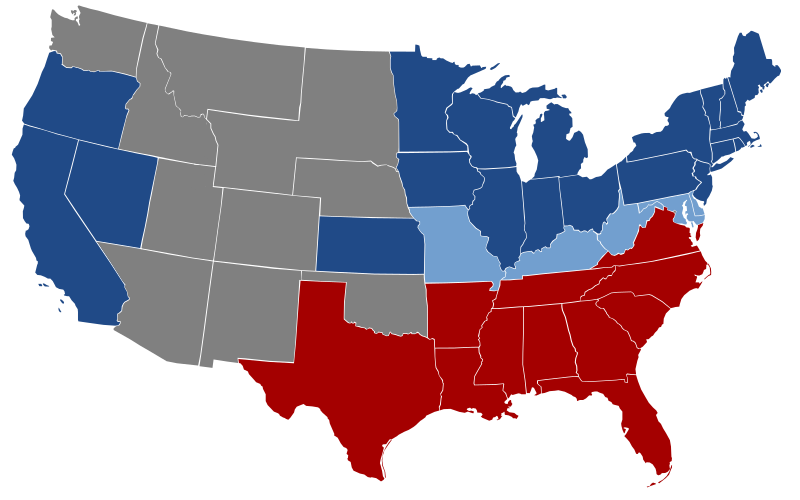
The American Civil War, if you try to look at the big picture, started off with the states dividing as this Wikipedia map indicates (although no state was all secessionist or all unionist, of course):

Union states in blue (light blue for states that permitted slavery), Confederate states in red.
Map by Júlio Reis via Wikimedia Commons.

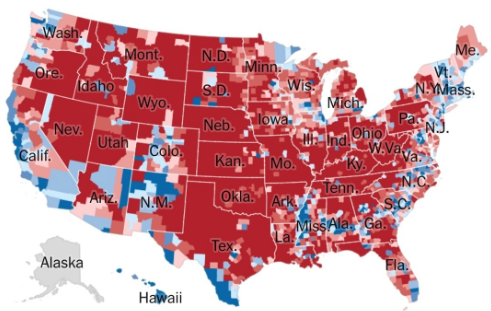
Potential lines of demarcation today, well, here’s a guess from a few years ago based on county voting patterns, and again it’s still an approximation:

Any civil strife on this modern battlefield will be very unlike the organized Union and Confederate armies of 1861-65 having stand-up battles against one another in the countryside. Tom Kratman wrote about a potential civil war breaking out several years ago and has reposted the first part on his Substack:

I can’t quite shake the feeling that the side that wins any new civil war, to the extent that anyone can be said to “win” such a frightfulness, will be the side that a) engages in as humanitarian a form of ethnic and political cleansing as possible, first, and b) shoots second. I say “as humanitarian … as possible” because, as previously discussed,1 we are not a nation of red and blue states. Rather, instead of red and blue states, we are, as discussed a couple of years ago, “counties and neighborhoods and streets and the couch versus the bedroom after an argument with a spouse or significant other over political matters”. In short, anyone who engages in really harsh internal security measures will tend to drive people who should be its friends over to the other side. Since I’m writing this on behalf of the more or less anti-bolshevik, anti-progressive, anti-SJW2 half of the country, let me emphasize that, when the northeast, the left coast, “Yes, we old retired farts can be bribed by robbing the future” Florida, “Under the Fairfax County Bootheel” Virginia, “Cannot control Baltimore” Maryland, and CorruptionRus Illinois, unchained from the restraints we’ve imposed on them, go full lunatic lefty, let them turn into Beirut of the 80s while we try to maintain something approaching civilization as long as we can. Yes, that means I think it would be easier for us to conquer or reconquer a California devolved into its own civil war if we can avoid the same in our areas.

Note that it’s a fine line we’ll have to try to walk, rounding up those who would turn us into Beirut, without rounding up those whose rounding up will cause their friends and family to turn us into Beirut. My suggestion would be using extreme measures for those who are certain enemies, but safe and comfortable lagering or exile for those about whom there might be some doubts.

Though I may find it distasteful, honesty compels that I not shy away from that other aspect of securing the base areas, ethnic cleansing. If this nightmare comes to pass then ethnic cleansing is going to happen, I am certain, to at least three groups, Moslems, Blacks, and Hispanics. Some of it will probably come in the form of self-exile, but I would be very surprised if more of it isn’t forced. So let me throw a little damper on the KKK/alt-white-wing of my readership, if any; Trump is leading by comfortable margins in Louisiana (over a third Black and Hispanic), Mississippi (close to 40% Black and Hispanic), and Alabama (over a quarter). He’s not leading in those places by the kinds of margins he is without a more than fair sprinkling of Blacks and Hispanics, who will not be much like the rioting for fun and profit thugs of Black Lives Matter (and White Lives Don’t). Those people are us as much as anyone can be. It would be a grievous and perhaps unhealable wound to your alleged souls if you don’t treat them that way.


  1. http://www.everyjoe.com/2015/01/12/politics/breakup-of-united-states-terrible-idea/#1
  2. SJW stands for social justice warrior. Unlike many such epithets, this one was coined by the people to whom it applies. Think of idiot PhDs who call canoeing “racist”, the universe of the trigglypuffs, and those who consider eating a taco to be a crime against Mexicans, if not even a crime against humanity, which latter classification expressly excludes whites.

Update, 14 October: Welcome, Instapundit readers! Please do have a look around at some of my other posts you may find of interest. I send out a daily summary of posts here through my Substackhttps://substack.com/@nicholasrusson that you can subscribe to if you’d like to be informed of new posts in the future.

Inventing boring Sundays – a British innovation

Filed under: Books, Britain, Economics, History, Religion — Tags: , , , — Nicholas @ 04:00

Ed West ruminates on the phenomenon of boring British Sundays and explains how they got that way:

Nietzsche thought that this was the whole idea, that the English designed Sundays that way in order to encourage people to appreciate the working week. In Beyond Good and Evil, he described how “The industrious races complain a great deal about having to tolerate idleness: it was a masterpiece of the English instinct to make Sunday so holy and so tedious, a form of cleverly invented and shrewdly introduced fasting, that the Englishman, without being aware of the fact, became eager again for weekdays and workdays.”

There may be some truth in this, so that before the Industrial Revolution there was the “Industriousness Revolution”, with a new emphasis on work rather than leisure. This is something which Joseph Henrich noted from studying reports from the Old Bailey between 1748 to 1803, and “spot-checks” observations about what Londoners were doing at a particular moment:

    The data suggest that the workweek lengthened by 40 percent over the second half of the 18th century. This occurred as people stretched their working time by about 30 minutes per day, stopped taking “Saint Mondays” off (working every day except Sunday), and started working on some of the 46 holy days found on the annual calendar. The upshot was that by the start of the 19th century, people were working about 1,000 hours more per year, or about an extra 19 hours per week.

Before the Industriousness Revolution it was common for people to enjoy a number of saints’ days as holidays, including the three-day weekends offered by these “Saint Mondays”. That all changed with the arrival of Protestantism, with its scepticism towards saints’ days, William Tyndale arguing that these were only celebrated by convention and that there wasn’t anything special about them.

While they were keen to abolish holidays, the reformers also believed in making the Sabbath more godly, and so the Boring English Sunday was invented. This followed from a growing sense that leisure time was wasted time, but it was also the case that many of the Protestant reformers just didn’t like people having fun. In God is an Englishman, Bijan Omrani noted how “From the end of the 1500s, Puritan preachers condemned the way people generally spent their Sundays: ‘full heathenishly, in taverning, tippling, gaming, playing and beholding bear-baitings and stage-plays, to the utter dishonour of God'”.

Theologian William Perkins believed that Sunday “should be a day set apart for the worship of God and the increase in duties of religion”. Lincolnshire cleric John Cotton said in 1614 that it should be unlawful to pass Sunday without hearing at least two sermons; the idea of going to church twice would have filled my ten-year-old self with intense horror.

Hugh Latimer asked: “What doth the people do on these holidays? Do they give themselves to godliness, or else ungodliness … God seeth all the whole holidays to be spent miserably in drunkenness, in glossing, in strife, in envy, in dancing, dicing, idleness, and gluttony”.

Latimer also disliked holidays for quite modern-sounding reasons related to social inequality, noting that “in so many holidays rich and wealthy persons … flow in delicates, and men that live by their travail, poor men … lack necessary meat and drink for their wives and their children, and … they cannot labour upon the holidays, except they will be cited, and brought before our officials”.

The reverse argument is now made against allowing supermarkets to drop Sunday trading hours – that it pressures working people into excessive toil so that Waitrose shoppers don’t suffer any inconvenience. Although, reading Latimer, I can’t help but suspect that his real objection was to people having fun.

The reformers won, and English Sundays became notably dull. Banjani quoted children’s writer Alison Uttley, who said of Sundays that “Nobody ever read a newspaper or whistled a tune except hymns”.

Why the Roman Army Conquered the World – Adrian Goldsworthy

Filed under: Europe, History, Middle East, Military — Tags: , , — Nicholas @ 02:00

Nathan Watson
Published 10 Nov 2024

‪@AdrianGoldsworthytheAuthor‬ talks about the Roman Army and Diplomacy

QotD: Male privilege revealed

Filed under: Books, Health, Media, Quotations — Tags: , , , , , — Nicholas @ 01:00

Self-Made Man by Norah Vincent documents the author’s 18-month experiment living as a man named Ned. She decided to embark on this experiment to explore gender dynamics from “the other side”, so to speak. Vincent, a liberal journalist with a strong feminist background, decided she wanted to understand men’s lives and social roles from within. She recognized, accurately, that men change their behavior when a woman is present, and she was curious to see how they were when no women were around.

Vincent described herself as a “bull dyke” and held strong feminist views. She expected, throughout the course of the experiment to uncover the secrets of male privilege and the societal advantages that, she was sure, are afforded to men. She anticipated that living life as a man would validate her beliefs that men lead easier lives and wield unchecked power. She figured that, at the very least, she could enjoy a couple of years as a powerful male.

Vincent disguised herself as a man by getting a new hair style and giving herself a fake five o’clock shadow, among other things. She had always been considered rather masculine in her usual feminist and lesbian circles, so she figured she could pass rather easily as a man, if perhaps a slightly effeminate one. She was right.

Her initial assumptions changed when Vincent discovered that men, contrary to her expectations of power and privilege, face their own unique set of pressures and struggles. Men, she discovered, were expected to suppress any signs of vulnerability. This quickly led to feelings of extreme isolation that she did not expect. Nobody “had her back” because, as far as they knew, she was just a man, and should “man up”. She quickly realized that men do not have inherently easier lives. Her preconceived notions of in-born male advantage evaporated. She was getting worried.

She realized that women do not have empathy for the struggles of men.

Norah, as Ned, experienced the behavior of women toward men firsthand. At one point, she tried dating women as a man. She figured this would be incredibly easy for her. Not only was she a woman herself and knew how women think, but she was also a lesbian and already liked women. She worried at first that she’d be too good at it and would have to tell interested women that she was a woman to stop them from pursuing her.

The reality was sharply different from her expectations. Her apparent femininity came across as her simply being an effeminate man. This caused women to be disinterested in her and their rejections were dismissive, cold, and often extremely brutal. Women would sometimes treat her with suspicion or outright hostility as they assumed her intent was negative.

These interactions eventually led Vincent to start developing misogynistic thoughts. That’s right: women treated her so poorly when they believed her to be a man that she started to develop misogynistic thoughts.

Interestingly, many of the supposedly straight women she had attempted to date, even those who had been brutal and cold toward her, immediately expressed interest in a lesbian “hook-up” when she told them she was a woman who had been disguised as a man for the sake of journalism.

Perhaps there’s no such thing as a “straight woman”. Is there even a such thing as a lesbian?

CTCG, “UNDERCOVER: A Feminist’s Year Living as a Man”, Codex Trivium Cosmic Genesis, 2025-06-16.

Powered by WordPress