Quotulatiousness

October 7, 2025

Antifa and the “propaganda of the deed”

Filed under: Politics, Quotations, USA — Tags: , , , , — Nicholas @ 11:30

On the social media site formerly known as Twitter, ESR examines the irrational behaviour of Antifa as an inheritance from their chosen historical models:

“antifa 8973ag” by cantfightthetendies is licensed under CC BY 2.0

An important concept for understanding why the behavior of Antifa is not strategically rational is “propaganda of the deed”.

This is a concept with a long pedigree in left-anarchist theory, transmitted to Antifa via its minority “black flag” left anarchist faction

19th-century romantic anarchists viewed the state and capitalism as powerful illusions that could be shattered by bold, exemplary acts, thereby proving their vulnerability and offering hope to the oppressed. These deeds were intended to ignite the spirit of revolt by alerting the masses to the possibility of revolution, much like a spark that could set off a larger fire — thus, the emphasis on symbolic targets over objectively effective ones.

This kind of political communication could be effective if a majority of society, or at least a critical minority, are seething cauldrons of resentment just begging to be triggered against their oppressors. It also assumes that the revolutionary rage of the masses can, once unleashed, be effectively directed against Antifa’s enemies.

Both assumptions are highly questionable, but the important thing to understand for purposes of predicting Antifa’s behavior is that (a) Antifa behaves as though it still believes them, and (b) Antifa’s aboveground allies don’t have the capacity to restrain its behavior in detail.

The Gramscian infiltrators in the U.S.’s institutions need to keep their links to overt terrorism deniable, so they manage it mostly by raising or lowering the temperature of public propaganda. For example, when a Democratic politician says “Abolish ICE”, describes government actions as “fascism”, or wishes death on the children of a political opponent, this is raising the temperature. The effect, the intended effect, is to license increased propaganda of the deed by Antifa.

Reminder: unceasing damnation of conservatives as fascists and Nazis constituted instructions to stochastic terrorists like Tyler Robinson that the time had come to do something like shooting Charlie Kirk through the neck.

One problem with this is that because of Antifa’s psychology and doctrine, raising the temperature is easy, but lowering it is hard. Thus, it’s not a process the Gramscians want to start unless they believe either that they have escalation dominance over their opponents, or their political position is deteriorating so rapidly that they’ll never get a better chance to induce a legitimacy collapse.

It is out of scope for this essay to analyze to what extent those conditions are true. The point is, we are in a situation where the limited control Antifa’s aboveground allies can exert is all directed towards escalation, and Antifa’s belief in “propaganda of the deed” makes this very difficult to reverse.

Antifa has probably lost sight of the fact that escalating to insurrectionary violence is premature — it doesn’t have an army or a sufficiently powerful and nearby state sponsor for that.

Thus, absent serious degradation of Antifa’s capacity by law enforcement, expect increasing violence. Including, but not limited to, the deliberate murders of law enforcement personnel and opposing politicians.

Big management shake-up at Cracker Barrel’s corporate HQ

Filed under: Business, Media, Politics, USA — Tags: , , , , , — Nicholas @ 05:00

Back in August, the US chain restaurant field saw a corporation decide that doing what their customers wanted was actually a pretty good strategy … after they’d tried the opposite and nearly gone the way of Bud Light:

Last week was the Red Wedding for Cracker Barrel.

Some senior people who were in the headquarters office last Monday weren’t there anymore as the weekend drew near, some old managers from an earlier corporate culture came back to rewind the clock, and the branding consultant that advised on the now-fatally-wounded rebranding effort was sent packing. The new logo departed. The redesigned stores were acknowledged as a failure and an embarrassment.

[…]

See what they said about the redesign? “We won’t continue with it”. The whole thing collapsed, a $700 million rebrand that slammed into a concrete wall and exploded.

It remains to be seen how much the rebranding of the rebranding will matter, and this is what Cracker Barrel stock looks like in the last month:

Now, a reminder: The New York Times columnist David French explained, just over a month ago, that the controversy over Cracker Barrel’s rebranding was an absurd fake crisis ginned up by right-wing idiots who were just pretending that something had gone wrong at the company. Along with the Sydney Sweeney thing, he concluded that we were watching some “completely frivolous and meaningless cultural disputes,” examples of the way “right-wing media both mobilizes its base and bends political reality”. If you believed that the Cracker Barrel rebranding was poorly done and would alienate the company’s customers, you were falling for an invented reality that was completely meaningless and frivolous.

Then Cracker Barrel fired a bunch of managers and its rebranding consultant, abandoned the rebranding, and apologized profusely, while its stock plummeted.

If you listened to David French, if you trusted the op-ed pages of the New York Times to explain the world to you, your understanding of the most basic outline of factual reality was flipped over, turned precisely upside down. He was only wrong about literally every single detail, completely missing what was happening, what it meant, and what would happen in the near future as a result of it. To listen to this idiot is to abuse your own mind, trapping yourself in the confines of an absurd house of ideological mirrors. He is inevitably wrong, completely wrong, reliably wrong to the point of absolute and unyielding madness.

How a Myth Started the Nuclear Arms Race – W2W 47

TimeGhost History
Published 5 Oct 2025

The Bomber Gap: a mid-1950s panic that convinced Washington the USSR was outproducing the U.S. in long-range strategic bombers — and triggered a massive nuclear buildup. This episode traces Eisenhower’s New Look, Curtis LeMay and SAC’s push for jets, the Dulles brothers’ influence, the M-4 “Bison” bluff, and the Symington hearings that turned bad intel into national policy. Learn how politics, optics, and deliberate Soviet deception combined to accelerate the arms race and reshape deterrence for decades.

[NR: At Dominion Review, Palmiro Campagna discusses the missile gap and how it impacted the decision to cancel the Avro Arrow.]
(more…)

An unexpected Gen Z “influencer” – Shakespeare

Filed under: Books, Health, History, Media — Tags: , , , , , — Nicholas @ 03:00

Ted Gioia describes the plight of a young man who had to move home after college and falls into a state of depression thanks to his hopeless situation and his dysfunctional home and social life. His name is Hamlet:

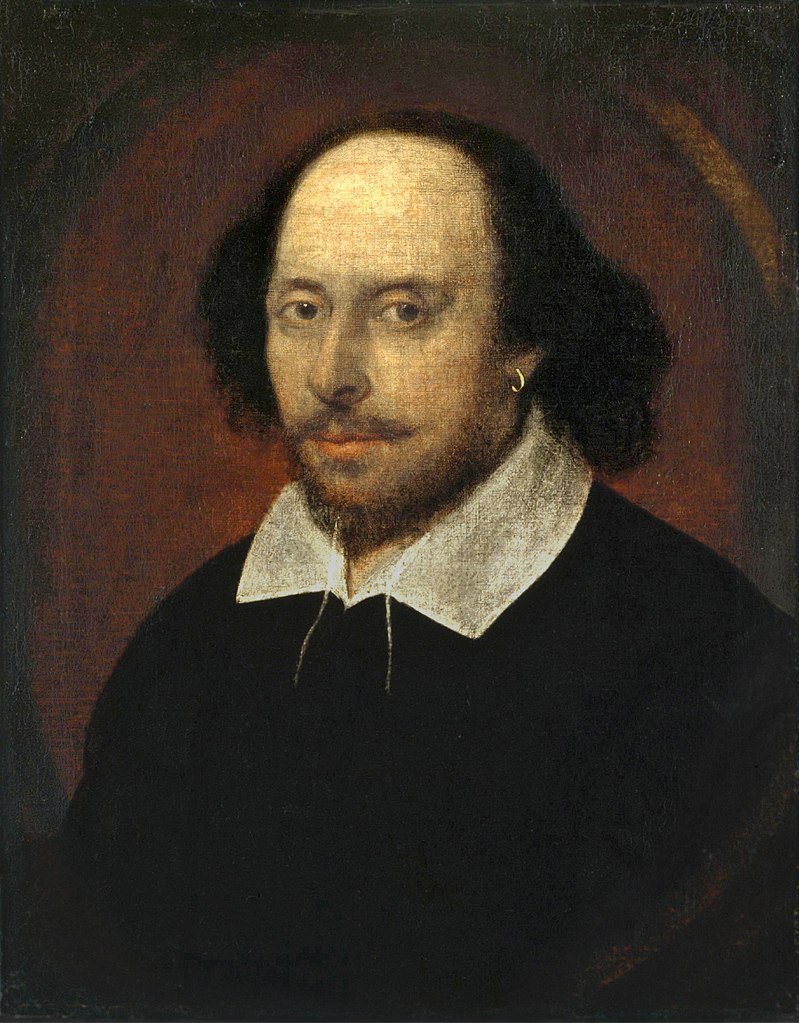
This was long thought to be the only portrait of William Shakespeare that had any claim to have been painted from life, until another possible life portrait, the Cobbe portrait, was revealed in 2009. The portrait is known as the “Chandos portrait” after a previous owner, James Brydges, 1st Duke of Chandos. It was the first portrait to be acquired by the National Portrait Gallery in 1856. The artist may be by a painter called John Taylor who was an important member of the Painter-Stainers’ Company.
National Portrait Gallery image via Wikimedia Commons.

It’s almost uncanny how relevant it feels right now.

So if I were directing Hamlet in the current moment, I’d give the title character an iPhone and game console. I’d have the characters onstage share photos on Instagram — and put up a big screen so the audience could see them posted in real time.

Hamlet could add pithy captions to his social media images. What a piece of work is a man! or maybe The lady doth protest too much!

Yes, Hamlet is many things, but one of them is, perhaps, a failed influencer.

Along the way, we may have answered the classic question about this play. For generations, critics have wondered why Hamlet wastes so much time, and can’t be bothered to take action.

Maybe he’s just too busy gaming and scrolling.

Okay, it sounds ridiculous. But is it really? Shakespeare possessed tremendous insight into the human condition — perhaps more than any author in history. So maybe he really did grasp the dominant personality types of our own time.

The Prince of Denmark still walks in our midst. And maybe — just maybe — careful attention to this play might help us, in some small degree, to heal the Hamlets all around us. Their number is legion.

Of course, the larger reality is that Shakespeare has proven himself relevant to every time and place. We can see that easily be examining how other generations viewed this same play.

Hamlet‘s original audience, four hundred years ago, clearly enjoyed the spectacle of violence and adultery. Nine key characters die during the course of the play — most of them murdered. Audiences loved these kinds of dramas back then, and Shakespeare always knew how to please the crowd.

But more sophisticated viewers, circa 1600, would have seen Hamlet as a political commentary — a reflection of all the tensions and rivalries of Elizabethan England. Nobody knew better than Shakespeare that monarchy is a dangerous game, and he always looked for opportunities to refer to current events in roundabout ways.

But two hundred years later, the Romanticists were in ascendancy, and they saw Hamlet as a very different kind of play. They ditched the politics, and embraced the Prince of Denmark for his pathos and personality. They tapped into the intense emotional currents of Shakespeare’s heroes — and the plays seemed perfectly suited for this kind of interpretation.

It’s no exaggeration to say that Hamlet continued to change for each new generation. He always feels timely and relevant.

A hundred years ago, critics began grappling with psychology and the unconscious — and Hamlet was a perfect character for these kinds of interests. In his 1900 book The Interpretation of Dreams, Freud focused on Hamlet as a case study in repression.

And who could disagree?

But fifty years later, Hamlet changed again. It now was the perfect play for those who had survived World War II. Jan Kott insists, in his book Shakespeare, Our Contemporary, that these old plays were more relevant than ever during the Cold War — just as timely as Beckett or Sartre or Brecht or Ionesco.

C93 Borchardt: the First Successful Self-Loading Pistol

Filed under: Germany, History, Military, Weapons — Tags: , , , , — Nicholas @ 02:00

Forgotten Weapons
Published 29 Nov 2015

Hugo Borchardt was a brilliant and well-traveled firearms designer. He was born in Germany but emigrated to the United States at a fairly young age, where he became engaged in the gun trade. He spent time working with Winchester, Remington (where he patented improvements on James Paris Lee’s box magazine idea), and Sharps (where he designed the M1878 rifle and worked as Superintendent). With this experience under his belt, he returned to Germany and worked with the Loewe/DWM corporation.

Borchardt’s seminal invention in Germany was his C93 automatic pistol, which was the first of its kinds using a reasonably powerful cartridge and a locked-breech action. Unlike the other designs extant at the time, the C93 went into commercial production, and 3000 were ultimately made. The gun was safe and reliable, and it set the standard for locating a detachable box magazine in the grip, which remains the standard today. However, its very bulky mainspring assembly led to it being a rather awkward handgun to use (although it was a quite nice carbine when used with its detachable shoulder stock).

Borchardt’s talents came hand-in-hand with a fair amount of hubris, and he refused to consider the possibility that his pistol could be improved. Several military trials requested a smaller and handier version of the gun, and when Borchardt refused to make those changes, DWM gave the job to a man named Georg Luger. Luger was very good at taking existing designs and improving them, and he transformed the basic action of the C93 into the Luger automatic pistol, which of course became one of the most iconic handguns ever made.

QotD: “That wasn’t real communism …”

Filed under: History, Politics, Quotations — Tags: , , , — Nicholas @ 01:00

Leftism has always been a ridiculously reductive creed, but the One Thing all Leftism reduces to has undergone a radical shift. For Marx, of course, the One Thing was that thesis-antithesis-synthesis Hegelian schmear. Hegel’s ontology claims that the universe is talking to itself. Literally. That thesis-antithesis-synthesis thing, summarized by the untranslatable German word Aufheben (“self-transcendence”; something like that), is literally a debate the World Spirit (or whatever) is having with itself.

All Karl Marx did was bring that down to the material level — it’s not the world spirit having a debate with itself, it’s the world, the material object. Both the debate and its conclusion are made manifest in History, capital-H, which is why Marx was one of a long line of gurus who claimed to make History into a hard science. That “wrong side of History” stuff the Left is always going on about? That’s why they use that phrase so much, and why it has such emotional resonance for them. If you’re a Dialectical Materialist, being against Socialism is like being against gravity. What could possibly be the point? You’re just being perverse, comrade, and on some level you must know that …

Alas, History isn’t a hard science. There are patterns, of course, any fool can see that, but those patterns are the intersection of human nature and emergent behavior. The proof is in the writings of Karl Marx himself — every prediction the man ever made was not just wrong, but ludicrously so, and after getting burned a few times he admitted in his letters to writing in such a way that he could never be “proven” wrong. See also: The complete history of the Soviet Union, 1917-1991, and as a side note, you can tell the intellectual caliber of Socialism’s defenders by the fact that they trot out the excuse “That wasn’t real Communism; real Communism has never been tried.” Ah, so Lenin — he of Marxism-Leninism — wasn’t a true Communist. They’ll shoot you for saying that in, say, China, but do please go on …

Severian, “Power”, Founding Questions, 2022-02-02.

Update, 8 October: Welcome, Instapundit readers! Please do have a look around at some of my other posts you may find of interest. I send out a daily summary of posts here through my Substackhttps://substack.com/@nicholasrusson that you can subscribe to if you’d like to be informed of new posts in the future.

Powered by WordPress