Quotulatiousness

September 23, 2025

Voters didn’t have to pay attention, but now they really, really should

Filed under: Cancon, Government, Media, Politics — Tags: , , , — Nicholas @ 05:00

On the social media site formerly known as Twitter, Tristin Hopper posted the best explanations I’ve seen for why Canada is in the state it’s in:
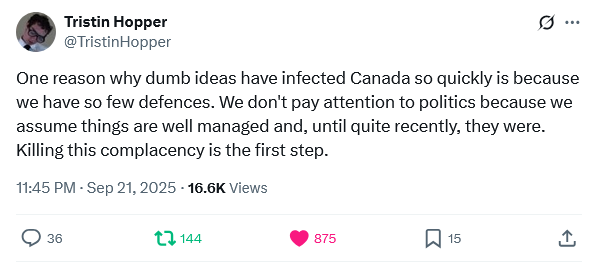
Canadians took it for granted that, no matter which party was in government, the country would continue to be stable, predictable, and competent. That’s clearly wrong today, yet the voters haven’t really accepted the new situation yet. Until they start paying attention, things may not improve.

It’s not just Canada, of course, but Canada is further down the road to ruin and thanks to the governments’ conscious actions, it will probably take longer to recover (and I don’t see a Canadian Javier Milei on the horizon, more’s the pity).

At The Freeman, Will Ogilvie Vega de Seoane discusses a related issue with most forms of representative government:

We are stupid. There, I said it. I feel much better now — like I’ve finally opened up in group therapy. PhDs won’t fix it, nor will subscriptions to all the best outlets. As individuals, we simply do not have the capacity to decide what is best in public life. As voters, we don’t usually care what our representatives are up to, nor do we have the faintest idea what the best policy on agriculture, artificial intelligence, or healthcare should look like — and that’s on a good day. But we do think we know. Deep down we think we are sovereign, that democracy is “all of us”, as though the government were some noble embodiment of “the people” rather than just another collection of organized persons with private agendas.

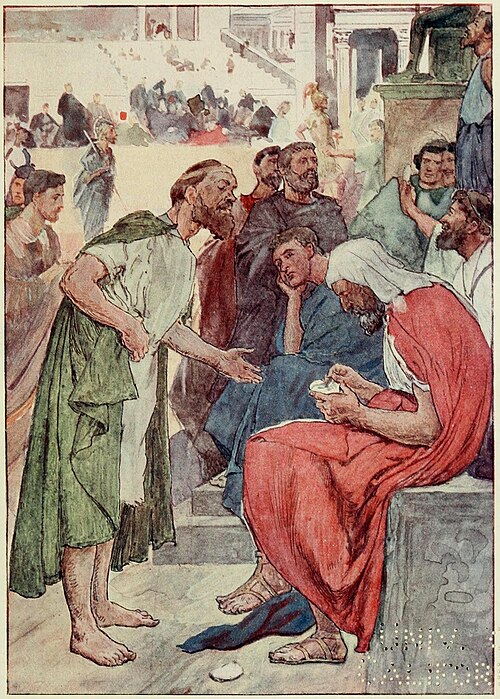
“Aristeides and the citizens” from Plutarch’s lives for boys and girls (1900).

Plutarch tells a story that I have always found marvelous. It’s about Aristeides “the Just”, one of Athens’s heroes in the Persian Wars. The Athenians, weary of kings and tyrants, invented ostracism — a mechanism to expel for ten years any citizen who got too powerful. Each voter would scratch a name onto a shard of pottery, and if more than 6,000 shards had the same name on them, the man was politely asked to take a decade-long sabbatical. Today we’d probably call it “a career break for the common good”.

Anyway, one day a farmer approached Aristeides himself — without realizing who he was — and asked him to write the name “Aristeides” on his shard. Surprised, Aristeides asked if he had ever harmed him. “No,” said the farmer, “nor do I know him by sight. But I am tired of always hearing him called ‘the Just’.” Aristeides, being annoyingly noble, wrote down his own name and handed the shard back. Later, as he left the city in exile, he prayed the opposite prayer of Achilles: that no crisis should come which would force the Athenians to remember him. On LinkedIn, Aristeides might have written: “Currently on a ten-year sabbatical generously sponsored by the people of Athens. Seeking new challenges outside the Attic peninsula #OpenToWork.”

This, in miniature, is how people vote. Not with knowledge, or vision, or even vague coherence — but out of envy, spite, boredom, or some other glorious irrationality. The Athenians had shards; we have hashtags. Instead of ostracism by pottery, we have ostracism by X: one bad joke, one leaked email, and the digital mob sends you packing. Today in Britain, people can even be jailed for their comments on social media. So much for parrhêsia, that old Athenian virtue of speaking frankly to power. We’ve managed to turn it into a crime — and worse, the canceling mob thinks it’s “speaking truth to power” when in fact it is obedience dressed as rebellion.

Modern voters aren’t any better. Some vote because the candidate owns a cute dog. Others because the candidate is endorsed by Taylor Swift. Entire campaigns have been won on promises of free cable, or by a politician smiling the right way on TikTok. In Spain, we even coined a term for it: the Charo. A Charo is usually an old lady with pink hair who parrots whatever our president says. Charos cannot resist the presidential smile. Even when the president contradicts himself, as he normally does, doing the exact opposite of what he promised, they just blush and blink as if to say: “Oh, Pedro, always misbehaving — we love you all the more for it.” They pamper their charming president and dismiss any criticism as fascist slander. Welcome to the Charocracy.
That’s a pitch-perfect description of the typical Liberal voter in Canada. Mark Carney’s Canada is clearly a maple-flavoured Charocracy.
Learn EVERYTHING from Home Depot wood

Filed under: Tools, Woodworking — Tags: , , — Nicholas @ 04:00

Rex Krueger
Published 22 Sept 2025

“[A]nyone who tries to tell you ‘Antifa is just an idea’ is not merely deluded, but consciously and deliberately lying”

Filed under: Media, Politics, USA — Tags: , , , , , — Nicholas @ 03:00

On the social media site formerly known as Twitter, ESR uses the methods of counter-terror analysis:

None of Antifa’s public propaganda channels have attempted to deny that they were behind the assassination of Charlie Kirk. This is a fact of considerable significance, which I will now use the methods of counter-terror analysis to examine.

Antifa’s distributed structure makes it impossible for any one chapter or cell to know what another subgroup didn’t do.

It is quite possible that Tyler Robinson is a true stochastic terrorist, inspired and motivated by Antifa propaganda and considering himself part of Antifa but without planning or logistical support from others in the organization. I give this about 60% probability.

The fact that Robinson had peers on Discord with apparent foreknowledge of the assassination attempt does not falsify this possibility. Even if they did assist with the assassination, their connections to Antifa might be equally deniable, equally just a matter of their states of mind.

The assassination was in complete accordance with Antifa doctrine and propaganda. Direct action against “fascist” targets, ranging from low level intimidation up to political killings and organized attacks on government facilities, is exactly what Antifa is organized to do.

Thus, with over 90% probability, other members and aboveground allies of Antifa regard the operation as a (tactically) successful Antifa op, whether or not they had any foreknowledge of it and whether or not Robinson was stochastic.

The ones who aren’t fanatics or idiots have probably figured out by now that the assassination was a serious strategic blunder. You might expect that they would be scrambling to deny that Antifa had anything to do with Kirk’s death.

Some of Antifa’s aboveground allies [are] in fact doing this; the dominant form of denial by Democratic politicians and activists is to deny that Antifa even exists as more than an idea.

But Antifa itself has not done this, and I predict very confidently (95%) that it will not. The real reason it won’t has nothing to do with its structural inability to know that no member of Antifa was involved.

To understand why this is, you need to grasp what Antifa is for. Not its ultimate purpose, which is to foment a violent revolution that will enable Communists or Left-Anarchists to seize power, but the way it operationalizes that goal in practice.

The purpose of Antifa direct action is to shape the political environment through terror. Its goal is to intimidate its opponents into paralysis — to raise the costs of their speech and public action by predictably opposing it with violence.

I am not speculating about this, because if you read Antifa’s propaganda and organizing materials it will tell you exactly this.

The assassination of Charlie Kirk is perfectly accordant with Antifa doctrine. Antifa cannot deny this, nor disown Tyler Robinson even in the likely event that he is only stochastically connected to the organization, because … what use is a terror network that disavows intimidation of its opponents?

Antifa’s goals require it to be a credible threat to “fascists”. If it denied that it had anything to do with killing Charlie Kirk, it would demotivate its own foot soldiers and decrease its usefulness to its aboveground allies.

Antifa needs to exist in a kind of mixed state — simultaneously deeply threatening to its enemies but deniable by many of its allies in the Democratic Party, journalism, and academia.

It is also, however, important that none of its aboveground allies can actually believe their own denials. Otherwise Antifa, perceived as useless, would risk losing the funding and political cover that has until now allowed it to operate with some degree of impunity.

You may therefore safely assume that anyone who tries to tell you “Antifa is just an idea” is not merely deluded, but consciously and deliberately lying.

At Woke Watch Canada, C.C. Harvey discusses the “red thread of Antifa subversion” over the last ten or so years:

Establishment leaders now even cuddle up with extremists who do not hide their violently subversive orientation. When the ENTIRE establishment took a knee for for the (self-identified) queer, Marxist, violently revolutionary group BLM during the 2020 riots, the subjugation of the professional classes was complete. We stopped being allowed to object to our institutions becoming vehicles for communist revolution. We were called racists and far right extremists and conspiracy theorists for even thinking bad thoughts about BLM and the woke communist revolution, and could be punished for talking to friends about it in group chats. We all became ideological captives of neoMarxist revolutionaries.

The DEI industry exploded, and although it is losing steam in the USA, it still functions as a modern Red Guard policing Canadian discourse and behaviour. If we’re being honest, we will admit that even most conservative politicians here were cowed. The entire establishment worked together to erect a new politburo and stasi throughout Canada and the USA, and far beyond.

Republicans are dismantling the neoMarxist structures that have been erected in America, and this is of course being disingenuously characterized by leftists as proof that Trump is fascist and authoritarian. BLM has largely imploded with corruption and infighting, but Antifa appears to have grown even stronger, especially its queer contingent, and their membership is agitating heavily as they see the Trump administration tearing down what they built.

Antifa is not just a gang of idealistic rabble-rousers in black hoodies rebelling against authority. It is the heir of a century-long Marxist project seeking massive, sweeping revolution, and advancing their goals via inversions: turning truth into lies, sin into virtue, desecration into liberation. From the beginning, Antifascist communists were passionately committed to revolution in all areas of human life and society.

It is not by coincidence that antifa and the LGBTQIA+ are entwined. Antifa have always been committed to sexual revolution — crossing sexual boundaries, normalizing deviance, dissolving the family.

Even in earliest iterations, the antifascists were dangerously radical in sexual ideology and policy: the historical record shows they handed children to paraphilic predators in the name of antifascist sexual liberation as early as postwar Germany. That anti-family, fetishistic spirit runs straight through antifascist history and is on full display in today’s TQ+ movement. TQ+ is conjoined with Antifa (Trantifa, if you will) to actively promote hypersexualization, the destabilizing of sex identity and family, and the mainstreaming of disorder and perversion.

Marx and Engels attacked the family as a “bourgeois prison”. Later Marxists carried this out through radical experiments in sex and pedagogy, all under the banner of liberation. Today’s gender and queer theorists are majority Marxists.

Marxists deal in inversions, so indoctrination presented as education, perversion rebranded as liberation, abuse disguised as compassion, self-mutilation celebrated as authentic selfhood. Today, Antifa-aligned “Queer Resistance” brigades advance sexual inversions and corruptions that are just as damaging as antifascists of bygone eras: in postwar Germany, the antifascist Kentler experiment assigned orphan boys to be raised by wealthy pedophiles. Today, an uncomfortable number of LGBTQIA+ activists have been caught adopting babies and toddlers to abuse, raping their own children, or sexually assaulting minors. As a result of our establishment embracing the far left revolutionary zeitgeist and sacralizing “marginalized” identities, safeguarding has been sacrificed on the altar of LGBTQIA+ identitarianism.

Update, 25 September: Welcome, Instapundit readers! Please do have a look around at some of my other posts you may find of interest. I send out a daily summary of posts here through my Substackhttps://substack.com/@nicholasrusson that you can subscribe to if you’d like to be informed of new posts in the future.

Beretta Model 1934: Italy’s Unassuming Workhorse Service Pistol

Filed under: History, Italy, Military, USA, WW2 — Tags: , , , — Nicholas @ 02:00

Forgotten Weapons
Published 16 May 2025

The Beretta Model 34 was basically the final iteration of a design by Tullio Marengoni that began all the way back in 1915. That pistol was updated in the early 1920s, and that one was updated in 1931. The Model 1931 was converted to .380 ACP (aka 9mm Short) as the Model 1932, which became the Model 1934 with the addition of a hammer half-cock notch and steel grip panel backing. Police and military contracts began in 1935, with the Italian Army formally adopting it in 1936 and purchasing nearly 400,000 of them by 1940. It would ultimately see service with basically all the armed elements of the Italian military and civil security services as well as foreign nations including Germany, Romania, and Finland. As a souvenir for British or American troops, the Model 1934 was also a prized piece.

Essentially, the Model 1934 is compact, simple, durable, and reliable. It is an excellent military pistol; easy to carry unobtrusively but dependable when called upon. After World War Two it stayed in production until 1980, despite introduction of many other more modern options by Beretta. Today a bunch of the pistols have become available on the US collector’s market. Thanks to Royal Tiger Imports for sending this example for me to film!

Beretta Model 1934 serial numbers and dates (source: “1915-1985 Settant’ Anni di Pistole Beretta“):
1934 – 1942 – from about 500073 to 999996
1934 – 1942 – from 1 to about 40000
1943 – 1945 – from F00001 to F99997
1943 – 1945 – from G00001 to G57486
1943 – 1945 – from 0001AA to 9997AA
1943 – 1945 – from 0001BB to 9971BB
1946 – 1949 – from C00001 to C99998
1949 – 1954 – from D00001 to D99999
1954 – 1967 – from E00001 to E95760
1967 – 1973 – from F50001 to F61693
1970 – 1975 – from G00007 to G49620
1972 – 1974 – from H00001 to H25000
1971 – 1980 – from T 1 to T 10217

Other pistols in the Beretta development series:
Modle 1915: • Beretta 1915: the First of the Berett…
Model 1923: • Beretta Model 1923
Model 1931: • Beretta Model 1931
Trials Model 1934: • Military Trials Beretta 34 – Can You …
(more…)

QotD: “Bye, Phoenicia”

Filed under: Africa, Books, History, Middle East, Quotations, Religion — Tags: , , , , — Nicholas @ 01:00

And now, as I promised, I’ll return to the Phoenicians, who are among Cline’s “winners” of the post-Collapse world. When things fell apart, their city-states — Sidon, Tyre, Byblos and all the rest — were just another motley collection of Canaanite settlements along the coast of what is now Lebanon. Two hundred years later, they were the centers of an enormous commercial and information network that spread across the entire Mediterranean world (and perhaps beyond). This makes them more than just resilient, Cline argues: they were actually antifragile, thriving in the chaos that followed the destruction of many of their powerful neighbors. (Can you even imagine how happy this chapter makes Nassim Taleb? Of course he blurbed the book.)

The long-distance trade of the Bronze Age had been dominated by large state actors. The ships were probably built and crewed by men from the Levantine coast, but the cargo was purchased and shipped by local representatives of the Great (and lesser) Powers of the age: luxury goods were an integral part of high-level diplomacy, so most trade was a virtual monopoly centrally directed from the palaces. When these polities were weakened (or in some dramatic cases like Ugarit completely destroyed) in the Collapse, they left behind a vacuum that independent Phoenician traders, operating without centralized control and serving only profit rather than the demands of empire, rapidly filled.

By the tenth century BC, the Phoenicians were importing silver from Spain, copper from Cyprus and Sardinia, and cinnamon from southeast Asia. They exported timber (the much-vaunted “Cedars of Lebanon”)1 and the valuable purple dye extracted from the murex sea snail, as well as a wide variety of finished luxury and quotidian goods they produced at home from raw materials obtained abroad. They founded colonies throughout the Mediterranean. And perhaps most importantly for the future of “the West”, they introduced the alphabet,2 which enabled the return of literacy to Greece and its far wider adoption than had ever been possible with Linear B.3

By the time the ascendant Neo-Assyrians began to encroach on their territory, the Phoenician city-states were so rich and economically well-connected that they were more valuable as semi-autonomous tributaries and middlemen than as conquered subjects. In fact, it was the Assyrian demands for metal (especially silver) that drove Phoenician colonization in the western Mediterranean: they founded Cadiz (Phoenician Gadir) to access the rich silver mines in the Spanish interior, as well as dozens of other smaller entrepôts along the sailing routes to and from the Levantine coast. Eventually they removed so much silver from Spanish mountains that its value in Assyria collapsed, inflated away by oversupply, just like Peruvian silver would destabilize the Spanish economy two thousand years later — but with the roles flipped. I enjoy these echoes.

It’s worth pointing out here that Phoenicians never called themselves Phoenicians: it’s a Greek word, deriving from a Mycenaean era (e.g., pre-Collapse) term for purple dye. In fact, they didn’t even have a term that clearly limned what the Greeks meant by “Phoenician” (essentially, “Levantine traders with really good ships who speak a related set of Semitic languages”). Instead, they sometimes referred to themselves more narrowly by reference to their native cities (Sidonian, Tyrian, Byblian, etc.) and other times more broadly as “Canaanite”, because of the cultural heritage they shared with the other survivors of Bronze Age Canaan. But even if they never employed it themselves, “Phoenician” is a terribly useful word, because these particular city-states had a lot in common with one another but diverged sharply from their Canaanite kin to both north and south.

Bronze Age Canaan had been relatively culturally homogenous, though the cities in the north came into the Hittites’ sphere of influence and those in the south the Egyptians’. After the Collapse, though, the city-states of northern Canaan (modern Syria), like their Neo-Hittite neighbors, seem to have continued more or less as they had been. Those in southern Canaan were not so lucky: weakened by the invading Sea Peoples and the withdrawal of Egyptian hegemony, the southern Canaanites were displaced by (or assimilated to) the new Semitic kingdoms in the region, including Israel, Judah, Edom, and Ammon. And the central Canaanites became the Phoenicians: master sailors and traders, they had seized their opportunity and so thoroughly transformed themselves that we join the Greeks in identifying them by a new name.

Most of the larger cities of the central Levant are buried beneath their modern equivalents, and Lebanon has not been a particularly salubrious place to excavate for the last few decades, so it’s hard to say a great deal about Phoenician continuity with their Bronze Age ancestors. There was obviously some, certainly genealogically but also linguistically and in terms of material culture. However, we also know that their lifestyles changed dramatically as their economic reach expanded and their cities became centers not only of exchange but of manufacturing. We know their commercial firms were organized around extended families, and that they began to settle foreign lands both as colonists in their own new cities and elsewhere as resident merchants with their own dedicated enclaves. And we know that as their city-states grew more powerful, they increasingly directed worship away from the traditional Canaanite pantheon, led by El, and towards the tutelary deity of each individual city. (The story that King Hiram of Tyre actually tore down the temples of El and Baal to make room for a magnificent new temple of his patron, Melqart,4 is probably an exaggeration, but points to the scale of the break with the past.)5

Jane Psmith, “REVIEW: After 1177 B.C., by Eric H. Cline”, Mr. and Mrs. Psmith’s Bookshelf, 2024-07-08.


  1. For a very funny story about an Iron Age Egyptian attempt to buy some, which I simply could not fit into this review, see the “Story of Wenamun“. Bonus points for imagining how it would have played out under the New Kingdom.
  2. Okay, the Phoenician “alphabet” is actually an abjad — it contains no symbols for vowels — but the Greeks quickly added those.
  3. It is much, much easier to learn to write with an alphabet than with a logosyllabic system like Linear B or cuneiform.
  4. Melqart is also the patron of the Tyrian colony of Carthage, and his name contributes one element to that of Hamilcar Barca. The –bal in Hannibal, Hasdrubal, etc., is of course from Baal.
  5. Cline doesn’t give a ton of detail on Phoenician culture; in this section I am also drawing heavily on the opening chapter of Richard Miles’s Carthage Must Be Destroyed: The Rise and Fall of an Ancient Civilization, which sentiment I fully endorse even though I haven’t finished the book yet.

Powered by WordPress