
In The Coolidge Review, Amity Shlaes discusses “the most outrageous campaign of lawfare in the history of the Anglosphere”, as Edmund Burke assailed Warren Hastings, the first governor general of India:
Why do even principled statesmen — and there are some in this administration, too — not dig in their heels and try to arrest the chain of revenge? Why do even cautious, logical men and women succumb to the passion of lawfare?
The most outrageous campaign of lawfare in the history of the Anglosphere, the impeachment and trial of the first governor general of India, Warren Hastings, was mounted by Mr. Incrementalism himself, Edmund Burke. The father of modern conservatism spent nearly a decade of his time in Parliament—from 1787 to 1795—crusading against Hastings, antagonizing allies all around.
Impeaching the “Wicked Wretch”
There were reasons to investigate what was going on in India: Hastings exploited the fact that the East India Company was, at that time, an adjunct of the Crown. That connection between a powerful company and a government — a far more powerful company than, say, Intel — was the trouble, for as Burke would put it, it created “a state in disguise of a merchant“.
Burke chose to prosecute Hastings — and failed. The “wicked wretch”, one of Burke’s slime phrases for Hastings, emerged from the ordeal with a pension, not a conviction. Burke biographer Russell Kirk has argued that the public flaying of Hastings served posterity — in England at least. After Burke’s death, at “every grammar and public school”, the story of Burke and Hastings “impressed upon the boys who would become colonial officers or members of Parliament some part of Burke’s sense of duty and consecration in the civil social order”. That slowed another chain, the chain of abuse by Britons of Indians. After Burke, England recognized that, as Kirk puts it, she had a “duty to her subject peoples in the East”.
Still, even Kirk’s excellent biography leaves readers wondering: Was Hastings truly the archest of the arch villains, as Burke maintained? And is this the right way to go about it all? A book that Burke penned in the same years that he waged his Hastings war, Reflections on the Revolution in France, influenced a far greater number, and in a greater number of lands, than the Hastings story. Burke might have had the same reach with a Reflections on the Abuses of the East India Company.
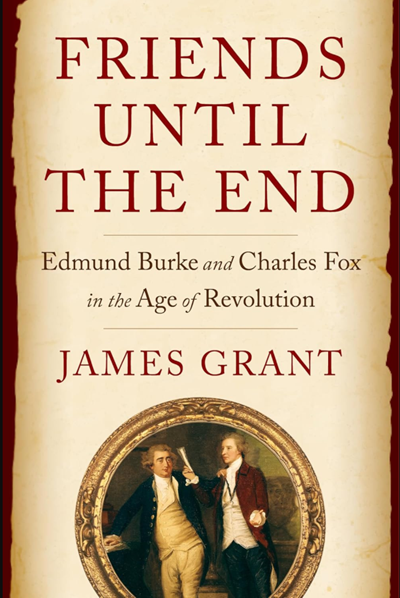
All the more welcome then is James Grant’s Friends Until the End, which gives the best-yet account of the chain reaction in Burke’s soul that drove him to weaponize government, what his crusade cost him, and what such crusades may cost all of us.
[…]
Next, however, came a challenge that deeply frustrated Burke. Scanning the empire’s horizon for a place to commence a model reform, Fox and Burke settled on the East India Company, which abused the some thirty million Indians it oversaw with the same admixture of plunder, condescension, and cruelty familiar to Catholics of Ireland. The pair put their hearts into the Indian reform: Fox promised a “great and glorious” reform to save “many, many millions of souls”. They also put their minds into the project. To track the East India Company, Burke personally purchased sufficient shares to win him rights to attend and vote at quarterly meetings. He steeped himself in knowledge of a land he’d never seen, learning names of “numerous Indian nawabs, rajas, nizams, subahs, sultans, viziers, and begums“.
Such prep work, as Grant points out, enabled the Whigs to identify the correct solution: de-mercantilization. “Separate the company’s two incompatible missions: sovereign rule and moneymaking”, Grant writes. The compromised statute that emerged from the House of Commons was not as neat: A seven-man commission would rule India, while a board would govern East India’s commercial operations. But the commercial board would be a subsidiary to the commission. And in marshaling their votes for the measure, the pair still confronted the formidable obstacle of East India shareholders in Britain, furious at the threat to their fortunes that such reform represented. Fox might emancipate Hindus, their opponent William Pitt warned, but he must also “take care that he did not destroy the liberties of Englishmen”.
The king and his allies in any case defeated Fox’s India Bill, as it was known, in the House of Lords. The king, who had that prerogative, booted Fox and Burke from paid posts. In the 1784 general election, Burke held on to his seat in Parliament, as did Fox (by a hair), but so many Whigs, now labeled “Fox’s martyrs”, were ousted by voters from Parliament that the Whigs’ opponent, Pitt, became prime minister. Burke’s disillusionment ran deep: “I consider the House of Commons as something worse than extinguishd”, he wrote.
It was thus, at the age of fifty-nine and merely an opposition parliamentarian, that Burke risked his high-stakes lawfare. He commenced impeachment proceedings with a four-day anti-Hastings polemic. Of course, Burke universalized his point: The Hastings trial was “not solely whether the prisoner at the bar be found innocent or guilty, but whether millions of mankind shall be made miserable or happy”. And of course he raised the stakes for fellow lawmakers by appealing to their honor: “Faults this nation may have; but God forbid we should pass judgment upon people who framed their laws and institutions prior to our insect origin of yesterday!” The House must join him in impeachment, the Lords convict Hastings.
The House did join him, handing to the Lords charges that Hastings had “desolated the most flourishing provinces”, “pressed, ruined, and destroyed the natives of those provinces”, and violated “the most solemn treaties”. In thousands of hours of speeches before a jury from the House of Lords, the eager prosecutor, Burke, dwelt on Hastings’s cruelty to the Rohillas, an Afghan tribe from land bordering Nepal. He also charged that Hastings had taken revenge on a crooked tax collector, Nandakumar, for alleging that he — Hastings — had taken a bribe, seeing to it that Nandakumar was convicted and hanged for forgery. Not all of this was proven. And, as the jury of Lords slowly considered the charges, as the months and years passed, Burke found himself more and more isolated. Fox, Burke’s initial ally in the undertaking, faded. By the time the Lords’ jury voted not to convict, eight years on, a full third of their original number had already passed away.


