
Quotulatiousness

September 18, 2025

Stop calling it “Turtle Island”

Filed under: Americas, Cancon, History, Media, Politics, USA — Tags: , , , , , — Nicholas @ 05:00

At Woke Watch Canada, Igor Stravinsky strenuously objects to calling North America “Turtle Island” and all the other woke shibboleths of the modern progressive cant:

As another school year rolls out, we can hope a more honest and realistic portrait of Canadian history will start to take shape in our schools. Students have been brainwashed into believing that Canada was a racist state bent on the extermination of Indigenous people, who were peaceful and wise, living in harmony with nature and each other. But reconciliation between Indigenous and non-Indigenous people is only possible if we base policy and action on the truth, not fairy tales, hearsay, anecdotes, or ideologies. We need facts, evidence, and reasoned debate. A good start would be for people to stop referring to North America as “Turtle Island”.

Calling it that is essentially to call the current geopolitical organization of the world invalid. If Canada, the United States, and other Western countries are in fact illegitimate, then that means national and international laws are also null and void. So, unless you are the direct descendent of an aboriginal person who was alive before first contact with Europeans, you are just a guest here — a second-class citizen at best. Non-Indigenous Canadians will simply never accept that. Nor should they.

In any case, “Turtle Island” is a nonsensical name on several levels. Firstly, North America is a continent, not an island. It is connected to South America by the Isthmus of Panama, which means it is not even surrounded by water. In any case an island is defined as a land mass surrounded by water that is part of a tectonic plate such as Greenland which is part of the North American Plate, thus is not a continent.

Then there is the fact that Indigenous North Americans were oblivious to the geography of the vast continent on which they lived. Like people everywhere in the distant past, they only knew the area they lived in, which could be substantial in the case of nomads, but was still a tiny fraction of North America’s 20+ million square kilometers. Of course, they knew nothing about the geography of the world with its 7 continents and 5 oceans.

Most importantly, the Turtle Island creation story is a myth believed by a particular cultural group. There is nothing wrong with believing in myths: I personally believe in the myth of human rights, as most Canadians do (pre-contact Indigenous people certainly did not). Myths are powerful: Our common belief in human rights has helped to make the Western world contain the safest and most prosperous societies ever. But when our institutions subscribe to myths not shared by the majority of Canadians, they are choosing to elevate one culture’s belief system above all others.

In the past, the Christian religion was regarded as the one true religion in Canada by most people, and the spiritual beliefs of Indigenous people were often denigrated as primitive superstition. But elevating Indigenous spirituality in our secularized 21st century world by treating it as a knowledge acquisition system equivalent to (or superior to) the scientific method is an attempt to correct for that past ethnocentrism. This is Critical Theory in action: It always strives to alleviate past wrongs with present wrongs, a formula for social disaster if ever there was one.
Broken feedback paths lead to broken organizations … like government

Lorenzo Warby on the ever-increasing dysfunction of most western governments due to the deliberate sabotage of what used to be functional feedback paths:

That institutions within Western democracies have deteriorated in recent decades is clear. That the march of progressivism through the institutions is at the heart of this deterioration is also clear.1

This has been progressives acting like progressives, with all the perverse relationship with information that is at the heart of progressivism. A perverse relationship that leads directly to their degradation of institutions.

Progressives use the imagined future as their benchmark of judgement, but there is no information from the future, so there is no reality-test in their benchmark of judgement. The imagined future can, however, be as glorious as one likes.

Conversely, anything actually created by humans will have downsides and even sins attached. This gives progressives a great rhetorical advantage over anyone who attempts to defend anything humans have actually built. All of the painful history of human achievement is rendered as naught, as mute, in the face of the splendours in their head.

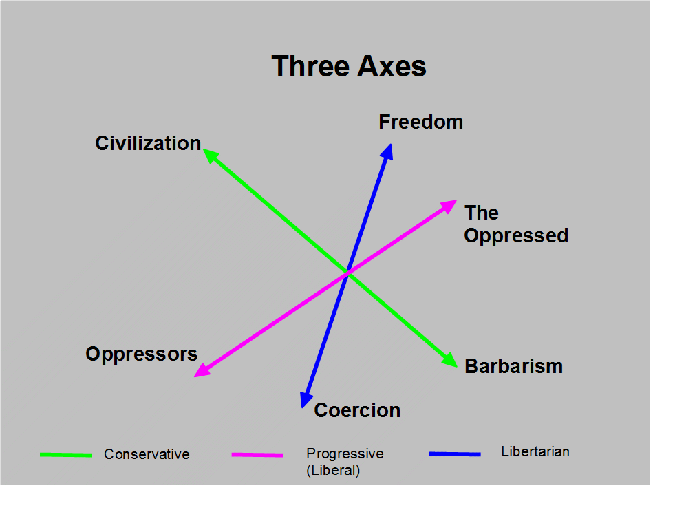
Arnold Kling’s Three Languages of Politics model.

If a group is disproportionately successful, that is not an example to emulate but a sign of their oppressor status. If they are comparatively unsuccessful, that is not a warning about what to avoid, but a sign of their oppressed status. This is an outlook deeply hostile to learning from what does, and does not, work.

For using the glorious imagined future as the benchmark of judgement creates the basis for denigrating anything that comes from the past: which is all the information we have about what works and does not. This includes denigrating the embedded learning in institutions. Even fundamental questions about what is required to sustain a social order get written out of acceptable discourse as not fitting with their imagined-future benchmark of judgement, with the splendours in their heads.

Using the imagined future as one’s benchmark of judgement also naturally leads to concluding that one owns morality, as any opposition to the glorious imagined future is clearly immoral. This leads to, at best, comprehensive disengagement with, and at worse, systematic denigration and delegitimisation of, those who disagree. A systematic denigration and delegitimisation that often involves systematic misrepresentation of those who disagree. The consequence of all this is to block feedback about one’s political projects.

The most extreme instance of this has been the UK, where the BlairBrown Governments of 1997-2010 took power away from elected officials (apart from the PM) and handed it to “experts” in quangoes, to judges via human rights legislation and to the EU. Those with the “correct” understandings could do their thing, insulated from voters. This made the UK a state, a polity, with broken feedbacks.

Modern Western civilisation is a civilisation with broken feedbacks — as I discuss here, here, here, here and here — but the Blair-Brown constitutional vandalism extended that pattern of broken feedbacks systematically to the British state. The consequences have become grimly obvious. Massive waves of unwanted migrants as part of a massively dysfunctional British state.

If you systematically kill feedbacks from voters, you systematically kill accountability. Of course dysfunction will spread across the organs of the state, as it has. (See here for a discussion of aspects of that horrifying dysfunction.)


  1. Feminisation of institutions has also been a corrosive factor, but that is deeply intertwined with the march of progressivism through the institutions.

Update, 19 September: Welcome, Instapundit readers! Please do have a look around at some of my other posts you may find of interest. I send out a daily summary of posts here through my Substackhttps://substack.com/@nicholasrusson that you can subscribe to if you’d like to be informed of new posts in the future.

NYC smokers get most of their cigarettes from the black market

Filed under: Bureaucracy, Business, Government, Health, USA — Tags: , , , , — Nicholas @ 03:00

Smokers in New York City pay very high taxes for their nicotine delivery systems, so it shouldn’t have surprised public health officials that many would turn to the black market … but the state and local taxes add so much to the price of a pack of cigarettes that most of the supply now comes from the black market:

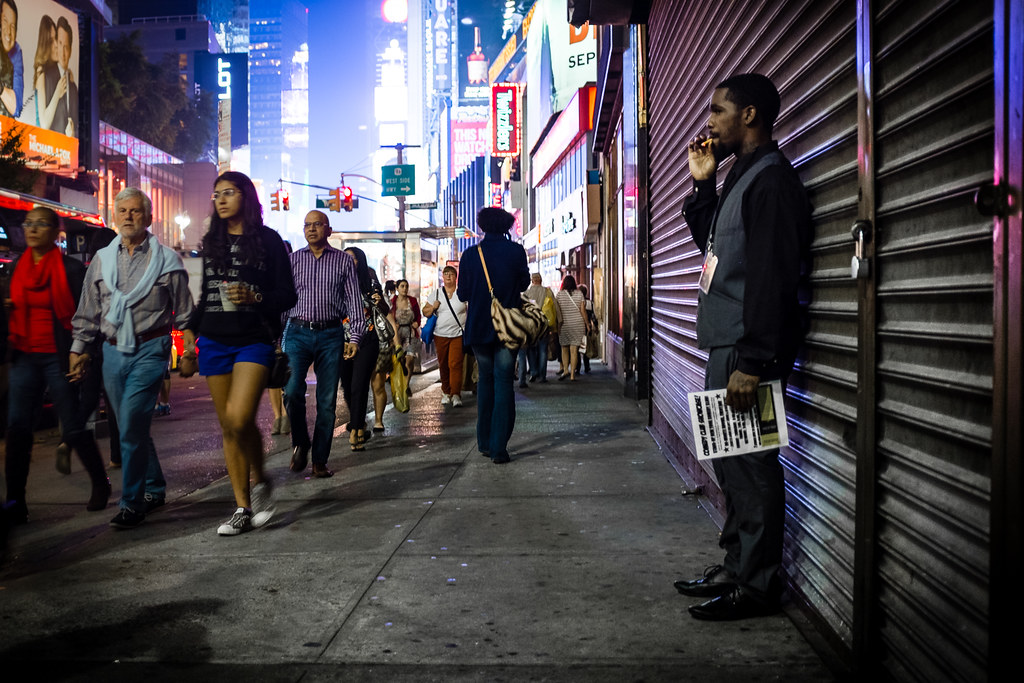
“Enjoyin’ a cigarette at busy Time Square, NYC” by Mel Schmidt is licensed under CC BY 2.0 .

In 2023, New York raised its cigarette excise tax by $1.00 to $5.35 per pack. New York City imposes its own tax of $1.50 per pack, and that’s before you include federal and sales taxes, making for the most expensive smokes in the country. That is, cigarettes are expensive in New York for those who pay those taxes. But state officials were warned that such a high rate would drive consumers to the black market, and that’s exactly what happened. According to recent research, more New Yorkers than ever are turning to tax-evading illicit sources for their nicotine needs.

Taxes Into Good Health — or Not

When the New York excise tax was hiked, the Albany Times-Union noted, “it’s the nation’s highest and brings a pack of cigarettes at many retailers to about $12 … Health advocates hailed the increase, saying it will lead to fewer smokers and cancer deaths. Anti-tax groups, though, predicted it will increase trafficking in illicit untaxed cigarettes in the state.”

Health advocates like taxing vices on the theory that raising taxes simultaneously generates government revenue while escalating prices for allegedly bad things — like cigarettes — out of reach of many consumers. What they rarely consider is that there are other options, such as buying cigarettes smuggled from jurisdictions with lower levies.

“New York has created a cigarette-smuggling empire, and the worst is yet to come,” Todd Nesbit, an economics professor at Ball State University, and Michael LaFaive, of the Mackinac Center for Public Policy, warned even before the 2023 tax increase. “It’s the unavoidable consequence of the state’s decades long history of raising the cigarette tax.”

“If enacted, consumers will go across borders to do their shopping or rely on black-market suppliers,” agreed the Tax Foundation’s Adam Hoffer. “Tax revenues will fall, illicit activities will thrive, and law enforcement spending will need to increase.”

In fact, as Nesbit, LaFaive, and Hoffer emphasized, even before the dollar-per-pack tax hike, more than half of cigarettes sold in the state of New York lacked local tax stamps and were smuggled from elsewhere. Since 2023, illicit dealers appear to have claimed even more market share.

“The British fleet is strong and at the ready” (1939)

Filed under: Britain, History, Media, Military, WW2 — Tags: , , , , — Nicholas @ 02:00

British Pathé
Published 12 Nov 2020

GAUMONT BRITISH NEWSREEL (REUTERS)

Comprehensive documentary of the Royal Navy in the lead up to war

Full Description:

SLATE INFORMATION: Britain’s Navy Ready for Any Challenge, The Combined Fleets Filmed by Gaumont-British News

Comprehensive documentary of the British fleet and their preparedness for action including shots of numerous ships at sea and at anchor, sailors on deck, aircraft on deck, ship’s guns, officers in quarters, destroyers, aircraft flying off deck and landing on water

Archive: Reuters
Archive managed by: British Pathé

QotD: Americans, poker, and chess

Filed under: Europe, Gaming, Government, History, Quotations, USA — Tags: , , — Nicholas @ 01:00

The game of chess has never been held in great esteem by the North Americans. Their culture is steeped in deeply anti-intellectual tendencies. They pride themselves in having created the game of poker. It is their national game, springing from a tradition of westward expansion, of gun-slinging skirt chasers who slept with cows and horses. They distrust chess as a game of Central European immigrants with a homesick longing for clandestine conspiracies in quiet coffee houses. Their deepest conviction is that bluff and escalation will achieve more than scheming and patience (witness their foreign policy).

J.H. Donner, “The King: Chess Pieces”, New In Chess, 2008.

Powered by WordPress



