
Well-sited weather stations can provide useful raw data on temperature ranges, wind speed, precipitation, and other measurables, but that “well-sited” makes a huge difference. Older weather stations situated in areas of rapid urban expansion will often be less reliable as they become part of the urban heat island and report higher temperatures due to locally generated heat sources rather than the ambient temperature they were able to record before. This is what has apparently happened to far too many of the UK’s temperature measuring sites, according to Chris Morrison in The Daily Sceptic:
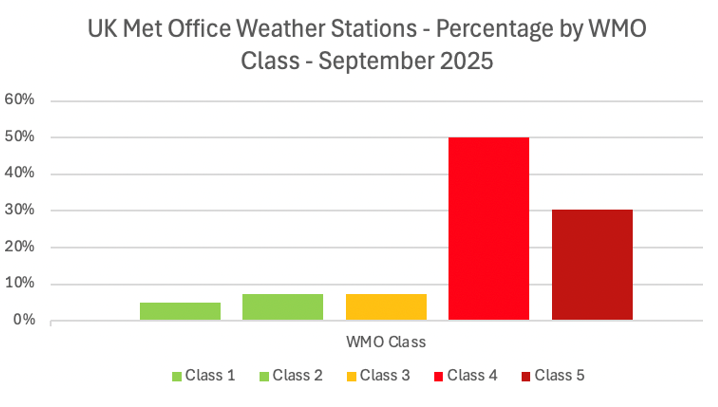
The latest WMO Class figures at the Met Office shown in block graph form. The higher the class number, the less reliable the station reports become.
Image from The Daily Sceptic
In March 2024 the Daily Sceptic shocked the science and political world by disclosing that nearly 80% of the UK Met Office’s temperature measuring sites were so poorly located that potential “uncertainties” could corrupt the readings by a numbers of degrees of centigrade. World Meteorological Organisation (WMO) Classes 4 and 5 in its CIMO scale come with “uncertainties” up to 2°C and 5°C respectively, and a Freedom of Information (FOI) request found that 77.9% of its sites were in these two “junk” categories. It should have been a wake-up call demanding immediate improvement of the nationwide network, not least because the Met Office frequently catastrophises its temperature figures in the interest of promoting the Net Zero fantasy. Alas, no. A new FOI has found that the Classes 4 and 5 junk sites have increased significantly over the last 18 months and now total an appalling 80.6% of the entire network. Pristine Class 1 sites – which measure a credible ambient air temperature with little chance of unnatural heat corruption – are just 4.9% of the total, having fallen in number in this short period from 24 to 19.
Hundreds of millions of pounds have flowed through this Government department over the last 18 months but little effort seems to have been made to improve its basic and important meteorological measuring function. What is worse is that the Met Office doesn’t seem to understand the scale of the problem. Over the 18 months, it appears that 20 new sites have been opened in its now 387-strong network. Seventeen of these have been given WMO classifications, of which a frankly ludicrous 64.7% are starting life in the Class 4/5 junk lane.
The WMO rates weather stations by the degree of possible temperature corruption caused by nearby unnatural or natural influences. Classes 1 and 2 are considered what we might call pristine, with no significant errors arising from artificial influences. The latest figures show that the Met Office has just 12.1% of its sites in these two unadulterated categories. Class 3 comes with an uncertainty of up to 1°C and accounts for 7.23% of the total. The real shocker is Class 4 where the percentage of the total has risen from 48.7% to over half at 50.1%. Class 5 has no defining conditions and could be located next to a blast furnace door. It has risen over the last 18 months from 29.2% to 30.5%. The WMO states that a Class 1 location can be considered a “reference site”. A Class 5 site is said to be a location “where nearby obstacles create an inappropriate environment for a meteorological measurement that is intended to be representative of a wide area”.
Despite this, Class 5 “extremes”, often caused by temporary but obvious heat spikes, litter the Met Office databases and record books. Of course such Class 5 data, unsuitable for providing an accurate temperature for a “wide area”, are loaded into databases producing “hottest evah” days, months, seasons and years. Their final destinations are the global datasets that exaggerate recent warming, again to promote Net Zero. Sprinkling the Class 4 and 5 fairy dust over the figures adds a bit more of the urgency required for elite political purposes.


