
TimeGhost History
Published 7 Sept 2025Breadlines, quotas, and Stasi fear collide with propaganda promises as East Germany erupts. In June 1953, strikes on Stalinallee ignite a nationwide uprising — Soviet tanks roll into Berlin, thousands are arrested, and the GDR tightens control. How did the regime survive this shock?
(more…)
September 8, 2025
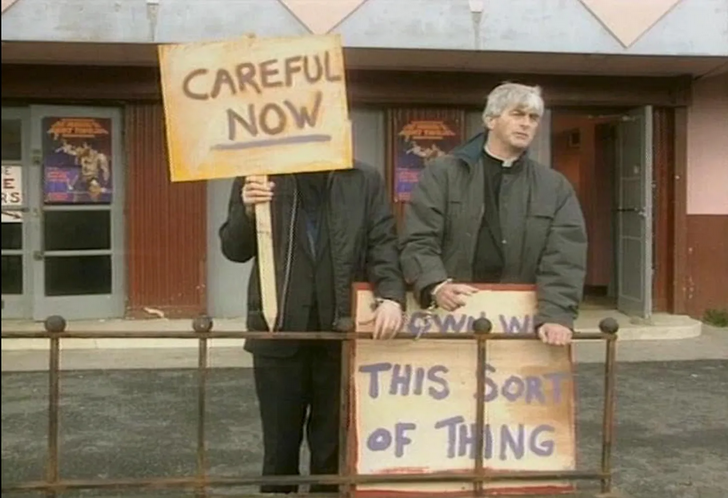
“Down with this sort of thing!”
In the free-to-cheapskates part of Ed West’s post on the Graham Linehan case in Britain, he identifies one of the reasons that Linehan’s Father Ted became so popular in the country it was situated in:

I don’t think I’d seen a “down with this sort of thing” placard in the flesh since I watched the Protest the Pope march back in September 2010. Those were the heady days of New Atheism, before the movement evolved into something more explicitly progressive.
The sign references an episode of the 1990s comedy Father Ted, in which the protagonist and his dim-witted sidekick Fr Dougal are forced to protest the screening of a blasphemous new film called The Passion of Saint Tibulus. Among the many catchphrases popularised by the comedy, back in 2010 this one suggested an ironic and gently mocking attitude to religion; that it was ridiculous, rather than evil.
This week, outside Westminster Magistrates’ Court in Marylebone Road, the sign appeared in a rather different context, carried by supporters of Father Ted co-creator Graham Linehan as he faced charges of harassment and criminal damage in an ongoing trial, following an incident at last year’s Battle of Ideas involving a young transgender activist.
Linehan had been bailed before trial, allowing him to travel to the United States to work on a new comedy project. When he arrived back at Heathrow on Monday, however, he was arrested by five armed police officers over three tweets he had posted back in April. The situation was as absurd and surreal as anything that had emerged from the writer’s fertile imagination.
As Linehan described it on his substack: “When I first saw the cops, I actually laughed. I couldn’t help myself. ‘Don’t tell me! You’ve been sent by trans activists’. The officers gave no reaction and this was the theme throughout most of the day. Among the rank-and-file, there was a sort of polite bafflement. Entirely professional and even kind, but most had absolutely no idea what any of this was about.”
The incident is embarrassing to Britain as it faces increasing scrutiny in the US for its poor record on free speech, especially over the Lucy Connolly case. It was unfortunate timing that this arrest happened just as Nigel Farage was heading in the other direction to talk about this very issue in Washington. But Linehan’s ordeal is also part of a much longer and sadder story about the perils of the political meeting the personal.
Arthur Mathews and Graham Linehan had worked on The Fast Show before renowned comedy producer Geoffrey Perkins had taken to one of their ideas, about a group of priests stuck on a remote Irish island, proposing that it be written as a six-part sitcom. It was brilliant, and hugely loved, and in its timing was significant.
Conor Fitzgerald wrote of Father Ted that, while well-loved in Britain, in Ireland it is more like “the national sitcom, a piece of light entertainment that nevertheless Says Something Meaningful About Us”. It also appeared at a crucial time in history.
Not only was Father Ted one of the few successful TV representations of Ireland, it was made during Ireland’s version of the Swinging Sixties, our flux decade of the Nineties. The accelerating collapse of the Church and the exposure of longstanding political corruption coincided with the dawn of the Celtic Tiger years, lending peripheral Ireland a sense of self-conscious modernity. It was a unique national turning point, where our 19th-century past seemed to co-exist with our 21st-century future. In reflecting this upheaval, Father Ted has become not just a social historical document, but a portent of where Ireland stands today.
When Ted was broadcast, the Church was formally still one of the central pillars of Irish life, but its authority rang hollow. Priests often felt like administrators of a vanished country. And on remote Craggy, Ted, Dougal and Jack mirror this directly. All good sitcoms feature characters who are trapped, but Ted is doubly so: first on his island; and second in an institution people are coming to see as irrelevant. He is still an essential member of the community, more than just a ceremonial functionary for weddings and funerals. But it’s just not clear what the essential thing he does is anymore, beyond being a common reference point that deserves token respect.
Ted and Ted therefore stand at a crossroads, and capture the more fundamental social change in Ireland at this time: the collapse in respect for older establishment hierarchies generally.
Those establishment hierarchies collapsed across the West in the late 20th century, first in more secularised nations such as Britain and France and later, and more quickly, in places like Ireland and Spain where the Catholic Church still held on.
The Church lost its power to patrol its taboos, without which it became a sitting duck for satirists; the Passion of St Tibulus was influenced by the protest against Life of Brian, successfully banned in Ireland until 1987. As a teenager, Linehan had to join a film club to watch it, but such censorship was disappearing everywhere.
Father Ted was a work of genius, employing a surreal style of humour that has often been characteristic of Linehan and Mathews, and later seen in their under-appreciated sketch show Big Train – including the brilliantly bizarre sketch in which Beatles producer George Martin is kidnapped by Hezbollah.
The clerical comedy bequeathed numerous catchphrases. “I hear you’re a racist now, Father”, which features in an episode where Fr Ted is wrongly accused of anti-Chinese prejudice, is still a popular meme. Likewise, “These are small, but the ones out there are far away“, Ted’s explanation of perspective to his idiotic housemate, is still used to mock the gormless.
The show was also charming, and its treatment of religion was far from vicious. Rather than being a vitriolic attack on Church authority, Father Ted poked gentle fun at the absurdity of the old order, a kind of mockery which is perhaps a more dangerous threat to a belief system that relies on awe and fear. It was innocent, and many years later Linehan said he would find writing Father Ted much harder in light of the abuse scandal.
Comments Off on “Down with this sort of thing!”
Ancient Historian Reviews Monty Python’s Life of Brian | Deep Dives
History Hit
Published 1 May 2025In this new video, classicist Honor Cargill-Martin delves into the iconic Monty Python’s Life of Brian. Is it historically accurate or is it a very naughty film?
00:00 Intro
00:53 Judea A.D. 33
01:55 Colosseum?
06:56 People’s Front of Judea
10:28 “What have the Romans done for us?”
16:05 Roman Grafitti
19:44 Hypocaust
23:30 Biggus Dickus
28:42 “Crucifixion?”
30:37 “… release a wrong doer from our prison”
32:09 “I’m Brian!”
(more…)
Comments Off on Ancient Historian Reviews Monty Python’s Life of Brian | Deep Dives
QotD: Sir Arthur Conan Doyle and the Cottingley Fairies
In 1911, the two English women recounted their experience in a book, An Adventure, using the pseudonyms Elizabeth Morison and Frances Lamont. The book immediately caused a sensation. Among those who were gripped by their time-travelling tale was a young J.R.R. Tolkien. So was Tolkien’s friend, fantasy writer C.S. Lewis, whose later book about time travel, The Dark Tower, referred to “the ladies of the Trianon”. At the turn of the century in England, there was great interest in the paranormal. Leading proponents included the eccentric occultist Aleister Crowley, author of The Book of Lies. It was an era when fascination with spiritualism created a culture of credulity in the face of fantastic fictions and clever hoaxes.
One of the most famous hoaxes of that era was the so-called Cottingley Fairies. Two girls in Yorkshire, cousins Elise Wright and Frances Griffith, took a series of five photos in 1917 showing themselves near a stream in the presence of tiny fairy-like creatures. Elsie’s father Arthur Wright, an amateur photographer, never doubted that the photos were fabricated. But the girl’s mother Polly was more credulous. The pictures became public when Polly Wright attended a lecture on “fairy life” at a Theosophical Society meeting in Bradford. They were quickly circulated among the group’s adherents, who found the photographed fairies consistent with their theosophical beliefs. The extraordinary images soon came to the attention of the famous author Sir Arthur Conan Doyle, an ardent spiritualist who was writing an article on fairies for the Strand Magazine. Conan Doyle, the creator of Sherlock Holmes, was convinced the fairies were real. His article was published under the headline Fairies Photographed, describing the Cottingley Fairies as an “epoch-making event”.
“The recognition of their existence will jolt the material twentieth century mind out of its heavy ruts in the mud, and will make it admit that there is a glamour and mystery to life,” wrote Conan Doyle. “Having discovered this, the world will not find it so difficult to accept that spiritual message supported by physical facts which has already been put before it.” In 1922, Conan Doyle followed up with a book, The Coming of the Fairies, in which he announced that proof of fairy existence was a blow to cold Victorian science, which “would have left the world hard and clean and bare, like a landscape in the moon”. He added: “There is nothing scientifically impossible, so far as I can see, in some people seeing things that are invisible to others.”
Conan Doyle was wrong of course. Like many other spiritualists at the time, he’d been taken in. The photos were fake. The two girls Elsie and Frances both lived into their 80s. Toward the end of their lives in the 1980s, they admitted that they’d fabricated the fairy photos using paper cutouts.
Matthew Fraser, “Marie Antoinette: Figure of Myth, Magnet for Lies”, Quillette, 2020-06-24.
Comments Off on QotD: Sir Arthur Conan Doyle and the Cottingley Fairies


