
Quotulatiousness

September 7, 2025

The BEF and the German Sichelschnitt of May, 1940

Filed under: Britain, France, Germany, History, Military, WW2 — Tags: , , , , , , — Nicholas @ 05:00

Dr. Robert Lyman rebuts the common-since-the-1950s adulation of the Wehrmacht‘s attacks of May-June, 1940 through the Low Countries that drove the British Expeditionary Force off the continent and destroyed the flower of the French army prior to the surrender of France in June:
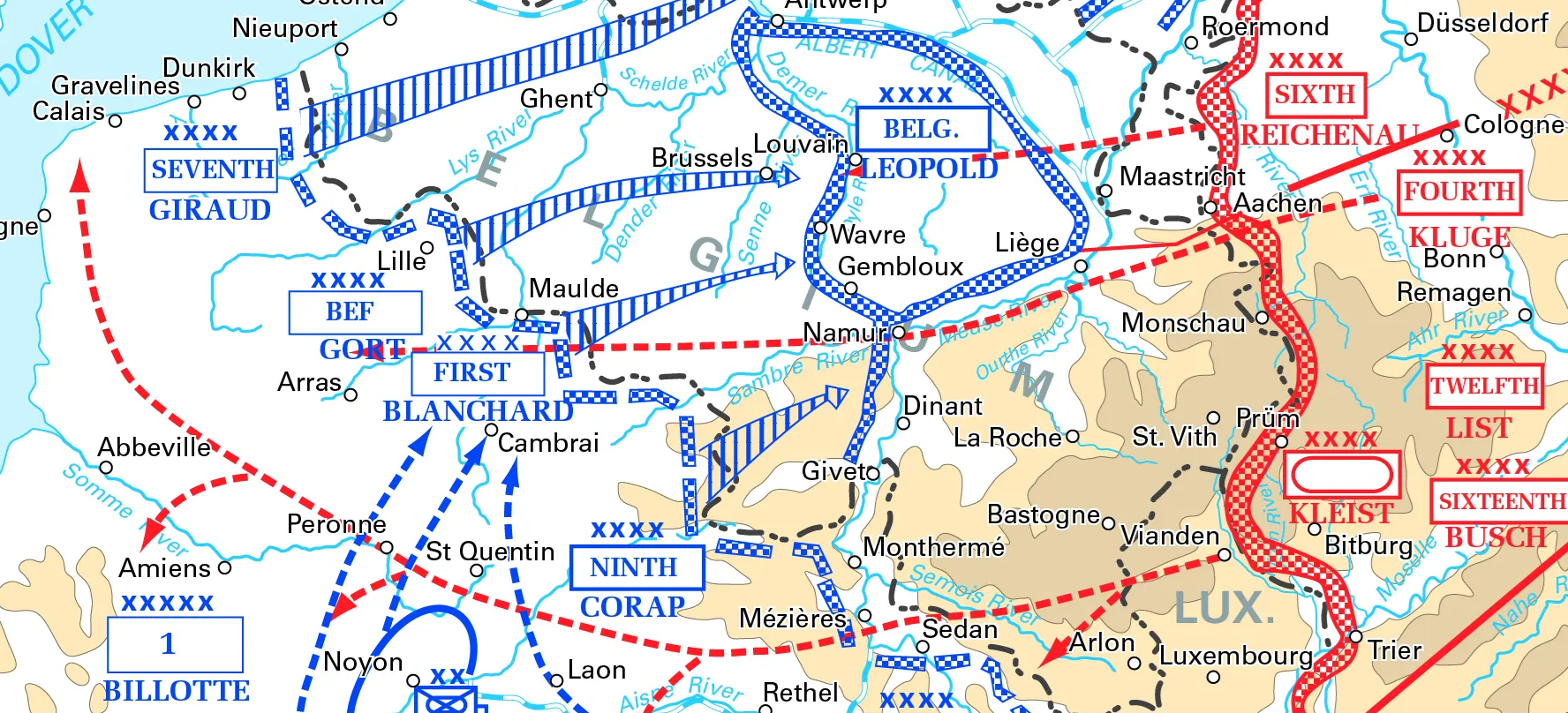
Detail from the West Point Military Atlas map of the “Campaign in the West, Disposition and Opposing Forces, 1940”
Full map.

The world has largely remembered Sichelschnitt as a brilliant German operation of war, but it was one that was fundamentally enabled by Allied ineptitude. Indeed, Blitzkrieg wasn’t particularly new, innovative or even a warfighting doctrine. It is best described, in the context of France 1940, as an event. It was simply the way that the Wehrmacht exerted its tactical and operational superiority over its more pedestrian enemies in 1940. In fact, it was the 1940 extension of what the German Army had first demonstrated in Flanders in March 1918, this time with tanks and Stukas. It was the Panzerwaffe (“tank force”) – combined with a tactical air force – which in 1940 would create the breakthrough that Ludendorff had been unable to achieve in 1918. Where it was applied, by Army Group A, it concentrated fast-moving armoured vanguards co-ordinated with tactical air power, such as 400 Ju 87 Stuka dive-bombers, to so overwhelm the enemy in both time and space that they were unable to respond quickly enough to the changing and challenging battlefield. In 1940 the panzer came into its own, the sound of clattering tracks on French cobblestones a new feature in the sound of battle and a key element in how France remembers its defeat in 1940.

It wasn’t the type of tank in the German inventory which mattered, but the way in which these tanks were employed. Only about 10 per cent of the army comprised tanks, the remainder relying on horse and wagons and the raw, painful feet of the marching infantry. Of the 2,539 tanks the Wehrmacht deployed in 1940, only 916, or 36 per cent were battleworthy, the remainder being clattering tin cans with machine guns (the obsolete Panzer Mark Is and Mark IIs). The only modern tanks were 683 Panzer Mark IIIs and Czech T38 tanks armed with a 37mm gun, and 278 of the larger Mark IVs with a short 75mm gun. But it was enough. The German operational strategy was to use this mass of armour not to fight a large confrontational tank battle, but to achieve breakthrough and breakout, bursting through the enemy’s linear defences. It was surprise and shock action that so discomforted the Allies, who had lazily and, given what we know of British failure to understand 1918, ignorantly assumed that the war would progress against a 1914 rather than a 1918 pattern. The armoured vanguard would surge through the outer skin of the enemy defences, concentrating heavy effort in one place, before driving hard into the heart of enemy territory. With an enemy intent on fighting a linear battle, the rear areas, behind this outer crust, would be weakly defended and full of rear-echelon, administrative and supply troops managing the lines of communication up to the front, not expecting to have to fight. It was by driving hard and fast behind the enemy front line, breaking the cycle of Allied battlefield decision-making, that Blitzkrieg was to achieve its psychological effect.

In contrast the Allies remained concerned about retaining the integrity of their defensive lines. The diaries of Major General Henry Pownall, for instance, are replete with concerns as the days spun past about the widening frontages on one defensive line or another. British concern was misplaced. It was to spread the ever-decreasing butter of the British infantry across ever-widening stretches of French and Belgian bread, without realising that the Germans were concerned not with rolling up a front line, but with driving hard to the rear. By so doing they would take risks with their flanks, but the discombobulatory effect on the enemy was considered to far outweigh any worry about the risk of counter- attack from an increasingly battered and disorganised enemy. Of course this operational concept was risky, but the risks taken were carefully calculated given what the German General Staff knew about British and French tactical doctrine, or the lack of it.

These German tactics were psychologically disconcerting for those not trained to expect them. As was demonstrated on the Meuse, artillery would batter a position in co-ordination with armoured columns bypassing fixed defences and attacking those it needed to clear from the flanks and the rear. The infantry accompanying the advancing armour – Panzergrenadiers (mechanised infantry) – arrived in tandem with the Stukas, which could drop their bombs from a screaming dive. Each Stuka seemed to those at the receiving end to be diving directly at them, personally. For untrained troops it was a terrifying experience. The panzers would sweep on while the truck-borne infantry would turn up to deal with survivors of this storm of fire and movement. By this time, of course, the disorientated French and British would now consider themselves cut off, behind their front line, with no prospect of being relieved. Surrender or a disorganised escape to the rear would seem to be a more sensible option than the forlorn hope of continued resistance when the surrounding fields were dotted with the grey-green uniforms and coal-scuttle helmets of their enemy. The psychological effect of Blitzkrieg was considerable. This wasn’t how their fathers had told them war was fought. How did the Germans manage to discomfort them on the battlefield so comprehensively? Were they inadequate soldiers, unable to meet the standards of campaigning set by the previous generation? Or was it that their tactics were simply not able to cope with the shock of a comprehensive assault by German infantry, armour and air power all descending on them at once? This was the battlefield that the British had entirely dominated, by virtue of their tactical innovations, in 1918. It was now Germany’s turn, a direct result of the failure of the British Army to develop its doctrine and approaches to warfighting at the end of the Great War. Brave men in 1940 did their duty, but against a battle-winning concept of their enemy, they were out-thought rather than out-fought. And critically, when an army thinks it is beaten, it is indeed beaten.

How Did Göring Get the Cyanide? OOTF Community Questions

Filed under: Europe, Germany, History, Japan, Military, WW2 — Tags: , , , — Nicholas @ 04:00

World War Two
Published 6 Sept 2025

In this episode of Out of the Foxholes, we dive into your community questions about World War II. How did Hermann Göring manage to get the cyanide capsule that ended his life at Nuremberg? What role did Slovakia really play in 1939? Why didn’t the Allies invade the Balkans instead of France, and why didn’t Japan use its submarines like Germany did?
(more…)

Long before the “Bad Orange Man”, there was “T.R.”

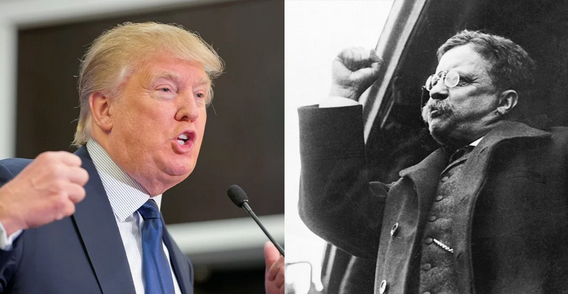
In the Coolidge Review, Amity Shlaes points out some strong similarities between Donald Trump’s career and that of the Bull Moose himself, Theodore Roosevelt:

Though a century apart—TR served from 1901 to 1909 — these two chief executives have favored the same modus operandi: using unpredictability to amass power. And the record of Theodore Rex, as Edmund Morris titled his TR biography, bodes ill for both the economy and the Republican Party.

The Trump-TR Parallels

But to the similarities. They start, for both men, pre–White House. As Trump did, TR staged his pre-presidential efforts as much with an eye to public recognition as to sustained reform or strengthening institutions.

Whenever TR stumbled, he pivoted to a new venture and publicized it like mad, though the medium in those days was the printed word, not season after season on The Apprentice. Before the cognoscenti had even absorbed the meaning of the young Roosevelt’s humiliating fourth-place score in a key 1886 New York City mayoral contest, for example, TR was off to the Badlands, memorializing his ranching experiences in dispatches and books such as Ranch Life and the Hunting Trail.

As Trump does, TR routinely alienated GOP grandees, circumventing them to get ahead. As Trump has, TR skillfully cultivated the media — so skillfully that members of Congress were left trying catch up with whatever shifts in public opinion resulted from the politician’s press alliances. TR’s Rupert Murdoch was the widely syndicated William Allen White of Kansas’s influential Emporia Gazette. TR’s equivalent of Fox News was the New York Journal, whose owner, William Randolph Hearst, drummed a steady beat of support when Roosevelt called for war against Spain.

Today, Murdoch must be scratching his head over what his showcasing Trump has wrought, especially now that Trump decided to sue both Murdoch and his Wall Street Journal. White, too, found that he had second thoughts about his decision to back TR: “Roosevelt bit me and I went mad,” White reportedly told a colleague.

[…]

BULLY

The occupant of what he labeled the Bully Pulpit — “bully” as in “excellent” — proved a literal bully as well.

As president, TR perpetually unnerved fellow Republicans, pivoting back to domestic politics. As Trump has, TR cast his campaigns in moral terms rather than economic ones. Where Trump launched his tariff war, TR made war against trusts, large combinations of companies. Relying more on whim than statute, Roosevelt segregated trusts into “good trusts” and “bad trusts”.

TR targeted an invincible-looking industry that, in those days, mattered as much as the interstate highways, or the internet, do today: railroads. James Hill’s Great Northern Railway took over a struggling competitor, Northern Pacific. Roosevelt asked Hanna what he made of the combined entity, Great Northern Securities. Hanna replied that it was “the very best thing possible for the future of the whole Northwest territory”. Roosevelt nonetheless sicced the Justice Department on the Great Northern.

J. Pierpont Morgan, a participant in the beleaguered deal, called on the president to inquire, as desperate steel importers these days do from time to time, whether their attorneys might work out the matter behind the scenes.

No.

Next, the disconcerted Morgan asked whether other investments of the House of Morgan might be assailed. Roosevelt’s reply captures the chill of arbitrary leadership. The administration would not go after the other Morgan companies, he said — unless “they have done something we regard as wrong”.

As Edmund Morris reports in Theodore Rex, to observers such as French ambassador Jules Jusserand, Roosevelt seemed “more powerful than a king”. That power suited many voters fine, which is why Roosevelt won so headily when he ran for office on his own in 1904.

Of course TR, like Trump, occasionally supported laws that aligned with his impulses. One example is the Elkins Act of 1903, which made it illegal for railroads to charge different freight rates for different customers. This shallow effort to achieve market “fairness” deprived the railroads of a standard business tool: the ability to provides discounts to those who buy the product in larger quantities. Shares in railroads promptly dropped more than 20 percent, a shift that undermined TR’s premise of railroad invincibility.

Up on the Mountain: a History of the Ski Cap

Filed under: Europe, Germany, History, Military, WW1, WW2 — Tags: , , , , — Nicholas @ 02:00

HatHistorian
Published 1 May 2025

The ski cap, sometimes also called by its german name of Bergmütze, is a visored cap with ear flaps secured to the front by buttons or a buckle. Allegedly descended from eastern bashlyks worn by Russian soldiers, it was popular in the alpine regions of Germanic countries. First adopted by the AUstro-Hungarian Empire as a field cap, it was infamously worn by the Wehrmacht during WWII. It continues to be used as a field or dress cap by German, Austrian, and Hungarian armed forces, and civilian versions can be found around Central and Eastern Europe.
(more…)

QotD: Generation X

Filed under: Books, Humour, Quotations, USA — Tags: , , , , , — Nicholas @ 01:00

… But Sailer’s right about Klosterman’s ability to grasp the obvious about Gen X. For instance:

    The concept of “selling out” — and the degree to which that notion altered the meaning and perception of almost everything — is the single most nineties aspect of the nineties. The complexity, nuance, and application of the term sellout was both ubiquitous and impossible to grasp. Nothing was more inadvertently detrimental to the Gen X psyche.

Or, as I like to put it, we were so obsessed with “authenticity” that we took as our guru an exquisitely sensitive longhaired goof who fronted a band named after spooge. […] But Klosterman does have genuine insights sometimes:

    The detail always noted in remembrances of the Bronco chase is the throngs of bystanders cheering for Simpson as the car rolled down the freeway, congregating on overpasses and holding makeshift cardboard signs proclaiming, “The Juice Is Loose”. It seemed perverse then and still seems perverse now. Yet this can also be understood as the primordial impulse of what would eventually drive the mechanism of social media: the desire of uninformed people to be involved with the news, broadcasting their support for a homicidal maniac not because they liked him, but because it was exhilarating to participate in an experience all of society was experiencing at once.

Sailer thinks that’s clever and perceptive, and I agree. Too bad you have to read some masturbatory bullshit about Zima to get to it.

Sadly, he doesn’t take that out a step (or, at least, he doesn’t get quoted doing so in Sailer’s review). Here’s Klosterman’s verdict on why Gen X, for all its faults, wasn’t so bad:

    The enforced ennui and alienation of Gen X had one social upside: Self-righteous outrage was not considered cool, in an era when coolness counted for almost everything. Solipsism was preferable to narcissism. The idea of policing morality or blaming strangers for the condition of one’s own existence was perceived as overbearing and uncouth. If you weren’t happy, the preferred stance was to simply shrug and accept that you were unhappy.

True enough, but look: Of all the things that made the Boomers so fucking insufferable, right near the top was their utter inability to let go of their youth. Instead of seeing Forrest Gump as a metaphor so unsubtle, an anvil to the head seems sneakier, they thought it was a lighthearted celebration of a simpler, more innocent time. We knew better. Since they couldn’t let go of their youth, we made “being old and jaded long before our time” into our signature thing.

But where, my fellow alterna-dudes, is that attitude now, when it matters? We’re in the same position in 2022 as our parents were in 1992: Staring down the barrel of middle age, teeing off on life’s back nine, pick your metaphor. It’s time to put away childish things. Grow the fuck up already, the way we wish our parents would’ve done for us back in 1992. Instead, we’re letting our lunatic children smear their pathologies all over what’s left of America, because … ?

I know why Klosterman does it: That’s what they pay him for. What’s our excuse?

Severian, “A Meta-Review”, Founding Questions, 2022-02-24.

Powered by WordPress


