Quotulatiousness

August 26, 2025

Plunder does not explain western prosperity

Filed under: Africa, Europe, History — Tags: , , , , — Nicholas @ 05:00

Lorenzo Warby digs deep into the “mountain range of bullshit” over the issue of plunder, as in the claims that the First World got that way by stealing everything they could from what became identified as the Third World:

I am using mainly European examples because it is the genetically (and archaeologically) best mapped continent. But these grim patterns are normal in the history of Homo sapiens. Consider, for example, the Bantu expansion across Africa that mirrors the march of Anatolian farmers across Europe.

The development of farming and animal herding led to the y-chromosome Neolithic bottleneck: a massive harrowing of male lineages that only about 1-in-17 male lineages survived. The development of farming and pastoralism created much higher populations plus plunderable assets. Folk developed much more coherent kin-groups. Teams of male warriors wiped each other out, taking the land, animals and women of the defeated as their spoils.

Plunder was thus endemic in farming and herding societies. The harrowing of male lineages came to an end via the development of chiefdoms and states. That is, the technology of exploitation — keep defeated males alive so they could breed more payers of tribute and taxes — overtook the technology of aggression (kin-groups).

States were both ordering and predatory. This process worked less well among pastoralists, as the need to defend the mobile assets of animal herds generated highly effective warriors who were harder to control or extract surplus from. Pastoralist states tended to be super-chiefdoms rather than full states and the harrowing of pastoralist male lineages continued, just at a lower level.

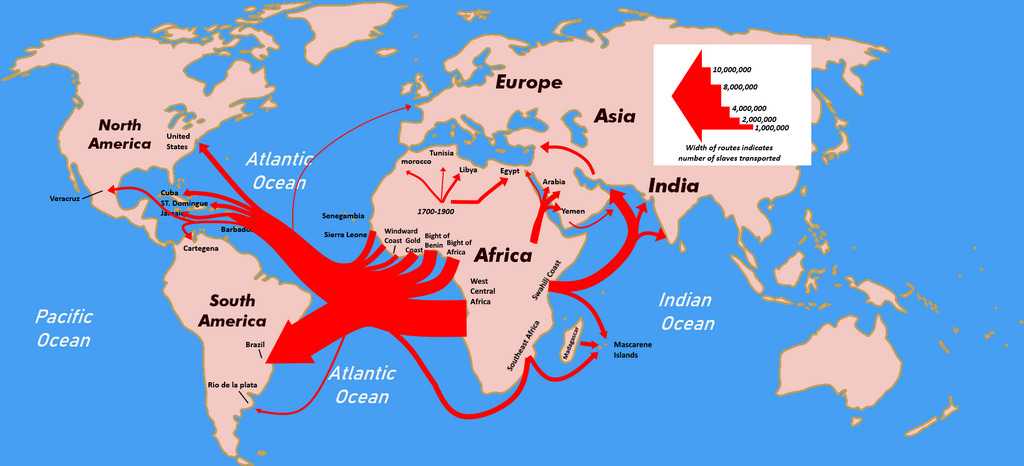
Africa was the continent of slavery because, being where Homo sapiens evolved, it was full of pathogens, parasites, predators and mega-herbivores that co-evolved with Homo sapiens, so could cope with them.1 This kept population density down. This meant that labour was more valuable than land. There was more potential wealth in grabbing able-bodied people than in grabbing land.

This made slavery endemic in Sub-Saharan Africa long before the Islamic, then the Atlantic, slave trades developed. Sub-Saharan African states were overwhelmingly slave states. Even those that were trade states traded in slaves.

The Atlantic slave trade looks like the most extreme pattern of Europeans plundering others — in this case, Sub-Saharan Africans. It was certainly true that the Atlantic slave trade was horrific and had multiple adverse effects on African society. But those adverse effects were to intensify patterns that already existed. Moreover, the original plundering of people by turning them into slaves was done by … Africans.

The life expectancy of a European who left the African coast was about a year: it was not practical for Europeans to do the original enslaving. They bought the slaves from Africans. This enabled the slave trade carried on by Catholics to conform to the Papal Bull Sublimis Dei (1537) which banned Catholics from enslaving the indigenous inhabitants of the Americas (and, by implication, elsewhere), but did not ban trading in, or owning, slaves.

Wikimedia Commons

Plunder was endemic across human societies: including turning fellow humans into plunder — aka slavery. It was sadly ordinary. It was not a European pattern, it was a Homo sapien pattern. The Islamic slave trade was on the same scale—given it operated for centuries longer — as the Atlantic slave trade, the Saharan passage was every bit as horrific as the Atlantic passage, and the Islamic slave trade had the extra horror of the castration of male slaves. Hence, there is not an ex-slave diaspora in Islam as there is in the Americas.

Just as plunder was endemic, so was poverty. Mass poverty was the norm across farming societies. While there were economic efflorescences across human history, and evidence of periods of sustained growth, the dramatic shifts to mass prosperity since the 1820s — since the application of steam power to railways and steamships — is utterly without precedent. Moreover, it started in precisely one society — Great Britain. None of the other Atlantic littoral societies of Europe showed any sign of such a take-off.


  1. The megafauna outside Africa — which did not co-evolve with Homo sapiens — almost all died out when Homo sapiens turned up.
“One of the top tips for having a decent country is never, ever, allow the fuckwits to gain power”

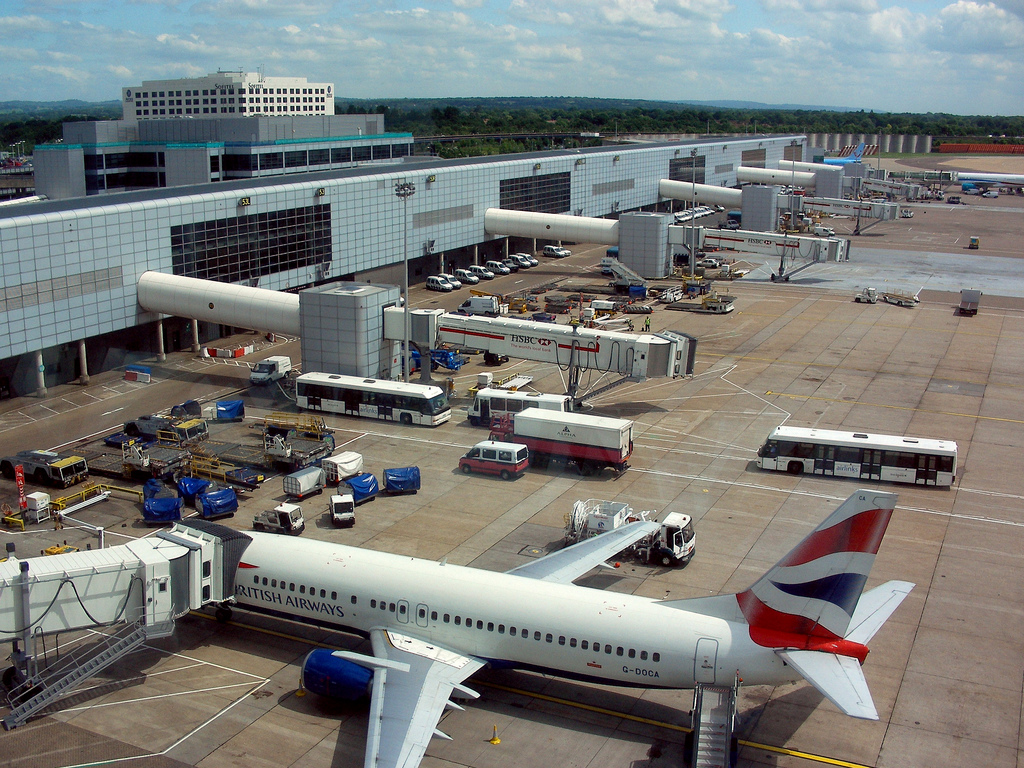
If you need to drop someone off at London’s Gatwick Airport, you’ll find yourself facing a £7 charge for the privilege, no matter what day of the week or time of day you choose. Tim Worstall explains why:

“Gatwick Airport, North Terminal” by Martin Roell from Berlin, Germany is licensed under CC BY-SA 2.0 .

It’s sod all to do with congestion and everything to do with the tractor production statistics the fuckwits have imposed upon the airport.

    The conditions attached by the transport secretary included national landscape provisions as per the Levelling Up and Regeneration Act 2023, more consideration for sustainability in buildings design and additional pollution-related mitigation measures.

    The government said in its formal response to the Planning Inspectorate’s recommendations on the Gatwick DCO that it wanted more detail on how it would achieve its commitment of 54% of passengers arriving at the airport via rail within the first year of dual runway operations, which could be by the end of this decade.

The government has a target. That 54% of the arrivals at an airport — yes, an airport, where people get on jet planes — must be by public transport. Therefore the airport is charging for car drop offs in order to decrease the number of car drop offs. There is no more reason than that. Or, as up at the top, the reason there’s a £7 drop off charge at Gatwick Airport is because we are ruled by the fuckwits who have a target for public transport to an airport where people then get on jet planes.

    London Gatwick has also accepted a requirement to have 54% of passengers using public transport prior to bringing the Northern Runway into operation and has reiterated the need for third parties, including the Department for Transport, to support delivery of the necessary conditions and improvements required to meet this target. This would include, for example, reinstating the full Gatwick Express train service.

    Given the reliance on other parties to achieve this 54% target, should it not be achieved then London Gatwick has also proposed an alternative cars-on-the-road limit to be met before first use of the Northern Runway to address concerns about possible road congestion. Furthermore, if neither the 54% transport mode share or the cars-on-the-road limit are met, then use of the Northern Runway would be delayed until £350m of road improvements have been completed. This would make sure any additional road traffic flows can be accommodated and any congestion avoided.

It’s all fuckwit targets set by fuckwits.

Of course, there are those who think that fuckwit targets set by fuckwits are a good idea. For one of the problems of life is that there are always fuckwits:

    When we talk about airport expansion, we often focus on runways, terminals, and the physical infrastructure. But what about how people actually get to the airport?

    The journey begins long before passengers step foot in a terminal, and their choices about transport can have a significant impact on congestion, carbon emissions, and overall passenger experience.

    One of the conditions set for Gatwick’s expansion is a legally binding guarantee that 54% of passengers will travel by public transport, up from today’s 44%. On the surface, it sounds like a simple shift. But transport isn’t just about availability — it’s about behaviour, convenience, and incentives.

One of the top tips for having a decent country is never, ever, allow the fuckwits to gain power. But we have done so therefore there is this £7 charge for a drop off at Gatwick Airport. That’s it, there is no other reason. There are fuckwits buried in the belly of the British state and they’re making the rules now.

Table saws, technological patents, and rent-seeking

Tom Knighton, who I’ve “met” on my favourite woodworking forum, celebrates a small victory in the never-ending battle against the rent-seekers of the corporate world:

“SawStop” by Comfr is licensed under CC BY-SA 4.0 .

What does this have to do with rent-seeking?

Well, there’s a company called SawStop. They make really great table saws with a unique safety feature. They’re equipped with a brake and sensor that, when it detects moisture such as one might find in a human finger, it locks the saw and drops the blade down into the saw’s body.

It’s a really great bit of technology, and the saws happen to be really good saws, too, so the company has done well for itself.

However, it started out as a company seeking to license the technology, only no one wanted it at the time.

SawStop decided to try and press the United States government to mandate their technology on all new table saws, and the government was going to.

Was.

This video has a good rundown of the whole thing. (I’d embed it, but the channel doesn’t allow it for some reason.)

The short of it is that the rule that was being considered has now been tossed because it would specifically give SawStop a monopoly on table saw sales in the United States, legally. Yes, they were going to offer up a patent for the public domain, but it wouldn’t be enough to replicate the technology in and of itself.

Plus, at a time when woodworking isn’t the biggest hobby in the world, even if it had been enough, driving up the cost for a central piece of tooling that most consider essential for woodworkers ain’t the way to change that.

For example, Skil makes a jobsite saw that typically runs under $300. SawStop’s equivalent is around three times that much, and that’s a lot of money to spend on something you’re not sure you’ll even enjoy.

Especially since just being careful can prevent the need for the brake in the first place, to say nothing of the fact that if you cut wet wood, it’ll trigger the brake, which is a pain for a lot of people, especially building contractors whose lumber isn’t super dry to begin with.

Seeing the rug pulled out from under SawStop is great, but the real issue here is that it doesn’t happen often enough. Rent-seeking is all too common and all too often works.

When Jagdpanther Fought Churchill

Filed under: Britain, Germany, History, Military, Weapons, WW2 — Tags: , , , — Nicholas @ 02:00

The Tank Museum
Published 18 Apr 2025

Jagdpanther vs Churchill. Tank destroyer vs tank. New technology vs proven veteran. Who will emerge victorious?

It’s 6pm on 30th July 1944. Outnumbered 6 to 1, a platoon of 3 German Jagdpanthers is about to go into action for the first time. Facing them will be a squadron of 18 British Churchill tanks. Within 5 minutes, 11 tanks will be knocked out.

The Jagdpanther is the latest German armoured vehicle to arrive in Normandy. With a devastating gun, and a heavily armoured superstructure, this tank hunter is quick, reliable and deadly.

The Churchill has been fighting with Allied armies in North Africa, Italy and on the Eastern Front. The early marks struggled with a range of issues, but by 1944 it is an essential part of the British and Canadian tank force.

It’s during Operation Bluecoat where these two machines would come face-to-face for the very first time. The Churchills of S Squadron, 3rd Battalion, Scots Guards, have captured Hill 226 – a strategically important area to the south of Caumont. They are preparing for a German counterattack, but their infantry is yet to arrive – leaving their left flank dangerously exposed. And a platoon of Jagdpanthers is ready to take full advantage of their vulnerable state …

00:00 | Introduction
00:35 | The Jagdpanther
02:38 | The Churchill
05:43 | Operation Bluecoat
07:46 | A Turkey Shoot?
12:25 | Aftermath
17:40 | Roll of Honour
(more…)

QotD: Problem-solving in large organizations

Filed under: Bureaucracy, Business, Quotations — Tags: , , — Nicholas @ 01:00

… but it’s the nature of bureaucracy itself that’s most to blame. Everyone who has ever worked for even a midsize company has had this kind of experience: You’re in Customer Service, and some hotshot from Sales calls you up. He’s promised a big new potential client the earth and stars, and now he needs you to deliver. Alas, you tell him, you can’t do it. Not won’t, can’t — you’re not set up for that kind of thing. So you call your Department Supervisor over, and he comes up with what looks like a workaround …

… except no, now Accounting chimes in, that looks like it might be a violation of some codicil to some sub-paragraph of an addendum to a regulation, better check with Compliance. But before you can do that, the Division Managers get into it, because hotshot has called his Department Supervisor over and said look, Dave, I brought in seventy gorillion dollars last fiscal year, you owe me this one …

… and so forth. Everybody with me? No one is corrupt in this scenario. Nobody’s trying to pull a fast one on anybody else. Indeed, everybody’s on the same page, and everybody has every incentive to find a solution, because all our Christmas bonuses are going to look a little nicer if the firm lands this fat client. All we’re trying to do is add one task to the existing Customer Service workflow, but it’s going to take at least a Division Manager-level meeting, if not the direct input of the Big Boss himself, to get it hammered out. It’s an exponential increase in energy expenditure.

And of course it ramifies, and of course that’s true no matter what solution you come up with. Make an exception to the workflow for this one client, and pretty soon you’re going to be making exceptions for every client — every wannabe-hotshot up in Sales is going to demand the works for every little podunk potential client. Same deal if you designate one guy from Customer Service as the dedicated exception-handler. Same deal if you create a whole new sub-unit inside Customer Service (but a lot faster). And so forth.

I’m sure everyone has had that experience, too: Watching your company lose out on a potential big client because the various Departments couldn’t get on the same page for whatever reason.

And that’s just around the office! Meaning: yeah, it’d be nice if we could land that big client, maybe see an extra hundred bucks on our Christmas bonus, but nobody’s losing any sleep over it. Well, ok, Hotshot up in Sales probably is, but even the best salesman loses far more often than he wins. He’ll get over it in a day or two, or he won’t be a salesman much longer.

But the same thing happens when it comes to stuff that matters, which is why complex societies collapse.

Severian, “Collapse II”, Founding Questions, 2021-12-09.

Powered by WordPress