
Quotulatiousness

August 18, 2025

Canada’s state-subsidized media now seem to see their job as pro-government PR

Filed under: Cancon, Government, Liberty, Media, Politics — Tags: , , , , , — Nicholas @ 05:00

At The Rewrite, Peter Menzies considers the state of Canadian media in how they reported on the Maritime provinces’ draconian policies during the ongoing wildfire season:

Screencaptured image of one of the August 2025 wildfires in the Maritimes from Global News via The Rewrite

There will always be conflicts between collective rights and individual liberties. One is valuable in ensuring there is order in society, which is important. The other is necessary to maintain freedom, which lots of people live without but is nevertheless desirable. When there’s too much freedom, people look for politicians who will restore order. When there is too much order, people rebel and demand freedom (see everything from the French Revolution to the Freedom Convoy).

Traditionally, those inclined to the order side if the ledger have been viewed as conservatives while “liberals” have led the fight for individual freedom manifest in the civil rights movement, the emancipation and advancement of women, freedom of speech, etc. that are now viewed as fundamental to the maintenance of a modern, liberal democracy.

But as Pete Townsend wrote a little more than half a century ago, the parting on the left is now the parting on the right (and the beards have all grown longer overnight). Journalists tend to lean left, which means their traditional opposition to the imposition of order has been replaced by a collectivist tendency to sympathize with those imposing it. It is left to the newsroom minorities on the right to carry the torch for individual liberties.

To wit, this CBC story on Nova Scotia’s wild fire-induced ban — enforced with a $25,000 fine until Oct. 15 — on walking anywhere in the woods was oblivious to the impact on personal freedom. Never crossed their minds. When the issue was raised on social media, Twitter journos took up the cause. Stephen Maher dismissed individual liberty concerns as fringe views and maintained that the restrictions could be justified as “reasonable” limitations of Charter rights. While the Globe and Mail‘s editorial board called the Nova Scotia move “draconian”, Globe columnist Andrew Coyne nevertheless wondered “How the hell did the right to walk in the woods of Nova Scotia during a forest fire emergency get elevated into the right’s latest cultural obsession?”

It was left to commentators such as Marco Navarro-Genie to point out the intellectual flaccidity fueling parts of the collectivist argument when New Brunswick followed Nova Scotia’s lead and NB Premier Susan Holt said this:

    Me going for a walk in the woods is gonna cause a fire. I can understand why people, uh, think that that’s, that’s. That’s ridiculous. But the reality is, it’s not that you might cause a fire, it’s that if you’re out there walking in the woods and you break your leg, we’re not gonna come and get you because we have emergency responders that are out focused on a fire that is, uh, threatening the lives of New Brunswickers.

That, believe it or not, was a good enough explanation for the collectivist thinking in most mainstream newsrooms.

If journalism is to be useful in defending democracy, those involved in it need to be intellectually equipped to understand the stakes. And their first instinct must be to treat the suppression of liberty as a serious issue whenever the powerful indulge in it at the expense of the powerless. That doesn’t mean liberty should always trump order (traffic lights are eminently reasonable). But it does mean that journos should demand that politicians justify their actions rather than simply helping them explain them to the Great Unwashed. To do otherwise is to fail.

How One Treaty Split The World In Two – W2W 40

Filed under: Britain, France, Germany, History, Russia — Tags: , , , , , — Nicholas @ 04:00

TimeGhost History
Published 17 Aug 2025

After WWII, Britain and France face the decline of their empires and the looming Soviet threat. Desperate for security, they forge the Dunkirk and Brussels Pacts, but quickly realize they need American support. As old alliances shatter and Germany becomes the front line, the world divides into two camps with the formation of NATO and the Warsaw Pact. Secret deals, rearmament, and the fear of communist tanks rolling across Europe set the stage for decades of Cold War rivalry.
(more…)

Canadian grocers are “maple-washing” products to hide their actual origin

Filed under: Business, Cancon, Food — Tags: , , — Nicholas @ 03:00

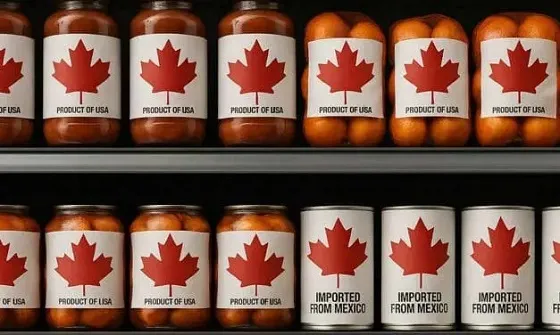
Sylvain Charlebois on the new phenomenon of grocery stores going to great lengths to pretend that items for sale are Canadian when they’re not — “maple-washing”:

Image by Troy Media via Todayville

Canadian grocery retailers are misleading shoppers about where their food really comes from. Behind the patriotic packaging lies a growing problem: “maple-washing” — using Canadian symbols to suggest products are homegrown when they’re not. It’s eroding consumer trust and must end.

That’s why more Canadians are paying closer attention to what labels actually mean. Awareness around origin labelling has grown as people learn the difference between “Product of Canada”, “Made in Canada”, and “Prepared in Canada”. The Food and Drugs Act requires labels to be truthful and not misleading. A “Product of Canada” must contain at least 98 per cent Canadian ingredients and processing. “Made in Canada” applies when the last substantial transformation happened here, while “Prepared in Canada” covers processing, packaging or handling in Canada regardless of ingredient source.

The differences may seem technical, but they matter. A frozen lasagna labelled “Prepared in Canada”, for example, could be made with imported pasta, sauce and meat — packaged here but not truly Canadian. These rules give consumers the clarity they need to make informed choices.

Armed with this clarity, many Canadians have become more selective about what they buy. That vigilance has emerged alongside a surge in consumer nationalism, spurred partly by geopolitical tensions and anti-American sentiment. Even with U.S. giants like Walmart, Costco and Amazon dominating Canadian retail, many shoppers are deliberately avoiding American food products. The impact has been significant: NielsenIQ reports an 8.5 per cent drop in sales of American food products in Canada over just a few months. In an industry where sales usually shift by fractions of a per cent, such a drop is extraordinary. It shows how quickly Canadians are voting with their wallets.

That kind of shift, rare outside of crises, caught many grocers off guard. The sudden change left supply chains long dependent on U.S. products under pressure, and store-level labelling grew inconsistent. Early missteps — like maple leaves displayed beside imported goods — were excused as logistical oversights. But six months later, those excuses no longer hold. Persisting with misleading displays and false origin claims has crossed the line into misrepresentation. Instances of oranges or almonds labelled as Canadian, with prices quietly adjusted after complaints, show the problem is systemic, not accidental.

Confederate Morse Carbine: Centerfire Cartridges Ahead of Their Time

Filed under: History, Military, USA, Weapons — Tags: , , , , — Nicholas @ 02:00

Forgotten Weapons
Published 23 Oct 2017

George Morse of Baton Rouge patented a design for a remarkably modern centerfire cartridge and breechloading rifle action in 1856 and 1858, using a standard percussion cap as a primer. This was coupled with a gutta percha washer for sealing and a rolled brass cartridge body that was strong and robust — easily reloaded, if somewhat complex to manufacture.

After positive trials by the Army and Navy, Morse received a contract to make first complete guns and then a royalty contract for the conversion of existing muskets to his system. Work began at the Harper’s Ferry Arsenal, but money ran out with only 60 conversion completed. When the Civil War broke out, Morse chose to side with the Confederacy, and the tooling for his conversions was taken from the captured Armory to be put to use. He initially set up in Nashville, but the city fell to the Union in 1862, and he was forced to relocate to Atlanta and the Greenville South Carolina. It was in Greenville that Morse was finally able to manufacture guns in quantity, and he built approximately a thousand brass-framed single shot cartridge carbines for the South Carolina state militia.

Unfortunately for the Confederacy, the infrastructure to supply a modern type of cartridge ammunition really did not exist in the South, and this crippled any chance of Morse’s carbines becoming a significant factor in the war. The best technology in the world is still of no use if ammunition cannot be provided!

This Morse carbine is of the third type, using a sliding latch on the breechblock to hold the action closed when firing. Two previous versions used different and less secure systems, but this third type was introduced around serial number 350 and would comprise the remaining 2/3rds of the production run.

Cool Forgotten Weapons merch! http://shop.bbtv.com/collections/forg…

QotD: Dostoevsky’s Demons can be read as “one long, savage parody of Fathers and Sons

Filed under: Books, History, Politics, Quotations, Russia — Tags: , , , , , — Nicholas @ 01:00

To understand what happens next [in Dostoevsky’s Demons], it helps to have read some Turgenev. His most famous work, Fathers and Sons, is of a piece with the most lurid boomer fantasies. The basic plot is that there are some genteel Russian liberals, good New York Times readers, people with all the right views. Their kids come back from college and are espousing all this weird stuff: stuff about white fragility and transgenderism and boycotting Israel, stuff that makes their nice liberal parents extremely uncomfortable. But it’s okay, you see? The kids magnanimously realize that their parents were once cool revolutionaries too, and the parents make peace with the fact that the kids are just further out ahead than they are, and everybody feels good about themselves because if the kids have seen far, it’s only by standing on the shoulders of giants. The important thing to understand is that everything about this plot is identity validation wish-fulfillment for the boomer liberal parents (like Turgenev himself). It’s the political equivalent of that YouTube genre where Gen Z Afro-American kids rock out to Phil Collins.

The macro-structure of Demons mirrors this so closely, you can almost read the book as one long, savage parody of Fathers and Sons.1 The sunny opening section is a satire of the boomer liberals, and the big vibe shift part way in is their kids coming back from college. But that’s where things go off the rails. In this book, the next generation shares their parents’ anti-religious and anti-monarchist attitudes, but unlike in Fathers and Sons, the kids in Demons are disgusted by the hypocrisy and cowardice of their genteel liberal parents, and eager to plunge Russia into a hyper-totalitarian nightmare. The exact contours of that nightmare are something they frequently argue about and change their minds over, but they can all agree that it will need to begin with an enormous mountain of skulls, and that their town is as good a place as any to start.

Dostoevsky’s other works put individuals front and center, his stories have unbelievably rich characterization (Nietzsche once said that Dostoevsky was the greatest psychologist to ever live), because for Dostoevsky the very highest stakes, the most important questions in the world, were about the damnation or salvation of individual souls. But Demons is different: here the characters all blur together, their names are disgorged to you in a never-ending torrent, and only a few of them are distinctive in any way.2 How could Dostoevsky think these people don’t matter? It’s because they aren’t real people anymore. It’s because they’re possessed. Their brains have been scooped out and all you can see in their eyes is a writhing mass of worms. Their ideas and ideologies have hollowed them out and are wearing their skins as suits.

But what if the ideas don’t matter either? It’s easy to interpret the second half of Demons as a novel of ideas, but it really isn’t. Your first clue is that the ideas are just so goofy. There’s one guy who thinks that by killing himself he will become God (don’t ask, it’s Dostoevsky, man). Another has written a book with ten chapters, explaining how “Beginning with the principle of unlimited freedom I arrive at unlimited despotism”, and proposing a method of brainwashing for reducing ninety percent of humanity to a mindless “herd”. Yet another thinks that everything can be solved by killing one hundred million people, but laments that even with very efficient methods of execution this will take at least thirty years.3 My own favorite might be the guy who refuses to explain what his system is, but just smugly declares that since everybody is going to end up following it eventually, it’s pointless for him to explain it.

John Psmith, “REVIEW: Demons, by Fyodor Dostoevsky”, Mr. and Mrs. Psmith’s Bookshelf, 2023-07-17.


  1. Further evidence for this reading: the book contains a character, the great writer “Karmazinov”, who is a straightforward expy of Turgenev himself.
  2. That said if you do need to keep track of them, this alignment chart made by some genius on the internet is a pretty handy guide: link.
  3. This one probably seems less funny after the 20th century than it did when Dostoevsky wrote it.

Powered by WordPress


