
In The Free Press, Rupa Subramanya discusses the — in my opinion, insane — court ruling in British Columbia that invalidated existing land titles in part of the Vancouver area, handing the titles to the properties over to the Cowichan First Nation:

A B.C. Supreme Court judge has granted several First Nations a portion of a 1,846-acre land claim on Lulu Island. B.C. Supreme Court
It turns out that all those land acknowledgments weren’t just symbolic. They may have been advance notice.
When Canada adopted its constitution in 1982, Prime Minister Pierre Trudeau slipped in a ticking time bomb: an explicit recognition of indigenous land rights without constitutional protection for property rights for other Canadians. That constitutional clause has fueled decades of lawsuits from First Nations — Canada’s indigenous people — asserting claims to huge portions of their ancestral territories.
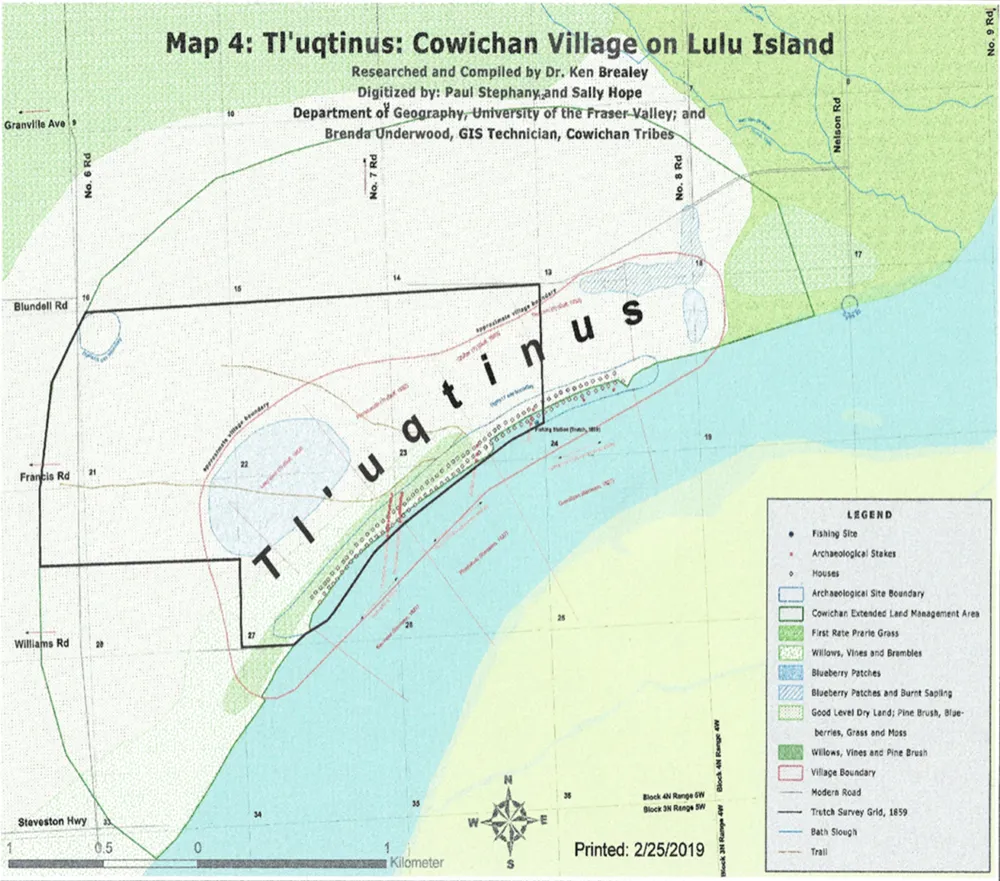
Last Thursday, the British Columbia Supreme Court ruled that the Cowichan Nation holds “Aboriginal title” to about 1,846 acres of land on the south shore of Lulu Island in Richmond, and constitutionally protected rights to fish in the south arm of the Fraser River.
This 275,000-word judgment doesn’t just affect government-owned lands. It also includes private property now owned by third parties. So if you’re a Canadian who is a property owner in British Columbia and not indigenous, your claim on what you think you own has just been superseded by indigenous claims, called a “senior” claim in legalese. Down the road, your land or house could be expropriated by the federal government and turned over to an indigenous group that claims ownership.
That has already happened in Ontario, where three northern Ontario First Nations claimed in a lawsuit last month that a 14-acre public park in Kenora called Anicinabe Park is actually unceded territory and should be returned.
“In constitutional terms, aboriginal rights trump private property rights,” Bruce Pardy, a professor of constitutional law at Queen’s University in Kingston, Ontario, told me. He pointed to last November’s ruling by a New Brunswick judge that the court might be in position to order the government to seize private property and turn it over to an indigenous group making a claim on it.
As Prime Minister Mark Carney tries to fast-track major infrastructure projects — roads, bridges, pipelines, power plants, and more — all part of his plan to boost Canada’s global competitiveness and reduce reliance on the U.S., some of those ambitions might be snarled by indigenous land claims that take years to resolve. The British Columbia case began in 2019 and is considered to be the longest trial in Canadian history.
The day before the Cowichan Nation ruling in British Columbia, a Yukon First Nation announced that it would oppose all new mining claims on its traditional territory while a regional land-use plan is developed. Yukon First Nations leaders said that new claims are “unwelcome” and “unlawful”, and that they plan to challenge the mining industry to protect the land from further industrial activity.
Stefan Labbé in BIV last week:
A B.C. court has handed the Cowichan Tribes and other First Nations title over a chunk of federal and city land in Richmond that for centuries was used as a winter fishing village, before colonial administrators evicted the people who lived there.
The landmark Aug. 7 ruling was handed down after more than 500 days of litigation before the B.C. Supreme Court.
It gives the Cowichan Tribes, the Stz’uminus First Nation, Penelakut Tribe, Halalt First Nation — as well as the Lyackson First Nation in a supporting role — Aboriginal title over the Tribes’ historic Tl’uqtinus village on the southeast side of Lulu Island.
The ruling also gives the First Nations fishing rights at the mouth of the Fraser River.
In a joint statement, the First Nation plaintiffs said: “We raise our hands to the generations of leaders” who fought for the return of the Tl’uqtinus village lands and their fishing rights in the Fraser River.
B.C. Supreme Court Justice Barbara Young suspended her decision for 18 months “to allow for an orderly transition of the lands” in keeping with the principle of reconciliation.
“Now that this multi-year journey has concluded, it is my sincere hope that the parties have the answers they need to return to negotiations and reconcile the outstanding issues,” she wrote.
Jamie Sarkonak in the National Post wrote on Monday:
This case of “land back” in action (Cowichan Tribes v. Canada) casts a shadow over the country’s property system. It jeopardizes the default means of owning land in Canada — the estate in fee simple, where owners have exclusive rights to sell land — wherever Aboriginal title is found to exist.
Aboriginal title is the right of an Indigenous group to use, control and reap benefits from the land. It’s granted to claimant groups that can prove they are descended from the sole occupants of an area at the time the British asserted sovereignty. Unlike regular fee simple ownership, it’s enshrined in Section 35 of the 1982 Constitution and impossible to sell to anyone but the Crown.
The Cowichan claim covered the site of their summer village near the mouth of the Fraser River, where they had established continuous, exclusive seasonal occupancy dating back to European contact in the 1790s.
In 1846, the British Crown asserted sovereignty over that land and the rest of what would become B.C. The following years would see property being surveyed and auctioned off to public and private buyers — but not the Cowichan summer village. Instead, it was set aside in 1860 and continued to be used as a settlement for the group. Colonial officials considered the possibility of making it into a reserve, and took initial steps to do so. After B.C. joined Canada in 1871, however, the summer village was carved into parcels and sold over the years until 1914. Purchasers included private parties (including “well-placed men” in the colony) and even the municipality itself; some of the land purchased privately would eventually be sold back to the Crown. Today, about half of these lots are held by public bodies, with the other half falling under private ownership.
A map shows the Cowichan title lands outlined in black. (B.C. Supreme Court) Photo by B.C. Supreme Court
The question before the B.C. Supreme Court was whether the taking of those village lands was legal to begin with. Justice Barbara Young (a Harper appointee, by the way) concluded it was not.



I guess it comes down to, is there a treaty where the natives agreed to cede the land in return for whatever was offered at the time. I find it hard to reconcile the “cede” the land part for roaming indigenous hunter gatherers who only traversed the areas, but hey, who I am to say what is right or wrong. Thankfully I am older, and will not live to see the confusion and conflict that this could cause, but if I was younger I would start looking at my family tree and decide which parcel of land should be mine by right of occupation. I am sure somewhere in Europe there is an old farmstead that was take by force, numerous times, that I could claim, right?
Comment by Dwayne — August 13, 2025 @ 14:43