Quotulatiousness

July 27, 2025

“[T]he wonderful warm kind progressives, the Maple Leaf edition of “‘hate has no home here'”

Filed under: Cancon, Health, Media, Politics — Tags: , , , , — Nicholas @ 05:00

Chris Bray looks at the kind of people who supported the lockdowns during the pandemic and heartily condemned those lesser folks whose careers and livelihoods were threatened and how they hope for examples to be made of the “leaders” of the Freedom Convoy back in 2022:

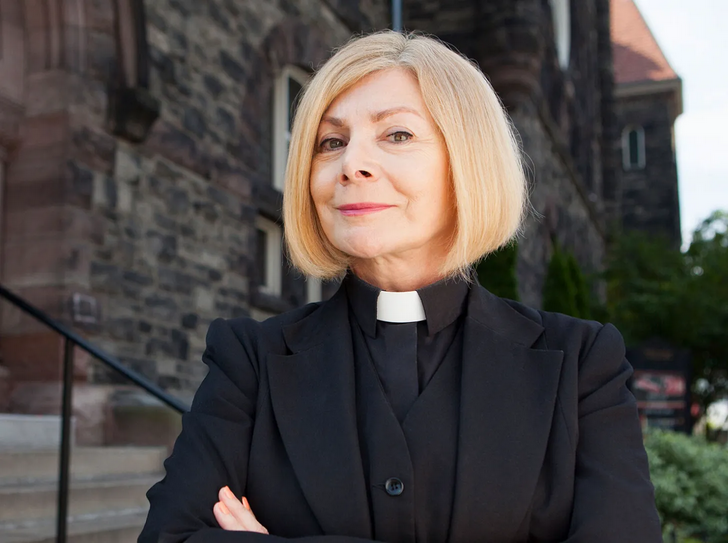
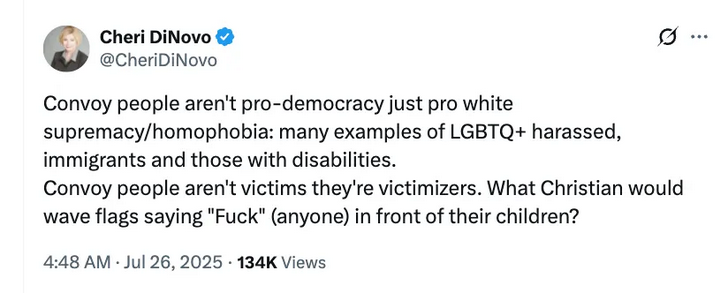
Let’s start with a comparison to the good people in Canada, the wonderful warm kind progressives, the Maple Leaf edition of “hate has no home here”. Cheri DiNovo is, let me put this very gently, an instantly recognizable social type, “one of Canada’s best-known and most ardent queer ministers and an Ontario politician who would help pass some of the province’s most integral LGBTQ2S+ policy”. You already know her by her facial expression:

slay, girlboss

As the leaders of the Freedom Convoy face sentencing in court, DiNovo has this to say about their monstrous cruelty:

The Freedom Convoy: white supremacist homophobes who harassed and brutalized LGBTQ+ people and immigrants and the disabled, lashing out in a stunning wave of public cruelty. It was like a NUREMBERG RALLY with trucks, obviously. Here, look at some of the monstrous acts of public brutality committed at this mass expression of hate and rage:

YOU KNOW WHO ELSE DANCED TOGETHER THINK ABOUT IT

Rupa Subramanya, a journalist who uses the old and mostly forgotten technique of talking to people, wandered the crowds in Ottawa (in her own neighborhood) and reported that Freedom Convoy protesters mostly talked about their desire to recover a sense of hope. Their grievances were clear, thoroughly explained, and entirely defensible. Here’s a sample paragraph, a discussion with one of the VICIOUS WHITE SUPREMACISTS:

    Kamal Pannu, 33, is a Sikh immigrant and trucker from Montreal. He doesn’t believe in vaccinations; he believes in natural immunity. He had joined the convoy because the Covid restrictions in the surrounding province of Quebec had become too much to bear. He said that he and his wife used to do their grocery shopping at Costco, until the government decreed that the unvaxxed would be barred from big-box stores. Since then, their monthly grocery bill had jumped by $200. “Before,” he said, “we didn’t look at the price of what we were buying. Now, we sometimes put items back because we don’t have that much money.”

See this clearly against Cheri DiNovo’s framing, and remember it:

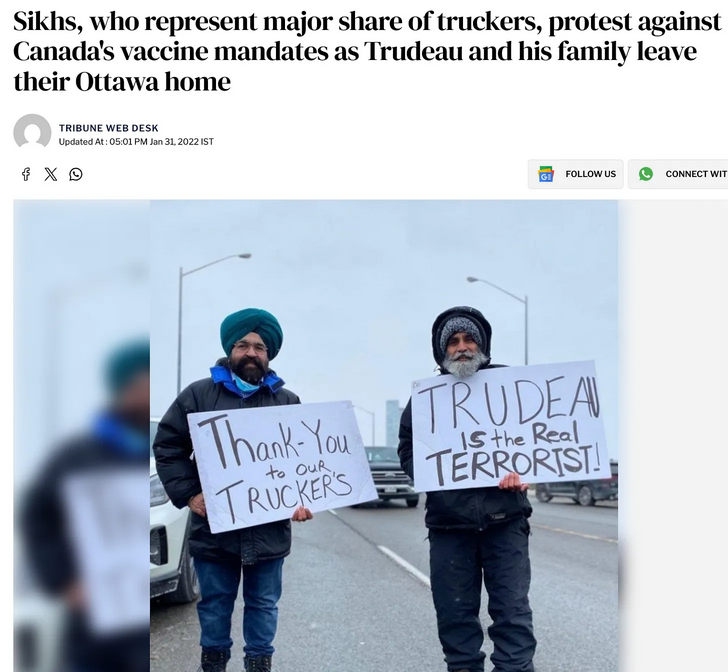
The white supremacist protesters who hate immigrants; for example, Kamal Pannu, a Sikh immigrant and trucker.

In fact, Sikhs make up a substantial share of the trucking industry in Canada, and so had a significant presence at the Freedom Convoy:

See the WHITE SUPREMACISTS saying that they HATE IMMIGRANTS!?!?!? Because Cheri DiNovo does. She thinks categorically: good people who support the Liberal Party, Literally Adolf Hitler who doesn’t. She has no capacity for seeing the thing itself, as it was on the ground, in physical reality. Literally nothing, no evidence or substance of any kind, could ever have prevented her from saying that a protest against Justin Trudeau’s government was white supremacist and homophobic. She’s out of her fucking mind. She has no connection to any form of reality, at all, in any way, ever. She doesn’t see anything. She doesn’t know anything. She’s ignorant noise and infinite sanctimony, with a pair of legs to carry it around.

This is “left” politics in the Anglosphere. Symbol symbol symbol, you NAZI! It doesn’t connect. It’s all chanting and performance and status-signaling, and it never leaves the house. It left reality behind ten years ago, and now it’s out there sailing past Pluto. For adherents of the Manichean religion of wokeism, categorical thinking covers all bases. People who don’t get mRNA injections are misogynistic racist bigots, obviously.
Update: Fixed broken link.
Day Nine – Hitler’s Halt Order and Tragedy at La Ferté – Ten Days in Sedan

Filed under: France, Germany, History, Military, WW2 — Tags: , , , , , — Nicholas @ 04:00

World War Two
Published 26 Jul 2025

May 18, 1940. Our coverage of the German blitzkrieg in France continues. Today, we take a break from the panzers for a spot of old-fashioned siege warfare. At Ouvrage La Ferté, a small garrison of French troops makes a doomed last stand against overwhelming German firepower. We follow their final hours, the decisions that sealed their fate, and what their sacrifice meant for the collapsing French front.
(more…)

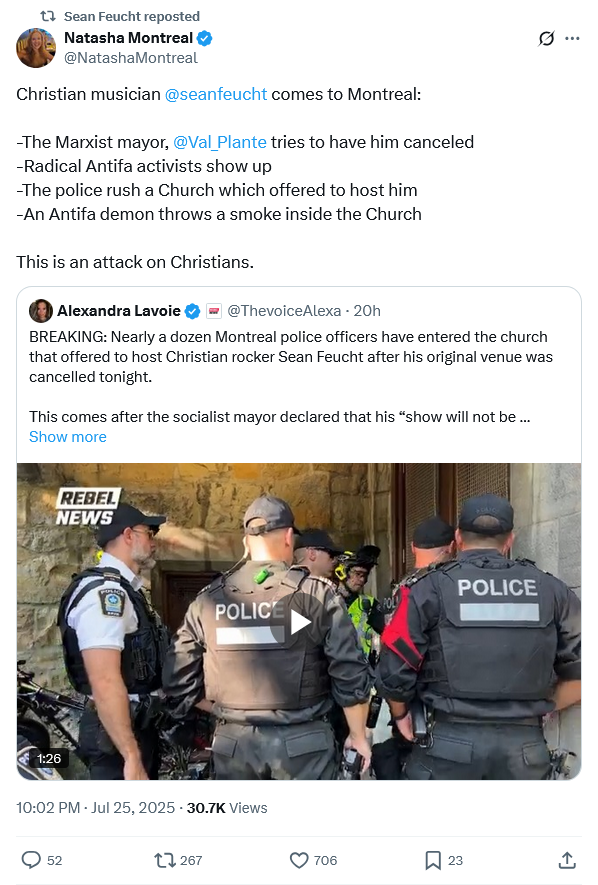
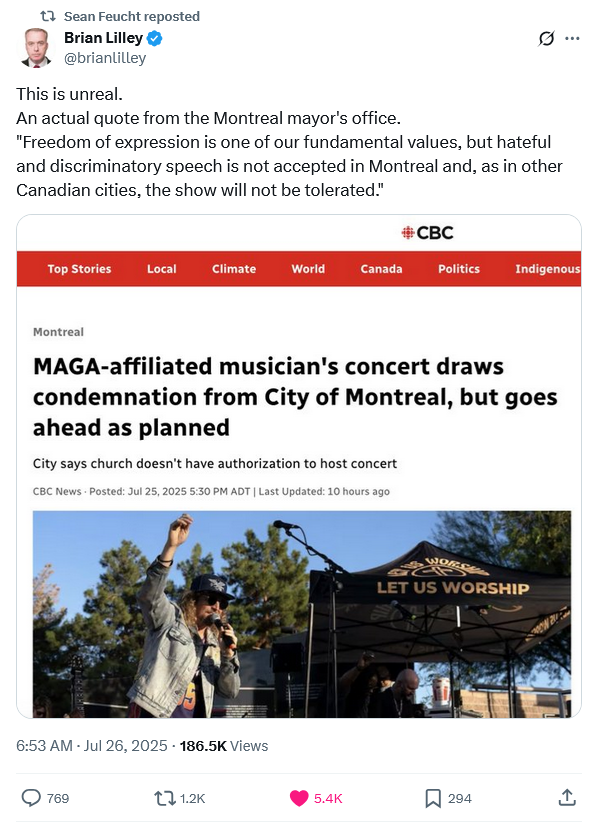
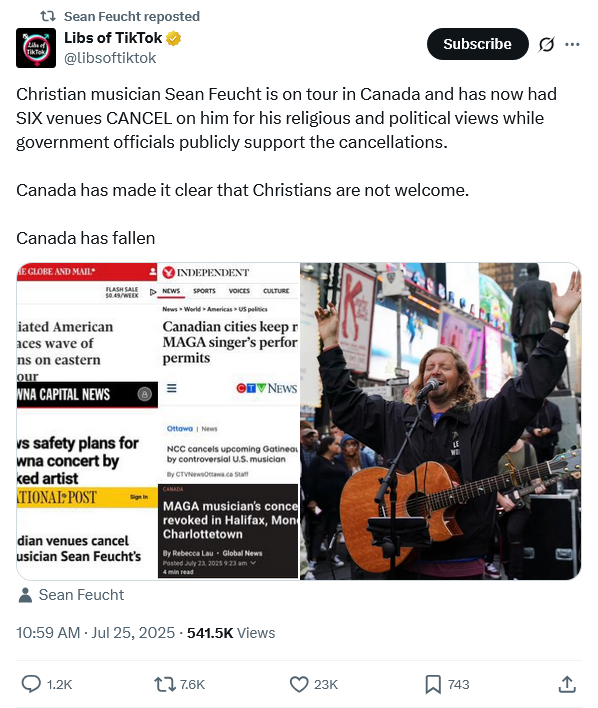
I’m sure I would never have heard of Sean Feucht until they tried to silence him

Filed under: Cancon, Government, Media, Politics, Religion, USA — Tags: , , , , , , — Nicholas @ 03:00

It’s hard to believe how Canadian municipal and provincial authorities deal so gently with disruptive pro-Hamas protests that regularly threaten the lives and property of Canadian Jews compared with the positively authoritarian way they are reacting to “MAGA” Christian performer Sean Feucht‘s concerts:

Shooting a .276 Pedersen PB Rifle

Filed under: History, Military, USA, Weapons — Tags: , , , , — Nicholas @ 02:00

Forgotten Weapons
Published 11 Aug 2015

Thanks to Alex C. at TheFirearmBlog, I recently had an opportunity to do some shooting with a .276 caliber Vickers-Pedersen model PB rifle. This was one of the very first rifles Vickers built when they thought the Pedersen would be adopted by the US military and could be further marketed worldwide — after only about 16 PB rifles they made some changes and started making the improved PA model instead (the two main improvements being the use of a reversible clip and the addition of a mechanism to allow ejection of a partially-full clip).

Anyway, in addition to Alex and myself, we were joined by Nathaniel F (a TFB writer) and Patrick R (from the TFBTV video channel). Between us we put about 60 rounds of original 1920s wax-lubricated Frankfort Arsenal .276 Pedersen ammo through the rifle.

QotD: London coffeehouses and Paris salons of the Ancien Régime

Marie Antoinette arrived in Paris at the end of this era of strict censorship, which helps explain why her honeymoon with French public opinion was short-lived. The official press, notably the Mercure and Gazette, continued churning out fawning snippets of society news about the royal couple. But the scandal-mongering libelles and pamphlets had their own paragraph men, called nouvellistes, who picked up “news” from well-informed sources posted on benches in the Tuileries, Luxembourg Gardens, and, of course, under the tree of Cracow. Police efforts to repress nouvellistes‘ gossip proved futile in the face of high demand. One famous libelle of the era, Le Gazetier cuirassé promised “scandalous anecdotes about the French court”. (It was printed in London, out of reach of official French censors.) Another publication printed in London starting in the 1760s was the famous Mémoires secrets, an anonymous chronicle of insider gossip and anecdotes from Parisian high society. A scurrilous book about Louis XV’s mistress, Madame du Barry, also appeared as a collection of gossip that nouvellistes had picked up around Paris.

Despite the libelles circulating in Paris, the Bourbon monarchy was still relatively protected compared with the hurly-burly across the channel in London, where coffeehouses buzzed with political innuendo and intrigue. Some French philosophes, it is true, attempted to replicate London’s coffeehouse culture at Parisian cafés, such as the Procope on the Left Bank. (Voltaire frequented the place, where he liked to add chocolate to his coffee.) Other regulars at the Procope — named after the Byzantine writer Procopius, famous for his Secret History — were Rousseau, Danton, and Robespierre, as well as Americans Benjamin Franklin and Thomas Jefferson.

The Parisian equivalent of the coffeehouse was the salon, which differed from London coffeehouses in both ambience and function. Whereas London coffeehouses were boisterously public, salons were essentially closed spaces, usually held in private homes. Most were by invitation only. Many were hosted by women, usually titled or wealthy ladies with an interest in culture and politics — such as Madame de Rambouillet, Madame Necker, Madame Geoffrin, and Mademoiselle Lespinasse. There was also the Marquise du Deffand, a friend to Voltaire and the English man of letters Horace Walpole, to whom she bequeathed not only her papers, but also her pet dog, Tonton.

As access to these rarefied spaces increasingly became a symbol of social success, admission got more tightly controlled. (Madame Geoffrin expelled Diderot from her salon because she found his conversation “quite beyond control”.) Still, those who frequented salons represented a great diversity within the elites — from rising young writers and established authors to powerful politicians and eccentric aristocrats. The tacit rule was, as in London coffeehouses, that wit was more important than rank. Many great French writers launched their careers thanks to their admittance. One was the philosopher Montesquieu, who found success at the salon of Madame Lambert.

Matthew Fraser, “Marie Antoinette: Figure of Myth, Magnet for Lies”, Quillette, 2020-06-24.

Powered by WordPress