
Tim Worstall on the deep reasons Britain can’t seem to build any new housing:
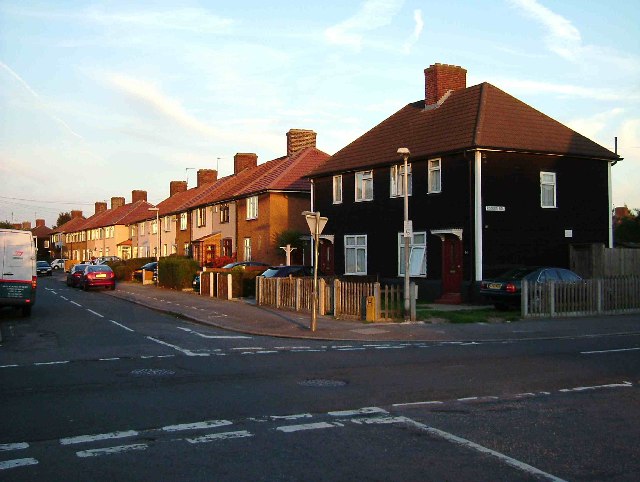
Homes Fit for Heroes – Dagenham
“These are typical examples of the housing on the Becontree Estate. Initially 25000 homes were built by the London County Council between 1921 and 1934. These homes fit for the heroes of WW1 had all mod cons gas, water and electricity with inside toilets and bathrooms. A further 2000 homes were built before WW2. The Becontree estate was the biggest council estate in the world.”
Image and description from geograph.uk. Photo by Glyn Baker – CC BY SA 2.0
The real problem Britain faces is that it’s no longer legal to build the housing we thought was the bare minimum acceptable a century ago.
The more apposite point is that a couple of hundred yards up the road are those post-WWI homes for heroes. Here. Semi detached, not huge to be fair. But kitchen, living room, parlour, 3 beds and indoor bathroom. They’re still highly desirable houses in fact. Note, they’ve front gardens. They’ve also back ones too.
Now, we’ve heard this, even heard it from someone on Bath City Council (who had heard it, we’re not quite old enough to know anyone who was on BCC in the 1920s), and never, quite tracked it down officially. But the statement was made that the Homes for Heroes needed to be on 1/4 acre gardens. The working man needed the space to grow vegetables for his family and to keep a pig. These houses, the 1920s ones, do have substantial gardens as the 1960s ones don’t.
As I pointed out:
But Homes for Heroes? We’ve done this before. And those Homes for Heroes? Right now, today, it’s illegal to build them. No, really. What was considered the basic minimum that the local council should provide to the working man is illegal to build now. Those decent sized houses were on those decent gardens d’ye see? You can get perhaps 9 dwellings with 1/4 acre gardens on a hectare of land. Last we saw the current insistence is that we must have no less than 30 dwellings per hectare in order to gain planning permission. Even though Englishcombe – as with so much other land – is there and ripe for the taking.
It’s actually illegal to build houses that were regarded as the proper minimum a century ago.
The reason we cannot is that Green Belt, itself stemming from the Town and Country Planning Act 1947. The point of which — no, really, the stated purpose — was to make sure that no one would ever be allowed to build housing for proles — sorry, stout Britons — anywhere anyone ever wanted to live.
Which is a bit of a problem. For, outside my own head, there’s no constituency for repealing the TCPA and abolishing the Green Belt.
However, there is a large constituency for plastering farmland with solar cells.
Waller-Barrett’s farm has been targeted for a massive solar plant, which will be called Glebe Farm, and now his landlord plans to take his land away, replacing potato crops with thousands of giant glass panels.
The decision, backed by edicts from Ed Miliband, the Energy Secretary, favouring solar farms over food production on UK farmland, means his flourishing food business will shrink – and staff will be out of work.
Meanwhile the distant landlord will be quids in, potentially quadrupling their rent with virtually no effort.
Oh.
And now one of those little wrinkles of the law. Those solar farms will last 20 years maximum. No, really, that’s tops. The wrinkle being that the land underneath them will be, in that 20 years’ time, defined as brownfield land. Been previously developed, see? And brownfield land to housing is usually pretty easy as a development path. Certainly wholly unlike greenfield (or even Green Belt) to housing.
The land area Ed wants to cover with these things is 2 to 3% of the land area of the country. Which, as it happens, is about the land area currently covered by housing — including their gardens.
So, therefore we can see that Ed is, in fact, playing the long game. He’s going to solve the housing problem by not having to take on the Campaign for the Preservation of Rural England and every LibDem middle-ager with too few grandchildren to occupy her time. He’s going to do an end run around that problem by building solar first.


