David Friedman on some of the aspects of Britain’s Royal Navy in the late eighteenth and early nineteenth century which may be incomprehensible to modern readers who encounter it in works of historical fiction (like the books of C.S. Forester or Patrick O’Brian):
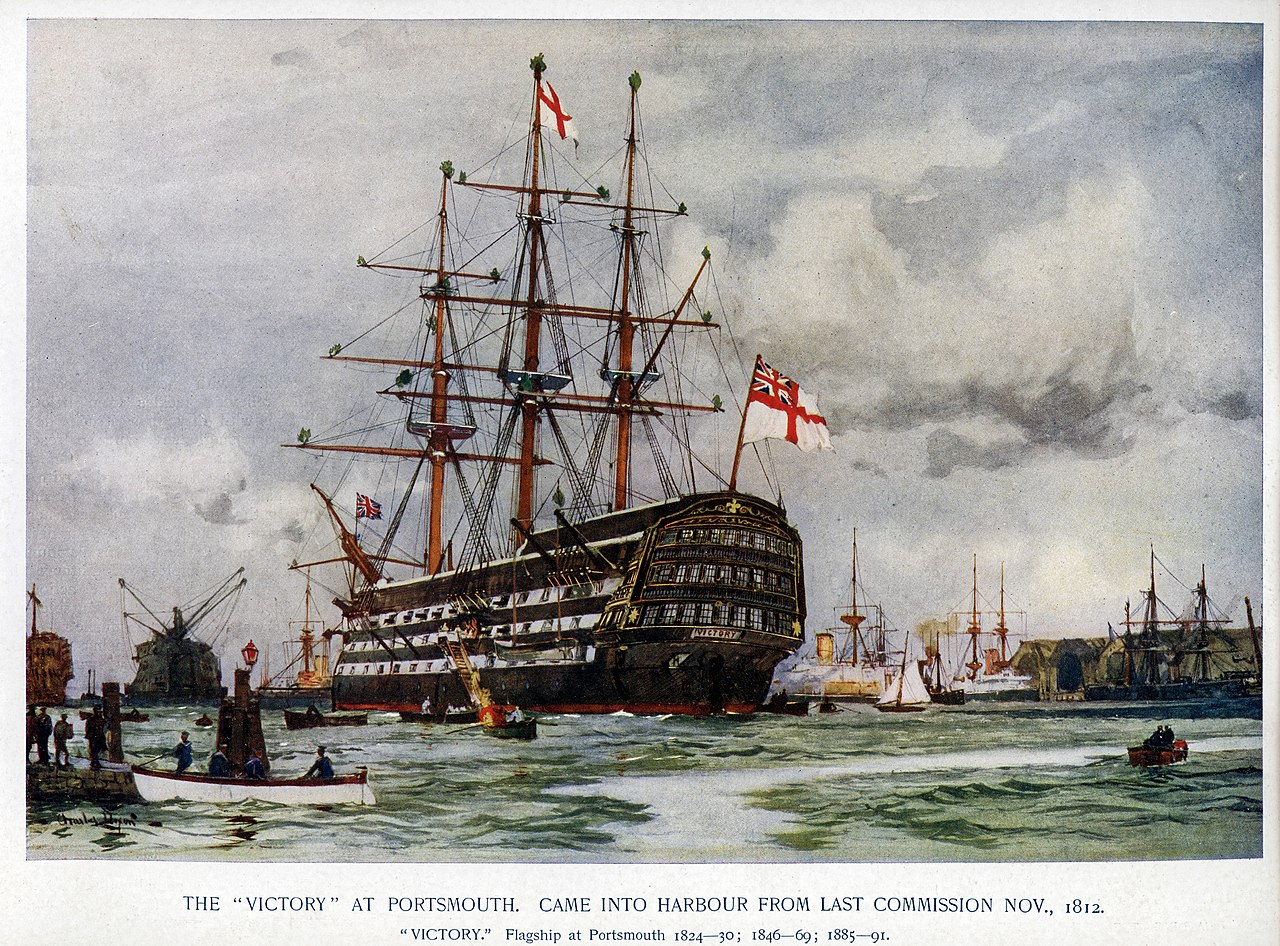
“HMS Victory in Portsmouth Harbour”
Painting by Charles Edward Dixon (1872-1934) via Wikimedia Commons.
I have read and enjoyed several series of novels set in the British navy during the Napoleonic wars, most recently one by Naomi Novik that departs a little further from history than its predecessors by providing the British and their enemies with dragons. The internal structure and the associated rules and customs of the navy seem very strange to a modern eye, yet it was a strikingly successful institution.
One feature likely to catch an economist’s eye was prize money. If a naval vessel captured a legitimate prize, an enemy warship or merchantman, and brought it back to port, the vessel and its contents were sold and the money distributed among those responsible. One large chunk went to the captain, another was distributed among his officers, a third among the crew, a fourth to the admiral under whose orders he was operating.
Another feature of the system was the role of patronage, political influence both within the navy and outside it in the career of an officer, especially a young officer. The critical step of promotion from lieutenant to captain depended in part on performance, in particular on the opinion of the captain under whom a lieutenant was serving. But it depended also on things that seem, to us, irrelevant.
One of Patrick O’Brien’s novels contains a conversation between Maturin, one of his protagonists, and a friend, a young officer of aristocratic birth. The officer has been having an affair with the separated wife of a high naval official and wants to know whether he should live openly with her. Maturin’s response is that, moral issues aside, it might be imprudent for him to offend a powerful official and so risk his future career. His friend replies that he has considered that matter but his family controls a significant number of seats in both houses of parliament and he thinks their influence will be sufficient to balance that of the man he will be offending.
Neither party sees anything strange in either the assumption that giving personal offense to someone within the bureaucracy will make it harder for a competent officer to be promoted or that having a politically influential family will make it easier; that is just part of how the system works. It was a system that produced extraordinarily successful results, a navy that, from the late 18th century to the early 20th won almost every ship to ship or fleet to fleet battle it fought at anything close to even odds.1
A third feature was the seniority system. Once a lieutenant was promoted to captain, his future rank depended only on how long he survived. His name was on the list of captains, the list was ordered by strict seniority, and the next captain to be promoted to admiral would be the one at the top of the list. When two or more captains were working together it was the senior who commanded. That provided an unambiguous rule for allocating command, since every captain knew where he was on the list and knew, or could readily find out, where any other captain was. But it was a rule that had nothing to do with the relative competence of two officers of the same nominal rank.
Promotion beyond captain was entirely determined by seniority; what the officer got to do with his rank was not. An insufficiently competent captain who made it to admiral would end up as an admiral of the yellow, an admiral without a fleet, effectively retired on half pay. A sufficiently competent captain could be assigned particularly important duties, including the command of a group of ships with the temporary position of commodore — provided none of the other captains in the squadron was senior to him. A sufficiently incompetent captain could end up without a ship, on half pay with no chance of prize money. In peacetime, when there was no shortage of competent captains, a minor failing might do it.
[…]
Consider the case of the pre-modern British navy. Prize money was a property solution. The admiralty wanted captains to have an incentive to capture enemy merchant ships, defeat and capture enemy warships, even at risk to their lives. Most of the relevant decisions were made by the captain, so he got the largest part of the reward, but other people, including the admiral whose orders determined what opportunities the captain had to earn prize money, got some of it. A pattern that shows up in the novels, and presumably in the real history, is an admiral who puts an unusually competent and aggressive captain in places where he is likely to encounter enemy warships not because he likes the captain but because he hopes to profit from successful encounters.
Allen argues that prize money was an imperfect property solution because capturing a warship was much riskier, more likely to get the captain killed, than capturing a merchant ship, but prize money was awarded for both. One puzzle he does not consider is why the navy did not solve the problem of misaligned incentives by lowering the prize money awarded for merchant ships or raising it for warships, which should have been easy enough to do.
Allen offers the imperfect alignment of incentives, such as the temptation for a captain in a fleet action to hang back and let other ships and their captains take the risk, as a reason why the property solution had to be supplemented with elements of the other two systems. The admiralty had detailed information on what a captain did through a system of three different logs, one by the captain, one by his first lieutenant, one by the sailing master, the ship’s senior warrant officer. A captain whose career showed him to be incompetent or too inclined to go after merchant ships and avoid warships might end up spending the rest of his career on shore with no ship, hence no opportunity for prize money. A captain who declined a clear opportunity for combat with a ship of the same class was subject to trial by court martial; one admiral ended up convicted and executed for failing to pursue the enemy fleet after an engagement.
1. With the possible exception of the War of 1812.