
Quotulatiousness

July 1, 2025

Like a cheap suit, Canada folds under Trumpian pressure on the Digital Services Tax grab

Filed under: Cancon, Government, Media, Politics, USA — Tags: , , , , , — Nicholas @ 05:00

A couple of days back, I characterized Prime Minister Mark Carney’s determination to push ahead with the Digital Services Tax “insane”, as it was overwhelmingly likely to trigger a strong reaction from the Trump administration. As it did. So, finally recognizing they were in a no-win situation, the federal government announced at the last minute that they wouldn’t be demanding the literally billions of dollars from the US “tech giants” after all. Michael Geist can legitimately say “I told you so” on this issue:
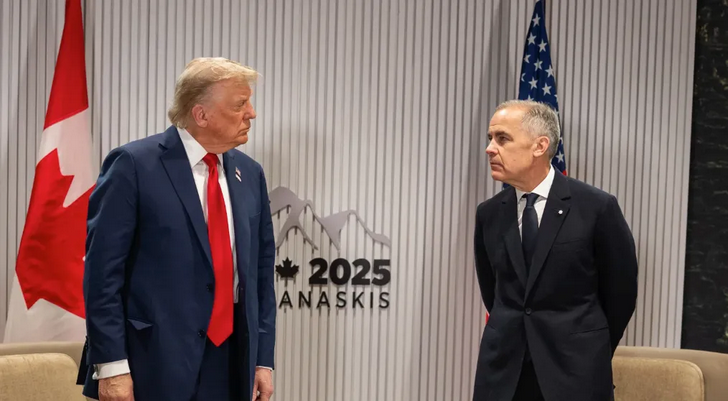
President Trump Attends G7 Summit in Canada by White House https://www.whitehouse.gov/gallery/president-trump-attends-g7-summit-in-canada/ CC BY 3.0 US

After years of dismissing the warnings of likely retaliation, the Canadian government caved last night on the digital services tax. Faced with the prospect of the U.S. suspending trade negotiations, Finance Minister François-Philippe Champagne announced that the government would drop the DST altogether, payments scheduled for Monday would be cancelled, and legislation will be forthcoming to rescind the legislation that created it in the first place. Over the weekend, I wrote about the repeated warnings that the DST was a serious trade irritant with the U.S. that cut across party and presidential lines. While ignoring the risks was bad enough, I argued that Canada played its DST card too early. Rather than delaying implementation in the hopes of incorporating it into a broader trade deal with U.S., it marched ahead, leading to an entirely predictable response from U.S. President Donald Trump. That left Canada in a no-win situation: stick with the DST but face the prospect of higher tariffs or embarrassingly drop the DST (and $7.2 billion in revenue over five years) with only restarting negotiations that were on until government overplayed its hand to show for it.

It is hard to overstate how badly the government managed the DST issue over the past five years. It alienated allies by pushing ahead with the DST despite efforts at an international deal at the OECD, stood alone in rejecting an extension of a moratorium on new DSTs, made the DST retroactive which solidified opposition, and continually downplayed the concerns of successive U.S. Presidents and Members of Congress from both sides of the aisle. Meanwhile, when companies began passing along the costs of the DST to Canadian businesses, it did nothing. And when they urged the government to delay implementation to at least allow for the issue to be incorporated into a broader trade pact, it ignored the advice.

At every step, there were better options. This year, the likelihood that the DST would come to a boil was obvious to anyone who was paying attention. But rather than following the UK strategy, which managed to salvage a smaller DST (2% rather than 3%) as part of a bigger agreement that includes a commitment to support UK digital access to the U.S. market and to negotiate a larger digital trade deal, Canadian officials seemingly assumed that the U.S. was bluffing and would not retaliate.

If this sounds familiar, it is because the Canadian government misreading the tech sector has become a hallmark of its policy. Talk tough, practically dare companies and foreign governments to respond, and then frantically seek an exit strategy when they do. This was the case with the Online News Act and Meta’s blocking of news links, with the government’s AI regulation which new Minister of AI Evan Solomon says will not be re-introduced, with the Online Harms bill, and now with the DST.

Tibet’s Last Stand: The Snow Lion vs. The Dragon – W2W 34

Filed under: Britain, China, History, India, Military — Tags: , , , , , — Nicholas @ 04:00

TimeGhost History
Published 29 Jun 2025

The fate of Tibet is decided on the roof of the world as Mao’s China sets its sights on Lhasa. This episode traces the dramatic showdown between the snow lion and the dragon — from imperial legacies and British invasions to the last years of de facto Tibetan independence. Discover how realpolitik, Cold War indifference, and the carrot-and-stick tactics of Mao’s regime sealed Tibet’s fate. Watch as the Dalai Lama faces impossible choices, world powers look away, and the dream of independence is crushed beneath the weight of history.
(more…)

The Food Professor explains what Trump got right in his Trade War

On the social media site formerly known as Twitter, Dr. Sylvain Charlebois, aka @FoodProfessor explains how Trump’s Trade War strategy is working out for US interests, in contrast to the Trudeau/Carney governments’ approach:

The Globalism Hangover: What Trump’s Trade War Got Right

“Trump’s bombastic style aside, his nationalist approach to trade and food policy is forcing global institutions to justify their existence — and that’s a conversation Canada can no longer afford to ignore.”

For the past six months, President Donald Trump’s trade policies have been widely mocked, criticized, and condemned. Some of it is certainly warranted. The Wall Street Journal, for instance, recently likened his tariff-heavy approach to global trade as a direct path toward another Great Depression. But data out of the United States tells a more nuanced story — one that challenges conventional wisdom.

Despite persistent headwinds, the U.S. economy continues to outperform expectations. The Federal Reserve Bank of Atlanta projects second-quarter GDP growth at 3.8%. In May, the U.S. economy added 139,000 jobs, outpacing forecasts, while inflation remained subdued at 0.1% month-over-month and 2.4% annually. The U.S. trade deficit has been cut nearly in half, pointing to stronger export performance and a rebalancing of trade relationships.

Canada, by contrast, is showing signs of economic strain. The national economy is shrinking, manufacturing is struggling under U.S. trade pressure, and food inflation is outpacing general inflation. In short, our economy is not keeping pace—despite our public criticism of the Trump administration.

To make matters worse, the Trump administration has now halted all trade negotiations with Canada, signaling that our bilateral economic relationship holds little strategic value for Washington. For the U.S., Canada is no longer a priority — especially under a Carney-led government that has visibly pivoted toward Europe, a market still heavily invested in maintaining close ties with the United States. From an agri-food standpoint, this shift is consequential: access to our largest trading partner is narrowing, while Ottawa appears more focused on diplomatic optics than on securing stable, competitive trade channels for the Canadian agrifood economy.

This is the one thing the ‘Elbows Up’ crowd never understood — and still doesn’t. We’re not in a trade war with the U.S. There’s no war to be won. For Trump, this is about a realignment of the global order, plain and simple — one centered entirely on American supremacy.

Love him or loathe him, Trump is not destroying the U.S. economy — not yet, anyway. His unapologetically nationalist agenda extends far beyond tariffs. He has withdrawn U.S. support from key global institutions such as the WHO and is threatening to sever ties with others, including NATO and several UN-affiliated agencies. Among them is the Food and Agriculture Organization (FAO), the UN’s most authoritative body on food security.

At a recent event in Brazil, a senior FAO official acknowledged that fundraising dynamics have shifted. In the Trump era, governments are asking harder questions: Why should we fund the FAO? What domestic benefit does it provide? What used to be assumed support is now conditional — and arguably, more accountable.

This shift isn’t unique to Washington. Many countries are quietly aligning with the U.S. position, scrutinizing globalist institutions with renewed skepticism. Transparency and accountability are byproducts of this anti-globalist sentiment — something not inherently negative.

For decades, globalism pushed the world to believe that trade liberalization was the only viable path to growth and prosperity. It became conventional wisdom. But globalism has made some nations — and some people — richer, while leaving others behind. In the process, domestic sectors, including agriculture, were often sidelined or sacrificed in the name of global efficiency.

The problem with globalism, particularly in agri-food policy, is its tendency to pursue uniformity over relevance. Canada, for example, adopted the carbon tax under a globalist climate agenda that often overlooks the vital role food producers play in feeding people. Instead of being supported, the sector is too often vilified as a problem. But agriculture is not a liability — it is a necessity.

Trump’s message — wrapped, of course, in provocative and often abrasive language — is that one-size-fits-all global policies rarely work. Nations have different socio-economic realities, and those should come first. While cooperation is essential, so is recognizing local and regional priorities. In this sense, his “America First” approach is not without logic — especially when it seems to be yielding short-term economic gains.

For Canada’s agri-food sector, the lesson is clear: striking a better balance between global commitments and national imperatives is overdue. We should not abandon multilateral cooperation, but we must stop anchoring policy to global agendas we have little influence over. Instead, let’s define what works for Canadians — what supports our farmers, protects our food security, and reflects our unique landscape — while keeping the broader global context in view.

We are not there yet. But if this moment of disruption sparks a more realistic and regionally attuned approach to food policy, we’ll be better for it.

The Maple Leaf Forever

Filed under: Cancon, History — Tags: , — Nicholas @ 02:00

Columbia Yore
Published 13 Jun 2018

The Maple Leaf Forever was written by Alexander Muir in 1867 and served as the unofficial anthem of Canada from 1867-1980.

QotD: Canadian measuring “systems”

Filed under: Cancon, Government, History, Quotations, WW1 — Tags: , , — Nicholas @ 01:00

There’s a section in a book about First World War that’s been called the most Canadian paragraph ever written. It’s in the book At the Sharp End by historian Tim Cook, and he’s describing the way Canadian soldiers built trenches. Writes Cook, “the front-line trenches were ideally some six feet deep, and surmounted by another half to full meter of parapet”. If you’re Canadian, you probably didn’t notice anything off about that. But what Cook did was to casually mix two measurement systems in a single paragraph: He starts off by measuring the trench in feet, and then switches to meters for no particular reason. And Canadians do this all the time. Most of the world uses the metric system. The Americans use imperial. And then Canada uses an unholy amalgam of both. It’s one of our weirdest national traits – and one of the first things that immigrants notice when they come here.

We measure weather and room temperature in Celsius, but we still bake in Fahrenheit. Your weight is in pounds, but your car’s weight is in kilograms. You drink alcohol by the ounce, but soda by the millilitre. The phenomenon was summed up in an imaginary dialogue by Canadian comedian Janel Comeau. Scene: An American, a European and a Canadian. The American says “I use miles and pounds”. The European says “I use kilometres and kilograms”. The Canadian takes an assortment of global measuring systems, crushes them into a powder, and snorts them like cocaine before declaring, “I’m 5’3, I weigh 150lbs, horses weigh 1000kgs, I need a cup of flour and 1L of milk”.

And none of this is an accident. Canada’s bizarre system of half-imperial, half-metric represents the truce lines of a culture war battle whose scale and ferocity is all but forgotten today. There were people in the 1970s who wanted to purge this country of any memory of the imperial system. Feet, inches and gallons were a relic of a backwards, colonial age, and the future belonged to rationalist, scientific metrication. A small army of bureaucrats armed with meter sticks and one-litre jugs were dispatched to spread the metrication gospel. And if you didn’t comply with the new metric zeitgeist, you could face severe consequences. For example, if you were a gas station continuing to sell gas by the gallon instead of by the litre, you could be fined.

But this grand plan to reprogram the Canadian psyche was thwarted, and thwarted forever. And when you buy beef by the pound or do your carpentry with inches and feet, you are the unwitting legacy of a populist, anti-government protest movement that hated the metric system and went all-out to stop it. We’re talking protests. Lawsuits. Civil disobedience. This story will literally feature a group of pissed-off Conservative MPs opening a “freedom” gas station to defy federal mandates to sell gasoline by the litre.

Tristin Hopper The metric schism | Canada Did What?”, National Post, 2025-03-11.

Powered by WordPress


