
Quotulatiousness

June 2, 2025

The progressive case for unlimited immigration

Theophilus Chilton takes on the progressive arguments for bringing in as many “high quality” immigrants as humanly possible from his own professional background:

One of the constants that you can count on in any debate about the value of immigration (of every sort) is the inevitable assertion about the NECESSITY of immigration. Immigrants POWER AMERICA. Without them, NOTHING WOULD HAPPEN! They are ELITE HUMAN CAPITAL without which the White American chuds who did things like build the atom bomb and otherwise created modern technological civilisation would barely be able to keep the lights on in their single-wides. It’s not just that immigrants want a new life or might be useful — they are an absolutely necessity and the ones coming here are the cream of the world’s crop.

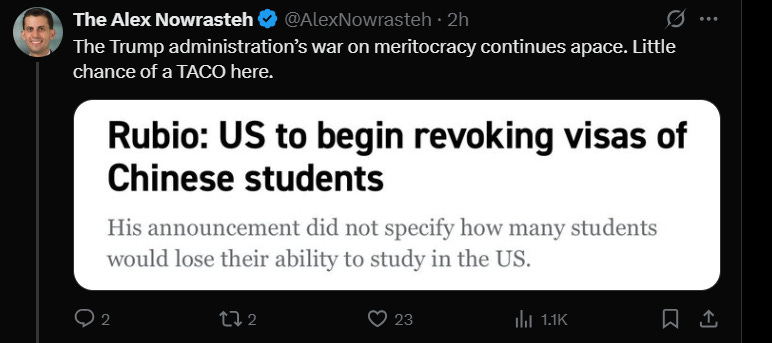
As a result, the recent move by Marco Rubio and the State Department to revoke visas from Chinese students in American universities (especially those associated with the CCP or who are in positions to commit especially damaging industrial espionage) will certainly not be well-received by this crowd. For example, witness Alex Nowrasteh, who’s whole schtick is to burble on about “meritocracy” and whine about “affirmative action for White Americans” while filling a useless sinecure at the Cato Institute that he got by being the token immigrant. He is appalled that we’d act in our own national interest rather than in the interests of a bunch of random foreigners.

Immigration man have big sad

Many people who know me on X already know this, but most readers here may not. Before I made a radical life-changing vocational choice a few years ago, I used to be a scientist in Big Pharma. For a little over two decades, I worked in the biotech/biopharma industry, covering a wide range of drug development stages and product types. I’ve developed vaccines (which is why I was skeptical about the Covid vaxx from the very beginning). I’ve developed small molecule drugs. I helped to bring to market several of the pharmaceuticals that millions take regularly and which you see advertised on television. I’ve done everything from bench scale analytical work to protein purification on 5000-liter batches used in support of human clinical trials. I’m proficient in literally dozens of different analytical techniques. Before that, in both undergraduate and graduate school, I specialised in synthetic organic small molecule development across a number of different subspecialties. And I’m good at all of this.

One other thing that I did throughout was work side-by-side with, and later manage, LOTS of visa holders and immigrants, especially from “tech heavy” countries like India and China, the stereotypical “H1-Bers”. As a result, I consider myself to be a pretty good judge of the value which visa holders bring to tech fields.

My judgment is, and has been for decades, that their value is minimal and it certainly does not live up to the hype. Indeed, one of the constants that I observed among most Indian, Chinese, and other visa holders was that they did not really, truly understand the science that was involved with the products being developed and the techniques being used to develop and test them. Most of these folks were the living embodiment of cramming to pass the test. When the test methods and the SOPs being employed were straightforward, these folks were great. They had a robot-like efficiency that comes with repetitively doing the same thing over and over and over again. Unfortunately, for anything requiring innovative or independent thinking, they’d be totally lost. If results from a test deviated from expectations and required some commonsense interpretation? That’s where the wheels came off. I mean, there was little to no capacity to deal with anything that wasn’t completely textbook.

Even basic scientific sense was often missing. At one job, there was an Indian guy who would takes dumps in the bathroom and then walk straight out back to his manufacturing suite in the cell line division without even washing his hands. I know this because I observed it for myself several times. I mean, even if you don’t care about getting fecal coliform bacteria all over door handles and whatnot, at least don’t carry them back into the suite where you’re helping to grow batches of genetically engineered E. coli. I assume he was properly gowned before going in, but still, there’s just that basic lack of sense there.

And then there are the ethics (or lack thereof) displayed by many visa holders (especially Chinese and Middle Eastern). Data manipulation, tweaked results, etc. etc. These tend to occur because both of those groups are under intense social pressure within their own cultures to “get the right results” rather than just dealing with the results you get. The “tiger mom” mentality carries over into the workplace. There is a reason for why these two groups are disproportionately overrepresented on the FDA’s debarment list. Indians can be subject to serious lapses in integrity as well, though theirs tend to revolve more around cutting corners and mistreating underlings, as I illustrated in a thread on X about three years ago where I recounted my time working for an Indian-owned company.

Over the years, my observations have been substantiated and reiterated by any number of people in various tech-heavy industry to whom I’ve related them. Whether it’s pharma or IT or medicine or metallurgy or whatever else, the familiar story is told. It’s really, really difficult to reconcile this mass of lived experience with the theoretical assertions made by people like Nowrasteh that immigrants are this valuable resource that we absolutely need to be or remain competitive in world markets.

In effect, the goal with this type of white-collar mass immigration is to “roboticise” tech fields which can’t be given over to AI or actual robotics just yet. The formula is to import masses of workers who can simply follow a script and save companies money on labour costs. If you think about it, this is really a low IQ, high time preference approach by corporations whereby they sacrifice real innovativeness and future competitiveness for short-term savings. I’d argue that the entry of H1-B and other visa holders in large numbers into American tech industries which accelerated around the late 2000s-early 2010s has actually led to a slowdown in real innovation. We may have tons of new apps for our phones, but fewer truly groundbreaking advances in tech across the board.
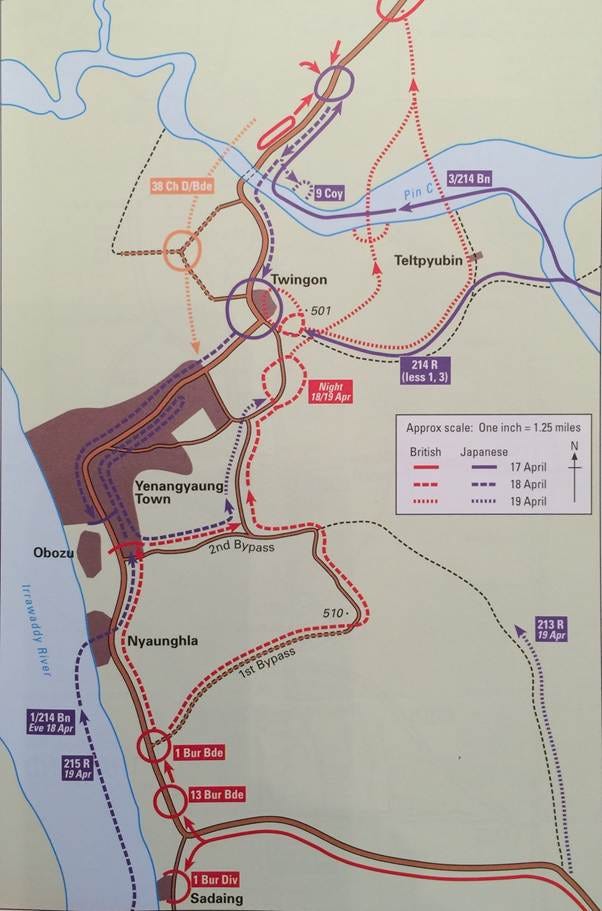
Fighting at Yenangyaung, 17-19 April 1942

Filed under: Britain, China, History, India, Japan, Military, WW2 — Tags: , , , , — Nicholas @ 03:00

Dr. Robert Lyman on the battle at Yenangyaung between 17-19 April 1942 early in the Burma campaign:

… the Yenangyaung battle is a fascinating one, with its own small degree of controversy, I decided to lay it out in this post. A mystery of the battle is the differing accounts of the Chinese attacks on the 19th April. In the British accounts (including Bill Slim’s in Defeat into Victory) the Chinese are blamed for failing to attack in the morning as they had promised, adding further jeopardy to the fate of the encircled 1st Burma Division. But was this true? The Japanese, Chinese and American accounts differ, so I thought I’d lay out the story to allow you, dear reader, to come to your own conclusion.

The fabulous map of Yenangyaung produced by the late Ian Lyall Grant.

The scrap at Yenangyaung was the final Corps-sized battle before the order to evacuate Burma Corps was given in early May. The Japanese had pushed out of Rangoon in mid-March, driving up the Irrawaddy on the left and against Toungoo on the right. Allied plans for the defence of Burma were inadequate, both Chinese (on the right) and Slim’s Burcorps (on the left) effectively fighting separate battles. Attempts by General Harold Alexander, the Army Commander, to control the battle and constrain the advancing Japanese ultimately came to naught. Alexander, Slim and Lieutenant General Joe Stilwell, nominally commanding the Chinese 5th Army, tried every trick in the tactical rule book to bring a halt to the relentless Japanese advance, and to destroy them in battle. After a month of fighting in which the Chinese were pushed out of Toungoo, the British lost control of Prome and an attempt to consolidate a defensive line across the country failed, the Japanese moved up the Irrawaddy in an attempt to turn the British flank, breaking in at the oilfield town of Yenangyaung on 17 April. At the time Slim’s Burma Corps was attempting to withdraw to the north from Allamyo. The Japanese infiltration into Yenangyaung cut the British in half. The 1st Burma Division was now cut off in Yenangyaung. The battle by the already weakened division (amounting to probably no more than 4,000 troops) into the Yenangyaung pocket over the period 17 and 19 April proved to be the severest trial yet faced by British troops in the short Burma campaign, the pressure applied by the Japanese exacerbated by the intense heat and the lack of water.

It was critical that Slim defeated this Japanese infiltration, rescue the 1st Burma Division from encirclement and retain the integrity of his Corps. If Yenangyaung were lost the Japanese would be free to sweep north to threaten Mandalay. It was crucial therefore that the divisional commander – Major General Bruce Scott – held on for as long as he could. But Slim had no reserve. The only hope of relief lay in assistance from the Chinese far to his right. He concluded that if he could engineer a attack into the pocket by the Chinese, across the Pin Chaung, combined with a breakout attack by 1st Burma Division, they might have a chance of escape. Nothing else looked likely to succeed.

When asked, Stilwell agreed to Alexander’s request for help to be provided to Slim, and gave him Lieutenant General Sun Lijen’s 38th Division – responsible for the defence of Mandalay – for the task. Chiang Kai-shek had given Sun responsibility for defending Mandalay. At midnight on 16 April Sun received an order from General Lo Cho-yin, “to dispatch his 113th Regiment to Kyaukpadaung, there to be commanded by the British General Slim …” Sun’s friend, Dr Ho Yungchi, recorded that by 3 a.m. he had arrived at Lo’s HQ at Pyawbe to discuss the order. Lo explained that the British were in serious trouble “in the oil town of Yenangyaung and had sent repeated requests for help”. By 6.30 a.m. it was agreed that Sun would personally take command of the 113th Regiment, while the two remaining regiments stayed to defend Mandalay. Sun and 1,121 men of 113th Regiment (commanded by Colonel Liu Fang-wu) arrived at Kyaukpadaung on the morning of 17 April.

Slim recalled: “The situation was not encouraging, and I was greatly relieved to hear that 113 Regiment of the Chinese 38th Division was just arriving at Kyaukpadaung. I dashed off in my jeep to meet their commander and give him his orders … this was the first time I had had Chinese troops under me … I got to like all, or almost all, my Chinese very much. They are a likeable people and as soldiers they have in a high degree the fighting man’s basic qualities – courage, endurance, cheerfulness, and an eye for country.”1

At Yenangyaung, Slim’s plan was for Sun’s 38th Division to attack from the north on the morning of 18th April while the 1st Burma Division, within the pocket, fought its way out. As Slim and Sun Lijen talked, discussing the details of the attack planned for the following morning Slim decided that he would place the Stuart tanks of the 7th Armoured Brigade directly under Sun’s command. It was only a move a man confident in the capabilities of his allies could make. Slim commented that “I was impressed by Sun and it was essential to gain his confidence. His division had no artillery or tanks of its own, and I was therefore arranging that all the artillery we had this side of the Pin Chaung and all available tanks should support his attack.” The commander of the British armoured brigade – Brigadier John Anstice – accepted this arrangement and according to Slim “he and Sun got on famously together”. What’s more, the soldiers worked well together too, Slim recording that the “gunners and tank crews, as is the way of British soldiers, soon got on good terms with their new comrades, and, in spite of language difficulties of an extreme kind, co-operation was, I was assured by both sides, not only close but mostly friendly.”2 Accordingly, at 6.15 a.m. on 18 April, Major Mark Rudkin of 2nd Royal Tank Regiment (2RTR) reported as instructed by Anstice to 38th Division HQ:

    There was little activity except for the cooking of breakfast and it seemed most unlikely that the attack could start on time. I asked the British liaison officer with the Chinese what was happening and he informed me that as the Chinese realized that they would not be ready to attack at 0630 hours, they had put their watches back one hour, so that officially they were still attacking at 0630 though the time would in reality be 0730. They had, therefore, not lost “face” by being late.

    The plan was that a troop of tanks would follow the leading troops of the leading Chinese battalion and give what support it could. Another troop was to follow the leading infantry battalion and assist the leading troop if required. The tanks would be almost entirely road bound owing to the going off the road.

    At 0730 the assaulting Chinese moved forward off the ridge on a front of about four hundred yards, the leading troop keeping very close behind on the road. On foot near the tanks was a Chinese interpreter who carried out liaison between the tanks and infantry.

    After advancing about half a mile the leading tank was hit by a Japanese 75-mm gun situated on the road just north of the Pin Chaung which was firing straight up 300 yards of road. The tank was disabled but there were no casualties.

    The Chinese advance continued and by afternoon had almost reached the line of the ford on the Pin Chaung which was still held by the enemy. The Chinese had had heavy casualties, especially amongst officers, as it was the custom for Chinese officers to lead, whatever their rank. It was finally decided to hold positions about half a mile north of the crossing and continue the attack next day.3

With the first attack a failure, the Japanese retained their grip on both the ford and the village of Twingon. The situation for the surrounded remnants of the 1st Burma Division was desperate; the Japanese close to achieving a complete victory. Slim and Sun then worked through a plan for another attempt to be made the following morning, 19th April. This day also began badly, however. The Chinese attack was scheduled to begin at 7 a.m. British accounts subsequently recorded that a Chinese attack did not materialise at this time. Slim subsequently recorded in Defeat into Victory that the failure to attack must have been a function of the administrative difficulties faced by the Chinese. He wrote that with the Chinese “lack of signalling equipment, of means of evacuating wounded and of replenishing ammunition, and their paucity of trained junior leaders it was not surprising that to sort themselves out, reform, and start a fresh attack took time”.4 Slim was invariably impressed with what he saw of the Chinese soldier in action, but considered their support and command functions to be shockingly poor and a source of constant frustration to themselves, and to all who had occasion to operate with them.

Slim, and most other British published accounts, including the Indian and British Official Histories, record that the attack finally went in at 3 p.m., when Colonel Liu’s 113th Regiment successfully captured the ford and penetrated into Yenangyaung.5 “When the Chinese did attack they went in splendidly” wrote Slim in admiration. “They were thrilled at the tank and artillery support they were getting and showed real dash. They took Twingon, rescuing some two hundred of our prisoners and wounded. Next day, 20th April, the 38th Division attacked again and with tanks penetrated into Yenangyaung itself, repulsing a Japanese counter-attack. The fighting was severe and the Chinese acquitted themselves well, inflicting heavy losses, vouched for by our own officers.”


    1. Slim, Defeat into Victory (1956), p. 63.

    2. Ibid., p. 65.

    3. Bryan Perrett, Tank Tracks to Rangoon: The Story of British Armour in Burma (London: Robert Hale, 1978)

    4. Slim, op. cit., p. 70.

    5. Bisheshwar Prasad (ed,) The Retreat from Burma 1941 – 42 (Calcutta, Combined Inter-Service Historical Section, 1954), p. 296.

How to Repair & Rebind a Damaged Paperback as a Hardcover Book

Filed under: Books, Tools — Tags: — Nicholas @ 02:00

Annesi Bindings
Published 14 Mar 2021

This video walks you through the process of repairing a damaged paperback and rebinding it as a hardcover book. It is intended for complete beginners and shows you how to take the book apart, repair torn pages, re-glue it using the double fan method, insert cords into the spine, rebind it as a hardcover book, and reattach the original covers.
(more…)

QotD: How to use your billions to influence those in power, without risking prosecution

Filed under: Business, Media, Politics, Quotations, USA — Tags: , , , , — Nicholas @ 01:00

Nobody really knows why your standard corporate merger happens, which is why they often seem so bewilderingly stupid to outsiders. Someone out there invents the next greatest web-based whatzit, which gets acquired by MySpace, which gets acquired by Yahoo, which gets bought out by Microsoft, all because the Accounting boys saw something on a spreadsheet cell … which 99% of the time, in tech anyway, turns out to be ass-pulled bullshit, and everyone loses bigly. Or never makes any money in the first place — e.g. Twitter and YouTube, neither of which have ever turned a profit so far as I know. Hell, I’m not sure Facebook (or “Meta” or whatever they’re calling it now) ever has; it has always floated along on its share price, which has always been buoyed up by … what, exactly? Even Amazon, which still depends to a large degree on the (eventual, shitty) delivery of an actual physical object (a cheap Chinese knockoff of what you actually ordered), took years to turn a profit.

In other words, there are no lessons there for us (except that people will tolerate shit like Fakebook and Amazon, which is indeed disturbing, but we already knew that). But blogs? Consider the Bulwark, or the Dispatch, or whatever it is (and if those are actually different things). Jonah Goldberg’s new outfit. I don’t follow this stuff, all I know is Ace of Spades calls it “The Cuckshed”, which is awesome, so let’s go with that. When Goldberg was pitching The Cuckshed to that Persian billionaire, he no doubt promised him all kinds of filthy, degrading acts of propaganda … in person.

I have to assume that the Cuckshed exists largely as his personal brand — he can go on whatever cable news shout show needs a “conservative” and the chryon says “Founder of leading conservative opinion site ‘The Cuckshed'” — and that’s what he pitched to the Persian, rather than reams of marketing data about the site’s literally hundreds of subscribers … but then again, maybe not, because I think we can all take it as read that 95% of the people who subscribe to The Cuckshed are fellow Swamp Things, no? Persians are a crafty lot, and this guy is no dummy, he understands the cardinal rule: Never write when you can speak, and never speak when you can nod.

To get his message into the [Washington, DC] intellectual ecosystem, then, the Persian Billionaire has two choices: He could either circulate a memo with “The Persian Billionaire’s Position on X”; or he could just have a flunky come into the room and start reading off a list of options, and he’ll nod when the flunky reaches the right one. Then the flunky slaps the list on the desk of a slightly lower-ranking flunky, pointedly tapping his finger at the chosen option. Then the lower-ranking flunky calls up one of his fart catchers, pulls out a highlighter, colors in the correct option, and hands it to him. Take that out through about six more levels of toadies, rump-swabs, and catamites, and it finally lands on Jonah Goldberg’s desk, at which point he starts punching up his “Word ’95” macros into a “column” telling the world what the Persian Billionaire wants them to hear.

Thus, if he’s ever called on the carpet by the Emperor’s Truthsayer, the Persian Billionaire can in all honesty say “I never told Goldberg to write that!” It just kinda worked out that way. As it always seems to. Every time.

Severian, “On Selling Out”, Founding Questions, 2021-11-26.

Powered by WordPress



