
Most modern economists focus on the lessons learned (and not learned) from the Great Depression, but as John Phelan points out, a better learning experience occurred nearly a decade earlier:
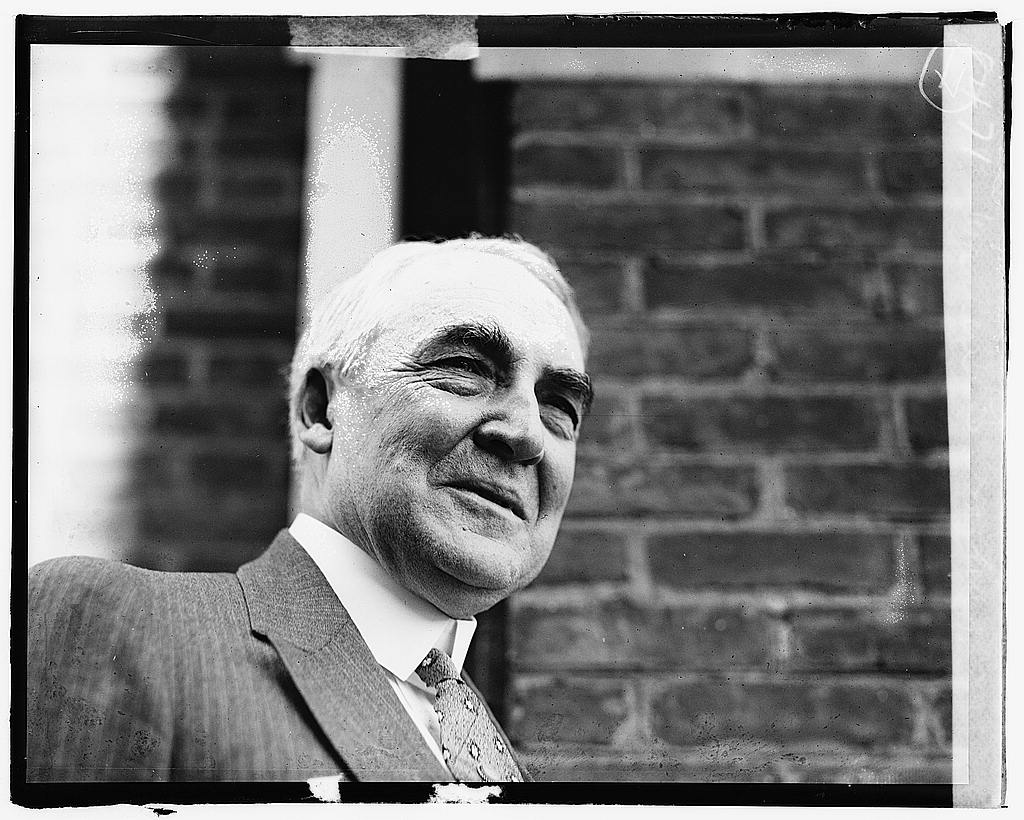
Warren G. Harding, 14 June 1920.
Library of Congress control number 2016828156
In July 1921, the United States emerged from a depression. Though the economic statistics of the time were rudimentary by modern standards, the numbers confirm that it had been bad.
By one estimate, output fell by 8.7 percent in real terms. (For comparison, output fell by 4.3 percent in the Great Recession of 2007-2009). From 1920 to 1921, the Federal Reserve’s index of industrial production fell by 31.6 percent compared to a 16.9 percent fall in 2007-2009. In September 1921, there were between two and six million Americans estimated unemployed: with a nonagricultural labor force of 31.5 million, this latter estimate implies an unemployment rate of 19 percent.
“In this period of 120 years,” wrote one contemporary, “the debacle of 1920-21 was without parallel”.
And then it was over. From 1921 to 1922, industrial production jumped by 25.9 percent and residential construction by 57.9 percent. Manufacturing employment increased by 9.5 percent and real per capita income by 5.9 percent. The 1920s began to roar.
What caused the crash of 1920-1921? Why was it so short? And why was the economic recovery so vigorous?
[…]
Bust to Recovery
As output slumped and unemployment soared, there were those urging action. In December 1920, Comptroller of the Currency John Skelton Williams wrote:
It is poor comfort to the man or woman with a family denied modest comforts or pinched for necessities each week to be told that all will be, or may be, well next year, or the year after. Privations and mortifications of poverty can not be soothed or cured by assurances of brighter and better days some time in the future. Our hope and purpose must be to forestall and prevent suffering and privation for the people of today, the children who are growing up and receiving now their first impression of life and their country.
No such policies were forthcoming.
In October 1919, Woodrow Wilson, then entering the last year of his presidency, was incapacitated by a stroke and his administration ground to a halt: “our Government has gone out of business”, wrote the journalist Ray Stannard Baker.
Wilson’s successor Warren G. Harding, who took office in March 1921, supported Strong’s policies, noting “that the shrinkage which has taken place is somewhat analogous to that which occurs when a balloon is punctured and the air escapes”.
While lower prices meant reduced incomes for some, they meant reduced costs for others. Eventually, producers and consumers started to buy again. By March 1921, lead and pig iron prices bottomed out: cottonseed oil, cattle, sheep, and crude oil followed by midsummer.
The higher interest rates had attracted gold. From January 1920 to July 1921, foreign bullion augmented the American gold stock by some $400 million to $3 billion. By May 1921, 80 percent of the volume of Federal Reserve notes was supported by gold. Interest rates could fall.
In April, the Federal Reserve Bank of Boston cut its main discount rate from 7 to 6 percent. The Federal Reserve Bank of New York followed suit next month, cutting from 7 to 6.5 percent. The Roaring Twenties began.
The Lessons
Students of macroeconomics will learn about the Great Depression of the 1930s. They will learn that many of the policies routinely used to fight downturns now — fiscal stimulus and expansive monetary policy — were forged in those years. You can earn a degree in economics without ever encountering the Depression of 1920-1921. Yet, initially, it was as bad as that which began in 1929 but ended more quickly and was followed by a rapid recovery.
Whereas the policymakers of the 1930s — led by the defeated vice-presidential candidate of 1920, Franklin D. Roosevelt — diagnosed the economic problem facing them as unemployment and deflation, those of 1920 diagnosed it as the preceding inflation. Where policymakers of the 1930s used cheap money and government spending to boost demand, those of the 1920s saw this as simply repeating the errors which had created the initial problem. To them, there could be no true cure that didn’t deal with the disease, rather than the symptoms.
It is for history to judge who was correct, but it’s undeniable that the recovery of the Depression of 1920–1921 was immensely stronger and faster than that of the Great Depression. Ironically, this may be the very reason it is often overlooked in history and economic courses.
An additional lesson of eternal relevance can also be drawn: successful solutions will be those which are based on a correct diagnosis of the problem.


