
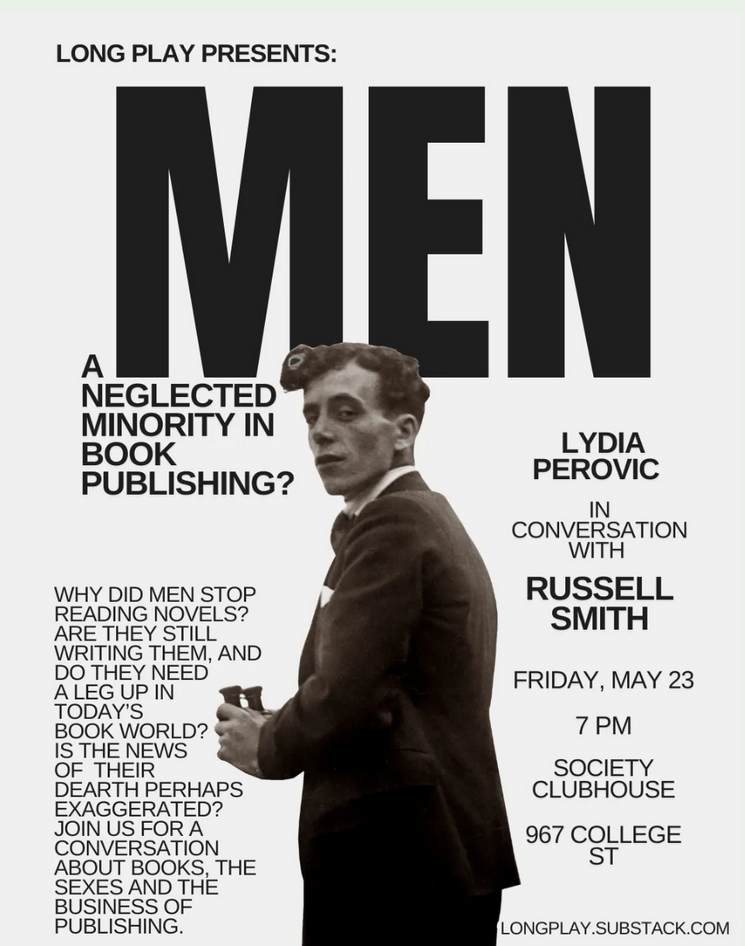
I belong to several genre-specific groups on various social media platforms, most of which appear to be disproportionally female in membership, and I read very little new fiction of any sort these days, partly for diminished interest and largely from diminished disposable income. I’ve often seen the assertion that men no longer read much fiction, but is it actually true?
You can see here some of the challenges involved in measuring reading habits. Are we talking reading books or purchasing books? Does buying correlate to reading or are women better gift givers? What about those hugely popular 20-part, 60-page-per-instalment romance series that might ratchet up purchases by women — anything like that in the fiction market for men? Should we base assumptions about readership of literary fiction on data about readership of general fiction, as many of the articles I’ve read do?
All we can safely say is that it does seem men read somewhat less fiction than women; they also read fewer books of any kind. As a person in the book industry, I wish that weren’t so, but it may not be a cultural calamity.
The most interesting article I came across in last night’s binge was published in 2009 by the University of Saskatchewan’s Virginia Wilson in Evidence Based Library and Information Practice. She undertook a small study of boys aged four through twelve, interviewing them about their reading habits. Her theoretical perspective was that if anyone was ever going to understand the reading habits of boys, they needed to recognize that the experts were the boys themselves. She quizzed forty-three of them about their book collections, what they liked and didn’t like, and their motives for reading.
Each of the boys had a personal collection of books. These ranged from eight to 398 volumes, with a median of 98. All but one of the boys had fiction in his collection. The most prominent genres were fantasy, science fiction, sports stories, and humour. The boys had no time for love stories, books about groups of girls, and such classic children’s fiction as The Adventures of Robin Hood.
Asked about their favourite books, most of the boys pointed to a non-fiction title: joke books, magic books, sports books, survival guides, science books, references, atlases, dinosaur books.
The boys also read a good deal of non-book material: comics, manga, magazines, sticker books, puzzle books, and catalogues. A number mentioned reading video game manuals, both to learn more about the games, but also to heighten their enjoyment of the narratives within the games.
The manuals were part of a bent toward pragmatic reading, something they found useful as much as pleasurable. The boys often read to support another hobby — Pokémon, for instance. They also appreciated non-linear texts and plenty of illustrations.
Interestingly, many of the boys tended to discount their own reading. They often described the informational stuff they liked—those video game manuals or computer guides or research materials for science projects—as “not really being reading”. Serious reading, in their minds, involved novels and conventional non-fiction books.
Wilson’s conclusion was that at least part of the “boys and reading problem” might come down to what counts as reading. Informational nonfiction, comic books, computer magazines, graphic novels, and role-playing game manuals were “not necessarily privileged by libraries, schools, or even by the boys themselves”.
Of course, as Wilson notes, one shouldn’t generalize too much from a small qualitative study involving forty-three boys. There’s nothing definitive to be learned here about Trump or contemporary masculinity (although I’ve read several lengthy screeds based on less).
Wilson’s paper simply reminds us that reading is complicated, and most of the available research on reading habits isn’t. Survey respondents are typically asked if they read books for leisure, or if they’ve read a book in the last year. There are many reasons to read other than for leisure. There are many things to read other than books. And not all books are equal.
I haven’t seen a study that tracks if men spend more minutes per day reading sentences than women. Or one that drills down to find who reads the most newspapers, magazines, websites, newsletters, contracts, annual reports, research papers, instruction manuals, catalogues, and cereal boxes. Each of those formats is as potentially edifying (if not as much fun) as Morning Glory Milking Farm: A Monster Bait Romance, with its 47,570 enthusiastic ratings on Goodreads.
I read so many concerns for and condemnations of contemporary males last night that it came as a surprise to learn that our most reliable measure of reading competence, the Program for the International Assessment of Adult Competencies, finds no real difference in literacy of men and women aged 16 to 64 in the US or Canada. We should all revisit that baseline before assigning responsibility for the state of civilization to whoever is or isn’t reading or buying contemporary fiction. (PIAAC did find that while Canadian literacy scores have been stable, US scores have slipped 5 percent since Trump was first elected. Make of that what you will.)
Does the men-and-fiction problem exist? I think yes, and my sense is that it’s one of both supply (what’s getting published) and demand (what men will read). I thought I’d have more than that to say. This is my kind of issue — the whole point of SHuSH is ill-considered opinion drawn from shaky evidence on a weekly timetable — but I can’t compete with what I’m reading, so I’m backing off for now.
I certainly find myself reading almost nothing that has been published recently with a few exceptions for well-researched and well-written histories and military histories. My preferred genre reading got taken over by the “jam the narrative into every story” crowd a few decades back, so I stopped buying SF and fantasy titles except those from authors I’d already read.


