
TimeGhost History
Published 16 Apr 2025The world has seen unspeakable horror and senseless death in excess over the past half-century. Now, the failures of the past give way to a hopeful declaration on the rights of humankind in the future, to ensure that these mistakes never repeat themselves. However, in a world as tumultuous as ours, how much power can such a declaration really have?
(more…)
April 17, 2025
The Declaration to Save Us All – W2W 21 – 1948 Q2
Comments Off on The Declaration to Save Us All – W2W 21 – 1948 Q2
Canadian labelling regulations save us from “too many vitamins”
In the National Post, Jesse Kline points out that Canadian food label regulations have become so nit-picky that they prevent safe and accurately labelled foods from Australia, Britain, and other countries from being sold here:
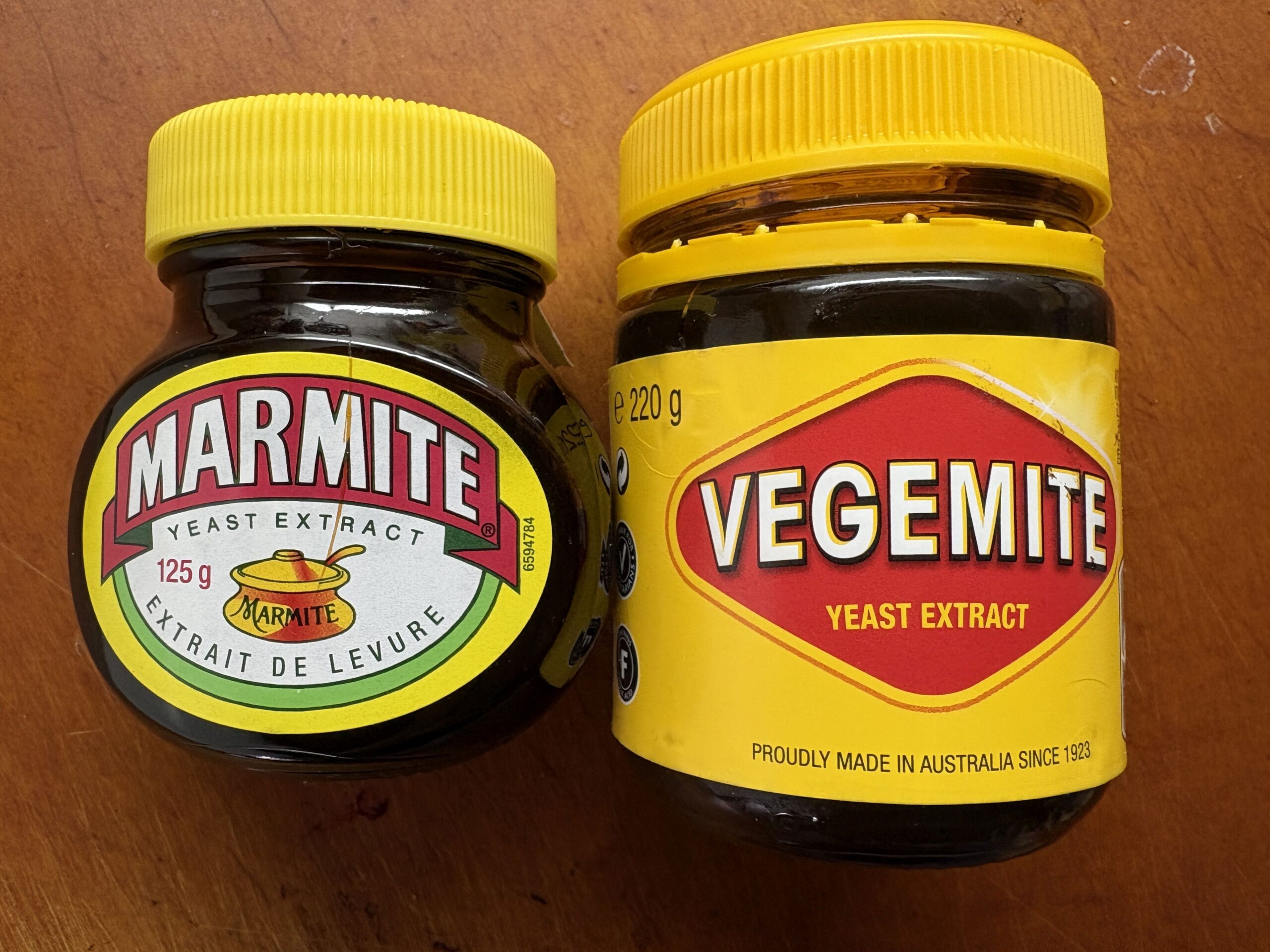
Marmite from the UK and Vegemite from Australia, two of the products at risk of Canadian over-regulatory twitches.
Shortly after winning the Liberal leadership, Mark Carney travelled to Paris and London to shore up our trading relationship with our European allies.
Yet it is noteworthy that Canada is one of only two countries that has not yet ratified the United Kingdom’s accession into the CPTPP, meaning that we don’t enjoy the benefits of free trade with the country with whom we share a system of government and a King. Meanwhile, France is one of a handful of countries that has yet to ratify the free-trade agreement between Canada and the EU.
If we can’t even agree to implement trade deals that have already been negotiated and agreed upon with countries that have such deep historical ties to Canada, what hope do we have of improving trade with our other partners around the world?
Part of the problem is that Canada refuses to follow the example of countries like Australia and New Zealand, which successfully phased out their own systems of supply management years ago with great success.
As a result, supply management has proven to be a sticking point in virtually every trade negotiation we’ve entered into, and is a constant source of tension even among countries we have free-trade deals with.
But we have also fallen into the trap, along with our European friends, of over-regulation. Modern bureaucratic states impose so many restrictions on commercial enterprises, it often becomes uneconomic to market their products in other countries.
Canada, for example, imposes stringent labelling requirements to ensure product information is available in both English and French, and that nutritional information conforms to our very specific requirements.
None of this is necessary, especially in an age in which we can hold a phone up to a box of French crackers to see what it says. But the problem extends far beyond language or disagreements over the recommended daily intake of fibre.
As the CBC reported on Monday, Leighton Walters, an expat from Down Under who owns several Australian-themed coffee shops in the Greater Toronto Area, was told earlier this year by the Canadian Food Inspection Agency (CFIA) that he was no longer allowed to sell the roughly $8,000 worth of Vegemite he had imported because it contains … too many vitamins.
Under current regulations, only a select list of products are allowed to contain added vitamins. Vitamin B-rich spreads like Vegemite and its British equivalent Marmite are not among them because … well, just because.
A similar situation arose a decade ago when reports that the government had ordered Marmite and the Scottish drink Irn-Bru to be taken off the shelves of a British supermarket in Saskatoon caused outrage on both sides of the pond.
The CFIA later clarified that only versions of those products formulated specifically to meet Canadian requirements — i.e., those that don’t contain added vitamins or a specific type of food colouring — are allowed to be sold in this country. Because heaven forbid we trust that other advanced Commonwealth nations would have reasonable enough food safety standards.
We have quite literally regulated ourselves into a corner. We can’t even import spreads like Marmite and Vegemite — which have been staples of British and Australian diets for decades — not because they’re unhealthy or unsafe, but because they don’t conform to our nit-picky regulations.
Comments Off on Canadian labelling regulations save us from “too many vitamins”
Why TOG II was BETTER Than You Think
The Tank Museum
Published 20 Dec 2024It was rejected and ridiculed for years — but TOG II is actually much better than you think.
In 1939, the UK Ministry of War issued the spec for a heavy assault tank. This hefty brief included the requirements to cross a 16ft gap, climb over anti-tank obstacles and enough firepower to penetrate 7 inches of concrete. Enter “The Old Gang”, a group of expert engineers, responsible for most of the tanks created during the First World War.
Two vehicles were created during this process — TOG I and TOG II. While the TOG projects have often been rejected as tanks out of time — relics of thinking from trench warfare — Content and Research Officer, Chris Copson, argues that these vehicles were highly innovative in terms of their mobility, armour and firepower.
Despite fulfilling their brief, TOG was sidelined in favour of other projects, and the lone survivor — TOG II — arrived at The Tank Museum in the 1950s. This lumbering beast that never saw active service, sat sidelined whilst surrounded by WW2 legends like the Churchill, Sherman, and the infamous Tiger 131.
But in 2012, a miracle happened. World of Tanks included the super heavy tank in their online video game — launching TOG II into viral popularity. Since then, interest in this unique vehicle has skyrocketed, and now more than ever people want to see TOG II in real life and find out more about its interesting history.
Shop TOG II merch at our online shop: https://tankmuseumshop.org/
00:00 | Introduction
01:24 | An Innovative Spec
05:00 | Innovations in Mobility
10:11 | Innovations in Armour
11:49 | Innovations in Firepower
16:21 | Would TOG II Have Worked?
18:46 | The Legend Lives OnIn this film, Chris Copson unpicks the misconceptions surrounding TOG II — that it was a ridiculous super-heavy tank built for a war from 30 years ago. Instead, this is a vehicle that was highly innovative and represented a significant engineering achievement. Thanks to videos games such as World of Tanks, TOG II is now celebrated as the goofiest super heavy tank in history, and lives on as an internet legend for a whole new generation of tank nuts.
(more…)
Comments Off on Why TOG II was BETTER Than You Think
QotD: Explaining mid-century American support of Chiang Kai-Shek and the Republic of China
[A question I posed on Founding Questions kindly answered by Pickle Rick:] Can anyone explain, in simple easy words, just exactly why the US State Department and/or other US government functionaries had such a mad pash for Chiang? Was it the Sun-Yat-Sen connection? Did he have inside info on the white slave trade in [Washington, DC]? Was it the opium smuggled in through diplomatic pouches? What in the Fu Manchu made Chiang of all the options the Juggalo pick of the litter? Every time I try to figure this out for myself, I end up in the same place … either [the Imperial Japanese Army] or the little red book fanatics couldn’t possibly have made a worse job of effing up what was left of Imperial China, so why Chiang of all the warlords?
PR: Because the missionaries in China had decided that it was going to become their great project, channeling that global do gooder impulse that had lain dormant since the end of the Civil War as their Great Cause — the missionaries were the grandchildren of the abolitionists and they took their fanaticism straight from that movement. China was to be “saved” from paganism, Catholicism and colonialism and they formed some kind of proto-NGO, ensuring that their views were made the policy of the government. It is not a coincidence that both Chaing and his wife were Protestant Christian converts (at least nominally) That impulse to “nation build” China into a facsimile of Progresssive Christian America (excluding, of course, the Old Confederacy) is the source of the drive to make their fantasy real, like that Utopian impulse we described the other day that is a bedrock of the Juggalo mindset. To find the roots of the China obsession you have to understand the power of the missionary movement. Nothing to me sums it up better than Kenneth Wherry, who became a big player in the China Lobby, with his mix of naivety, pathological altruism, and religious fervor-
With God’s help, we will lift Shanghai up and up, ever up, until it is just like Kansas City …
[…]
That’s an important point — the Protestants never had the same fervor to make Vietnam or Cuba or even the Philippines (even though it was OUR colony) into Kansas City, because they were either already Catholic or had a minority Catholic elite. China, however, gave them that sweet Protestant fix in making a new China with the “right” kind of Christianity. It’s also why they hated Japan so — Japan had slammed the door on Protestant missionaries pretty hard and their Christian minority (in Nagasaki, ironically) was Catholic.
From the comment thread on “WNF: A Twofer”, Founding Questions, 2025-01-15.
Comments Off on QotD: Explaining mid-century American support of Chiang Kai-Shek and the Republic of China


