Quotulatiousness

September 5, 2009

Obsession takes many forms

Filed under: Randomness — Tags: , — Nicholas @ 10:50

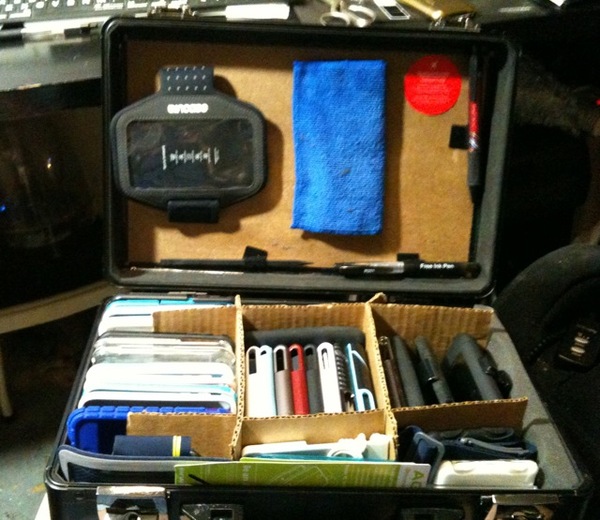
I guess the “collector” urge can manifest itself in almost any form. As proof, here’s iPhone case collector “WyldCeltic” and her collection of cases:

Wyldceltic_iPhone_case_collection

And I was feeling guilty about thinking of getting a second case for my iPhone.

Oh, and on the general topic of the iPhone, you AT&T haters may be blaming the wrong group for all the problems:

For years, AT&T’s iPhone customers have endured dropped calls, slow connections, and crippled service, especially in crowded areas such as New York and San Francisco. And for this, customers pay a higher rate than most other phone users. If you own the iPhone, hating AT&T is practically written into the two-year service contract.

I think AT&T’s getting a raw deal. The company has to shoulder the complaints of people who use their data plans way more than anyone else, sucking up bad blood while other carriers are viewed as knights in shining armor. Oh sure, let’s fantasize about a Verizon Wireless iPhone, but are we sure that Verizon can handle iPhone users, and the ten times more traffic they consume than other smartphone owners?

Scientific head-scratchers

Filed under: Environment, Science, Space — Tags: , — Nicholas @ 10:30

Courtesy of Roger Henry, a list of oddities from New Scientist:

2. Dark Flow: Something unseeable and far bigger than anything in the known universe is hauling a group of galaxies towards it at inexplicable speed.

3. Eocene Hothouse: Tens of millions of years ago, the average temperature at the poles was 15 or 20 °C. Now let’s talk about climate change.

4. Fly-by Anomalies: Space probes using Earth’s gravity to get a slingshot speed boost are moving faster than they should. Call in dark matter.

Rosenfels doesn’t dispel the doubts

Filed under: Football — Tags: , — Nicholas @ 10:18

Last night’s final preseason game against the Dallas Cowboys could have gone better, both for the team and for Sage Rosenfels, who is fighting for the backup QB spot behind Brett Favre:

Brad Childress knows he has his starting quarterback now that Brett Favre is wearing purple. But with eight days until the regular-season opener in Cleveland, the Vikings coach cleary isn’t happy with his quarterback situation as a whole.

That became clear after Sage Rosenfels and John David Booty threw third-quarter interceptions that were returned for touchdowns in the Vikings’ 35-31 loss to Dallas on Friday night in their preseason finale before an announced crowd of 62,334 at the Metrodome.

“At times [the quarterback play] was embarrassing,” said an upset Childress, who rarely is critical of his players in his postgame news conferences. “I’ll end up putting that on myself. Not having them ready to come out of the locker room at halftime. But all the quarterbacks I’ve ever coached have some regard for the football, and you can’t throw it to them.”

I’m still hoping that the Vikings hang on to Tarvaris Jackson, rather than cutting or trading him. He showed that he’s still got lots of potential:

Jackson started and played through the Vikings’ first series of the second quarter, completing two of four passes for 42 yards with a touchdown and a 127.1 passer rating. Rosenfels entered in the second quarter and finished 7-for-15 for 115 yards with a subpar 45.1 rating; Booty was worse, going 7-for-13 for 85 yards with a 42.1 rating. Childress said he benched both quarterbacks after their interceptions, meaning Booty replaced Rosenfels, threw one pass and then was lifted for Rosenfels.

“It always seems like you want to take back one play, and I wish I could take that one back,” Rosenfels said of a pass that was picked off by Cowboys cornerback Pat Watkins and returned 23 yards down the near sideline for a touchdown. “It was just a bad play by me. Other than that, I felt real comfortable out there, and I thought I did a pretty good job executing the offense other than that one play.”

Today is the worst part of the season for aspiring young players, or for veterans trying to catch on with a new team: it’s when teams have to cut down to their 53-man roster.

September 4, 2009

“They shot him. Right there in court.”

Filed under: Law — Tags: , — Nicholas @ 12:54

Radley Balko links to the weirdest “cops gone wild” story I’ve encountered in quite a while:

It was just too much, having to return to court twice on the same day to contest yet another traffic ticket, and Fire Chief Don Payne didn’t hesitate to tell the judge what he thought of the police and their speed traps.

The response from cops? They shot him. Right there in court.

Note also the fascinating fact that there are 7 police officers watching over a population of 174 people. That’s an amazing level of “protection” those folks are getting.

Original story here.

Update: Bonus story from Radley’s site, Feds bust doctor for . . . meeting women on the internet. Amazing. Just freakin’ amazing.

The show must go on!

Filed under: Education, Politics — Tags: — Nicholas @ 12:45

David Harsanyi looks at all the reasons it would be a good thing to support President Obama’s schools webcast next week:

Why would anyone want to deprive impressionable school-age children of hearing the inspiring wisdom of the president? Barack Obama is determined to impart his knowledge upon our pliable offspring via webcast across the country next week, and we should not stand in his way.

This is, as they say, a teachable moment. There is nothing to fear. Naturally, teachers and parents, incapable of handling the sheer concentrated intellectual force of such a historic event, have been forwarded a detailed lesson plan by the Department of Education (sic) so that no child will be blinded inadvertently by the dazzling light of hope.

[. . .]

Moreover, if your child is incapable of handling a 20-minute haranguing from a self-important public servant, he will be tragically unprepared for the new world. (Whom do you think he will be dealing with when he needs that hip replacement in 60 years?)

Even if you oppose the president on a political level, it is empirically evident that the more one hears his homilies the less inclined one is to trust him. And Obama’s penchants to lecture us endlessly, to be the center of attention endlessly and to saturate the airwaves and national conversation are clear indications that he believes government is the answer to every societal, religious, economic, and cultural question we face. Why should your kids be immune?

Well, I’m convinced. Just as long as there’s no singing (Monty Python reference, in case it’s too obscure.).

How many blog checkmarks would you need?

Filed under: Books, Media — Tags: , — Nicholas @ 12:38

Jacob Sullum looks at the quaint, old-fashioned notion of internal fact-checking:

When I was a “reporter-researcher” at Fortune during college, the Time Inc. policy was that one verification by book was worth two verifications by newspaper. If I’m remembering the color scheme correctly, the former was a “red check,” which was good enough on its own, whereas the latter was a “black check,” acceptable only in pairs. I may have the colors reversed, but the point is that we all assumed books were more reliable than newspapers (or other periodicals). That was a mistake, I think. While some books categorized as nonfiction, such as reference works and peer-reviewed releases from academic presses, go through some sort of fact checking, the vast majority do not. (They are generally reviewed by lawyers with an eye toward possible libel issues, but you can get lots of things wrong without risking a lawsuit.) In fact, judging from the finished products, I’d say most books are barely edited, let alone checked for accuracy. By contrast, newspaper stories typically are reviewed by two or three editors before they see print. It’s true that books take longer to produce, which gives a conscientious author more time to catch mistakes. Then again, they are a lot longer than newspaper stories, so there is more room for error.

So, how many checkmarks (of a murky shade of orange) would be required for blog references? Can any blogger count that high?

Yesterday, the wine. Today, it’s the candy label.

Filed under: Britain, Humour — Tags: , , — Nicholas @ 12:08

After yesterday’s indecent-in-Alabama wine label, today’s outrage is a German candy wrapper that has raised someone’s ire in Britain. Here’s the Telegraph report:

Obscene_candy_wrapper

Simon Simpkins, a father of two, said he was shocked at the “pornographic” poses when he bought the sour candy for his children Benjamin and Ofelia.

Mr Simpkins, of Pontefract, West Yorks, told The Sun: “The lemon and lime are locked in what appears to be a carnal encounter.

“The lime, who I assume to be the gentleman in this coupling, has a particularly lurid expression on his face. I demanded to see the shop manager and, during a heated exchange, my wife became quite distressed and had to sit down in the car park.”

H/T to Christian T. for the link. Roger Henry quickly commented:

I can understand why his wife became distressed and had to sit down in the car-park. Probably overcome with hysterics after watching her husband make an absolute public prat of himself.

Couldn’t have said it better myself.

Survey of military use of UAV assets

Filed under: Military, Technology — Tags: , — Nicholas @ 08:17

There’s a useful overview of how Unmanned Aerial Vehicles (UAVs) are changing the tactical situation for troops on the ground in this week’s Economist Technology Quarterly section:

Drones are much less expensive to operate than manned warplanes. The cost per flight-hour of Israel’s drone fleet, for example, is less than 5% the cost of its fighter jets, says Antan Israeli, the commander of an Israeli drone squadron. In the past two years the Israeli Defence Forces’ fleet of UAVs has tripled in size. Mr Israeli says that “almost all” IDF ground operations now have drone support.

Of course, small and comparatively slow UAVs are no match for fighter jets when it comes to inspiring awe with roaring flyovers — or shooting down enemy warplanes. Some drones, such as America’s Predator and Reaper, carry missiles or bombs, though most do not. (Countries with “hunter-killer” drones include America, Britain and Israel.) But drones have other strengths that can be just as valuable. In particular, they are unparalleled spies. Operating discreetly, they can intercept radio and mobile-phone communications, and gather intelligence using video, radar, thermal-imaging and other sensors. The data they gather can then be sent instantly via wireless and satellite links to an operations room halfway around the world — or to the hand-held devices of soldiers below. In military jargon, troops without UAV support are “disadvantaged”.

Of course, it wouldn’t be a current-day Economist article without at least one gloomy caveat:

There is a troubling side to all this. Operators can now safely manipulate battlefield weapons from control rooms half a world away, as if they are playing a video game. Drones also enable a government to avoid the political risk of putting combat boots on foreign soil. This makes it easier to start a war, says P.W. Singer, the American author of “Wired for War”, a recent bestseller about robotic warfare. But like them or not, drones are here to stay. Armed forces that master them are not just securing their hold on air superiority — they are also dramatically increasing its value.

I don’t particularly credit this risk . . . as Chris Taylor pointed out in a comment on a recent post, “degrading the comm links is the easiest way to render UCAVs largely toothless. In their current incarnation they are only good for permissive environments where the other guy can’t really harm your aircraft or comms. When they get autonomous then they’ll be more practical for warfighting against advanced foes.”

Actually, go read the comment thread on that post. Between Chris and “cirby”, I think they cover the technical side very well indeed.

September 3, 2009

AT&T may be happy to end exclusive iPhone deal with Apple

Filed under: Technology — Tags: , — Nicholas @ 18:32

According to Henry Blodget, AT&T may be willing to see the end of their exclusive deal with Apple to support the iPhone, as the traffic is “Crushing AT&T’s Cell Network”:

  • Performance issues will likely hasten the end of AT&T’s exclusive on the iPhone (which is scheduled to end next year anyway). At this point, it would actually be in AT&T’s interest to spread the network demand around.
  • AT&T will have to spend a lot of money and rush to upgrade the network before its reputation gets any worse (a third of people who don’t buy iPhones don’t buy them because of AT&T)
  • This is GREAT news for the future of the mobile web: Now that the iPhone has created a compelling mobile online experience, mobile usage is finally exploding. This is already leading to the growth of a whole new industry based on mobile apps and gadgets.
  • This is great news for the iPhone: If people are willing to put up with performance this lousy, it shows how much they love their iPhones.

Was Fukuyama correct after all?

Filed under: China, Economics, History — Tags: , — Nicholas @ 18:28

Scott Sumner has an interesting post up about Francis Fukuyama’s “end of history” thoughts of the late 1980s:

So the obvious choice for most successful prediction is Francis Fukuyama’s 1989 claim that “history was ending,” that the great ideological battle between democratic capitalism and other isms was essentially over, and that henceforth the world would become gradually more democratic, peaceful, and market-oriented.

[. . .]

I get very annoyed when I see people say “the Chinese case proves that economic development doesn’t inevitably lead to political liberalization.” There are so many problems with this sort of statement that one hardly knows were to begin. China has seen incredible political liberalization since 1978, indeed even some progress since 1998. But what about western-style democracy? To answer that question, consider the list above. I would argue that China most resembles Thailand. Both have similar per capita GDPs, both have a huge split between the urban elite and the rural poor. My hunch is that consciously or subconsciously, the urban residents of China are not thrilled by the idea of a pure democracy that would effectively turn the country over to the rural poor. But wait a few decades, when China goes from being 60%-70% rural, to 60%-70% urban, and from mostly poor to mostly middle-income, and from mostly undereducated to mostly educated. Then let’s see how Fukuyama’s thesis holds up.

History is still ending. Or maybe I should say “his story” is ending, the story of war, revolution and voyages of discovery. The Illiad and the Odyssey. And “her story” is beginning. A world focused on improving education, health care, cuisine, leisure time, the arts, communication, animal rights, the environment, etc.

QotD: “The red-headed step-child of the environmental movement”

Filed under: Environment, Quotations, Railways, Technology — Tags: — Nicholas @ 16:48

As a practical matter, we’d probably get more environmental benefit (and save more wear-and-tear on our roads) from improving our freight rail system, like the abysmal mess in Chicago, than from high speed passenger rail that is very unlikely to carry more than a handful of Americans on any regular basis. . . But this does not attract one eightieth of the interest that you see in HS(P)R. As I understand it, there is finally some actual progress on Chicago, but it’s still bogged down in process, and it’s not clear to me whether it’s really enough. It seems clear to me that switching freight to rail whenever possible should be a policy priority, but it’s the red-headed stepchild of the environmental movement. We need freight cars that look more like pandas.

Megan McArdle, “Rail: It’s Not Just for Passengers”, Asymmetrical Information, 2009-09-03

Alabama belatedly bans “indecent” wine

Filed under: Bureaucracy, USA, Wine — Tags: , — Nicholas @ 13:01

Three years after it started being sold in the state, Alabama decided that this is indecent:

Cycles_Gladiator_label

Slashfood reports:

Wine and scantily clad women may sound like some cad’s idea of a good time, but the combo spells trouble in Alabama, which last week banned the sale of a California-made wine bottle adorned with a naked nymph — helping boost its sales elsewhere in the nation.

Pursuant to the state’s administrative code, the Alabama Beverage Control Board ordered Hahn Family Wines to remove its Cycles Gladiator wines from shelves throughout the state, calling its label “immodest.” According to Hahn president Bill Legion, a small state board in Alabama rejected the artwork last year, but the ruling did not catch Legion’s eye. His apparent defiance of the state’s decision — he claims the paperwork “fell through the cracks” — led to the ban.

“It’s turned out to be a great thing for us,” laughs Legion, who says he’s received calls of support from oenophiles around the world.

I haven’t tried the Cabernet Sauvignon, but I did have a few glasses of their Pinot Noir last week . . . very nice, although rather more full bodied than traditional Pinot (Burgundy, where pinot noir is the primary red wine grape, is a cool climate zone, as are most of the other well known pinot producer regions).

That’d better be a really, really good concert

Filed under: Humour — Tags: , , — Nicholas @ 10:23

Colby Cosh reposts a very odd craigslist posting (well, I’m assuming that it’s not representative of typical craigslist postings . . .)

Tarvaris Jackson on the trade block?

Filed under: Football — Tags: , , — Nicholas @ 09:19

Last month I wrote,

Sage Rosenfels and Tarvaris Jackson try to avoid saying anything newsworthy to the media. Hard to blame them . . . they’ve each just had their best chance for professional success kicked out from underneath them. I’m sure each is thinking “it’s only a one-year deal . . .”

Of course, there’s the other aspect: most NFL teams only carry three quarterbacks into the regular season — who’ll be the odd man out? Rosenfels played well in the pre-season opener, and was brought in for a 4th round draft choice. Jackson was a 2nd round pick, but still hasn’t shown that he’s able to be consistent. Booty is still the total unknown. Who will be given their walking papers?

The answer is apparently Tarvaris Jackson:

The Vikings have called teams to see what they would be willing to offer in exchange for backup quarterback Tarvaris Jackson, according to a league source.

The Vikings have four quarterbacks on their roster, which must be trimmed to 53 players by Saturday. Coach Brad Childress said recently the team possibly could keep four quarterbacks, but it seems more likely that it will trade or release one.

Jackson has been the subject of trade rumors since Brett Favre arrived. However, it remains unclear which direction the Vikings will go if they are unable to trade Jackson.

I’m not surprised, but I am disappointed. Jackson has the potential to be very, very good, as he demonstrated in the second pre-season game. Unfortunately, he’s not been as consistent as he needed to be. It’s likely he’ll be picked up by another team, but not many teams are looking at adding players right now: mandatory roster cuts are looming (teams must be down to 53 players by Saturday).

1939: Britain declares war on Germany

Filed under: Cancon, Europe, History, WW2 — Tags: — Nicholas @ 08:54

The German invasion of Poland two days earlier triggered the French and British governments’ guarantee to Poland, so after the expiry of the ultimatum, war was declared. Here’s British PM Neville Chamberlain’s announcement of the state of war (RAM file, not WMV).

Unlike the situation in 1914, where Canada was automatically at war when Britain went to war, in 1939 Canada was able to decide whether and when to go to war. It wasn’t until a week later, on September 10, that Canada was formally at war with Germany.

« Newer PostsOlder Posts »

Powered by WordPress