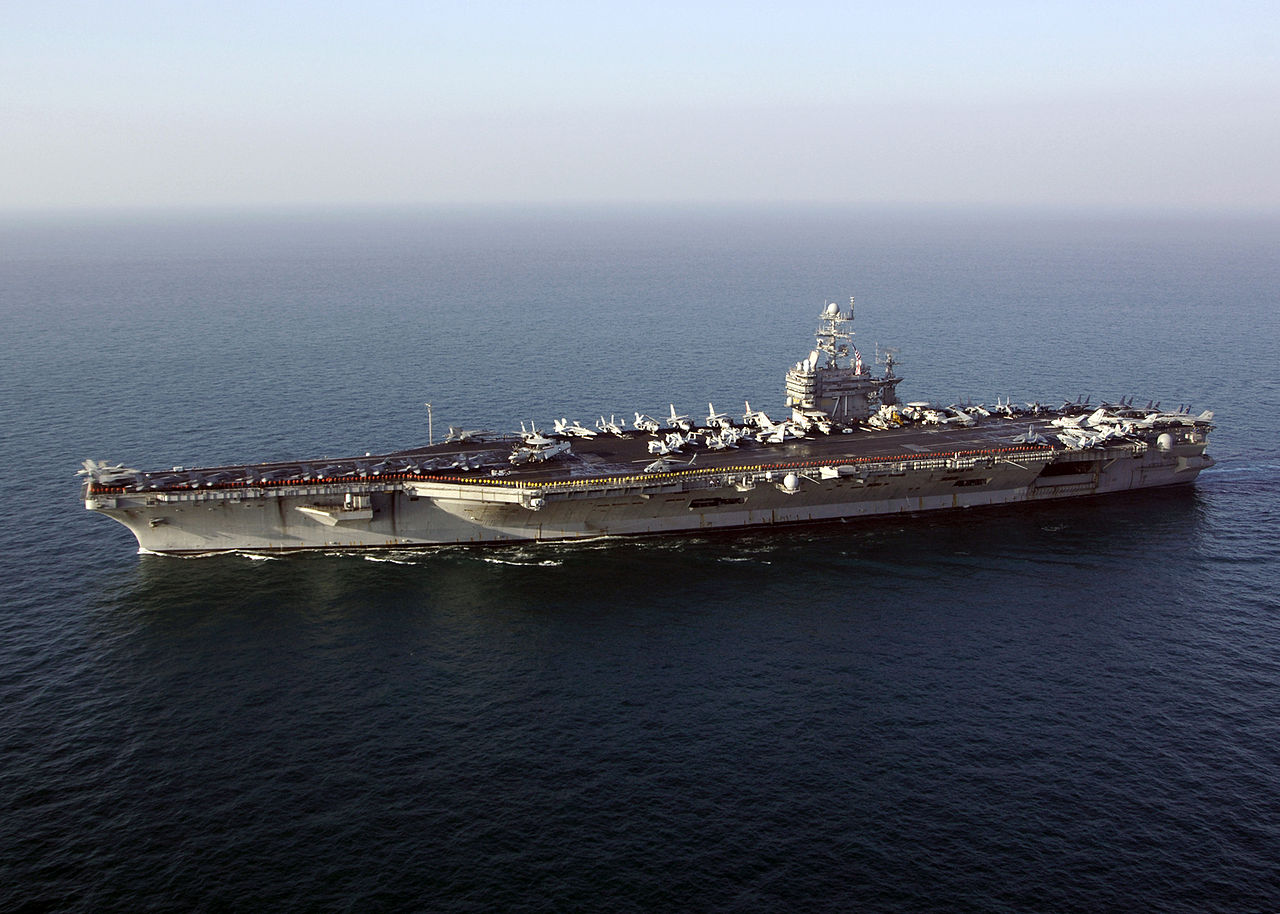
Let’s talk about aircraft carriers for a moment […] There is currently a long-raging debate about the future of the aircraft carrier as a platform, particularly for the US Navy (by far the largest operator of aircraft carriers in the world), to the point that I suspect most national security publications could open companion websites exclusively for the endless whinging on aircraft carriers and their supposed obsolescence or non-obsolescence. And yet, new aircraft carriers continue to be built.
As an aside, this is one of those debates that has been going on so long and so continuously that it becomes misleading for regular people. Most writing on the topic, since the battle lines in the debate are so well-drawn, consists of all-or-nothing arguments made in the strongest terms in part because everyone assumes that everyone else has already read the other side; there’s no point in excessively caveating your War on the Rocks aircraft carrier article, because anyone who reads WotR has read twenty already and so knows all of those caveats already. Except, of course, the new reader does not and is going to read that article and assume it represents the current state of the debate and wonder why, if the evidence is so strong, the debate is not resolved. This isn’t exclusive to aircraft carriers, mind you – the various hoplite debates (date of origin, othismos, uniformity of the phalanx) have reached this point as well; a reader of any number of “heterodox” works on the topic (a position most closely associated with Hans van Wees) could well be excused for assuming they were the last word, when it still seems to me that they represent a significant but probably still minority position in the field (though perhaps quite close to parity now). This is a common phenomenon for longstanding specialist debates and thus something to be wary of when moving into a new field; when in doubt, buy a specialist a drink and ask about the “state of the debate” (not “who is right” but “who argues what”; be aware that it is generally the heterodox position in these debates that is loudest, even as the minority).
Very briefly, the argument about carriers revolves around their cost, vulnerability and utility. Carrier skeptics point out that carriers are massive, expensive platforms that are increasingly vulnerable to anti-ship missiles and that the steadily growing range of those missiles would force carriers to operate further and further from their objectives, potentially forcing them to choose between exposing themselves or being pushed out of the battlespace altogether (this, as an aside, is what is meant by A2/AD – “Anti-Access/Area-Denial” – weapons). The fear advanced is of swarms of hypersonic long-range anti-ship missiles defeating or overwhelming the point-defense capability of a carrier strike group and striking or even sinking the prize asset aircraft carrier – an asset too expensive to lose.
Carrier advocates will then point out all of the missions for which carriers are still necessary: power projection, ground action support, sea control, humanitarian operations and so on. They argue that no platform other than an aircraft carrier appears able to do these missions, that these missions remain essential and that smaller aircraft carriers appear to be substantially less effective at these missions, which limits the value of dispersing assets among a greater number of less expensive platforms. They also dispute the degree to which current or future weapon-systems endanger the carrier platform.
I am not here to resolve the carrier debate, of course. The people writing these articles know a lot more about modern naval strategy and carrier operations than I do.
Instead I bring up the carrier debate to note one facet of it […]: the carrier debate operates under conditions of fearsome technological uncertainty. This is one of those things that – as I mentioned above – can be missed by just reading a little of the debate. Almost none of the weapon systems involved here have seen extensive combat usage in a ship-to-ship or land-to-ship context. Naval thinkers are trying to puzzle out what will happen when carriers with untested stealth technology, defended by untested anti-missile defenses are engaged by untested high-speed anti-ship missiles which are guided by untested satellite systems which are under attack by untested anti-satellite systems in a conflict where even the humans in at least one of these fighting forces are also untested in combat (I should note I mean “untested” here not in the sense that these systems haven’t been through test runs, but in the sense that they haven’t ever been used in anger in this kind of near-peer conflict environment; they have all been shown to work under test conditions). Oh, and the interlinked computer systems that all of these components require will likely be under unprecedented levels of cyber-attack.
No one is actually certain how these technologies will interact under battlefield conditions. No one can be really sure if these technologies will even work as advertised under battlefield conditions; ask the designers of the M16 – works in a lab and works in the field are not always the same thing. You can see this in a lot of the bet-hedging that’s currently happening: the People’s Republic of China has famously bet big on A2/AD and prohibiting (American) carriers from operating near China, but now has also initiated an ambitious aircraft carrier building program, apparently investing in the technology they spent so much time and energy rendering – if one believes the carrier skeptics – “obsolete”. Meanwhile, the United States Navy – the largest operator of aircraft carriers in the world – is pushing development on multiple anti-ship missiles of the very sort that supposedly render the Navy’s own fleet “obsolete”, while also moving forward building the newest model of super-carrier. If either side was confident in the obsolescence (or non-obsolescence) of the aircraft carrier in the face of A2/AD weapons, they’d focus on one or the other; the bet hedging is a product of uncertainty – or perhaps more correctly a product of the calculation that uncertainty and less-than-perfect performance will create a space for both sets of weapon-systems to coexist in the battlespace as neither quite lives up to its best billing.
(I should note that for this brief summary, I am treating everyone’s development and ship procurement systems as rational and strategic. Which, to be clear, they are not – personalities, institutional culture and objectives, politics all play a huge role. But for now this is a useful simplifying assumption – for the most part, the people procuring these weapons do imagine that they are still useful.)
In many ways, the current aircraft carrier debate resembles a fast moving version of the naval developments of the late 1800s and early 1900s. Naval designers of the period were faced with fearsome unknowns – would battleships function alone or in groups? Would they be screened against fast moving torpedo boats or forced to defend themselves? How lethal might a torpedo attack be and how could it be defended against? Would they be exposed to short-range direct heavy gunfire or long-range plunging gunfire (which radically changes how you arm and armor these ships)? With technologies evolving in parallel in the absence of battlefield tests, these remained unknowns. The eventual “correct solution” emerged in 1903 with the suggestion of the all-big-gun battleship, but the first of these (HMS Dreadnought), while begun in 1904 was finished only after the Battle of Tsushima (May 27-8, 1905) had provided apparently startling clarity on the question.