The other day, Scott Alexander responded to a hair-on-fire New York Magazine piece of hysteria-mongering about climate change warming up arctic zones that may still harbour ancient plagues that can return:
I’m a little nervous talking about this, because I am not a microbiologist. But I haven’t seen the proper experts address this properly, so I’ll try, and if I’m wrong you guys can shout me down.
(Also, the real microbiologists are apparently “self-injecting [3.5 million year old bacteria] just out of curiosity” and we should probably stay away from them for now)
I think we probably don’t have to worry very much about ancient diseases from millions of years ago.
Animal diseases can’t trivially become contagious among humans. Sometimes an animal disease jumps from beast to man, like COVID or HIV, but these are rare and epochal events. Usually they happen when the disease is very common in some population of animals that lives very close to humans for a long time. It’s not “one guy digs up a reindeer and then boom”.
If a plague is so ancient that it’s from before humans evolved, it’s probably not that dangerous. In theory, it could be dangerous for whatever animal it originally evolved for — a rabbit plague infecting rabbits, or an elephant plague infecting elephants. And then maybe after many rabbits are infected, some human might eat an infected rabbit and get unlucky, and the plague might mutate to affect humans. But I don’t think this is any more likely than any of the zillion plagues that already infect rabbits jumping to humans, and nobody is worrying about those.
The story about anthrax is a distraction. The fact that someone got anthrax from a corpse frozen in permafrost is irrelevant; there is anthrax now, and you could get it from a perfectly fresh corpse or living animal if you wanted. It’s adapted to animals and it can’t spread from person to person. Just because you got an irrelevant-to-humans modern animal disease when you dug up a modern animal, doesn’t mean you’re going to get a dangerous-to-humans disease from an ancient animals.
But I’m more concerned about recent human plagues coming back.
Not bubonic plague; that one is another distraction. The reason we don’t get more Black Deaths isn’t because yersinia pestis died off or mellowed out. It’s because we have good sanitation and pest control.
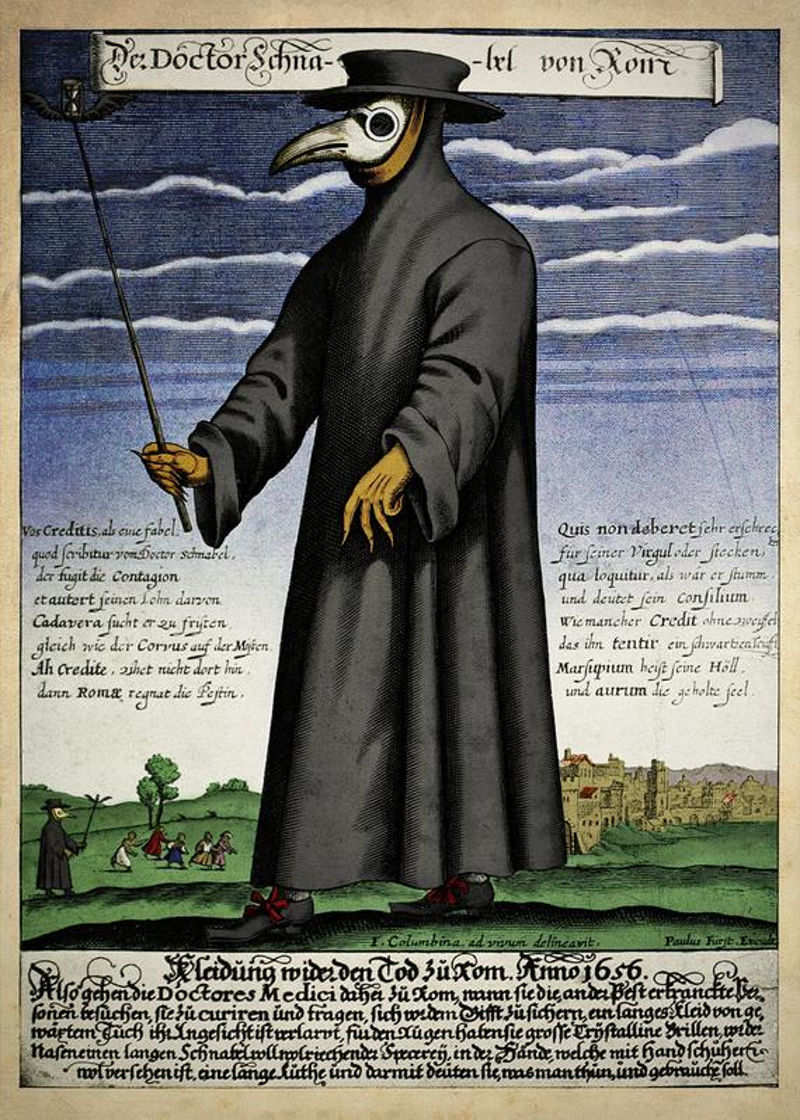
And doctors whose knowledge of medicine doesn’t begin and end with “look like a creepy bird”
But the 1918 Spanish flu has, as far as I know, legitimately died out. Lots of people like saying that in a sense it’s still with us. This NEJM paper (with a celebrity author!) points out that it’s the ancestor of all existing flu strains. But most of these flu strains are less infectious than it was. This didn’t make sense to me the first, second, or third time I asked about it: why would a flu evolve into an inferior flu? Sure, it might evolve into a less deadly flu because it’s perfectly happy being more infectious but less deadly. But I think the Spanish flu was also especially infectious; so why would it evolve away from that?