
Operations is the middle layer of military analysis, below strategy and above tactics. Operations concerns the movement of forces (often over multiple lines of advance to fully utilize the transportation network available) and their logistical support. Fundamentally, operations are about getting forces to the objectives specified in your strategy with sufficient supply to sustain themselves, so that once there they can employ your tactics to achieve victory. The specific task of crafting operations which will achieve a set of strategic objectives is called “operational art” in US doctrine. Operational failures typically manifest as logistics and maneuver failures – particularly operational plans with unreasonable timetables – both of which have been particularly in evidence in the initial Russian invasion [of Ukraine in 2022].
[…]
Strategy is the upper layer of military analysis. Fundamentally strategy concerns the identification of final objectives, the way those objectives can be achieved and the resources to be used to achieve those objectives; these three components of strategy in US doctrine are termed “Ends, Ways, and Means” respectively. Strategy is thus the “big picture” thinking behind an action, including the decisions to both commence hostilities and end them.
[…]
Tactics are the lowest layer of military analysis. Tactics concern the methods to be used to win battles. Things like flanking, suppressive fire, ambushes, etc. are tactics. A military’s tactical system is often spelled out in doctrine. In theory, operations is designed to deliver forces to battles in such a way (positioning, comparative force, etc.) that their tactics can win those battles, while strategy should aim to ensure that winning those particular battles will achieve the desired political end (whatever concessions are desired). It is important to distinguish actions which are strategy (designed to directly produce a desired end to the conflict) from those which are merely tactical (designed to achieve a local success or advantage in a given engagement). It is important when assessing failures in war to distinguish between strategic failures (typically a failure to come up with realistic goals and the means to reach them), operational failures (e.g. logistics failures or unreasonable maneuver timetables) and tactical failures (e.g. failure to use combined arms effectively).
Bret Devereaux, “Miscellanea: A Very Short Glossary of Military Terminology”, A Collection of Unmitigated Pedantry, 2022-03-25.
March 6, 2026
QotD: Operations, strategy, and tactics
February 23, 2026
Grand Strategy of the Roman Empire PART TWO
Adrian Goldsworthy. Historian and Novelist
Published 27 Aug 2025This should have posted earlier this morning, but for some reason did not.
This is the follow up to last week’s discussion of grand strategy, looking at the reactions and criticisms of Luttwak’s ideas, followed by some of my own thoughts.
January 26, 2026
The 2026 US National Defence Strategy
Noah looks at the recently released American National Defence Strategy and identifies areas of interest (or concern) for Canada (edited for typos):
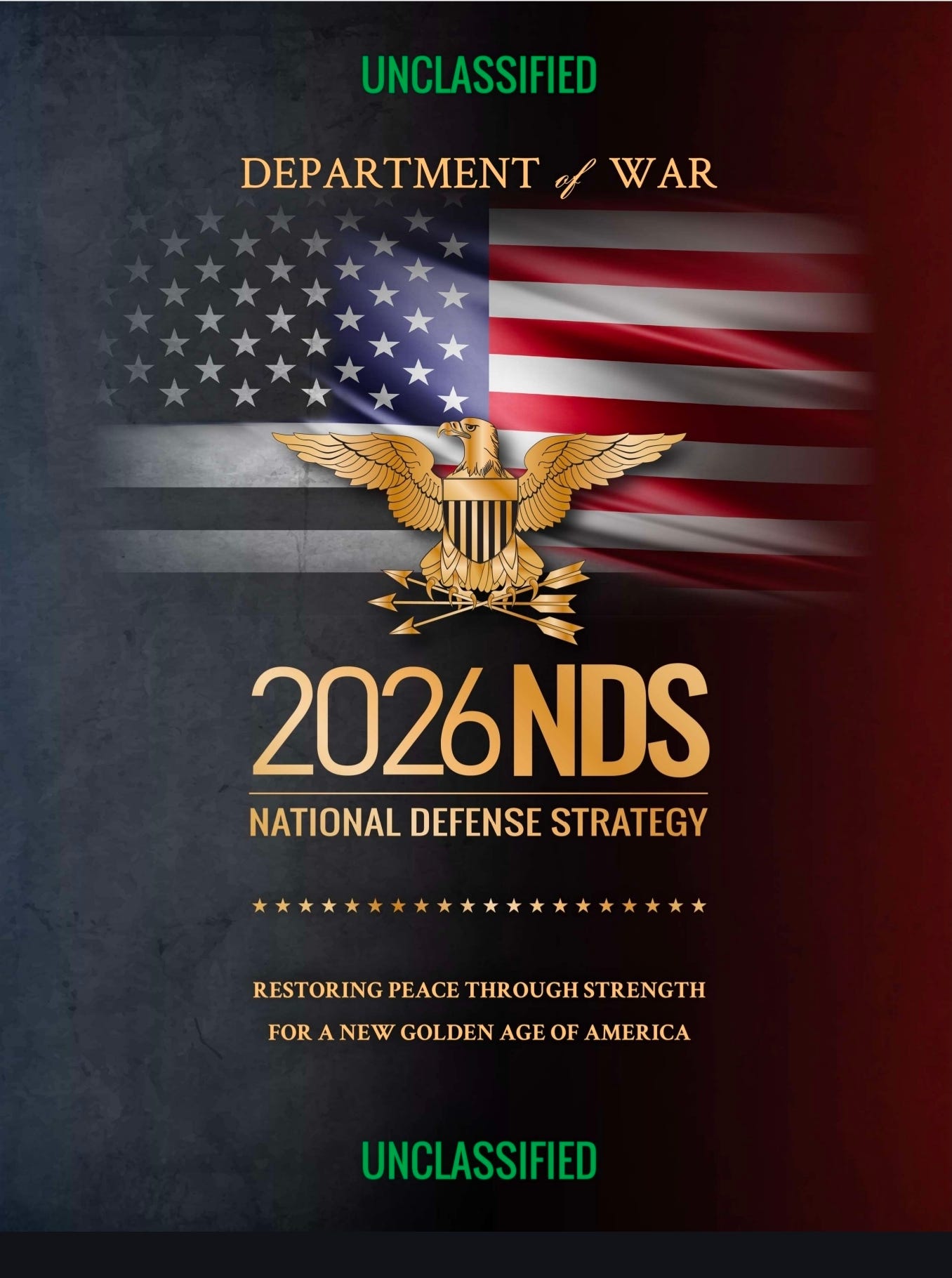
The 2026 National Defense Strategy is out, and with it we get a few references to Canada. While our mention is little, and when there is it is fairly mundane, there is a message. You either step up or get stepped over. [NR: This has always been true, but administrations in the past have been more coy about it than President Trump … who is the opposite of coy. On the other hand, the Canadian government has been quite blatant about giving mere lip service to shared US-Canadian defence interests and slacking off completely on any serious work to keep the Canadian Armed Forces in a state to be able to do what the government pretends to want.]
This policy was shadowdropped in the middle of the night, so I decided to quickly rush to get just about anything out about it. This isn’t a full analysis, but more a quick rundown with some personal thoughts for those who want the quick go of whats happening.
To start, here are the direct mentions of Canada:
We will engage in good faith with our neighbors, from Canada to our partners in Central and South America, but we will ensure that they respect and do their part to defend our shared interests. And where they do not, we will stand ready to take focused decisive action that concretely advances U.S. interests.
The policy continues:
Canada also has a vital role to play in helping defend North America against other threats, including by strengthening defenses against a missile, and undersea threats. In addition, U.S. partners throughout the Western Hemisphere can do far more to help combat illegal migration as well as to degrade narco-terrorists and prevent U.S. adversaries from controlling or otherwise exercising undue influence over key terrain, especially Greenland, the Gulf of America, and the Panama Canal.
The strategy itself is fairly domestic in focus, with repeated mention of the Western Hemisphere and borders as the key areas for which the United States should focus. It takes a backseat approach to the Indo-Pacific, favoring a collaborative approach to Chinese containment that focuses on “peace through strength”, instead of what the NDS refers to as “confrontation”.
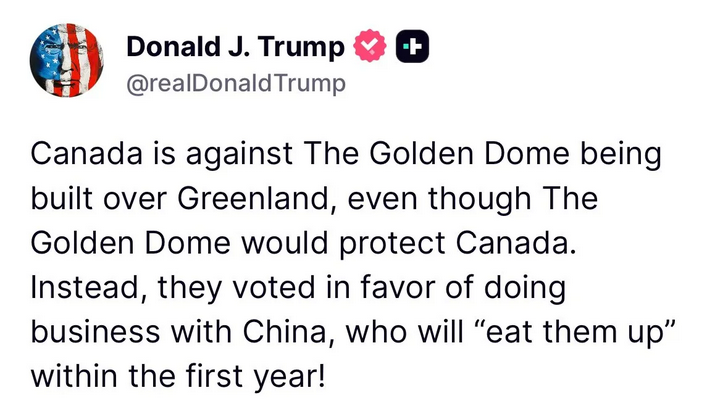
In this regard, it is funny that despite criticisms today from President Trump regarding Canada’s trade deal with China, as well as criticism over an apparent lack of Canadian support for Golden Dome, the NDS further states that “President Trump seeks a stable peace, fair trade, and respectful relations with China.” [NR: I think Noah is being a bit naive here … Trump wants to deal with China as a normal trading partner, but China’s actions in so many ways show that China doesn’t want to reciprocate.]
The strategy further states that “Our goal in doing so is not to dominate China; nor is it to strangle or humiliate them. Rather, our goal is simple: To prevent anyone, including China, from being able to dominate us or our allies.”
On today’s Golden Dome comments, I wanna take note that Canada has been discussing participation fairly openly and trying to figure out in what ways we can align even without full participation. There is no indication the current government is against Golden Dome.
The RCAF has its own IAMD study underway in Canadian Shield. It is already fairly well aligned to what the Americans are doing. People will focus on space-based interceptors and such, but Golden Dome is far more extensive than that. There’s much we align on without joining.
Canada is also undertaking its own extensive modernization of both NORAD and space-related assets, both of which will significantly contribute to Continental Defence in a variety of different ways. That includes OTHR and F-35, yes, but is so much more extensive.
From autonomous vehicles in the Arctic to ground- and space-based optical capabilities, AEW&C aircraft, new satellite constellations for both communication and surveillance, domestic launch investments, and even establishing a VLF communication capability.
There is so much going on that can and will contribute to collective Continental Defence. Much more than I believe anyone truly knows about, even myself. We need to highlight and promote these investments if we want mentalities to change and people to recognize the effort.
January 25, 2026
Grand Strategy of the Roman Empire – Part ONE, the start of the debate
Adrian Goldsworthy. Historian and Novelist
Published 20 Aug 2025Following on from videos about military planning under the Republic, and about forts and garrisons, today we will begin to look at one of the big debates in the study of the Roman army and the Roman empire — did the Romans plan in a rational and informed way how to secure and defend their empire for the long term future. In short, did the Roman emperors and their advisors have a Grand Strategy which informed their decisions. This time, we will think about how this all started, and in particular Edward N. Luttwak, The Grand Strategy of the Roman Empire (1976), which really kicked off and did much to shape the debate.
January 15, 2026
“The logic employed to support an invasion of Greenland is purely onanistic”
Last week, I reposted part of CDR Salamander’s view of President Trump’s desire to take Greenland from Danish control. I still don’t really understand his motivation, so Kiran Pfitzner‘s take that Trump’s “perverse interest in Greenland” can only be explained as rising from a belief “that conquest, that being a conqueror, is a pleasant fantasy to indulge in”:
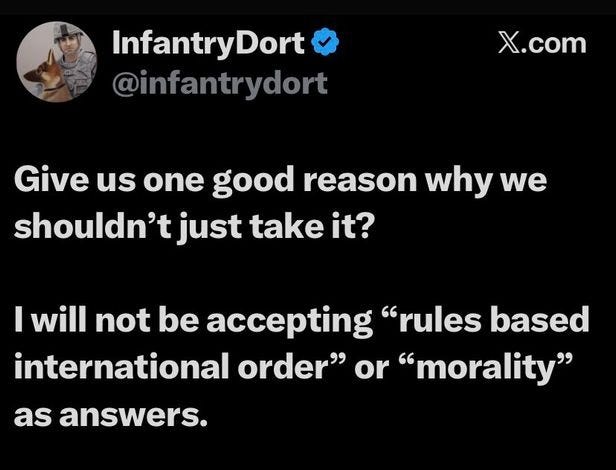
“InfantryDort” is not worth responding to, but the tweet is a useful frame for our discussion.
Aside from morality and legality, invading Greenland is, strategically speaking, utterly pointless. Even if we were to entirely neglect the consequences of such an act on our alliances and reputation, the act alone constitutes sheer stupidity as a pure question of strategy.
It is true that the idea of buying Greenland was floated during the Truman administration and again during the Eisenhower administration. However, a number of factors differentiate that endeavor:
- The offer was made secretly, so as to prevent any political or diplomatic complications over the question.
- The significance of Greenland was peculiar to the time — a nuclear attack on the US would have had to have come over the Arctic by Soviet bombers — technology has since starkly reduced its importance.
- Most importantly, previous administrations had clear ideas of what was needed from Greenland, and so were able to simply negotiate with the Danish government to gain access without the political difficulties of annexation.
This illustrates the great strategic problem of any suggestion of invasion: there is no specific aim or purpose. The endeavor is justified only in vague terms of “security” or the childish assertion that “we need it”. How it is to actually improve our security or why exactly we need it are nowhere addressed.
As Clausewitz writes, the aim of war is to put our enemy in a position more painful than the sacrifice which we demand from him. What exactly is it we want from Greenland? What have they denied us that we should seek to gain by force?
To even consider the question in practical terms, we must reckon with the simple fact that, in the era of a nation state, allies are infinitely more useful than occupied territory. Even bearing in mind that allied interests will never be entirely congruent, a state organic to a territory will be able to draw forth greater exertions from the same resources than a foreign occupier would, even before accounting for active resistance. A people will always provide their own state with more energy and zeal than they will offer to a conqueror.1 There is less “friction”.
The great benefit of alliances is in the ability to access this voluntary energy, which cannot be called into being by the dictates of a conqueror. Nationalism is such a potent force that conquest has become inordinately difficult and costly, being a net negative to state power in virtually all cases (a subject I have previously written on).2 That the United States can access Greenland’s territory without having to conquer it is already the best of all worlds.
- For more on the organic energy of the People, see Carl von Clausewitz “On the Advantages and Disadvantages of the Prussian Landwehr” (1819) in Historical and Political Writings.
- See also: Posen, Barry R. “Nationalism, the Mass Army, and Military Power”. International Security 18, no. 2 (1993): 80–124.
January 11, 2026
QotD: The limits of foreign policy realism
Instead realism is the view that international politics is fundamentally structured by the fact that states seek to maximize their power, act more or less rationally to do so, and are unrestrained by customs or international law. Thus the classic Thucydidean formulation in its most simple terms, “the strong do what they will, the weak suffer what they must”,1 with the additional proviso that, this being the case, all states seek to be as strong as possible.
If you accept those premises, you can chart a fairly consistent analytical vision of interstate activity basically from first principles, describing all sorts of behavior – balancing, coercion, hegemony and so on – that ought to occur in such systems and which does occur in the real world. Naturally, theory being what it is, neo-realist theory (which is what we call the modern post-1979 version of this thinking) is split into its own sub-schools based on exactly how they imagine this all works out, with defensive realism (“states aim to survive”) and offensive realism (“states aim to maximize power”), but we needn’t get into the details.
So when someone says they are a “foreign policy realist”, assuming they know what they’re talking about, they’re not saying they have a realistic vision of international politics, but that they instead believe that the actions of states are governed mostly by the pursuit of power and security, which they pursue mostly rationally, without moral, customary or legal constraint. This is, I must stress, not the only theory of the case (and we’ll get into some limits in a second).
The first problem with IR Realists is that they run into a contradiction between realism as an analytical tool and realism as a set of normative behaviors. Put another way, IR realism runs the risk of conflating “states generally act this way”, with “states should generally act this way”. You can see that specific contradiction manifested grotesquely in John Mearsheimer’s career as of late, where his principle argument is that because a realist perspective suggests that Russia would attack Ukraine that Russia was right to do so and therefore, somehow, the United States should not contest this (despite it being in the United States’ power-maximizing interest to do so). Note the jump from the analytical statement (“Russia was always likely to do this”) to the normative statement (“Russia carries no guilt, this is NATO’s fault, we should not stop this”). The former, of course, can always be true without the latter being necessary.
I should note, this sort of “normative smuggling” in realism is not remotely new: it is exactly how the very first instances of realist political thought are framed. The first expressions of IR realism are in Thucydides, where the Athenians – first at Corinth and then at Melos – make realist arguments expressly to get other states to do something, namely to acquiesce to Athenian Empire. The arguments in both cases are explicitly normative, that Athens did not act “contrary to the common practice of mankind” (expressed in realist dog-eat-dog terms) and so in the first case shouldn’t be punished with war by Sparta and in the latter case, that the Melians should submit to Athenian rule. In both cases, the Athenians are smuggling in a normative statement about what a state should do (in the former case, seemingly against interest!) into a description of what states supposedly always do.
I should note that one of my persistent complaints against international relations study in political science in general is that political scientists often read Thucydides very shallowly, dipping in for the theory and out for the rest. But Thucydides’ reader would not have missed that it is always the Athenians who make the realist arguments and they lost both the arguments [AND] the war. When Thucydides has the Melians caution that the Athenians’ “realist” ruthlessness would mean “your fall would be a signal for the heaviest vengeance and an example for the world to meditate upon”2 the ancient Greek reader knows they are right, in a way that it often seems to me political science students seem to miss.
And there’s a logical contradiction inherent in this sort of normative smuggling, which is that the smuggling is even necessary at all. After all, if states are mostly rational and largely pursue their own interests, loudly insisting that they should do so seems a bit pointless, doesn’t it? Using realism as a way to describe the world or to predict the actions of other states is consistent with the logical system, but using it to persuade other states – or your own state – seems to defeat the purpose. If you believe realism is true, your state and every other is going to act to maximize its power, regardless of what you do or say. If they can do otherwise than there must be some significant space for institutions, customs, morals, norms or simple mistakes and suddenly the air-tight logical framework of realism begins to break down.
That latter vision gives rise to constructivism (“international relations are shaped by ideology and culture”) and IR liberalism (“international relations are also shaped by institutions, which can bend the system away from the endless conflict realism anticipates”). The great irony of realism is that to think that having more realists in power would cause a country to behave in a more realist way is inconsistent with neo-Realism which would suggest countries ought to behave in realist ways even in the absence of realist theory or thinkers.
In practice – and this is the punchline – in my experience most “realists”, intentionally or not, use realism as a cover for strong ideological convictions, typically convictions which are uncomfortable to utter in the highly educated spaces that foreign policy chatter tends to happen. Sometimes those convictions are fairly benign – it is not an accident that there’s a vocal subset of IR-realists with ties to the CATO Institute, for instance. They’re libertarians who think the foreign policy adventures that often flew under the banner of constructivist or liberal internationalist label – that’s where you’d find “spreading democracy will make the world more peaceful” – were really expensive and they really dislike taxes. But “we should just spend a lot less on foreign policy” is a tough sell in the foreign policy space; realism can provide a more intellectually sophisticated gloss to the idea. Sometimes those convictions are less benign; one can’t help but notice the realist pretensions of some figures in the orbit of the current administration have a whiff of authoritarianism or ethnocentrism in them, since a realist framework can be used to drain imperial exploitation and butchery of its moral component, rendering it “just states maximizing their power – and better to be exploiter than exploited”.
One question I find useful to ask of any foreign policy framework, but especially of self-claimed realist frameworks is, “what compromise, what tradeoff does this demand of you?” Strategy, after all, is the art of priorities and that means accepting some things you want are lower priority; in the case of realism which holds that states seek to maximize power, it may mean assigning a high priority to things you do not want the state to do at all but which maximize its power. A realism deserving of the name, in applied practice would be endlessly caveated: “I hate, this but …” “I don’t like this, but …” “I would want to do this, but …” If a neo-realist analysis leads only to comfortable conclusions that someone and their priorities were right everywhere all along, it is simply ideology, wearing realism as a mask. And that is, to be frank, the most common form, as far as I can tell.
That isn’t to say there is nothing to neo-realism or foreign policy realists. I think as an analytical and predict tool, realism is quite valuable. States very often do behave in the way realist theory would suggest they ought, they just don’t always do so and it turns out norms and expectations matter a lot. Not the least of which because, as we’ve noted before, the economic model on which realist and neo-realist thinking was predicted basically no longer exists. To return to the current Ukraine War: is Putin really behaving rationally in a power-maximizing mode by putting his army to the torch capturing burned out Ukrainian farmland one centimeter at a time and no faster? It sure seems like Russian power has been reduced rather than enhanced by this move, even though realists will insist that Russia’s effort to dominate states near it is rational power-maximizing under offensive realism.
Bret Devereaux, “Fireside Friday, June 27, 2025 (On the Limits of Realism)”, A Collection of Unmitigated Pedantry, 2025-06-27.
- Thuc. 5.89.
- Thuc. 5.90.
January 8, 2026
WW1: The War Begins… | EP 1
The Rest Is History
Published 25 Aug 2025Following the declaration of war in 1914, how did the outbreak of the First World War unfold? What were the earliest military engagements of this terrible, totemic event? Who were its key political players and how did they respond? What was the attitude to the war in Germany? Were the allies unified from this early stage, or were they suspicious and frozen by indecision? And, how did the Germans, with the mightiest army in all the world, make its move on “plucky little” Belgium?
Join Dominic and Tom as they launch into one of the most consequential events of all time: the outbreak of the First World War.
00:00 – Germany: from peaceful nation to war machine
02:30 – Introduction to WWI series: scope and importance
04:16 – Was Germany uniquely responsible for the war? Historians’ debate
06:12 – Fear versus aggression: German motivations
06:46 – The July Crisis: Sarajevo, blank cheque, Kaiser’s holiday, Austrian ultimatum
08:08 – Helmuth von Moltke the Younger: personality, melancholy, moustaches
12:01 – Germany’s strategic weakness: encirclement fears, manpower and GDP
13:45 – The Schlieffen Plan explained
18:06 – Von Moltke panics
19:00 – Kaiser signs mobilization order; emotional scene in Berlin
22:53 – The problem of Belgian neutrality and Britain’s obligations
23:47 – British cabinet debates: how far into Belgium would justify war?
25:04 – German ultimatum to Belgium: demands for railways and fortresses
26:14 – Belgium rejects ultimatum; King Albert’s defiance
27:59 – “A scrap of paper”: German gaffe fuels British propaganda
28:35 – King Albert’s speech to parliament: “Determined at any cost”
29:52 – Total War Rome (Creative Assembly)
30:37 – German invasion begins
36:18 – German reprisals in Belgium
50:00 – Comparisons with Allied conduct in Ireland, colonies, and elsewhere
50:47 – The Leuven library fire: destruction of manuscripts, global outrage
52:12 – Germany’s reputation collapses: admired culture turned to “barbarism”
53:28 – Fall of Brussels: German army enters the capital
(more…)
January 3, 2026
Britain’s government – a modern-day Ship of Fools
On his Substack, Dr. Robert Lyman takes a break from discussing events in India and Burma during the Second World War to consider the current British government:
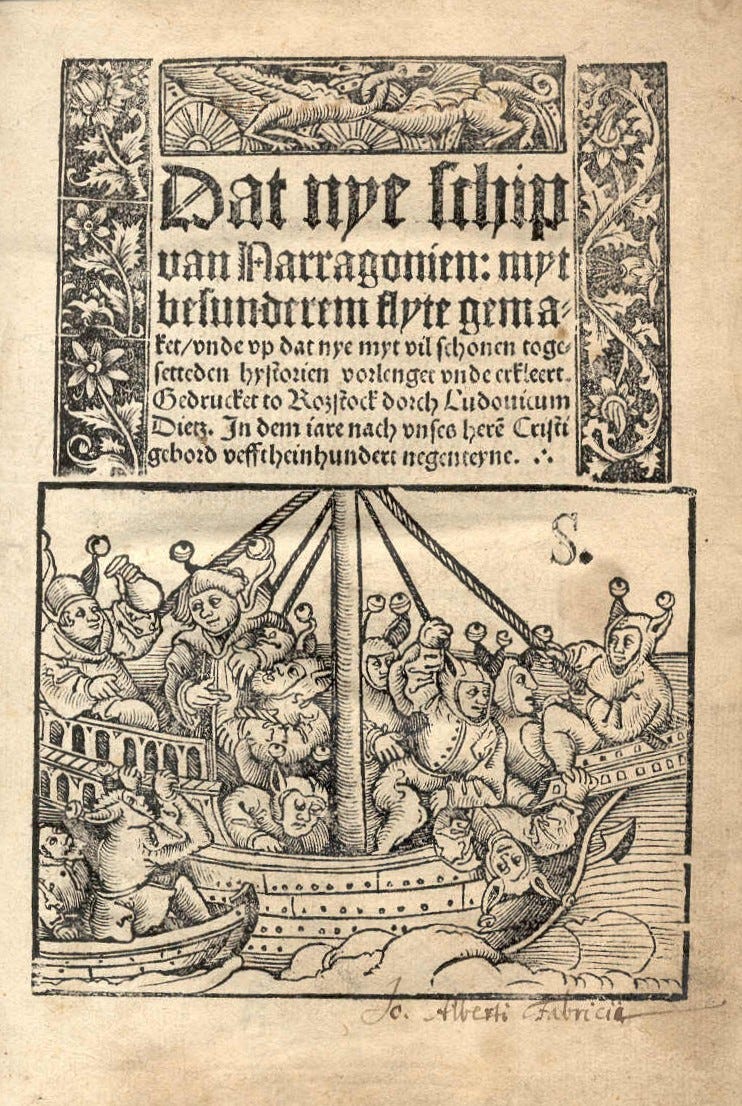
The 1519 title page of Sebastian Brant‘s 1494 satirical book Ship of Fools
I began life as a medievalist and often find myself instinctively going back to old texts when contemplating today’s problems. I have been forced to think much in recent days about the incompetence of our current governing class in respect of their understanding of defence and its value. More especially, their failure to understand how to use the military instruments of defence to uphold our national interest. The Ship of Fools, which first appeared in Plato’s Republic but was resurrected in Europe in the late 1400s as a metaphor for desperately poor leadership, is the perfect allegory for me. It tells a simple story that resonates with thoughtful people in every age who look on in wonderment at the idiots governing them. The story is of a ship with a crew who talk (and drink) a lot, but with their cloth ears make all the wrong decisions. The result is chaos. In the 1480s the ship in question was the Church of Rome, but the allegory is easily transportable to Britain in the early days of 2026. What on earth is going on in defence in the UK as we enter 2026? I can only surmise that in the UK at least, we are in a ship governed by fools.
I was going to start this piece by complaining that our government simply doesn’t understand Clausewitz, but I thought that this might be a little too obtuse for most politicians. But one of Clausewitz’s points about the use of military power is pertinent to our age. When Napoleon invaded Russia in 1812 he did so not because he had an existential hatred of Slavs, or of the Tsar. Indeed, Napoleon and Tsar Alexander I had a remarkably friendly relationship. He did it because the practice of friendly diplomacy between the two leaders had failed. Napoleon had attempted to persuade the Tsar to refuse the British trading rights in Russia’s ports. Alexander I had demurred, so Napoleon considered that the only thing left to him in his tool kit of levers to persuade Alexander to change his mind, was force. So, he marched on Moscow. We know the story and its outcome well, so I won’t rehearse it now. Using this as an example, Clausewitz was simply saying that in the hurly burly of diplomacy, war is one of the tools available to a national leader to persuade an opponent to change course. Hence, we get the oft misquoted Clausewitzian maxim that “War is the continuation of policy with other means”.
Clausewitz was correct, of course. Yet we in Britain have forgotten this, if politicians over the past three decades have really understood it. Since 1990 I am not sure we’ve had any politicians who’ve truly understood it, despite the fine words we get from successive Secretaries of State about the first priority of government being to protect its citizens, etc. This, without action to demonstrate any understanding of how to achieve the protection of our citizens, is merely St Paul’s clanging cymbal. Put frankly, we no longer have an Army, Navy or Air Force able seriously to achieve any form of influence on the European stage — let alone deter an enemy or fight a serious war — and the state of the Continuous At Sea Deterrent (CASD) is abysmal I’m told, though you wouldn’t know this from the hollow rhetoric regularly emanating from No 10. We are deluding ourselves if we think we can exercise real influence in Europe or anywhere else for that matter if we don’t have the practical means to do so.
The truth is that the cupboard is bare.
How have we got to where we are? The primary reason over the years has been the saving of money for politicians who have simply not valued investment in the hard practice of defence, unless it is in a shipyard in their constituency. The end of the Iron Curtain in 1989/90 meant, to many people in the corridors of power, that we no longer needed to bear the burden of spending 5% of GDP on defence.
But a second problem is only becoming clear to me. I hope I am wrong, but I can only conclude that we now have a government that actively hates the idea of defence, and while it will never admit it, is determined to remove it as one of its levers or instruments of power. I came across this in a meeting recently. Why do we need defence, the argument seemed to go, when we should be encouraging the international community to regulate itself by means of adherence to international laws and norms of behaviour? Should not our effort as a country be in building up these international systems and structures of law and governance (many based on the United Nations as an idea and a regulator) and rely on these to reduce the potentiality for war? Surely, building up arms simply makes war more likely, not less?
Update, 4 January: Welcome, Instapundit readers! Please do have a look around at some of my other posts you may find of interest. I send out a daily summary of posts here through my Substack – https://substack.com/@nicholasrusson that you can subscribe to if you’d like to be informed of new posts in the future.
December 12, 2025
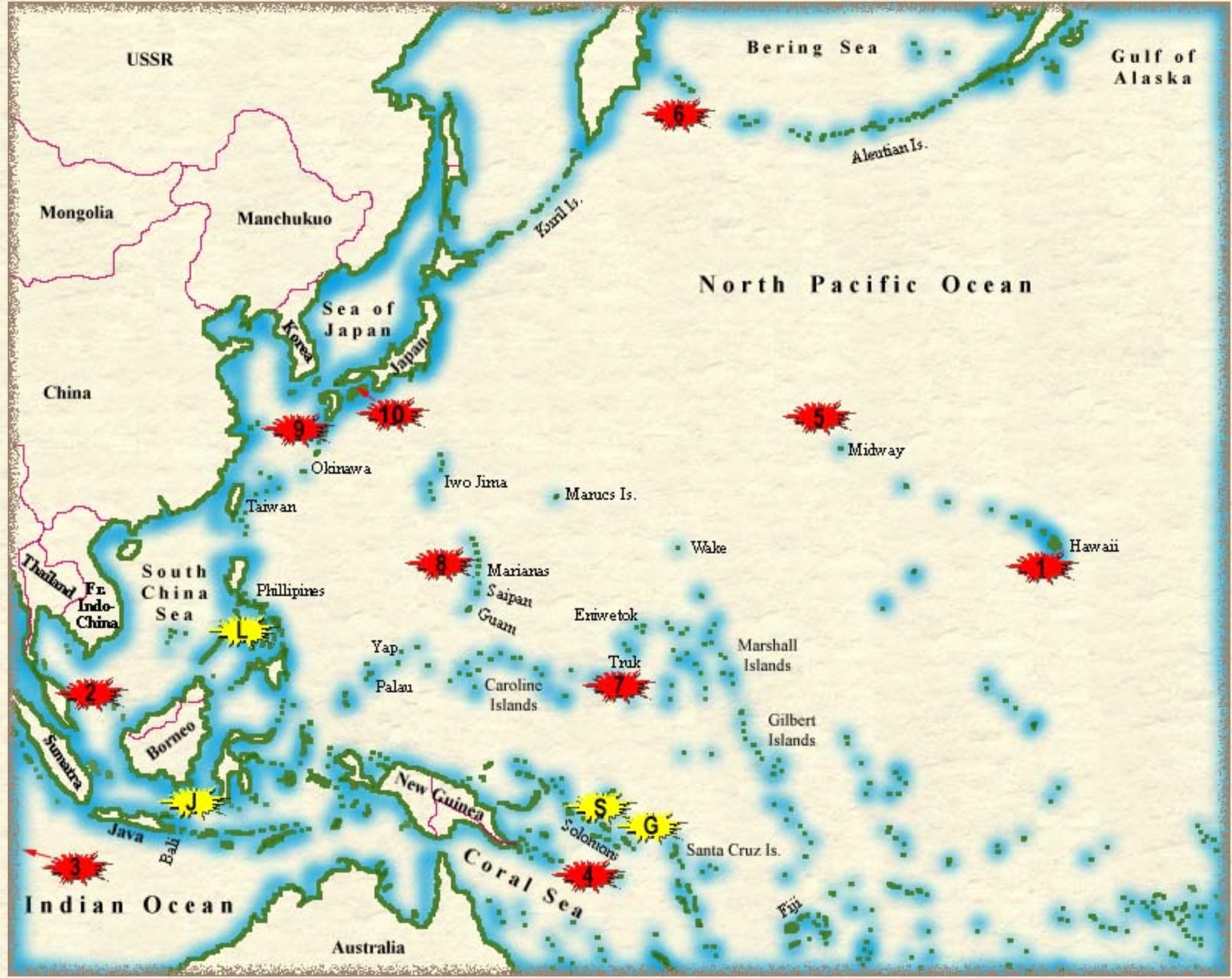
Re-orient your map to understand China’s view of the world
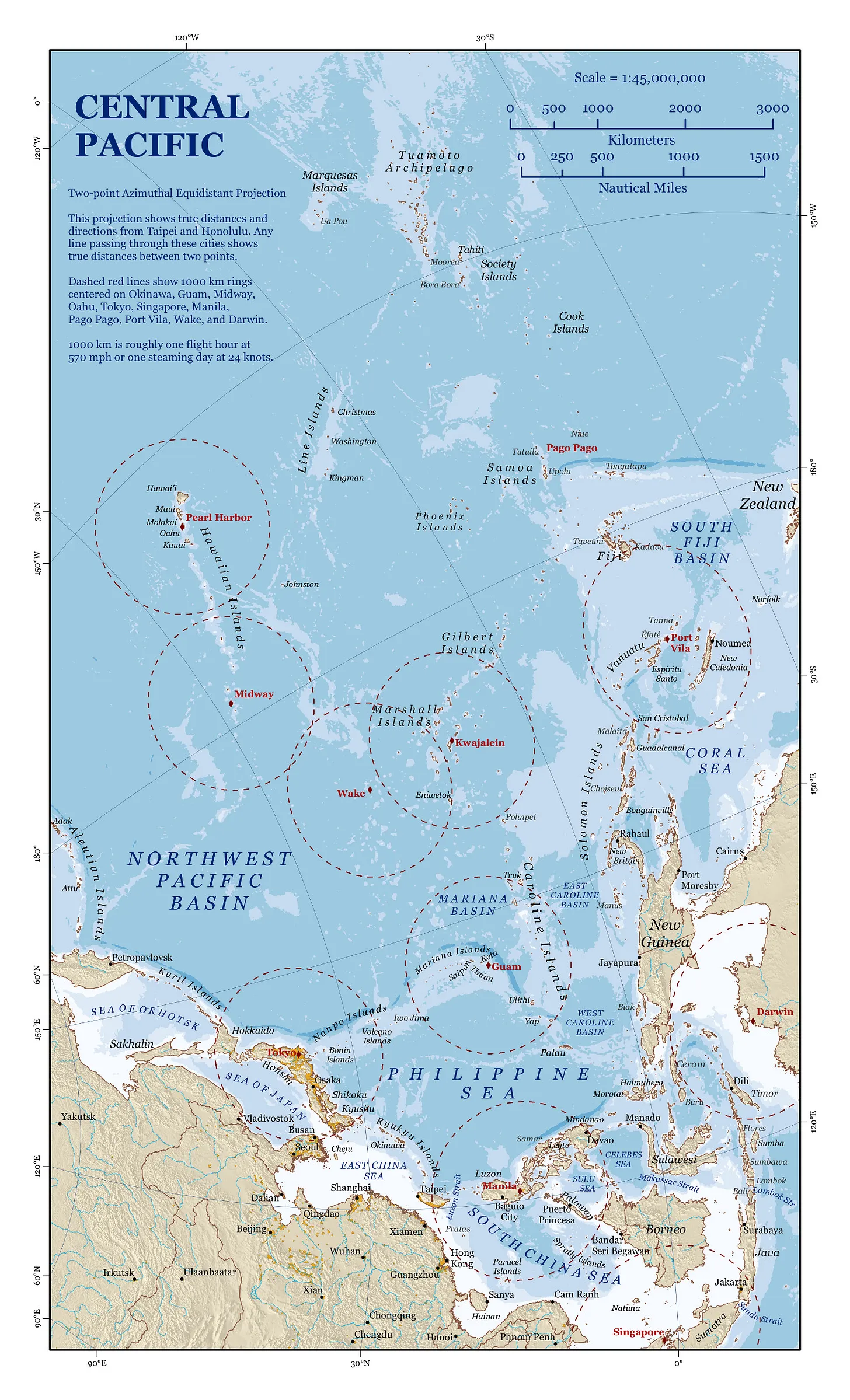
CDR Salamander provides a helpful guide to seeing the world, specifically their Pacific front, by turning your map sideways. I hope you won’t look back on this from a slightly later date when the maps get all flaggy and arrow-y:
I first saw this map three years ago, and it recently resurfaced in my thoughts.
I remain convinced that a lot of the problem with trying to get everyone to fully understand the challenge in the Western Pacific is that to a large part, we think in a “north-up” orientation.
I don’t think that is all that helpful.
Just a few days ago, we had another Pearl Harbor Day anniversary and we’ve all seen the maps, usually centered on Hawaii, where the Imperial Japanese Navy’s Kidō Butai comes at the Pacific Fleet from stage left off the map. Then we fought battles in the Coral Sea, Midway, and so on.
To the lay eye — or to those who don’t have time to dig into the reasons — a traditional north-up map looks disjointed; things seem all over the place.
No, not really. Let’s bring back that first map.
[Click to embiggenate]
For both Imperial Japan in the early-mid 20th century and Communist China today, the most important part of this map is the access to the resources in or going through the bottom-right hand corner.
Today’s greatest bone of contention — not unrelated to the most important part of the map mentioned above — is Taiwan, right at the mouth of the funnel.
If we need to bring a fight there, that is one hell of a fight to get there if the People’s Republic of China (PRC) wants to prepare a proper welcome for us.
For the PRC, the primary military threat to plan for comes across the Pacific into a funnel that terminates at its most important SLOC. It’s the United States of America, and the US has a series of islands leading right into the heart of the PRC’s. It starts in Hawaii — Midway, Wake, Guam — and then to U.S. allies: the Philippines, Japan, and Australia.
They’re planning a layered defensive fight. Their actions make that clear.
Make no mistake, we may say we are going to “defend Taiwan”, but to do that we will have to fight an aggressive war across the Pacific, into the enemy’s prepared funnel.
Update, 13 December: Welcome, Instapundit readers! Please do have a look around at some of my other posts you may find of interest. I send out a daily summary of posts here through my Substack – https://substack.com/@nicholasrusson that you can subscribe to if you’d like to be informed of new posts in the future.
October 18, 2025
The Battle of Sedan: The Anatomy of Failure
World War Two
Published 17 Oct 2025In May 1940, a period of ten days flipped the world order on its head. France, the titan of the Great War, was carved apart by the armored fist of the Wehrmacht: Panzergruppe Kleist. Now, in this new feature-length production, we explore why it happened, whether this was ever avoidable, and whether France’s flaws stemmed from incompetence, or something far more sinister.
(more…)
October 16, 2025
“The ‘big secret’ of the Soviet archives was that the communists really were communist”
Big Serge talks to historian Sean McMeekin, the author of Stalin’s War and other works that some call “revisionist” for their different views of “settled” historical events:
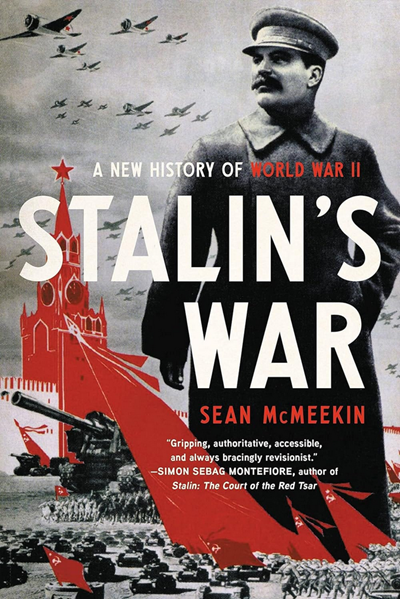
Big Serge: “One of the first things that stands out about your work is that you have found success writing about topics which are very familiar to people and have a large extant corpus of writing. World War One, the Russian Revolution, World War Two, and now a broad survey of Communism – these are all subjects with no shortage of literature, and yet you have consistently managed to write books that feel refreshing and new. In a sense, your books help “reset” how people understand these events, so for example Stalin’s War was very popular and was not perceived as just another World War Two book. Would you say that this is your explicit objective when you write, and more generally, how do you approach the challenge of writing about familiar subjects?”
Dr. McMeekin: “Yes, I think that is an important goal when I write. I have often been called a revisionist, and it is not usually meant as a compliment, but I don’t particularly mind the label. I have never understood the idea that a historian’s job is simply to reinforce or regurgitate, in slightly different form, our existing knowledge of major events. If there is nothing new to say, why write a book?
Of course, it is not easy to say something genuinely new about events such as the First World War, the Russian Revolution, or World War Two. The scholar in me would like to think that I have been able to do so owing to my discovery of new materials, especially in Russian and other archives less well-trodden by western historians until recently, and that is certainly part of it. But I think it is more important that I come to this material – and older material, too – with new questions, and often surprisingly obvious ones.
For example, in The Russian Origins of the First World War, I simply took up Fritz Fischer’s challenge, which for some reason had been forgotten after “Fischerites” (most of them less than careful readers of Fischer, apparently) took over the field. In the original 1961 edition of Griff nach der Weltmacht (Germany’s “Bid” or “Grab” for World Power, a title translated more blandly but descriptively into English as Germany’s Aims in the First World War), Fischer pointed out that he was able to subject German war aims to withering scrutiny because basically every German file (not destroyed in the wars) had been declassified and opened to historians owing to Germany’s abject defeat in 1945 – while pointing out that, if the secret French, British, and Russian files on 1914 were ever opened, a historian could do the same thing for one of the Entente Powers. I had already done a Fischer-esque history on German WWI strategy, especially Germany’s use of pan-Islam (The Berlin-Baghdad Express), inspired by a similar epigraph in an old edition of John Buchan’s wartime thriller Greenmantle – Buchan predicted that a historian would come along one day to tell the story “with ample documents”, joking that when this happened he would retire and “fall to reading Miss Austen in a hermitage”. So it was a logical progression to ask, if Fischer can do this for Germany’s war aims, why not Russia?
Readers may have missed the obvious Fischer inspiration for Russian Origins owing to the editors at Harvard/Belknap, who thought my original title – the obviously Fischer-inspired Russia’s Aims in the First World War – was boring and unsexy. Probably this helped sell books, but it did lend my critics an easy line that I was “blaming Russia for the First World War” rather than simply applying a Fischer-esque lens to Russia’s war aims. Some also called me Russophobic, which is understandable, though I think it misses the point. To my mind, subjecting Russian strategic thinking, wartime diplomacy and maneuvering to the same scrutiny as those routinely applied to Germany and the other Powers is taking the country seriously on its own terms, rather than ignoring Russia, as nearly every historian of, say, Gallipoli has done.
A book on Russian war aims was also long overdue. Other than an underwhelming Chai Lieven study from 1983 and a few articles, no one had really done this for Russia since Soviet scholars and archivists had (with very different motivations) published annotated volumes of secret Russian diplomatic correspondence back in the 1920s. For me, this was a door wide open, and I walked right in. Stalin’s War is in many ways a sequel to Russia’s Aims in the First World War (my own title!), written in a similar spirit, albeit much longer and in some ways more ambitious.
With the Russian Revolution, it was probably still harder to say anything really new, particularly after the popular histories of Richard Pipes and Orlando Figes (and a huge new literature written partly in response to them) came out in the 1990s. And I do not think my “take” was quite as revisionist or controversial as those on WWI or WW2. What I did try to do, in order to add something new to the story, was to combine my own research in a number of areas (Russian army morale reports before and after Order No. 1, depositions taken after the July Days, police reports from 1917, Bolshevik finances and expropriation policies, etc.) with new work done by others since 1991 on, especially, Russia’s military performance in WWI (a topic almost completely ignored in Cold War era literature on the Revolution, both Soviet and western), to reinterpret both the February and October Revolutions. In full disclosure, I would have preferred to write an ambitious history on just 1917, where I had the most original material and new points to make, but my publisher wanted a one-volume “comprehensive” history of the Revolution, so that is what I wrote. Like most historians and writers, I like to think that I write entirely from inspiration with a free hand, but of course there are all kinds of factors that play into our work.
Getting back to your question – while I have certainly done original research for all of these books, I am hardly the only historian to take advantage of Russian archives opened after the collapse of the USSR in 1991 – including, I should add, all the incredible archival material compiled by Russian researchers in the 1990s and 2000s into huge published volumes of Soviet-era documents. I think it is my mindset that differentiates me from other scholars who have taken similar advantage of this opportunity. Simon Sebag Montefiore, for example, uncovered incredibly rich veins of new material for Stalin. Court of the Red Tsar, as Antony Beevor did for Stalingrad, both of which books made an enormous splash. They’re not exactly “revisionists”, though. Rather, these historians retell stories already partly familiar, but with reams of fascinating new details that greatly enrich the story. I think this is a wonderful way to write history, and thousands of readers evidently agree. It is just not what I do.”
Big Serge: “I’m glad you brought up The Russian Origins of the First World War. This was the first of your books that I read, and I found it interesting for a counterintuitive reason, in that its arguments seem like they should be obvious and not particularly controversial. The essence of the book is that the Tsarist state had agency and tried to use the First World War to achieve important strategic objectives. That should be obvious, after all this was an immensely powerful state with a long pedigree of muscular foreign policy, but people are very accustomed to the Guns of August sort of narrative where all the agency and initiative is with Germany, and everyone else is reduced to the role of objects in a story where Germany is the sole subject.
It makes me think somewhat of a quip that Dr. Stephen Kotkin has used in interviews about his Stalin biographies, when he says that the “big secret” of the Soviet archives was that the communists really were communist. His point is that, even in a very convoluted and secretive regime, sometimes what you see really is what you get. I think you made a similar sort of point with Russian Origins. If I could paraphrase you, the big reveal is that the big, powerful Tsarist Empire was behaving like a big powerful empire, in that it had cogent war aims and it consistently sought to work towards those – so consistently in fact that the war aims were initially largely unchanged after the fall of the monarchy in 1917. You’re saying something very similar with Stalin’s War: the shocking secret here is that a powerful, expansionist, heavily militarized Soviet regime acted like it and worked aggressively to pursue its own peculiar interests.
How do you conceptualize this? It strikes me as a little bit odd, because, as you say, there is sometimes a bit of a stigma round the label “revisionist”, but your books generally present schemas that are fairly intuitive: Tsarist Russia was a big, powerful empire that pursued big imperial aims; Stalin was the protagonist of his own story and exercised a muscular, self-interested foreign policy; the Bolsheviks used extraordinary violence to conquer an anarchic environment. Are you surprised that people are surprised at these things?”
Dr. McMeekin: “I wish I was surprised, and perhaps at first I was, but I suppose that, over the years, I have become inured to the shocked! Shocked! reactions I receive when I point out fairly obvious things. Historians, like most groups, tend to be pack animals, who like to run in safe herds. When it comes to a familiar subject such as the outbreak of World War I, the literature tends to groove around well-trodden themes and questions. Certainly it has done since Fischerites took over the field: it’s Germany all the time, with perhaps a nod to Austria-Hungary in the Serbian backstory, or Britain with the naval race. France and Russia had almost disappeared from the story, as if one of the two major continental alliance blocs was irrelevant. I was heartened that my own treatment of Russia’s role in the outbreak of the war and Russia’s war aims garnered attention and shaped the conversation, both in itself and through Christopher Clark’s bestseller Sleepwalkers (which draws on Russian Origins). By contrast, Stefan Schmidt’s pathbreaking 2009 study of the French role in the outbreak of the war (Frankreichs Aussenpolitik in der Julikrise 1914), which Clark and I draw on heavily, has still not been translated into English, making barely a ripple in the profession. Clark and I have poked around with English-language publishers, trying to gin up interest in a translation, but so far without luck.
With the Second World War, I suppose the “shock” value is still greater, and perhaps therefore even less surprising. In Germany, after all, there are laws on the books making it illegal to “trivialize” the Holocaust, for example by foregrounding Soviet war crimes on the eastern front, and of course whole areas of the war such as the Molotov-Ribbentrop Pact, Soviet war plans in 1941, and even Lend-Lease are highly sensitive in Russia, though I’ll note that there has been a curious exception for the “full-on” revisionism of Rezun-Suvorov (Icebreaker, etc.) – perhaps because his thesis is so extreme as to be easily caricatured, or maybe just because his books sell so well, it has never been difficult to find them in Russian bookstores. In a way, I also think the popularity of Suvorov’s books in Russia relates to the way they do take the Soviet Union seriously as a great power, as I do, of course – whether or not one agrees with his thesis, and I’m sure many of his Russian readers do not, it is less condescending than western histories that treat the Soviets as passive victims of fate in the Barbarossa story before Stalin woke them up.
I was perhaps more surprised at the visceral reaction to Stalin’s War in Britain, particularly my discussion of Operation Pike (eg British plans to bomb Soviet oil installations in Baku in 1940), which sent certain reviewers into paroxysms of rage I found absolutely bewildering. If anything, I should have thought my sharply critical treatment of Hopkins and Roosevelt would have offended Americans far more gravely than my slightly more sympathetic portrayal of Britain’s wartime statesmen, but it was quite the opposite. Certainly some American Roosevelt admirers were annoyed, but this was nothing like British reviewers’ hysteria over Operation Pike. Curiously enough I had dinner not long ago with one of these reviewers, and he brought up Stalin’s War. He was very civil, full of British charm, but he still wanted desperately to know why I had argued that Britain “should have gone to war against the Soviet Union instead of Nazi Germany”. As always when I am accused of this – another reviewer stated this point blank in the TLS – I simply asked him if he could locate a passage in the book where I had stated any such thing? The entire subject of World War II has become so encrusted with emotion and taboos that I think it clouds people’s vision. They see ghosts.”
October 9, 2025
Russia’s Great Retreat 1915
The Great War
Published 9 May 2025In May 1915, the Central Powers launched one of the greatest offensive operations of the First World War. The armies of Germany and Austria-Hungary planned to smash their way through Russia lines and tip the strategic balance in their favor. The result was one of the biggest and bloodiest campaigns of the war, known today as the Great Russian Retreat.
(more…)
August 19, 2025
QotD: The fall of France: mass and defeat in detail
As mentioned, for Clausewitz, the defeat of Prussia in the war of the Fourth Coalition was the template, but the more contemporary archetype is the Fall of France in WW2. French command and control was oriented towards a lengthy war of attrition and proved unable to react quickly enough to the German breakthrough at Sedan. Counterattacks were therefore only undertaken on the local level and without coordination. Despite German vulnerability, they were able to defeat the piecemeal commitment of superior forces and ultimately collapse Allied defenses.
The initial German breakthrough was made possible by local air superiority, enabled by the same principle. This was achieved despite an overall superiority by the Allies in aircraft (even when counting only modern planes) because the Allies kept many planes in reserve, anticipating a long war. By the time they realized the significance of the German concentration, the Germans had been able to move forward anti-aircraft guns and it was too late to destroy the bridgeheads over the Meuse (despite the desperate kamikaze-like efforts of a stricken bomber).
The case of France in 1940 gives a clear example of why a defeat in detail has been so feared. French strategy was premised on winning a lengthy war — the initial battle was assumed to be no more conclusive than the Battle of Frontiers had been in 1914 [Wiki]. The exact error of the French is unlikely to be replicated, but the nature of the mistake remains a universal peril. Dismissing the likelihood of an early decision and preparing for a “later” that never comes is the reciprocal mistake of assuming an early decision is inevitable (which can be identified with the “Cult of the Offensive” that preceded WWI).
Kiran Pfitzner, “In Defense of Taiwan: Attrition or Annihilation”, Dead Carl and You, 2025-05-14.
August 7, 2025
The Arctic, strategically speaking
CDR Salamander suggests we tilt our globes (you have a globe on your desk, don’t you?) 90 degrees and consider the Arctic Ocean:
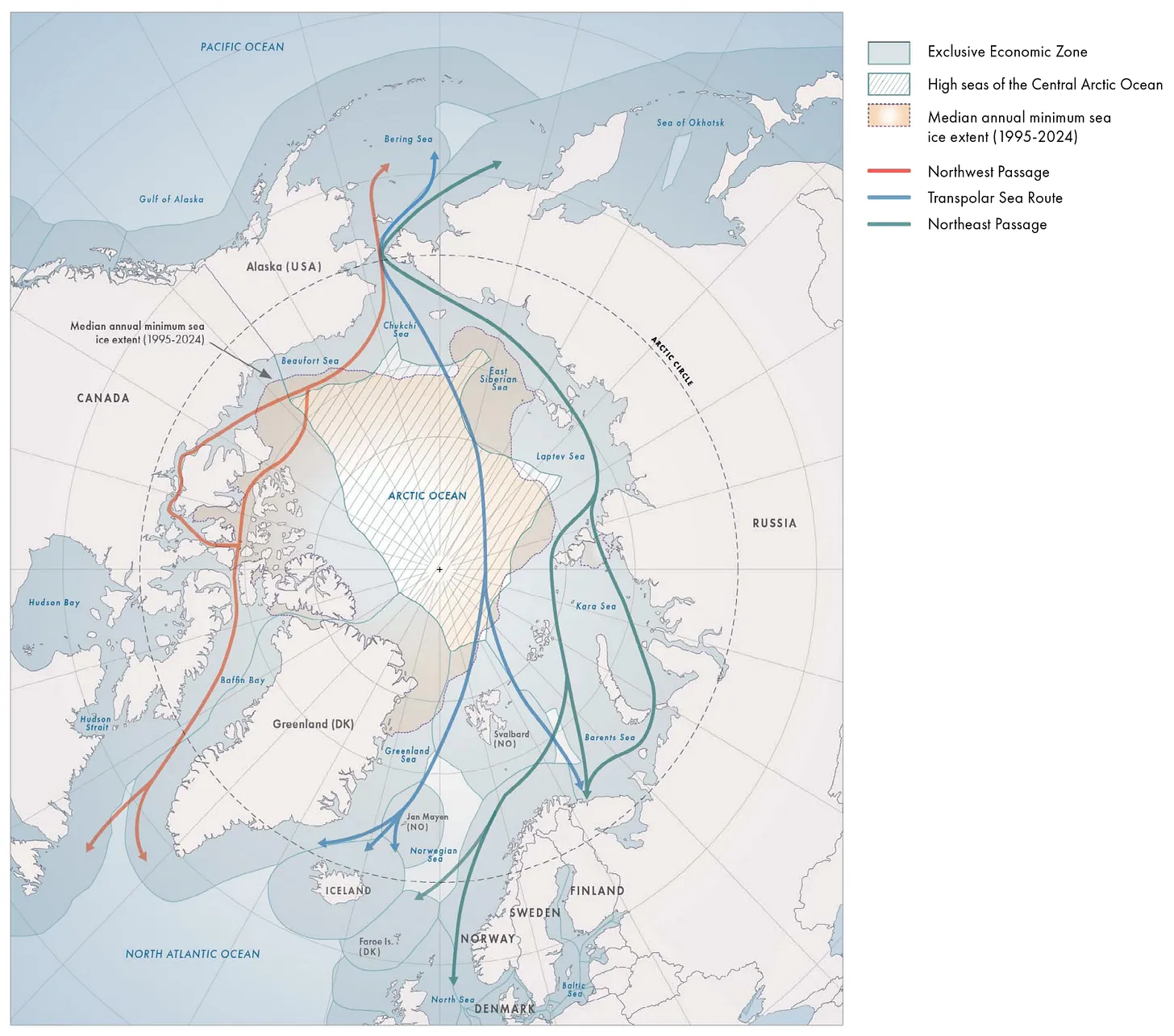
First things first, as it is the focus of the report, let’s go to the chart room and properly define the, “Central Arctic Ocean”.
There it is, the horizontally shaded bit outside everyone’s EEZ.
The chart comes from the report in question by RAND: The Future of Maritime Presence in the Central Arctic Ocean.
Before we dive in — and the Front Porch knows exactly where I am going here — I need to point out again what we see at the very top where all the red, green, and blue lines intersect. You can’t miss it, and it should have you screaming to whatever direction The Pentagon is from where you sit.
Yes kiddies, that is the Bering Strait, half of which is ours, and the other side is Russia. As you move from the Arctic into the greater Pacific or from the Pacific to the Arctic, you have to pass through that strait, and before it the American Aleutian Islands.
As we’ve covered here before, we have criminally avoided leveraging the blessings of the geography bequeathed to our nation, that of controlling both the inner and outer gates to the Arctic Ocean from the Pacific.
I should not have to explain to you the importance of the Arctic shores of Alaska to anyone. Challengers to the security of our resources in the north, both old and new, are back on the scene. We are a decade late in building a base at Nome and reactivating Adak. I covered that in a previous Substack linked in the prior sentence. Read it and come back if you need to catch up.
A weakness of much of the RAND report is, it is mostly based on stale talking points about immediate climate change in the Arctic, and questionably alarmist assumptions about the Arctic climate for the rest of the century, which seem more suited to the first Obama Administration, but put this to the side.
Should the climate in the Arctic mid-century trend towards the more ice or less, the simple facts remain — the competition in the Arctic is only increasing and the time to act on this new reality is now.
July 29, 2025
QotD: Thucydides wasn’t articulating a deterministic law of geopolitics – he was writing a tragedy
These concerns were not limited to the fringes, they were real. So real were they that respected geopolitical analysts like George Friedman (later of Stratfor) wrote books like [The Coming War With Japan] The argument was that an upstart like Japan would crash head first into US economic and security interests, sparking another war between the two. This conflict was inevitable because challengers will always seek the crown, and the king will always fight to maintain possession of it.
Suffice it to say that this war did not come to pass. The Japanese threat was vastly overstated, and its economy has been in stagnation-mode for decades now (even though living standards remain very high in relative terms). What may seem inevitable need not be.
The next several years will see marked increase in tension between the USA and China, as the former completes its long awaited “Pivot to East Asia”. So anxious are the Americans to pivot that they have been threatening to “walk away” from Ukraine if they cannot hammer down a peace deal in the very near future. This indicates just how serious a threat they view China’s ascent to be to its economic and security interests. If they are willing to sacrifice more in Ukraine than originally intended, the implication is that China’s rise is a grave concern, and that a clash between the two looks very likely … some would argue that it is inevitable, appealing to a relatively new IR concept called the “Thucydides Trap“.
Andrew Latham explains the concept to us, arguing that Thucydides is misunderstood, making conflict between rising powers and hegemons not necessarily inevitable:
The so-called Thucydides Trap has become a staple of foreign policy commentary over the past decade or so, regularly invoked to frame the escalating rivalry between the United States and China.
Coined by political scientist Graham Allison — first in a 2012 Financial Times article and later developed in his 2017 book Destined for War — the phrase refers to a line from the ancient Greek historian Thucydides, who wrote in his History of the Peloponnesian War, “It was the rise of Athens and the fear that this instilled in Sparta that made war inevitable.”
Distortion:
At first glance, this provides a compelling and conveniently packaged analogy: Rising powers provoke anxiety in established ones, leading to conflict. In today’s context, the implication seems clear – China’s rise is bound to provoke a collision with the United States, just as Athens once did with Sparta.
But this framing risks flattening the complexity of Thucydides’ work and distorting its deeper philosophical message. Thucydides wasn’t articulating a deterministic law of geopolitics. He was writing a tragedy.
This essay might be an exercise in historical sperging, but I think it has value:
Thucydides fought in the Peloponnesian War on the Athenian side. His world was steeped in the sensibilities of Greek tragedy, and his historical narrative carries that imprint throughout. His work is not a treatise on structural inevitability but an exploration of how human frailty, political misjudgment and moral decay can combine to unleash catastrophe.
That tragic sensibility matters. Where modern analysts often search for predictive patterns and system-level explanations, Thucydides drew attention to the role of choice, perception and emotion.
His history is filled with the corrosive effects of fear, the seductions of ambition, the failures of leadership and the tragic unraveling of judgment. This is a study in hubris and nemesis, not structural determinism.
Much of this is lost when the phrase “Thucydides Trap” is elevated into a kind of quasi-law of international politics. It becomes shorthand for inevitability: power rises, fear responds, war follows.
Therefore, more of a psychological study of characters rather than structural determinism.
Giving credit to Allison:
Even Allison, to his credit, never claimed the “trap” was inescapable. His core argument was that war is likely but not inevitable when a rising power challenges a dominant one. In fact, much of Allison’s writing serves as a warning to break from the pattern, not to resign oneself to it.
Misuse:
In that sense, the “Thucydides Trap” has been misused by commentators and policymakers alike. Some treat it as confirmation that war is baked into the structure of power transitions — an excuse to raise defense budgets or to talk tough with Beijing — when in fact, it ought to provoke reflection and restraint.
To read Thucydides carefully is to see that the Peloponnesian War was not solely about a shifting balance of power. It was also about pride, misjudgment and the failure to lead wisely.
Consider his famous observation, “Ignorance is bold and knowledge reserved”. This isn’t a structural insight — it’s a human one. It’s aimed squarely at those who mistake impulse for strategy and swagger for strength.
Or take his chilling formulation, “The strong do what they will and the weak suffer what they must”. That’s not an endorsement of realpolitik. It’s a tragic lament on what happens when power becomes unaccountable and justice is cast aside.
and
In today’s context, invoking the Thucydides Trap as a justification for confrontation with China may do more harm than good. It reinforces the notion that conflict is already on the rails and cannot be stopped.
But if there is a lesson in The History of the Peloponnesian War, it is not that war is inevitable but that it becomes likely when the space for prudence and reflection collapses under the weight of fear and pride.
Thucydides offers not a theory of international politics but a warning — an admonition to leaders who, gripped by their own narratives, drive their nations over a cliff.
Latham does have a point, but events have a momentum all their own, and they are often hard to stop. Inevitabilities do exist, such as Israel and Hezbollah entering into conflict with one another in 2022 after their 2006 war saw the latter come out with a tactical victory. Barring a black swan event, the USA and China are headed for a collision. The question is: in what form?
Niccolo Soldo, “Saturday Commentary and Review #188 (Easter Monday Edition)”, Fisted by Foucault, 2025-04-21.


