Quotulatiousness

September 17, 2019

From Bolt Action Lee to LMG: The Charlton Automatic Rifle

Filed under: History, Military, Weapons, WW2 — Tags: , , , , — Nicholas @ 02:00

Forgotten Weapons
Published on 26 Jul 2019

http://www.patreon.com/ForgottenWeapons

Cool Forgotten Weapons merch! http://shop.bbtv.com/collections/forg…

The Charlton automatic rifle is one of very, very few examples of a conversion from bolt action to self-loading rifle actually working reasonably well. Typically this sort of project founders in expense and unreliability. Charlton, however, was able to take his vision for providing the New Zealand Home Guard with a new weapon made form obsolete surplus and bring it fully to fruition, with 1500 guns made. They were never fired in anger, but allowed New Zealand to put all of its Bren guns into the field while retaining the Charltons as emergency weapons in case of Japanese invasion. Sadly, virtually all were destroyed in a warehouse fire after the war, leaving them extremely rare today.

Many thanks to the Royal Armouries for allowing me to film and disassemble this very scarce automatic rifle! The NFC collection there – perhaps the best military small arms collection in Western Europe – is available by appointment to researchers:

https://royalarmouries.org/research/n…

You can browse the various Armouries collections online here:

https://royalarmouries.org/collection/

For the whole detailed story on Charlton manufacture, and to download a copy of the manual, check my web site article here:

https://www.forgottenweapons.com/light-machine-guns/charlton-automatic-rifle/

Contact:
Forgotten Weapons
PO Box 87647
Tucson, AZ 85754

July 26, 2019

Post-Brexit, consider CANZUK

Filed under: Australia, Britain, Cancon, Economics — Tags: , , — Nicholas @ 03:00

Tom Colsey explains why in a post-Brexit world, CANZUK might be an attractive economic alternative:

One possible option would mean the island nation would initially turn away from Europe toward certain anglophone Commonwealth nations and former colonies. I talk, of course, of the promising CANZUK proposal that would see Canada, Australia, New Zealand, and the United Kingdom band together with voluntary agreements on multilateral free trade and movement, forming a bloc that would singularly hold the third largest nominal GDP in the world.

The Free Movement Proposal

What makes CANZUK unique is how viable and well-thought-out it is on every level. Unlike within the EU, the grouping would not be consolidated through impositional treaties laced with unpleasant footnotes delegating political power to a bureaucratic institution. Freedom of movement would assist meeting labor market demands across the countries, yet this would be prohibited to those with serious criminal records.

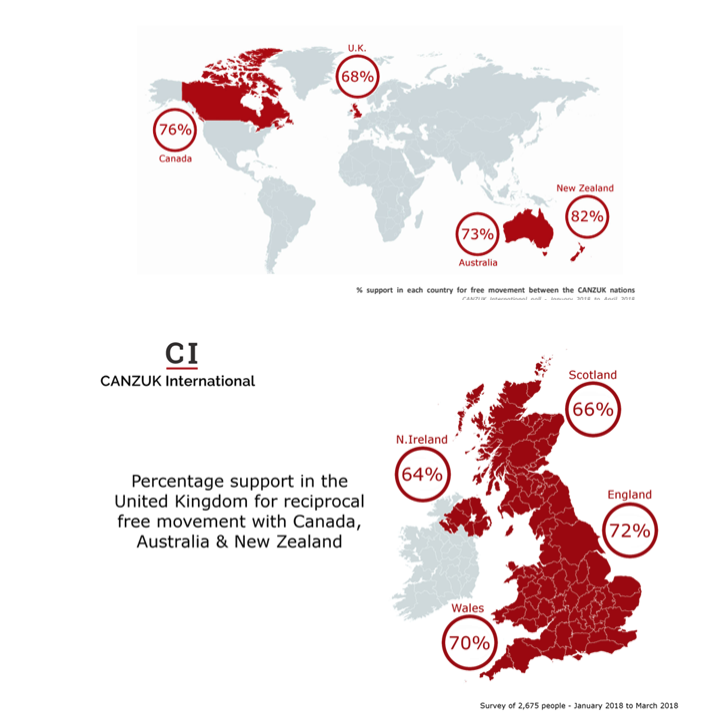
Everything the EU seemed to get wrong about forming unions under a liberal-internationalist pretense, CANZUK proposals seem to get right. They account for social attitudes and the dangers of becoming impositional, eroding national sovereignty. Free movement within the European Union had been widely reviled by the domestic population — and is part of the reason Britain now is set to leave. Yet the very same population overwhelmingly favor the same principle, alternatively implemented, across the CANZUK nations, polling outright majorities in favor in every region.

Perhaps a reason for this is that while the nations are extremely close culturally, they are also resoundingly similar socio-economically. Despite their distances, the states could have been separated at birth (of course, they do share the same monarch).

June 29, 2019

Determining who the “original” inhabitants were

Filed under: Africa, Americas, Australia, Europe, History, Pacific, Science — Tags: , , , — Nicholas @ 03:00

It’s become quite common in some countries to pay formal lip service to the “original” peoples who inhabited the land before being dispossessed of that territory by various Europeans. Actually determining who were the first human inhabitants, however, is much more fraught … you can’t exactly expiate some residual guilt of your culture by acknowledging the previous culture if the previous culture in their turn dispossessed an even earlier group, can you? How far down the rabbit hole do you need to go? Tim Worstall explains:

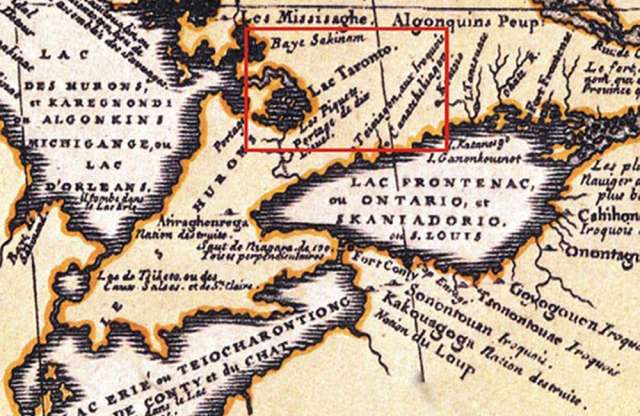
Detail from a 1688 map of western New France by Vincenzo Coronelli that locates “Lac Taronto” at Lake Simcoe.
City of Toronto Culture Division/Library and Archives Canada via the National Post

… within all that the accurate answer to “Whose land are we on?” is the land of the latest bunch of murderous bastards who killed all the previous inhabitants. Perhaps moderated to say the peeps who killed all the previous men then dated the remaining womenfolk. Because once we’ve got past that nullius stage that’s the way it has been. The Moriori are in short supply these days on the Chatham Islands given that the Maori decided to eat them.

The original inhabitants of the British Isles, the Beaker Folk, were entirely replaced by the next lot, the Iron Age Celts and similar. The Angles displaced to the west the Romano Celts in their turn, detailed DNA studies showing rather more of the female side of the R-C’s bred into the new population than the male. The Franks weren’t indigenous to France, the Allemani to Germany, the Turks to Turkey.

In fact, we’ve between little and no proof that the varied Amerinds were the original inhabitants of the lands where the White Europeans found then from 1492 onwards. In the case of both the Incas and Aztecs as political powers, proof they weren’t. And horses and Plains Indians simply weren’t a thing until the Eurasian horse was introduced post 1492.

Basically, this is indeed true. Anywhere is the possession of simply the last group of people to have slaughtered, or outbred, the previous group.

An interesting observation – if we apply the oft stated Americas example elsewhere, that Whitey stole it all and should give it back, then the Bantu should be back in Nigeria and Central Africa returned to the Pygmies, Southern to the Khoi San. We don’t say that and for the life of me I can’t work out why.

February 24, 2019

The Hobbit: The Desolation of Warners (Part 3/2)

Filed under: Books, Media — Tags: , , , , , — Nicholas @ 02:00

Lindsay Ellis
Published on 20 Apr 2018

Nothing is pure.

From the comments:

Special Agent Washing Tub
2 months ago

Me; * watching this and feeling my childhood shatter*
“Why does it hurt so much?”
Lindsay: “BECAUSE IT WAS REAL.”

June 5, 2018

The Landings At ANZAC Cove And Suvla Bay 1915 I THE GREAT WAR On The Road

Filed under: Australia, Britain, History, Military, WW1 — Tags: , , , , , — Nicholas @ 04:00

The Great War
Published on 4 Jun 2018

With thanks to Mr. Ali Serim for making this episode possible.

Indy and our guide Can Balcioglu explore the northern landings sites of Gallipoli where the Australian and New Zealand Army Corps (ANZAC) landed in 1915.

February 12, 2018

Australia’s unique contribution to hamburger culture – beetroot

Filed under: Australia, Food, History, USA, WW2 — Tags: , — Nicholas @ 03:00

On one of my mailing lists, an Australian member made a bit of a to-do about the only “proper” burger having “beetroot” on it, along with other (one assumes lesser) condiments. Having been pranked more than once by Aussie friends, I was sure he was just doing his bit to wind up the American burger purists on the list. Yet, a very cursory search produced this article from back in 2014 that appears to fully back the original assertion:

Australian hamburger sightings started during the ’30s: a by-product, no doubt, of our blossoming post-first world war relationship with America, but it wasn’t until the 1940s that beetroot began regularly appearing alongside tomato, lettuce and onion on burgers. That was thanks largely to the openings of the Edgell and Golden Circle canneries in 1926 and 1947 respectively – but one of the more interesting theories, however, suggests the trend has its origins in pranking US troops ashore on R&R.

“Maybe it was our desire not to be Americanised?” ponders Warren Fahey, Australian folklore collector and author of Australian food history compendium, Tucker Track. “For some reason the idea of hamburger wrapping stained by beetroot juice was accepted as the sign of a great hamburger. People get quite emotional over the subject of Australian hamburgers. Some say a real hamburger must have slices of canned beetroot and others still declare its inclusion as a travesty.”

According to Fahey, beetroot on burgers had its heyday in the ’50s and ’60s. Following the simultaneous 1971 arrival of fast food’s big two – the first McDonald’s opened in the Sydney suburb of Yagoona, while Hungry Jacks, the Aussie nom de plume of Burger King, began its Aussie campaign in Innaloo, just north of Perth – the combination’s popularity began to wane, as did that of milk bars, beachside kiosks and other traditional hamburger vendors.

Despite the sustained growth of American franchises, however, Australia’s burger-with-beetroot population remains stable. Even once the big players pull their seasonal go-Aussie burgers after 26 January, the odds of finding a beetroot-enriched specimen at a neighbourhood lunch bar or new-wave “gourmet” hamburger chain remain good.

[…] the country’s last Australian-owned cannery shut in 2013. Fortunately, the signs are promising that farmers in Queensland’s Lockyer Valley might soon have a processing facility to call their own. It’s a cause we can all get behind, not just for the sake of a rural Australian community, but in the name of national pride: an Aussie hamburger made using beetroot processed overseas just doesn’t seem fair dinkum.

A New Zealand member of the list also chimed in, saying that beetroot was an essential component of Kiwi hamburgers as well. While it might sound weird, it’s probably no more so than pickles or relish as a burger topping, once you get used to it.

Update: In 2017, New Zealand McDonald’s re-introduced the Kiwiburger, including beetroot:

So, you can get your beetroot burger fix in both Australia and New Zealand (for a limited time, anyway).

November 28, 2017

Invasions, Naval Battles and German Raiders – WW1 in the Pacific I THE GREAT WAR Special

Filed under: Australia, Germany, History, Military, Pacific, WW1 — Tags: , , , , — Nicholas @ 05:00

The Great War
Published on 27 Nov 2017

New Zealand: A Society At War: http://amzn.to/2A7Ojz0

One of the theatres of war that’s often overlooked, the Pacific saw some of the earliest military actions of the Great War. On top of this, there were many naval engagements in this particular ocean, including some famous German merchant raiders. We cover all this and more in today’s special episode.

October 22, 2017

New Zealand’s PM-elect will save the country from the evils of capitalism

Filed under: Economics, Government, Pacific, Politics — Tags: , — Nicholas @ 05:00

At Catallaxy Files, Steve Kates views the statement of the next Prime Minister of New Zealand with disdain:

The stupidity of some people plumbs depths that are always hard to fathom. Is it really all that hard to learn from history? Jacinda Ardern: ‘Capitalism has failed New Zealanders’. Listen to this bewildering idiocy and marvel how someone can remain so ignorant in the midst of a world of socialist horrors.

    New Zealand prime-minister-elect Jacinda Ardern has described capitalism as a “blatant failure” in the country, nominating poverty and homelessness as her priorities when she takes office.

    Speaking in her first sit-down interview, on TV3’s The Nation, Ms Ardern said New Zealanders were not feeling the benefits of prosperity. Asked if capitalism had failed New Zealanders on low incomes, Ms Ardern was blunt: “If you have hundreds of thousands of children living in homes without enough to survive, that’s a blatant failure. What else could you describe it as?”

    “When you have a market economy, it all comes down to whether or not you acknowledge where the market has failed and where intervention is required. Has it failed our people in recent times? Yes.

    “Wages are not keeping up with inflation (and) and how can you claim you’ve been successful when you have growth at roughly 3 per cent, but you have the worst homelessness in the developed world?”

I personally had no idea that the economy was so terrible in New Zealand, with literally hundreds of thousands of New Zealand’s children living in starvation conditions. According to Wikipedia, there are less than five million people in all of New Zealand, and roughly 20% of the population are under the age of 15: that means at least two-hundred thousand children are starving right now! That’s nearly Venezuelan levels of privation. How has such a shocking humanitarian crisis engulfed a modern, first-world economy with no warning from the media or our political leaders? We must organize help immediately!

March 31, 2017

Why Do Some English Speaking Countries Pronounce Z as “Zed” and Others as “Zee”?

Filed under: Australia, Britain, Cancon, USA — Tags: , — Nicholas @ 02:00

Published on 19 Mar 2017

It’s not just the British that pronounce “z” as “zed”. The vast majority of the English speaking world does this. The primary exception, of course, is in the United States where “z” is pronounced “zee”.

February 15, 2017

CANZUK gets a boost from the Financial Post

Filed under: Australia, Britain, Cancon, Economics — Tags: , — Nicholas @ 03:00

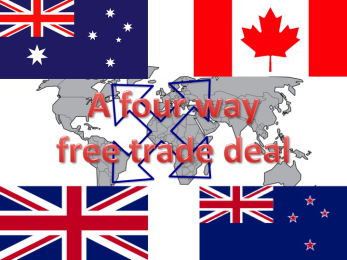
Andrew Lilico discusses the potential benefits to Canada, Australia, New Zealand, and the UK if these countries work on forming a four-way free trade deal:

The idea of CANZUK begins with a free-trade agreement, free-movement area (the freedom to live and work in each others’ countries) and defence-partnership agreement. O’Toole favours all three of these main planks, and he’s right that it all makes perfect sense.

The CANZUK countries, working closely together, would make a formidable contribution to world affairs. They would have the largest total landmass of any free-trade zone. They would collectively constitute the fourth-largest market in the world, after the U.S., EU and China.

Their combined military spending would be the world’s third largest, well ahead of Russia, and on European Geostrategy’s geopolitical power index, the CANZUK countries collectively have a strength around 70 per cent of that of the U.S. — and nearly twice that of China or France. With a combined global trade footprint nearly twice as big as Japan’s, the CANZUK countries would have substantial influence in opening up global markets and guiding global regulation across a range of issues from banking to shipping to the environment.

What makes CANZUK a natural union is perhaps self-evident. Canada, the U.K., Australia and New Zealand share a similar culture, similar values, and analogous legal, business and social systems that allow us to get along easily and interchangeably. (The term CANZUK was originally a term diplomats used to refer to these four countries because of how frequently they would vote the same way at the UN.)

Most of the main issues our political parties focus upon are instantly comprehensible to anyone from another CANZUK state. Our laws and constitutions share many features, making trade deals and mutual regulatory recognition a relatively straightforward matter. Our citizens enjoy a roughly similar per capita GDP (which is just not true of the other Commonwealth nations with similar constitutions) and face few hurdles in integrating into another CANZUK country’s labour market. Our societies are peaceful and orderly.

February 10, 2017

Gadzooks! It’s CANZUK!

Filed under: Australia, Britain, Cancon, Economics, Pacific — Tags: , — Nicholas @ 03:00

Ted Campbell is touting the benefits of a trade pact among the “other” Anglosphere nations (Canada-Australia-New Zealand-United Kingdom):

First, I am a committed free(er) trader. My reading of history is that free(er) trade always leads to greater peace and prosperity and that, conversely, protectionism usually paves the way for recessions, depressions and wars.

Second, the time seems ripe. Given the global trade situation ~ Brexit, Trump, the demise of the TPP, etc ~ and given that Canada (and Australia and New Zealand, too, I guess) and Britain are interested in a free(er) trade deal it might be an opportune moment to hit the pause button, briefly, and engage in four way negotiation since we are, all four, likely to have very similar aims. Canada has, probably, reached tentative and tentatively acceptable agreements with Australia and New Zealand in the TPP negotiations and we have made equally tentative and acceptable agreements with Britain during the CETA negotiations. It shouldn’t be beyond the wit of men and women of good-will to broaden and deepen those agreement for the mutual benefit of all four partners. (Although Mr O’Toole’s professed support for supply management may be a problem as it is, I think, one of the things we agreed to sacrifice for the TPP and it, ending supply management of the egg and dairy sector, is a long standing Australian/NZ demand.) It might make it easier for all four of us to deal with America, the ASEAN nations, China, the European Union and India, amongst others if we are reasonably united, homogeneous trade block of four friendly nations with a population of (Dr Lilico’s figures) 128 million people, a combined GDP of $(US) 6.5 Trillion, and global trade worth more than US$3.5 Trillion (versus around US$4.8 T for the U.S., US$4.2 T for China, or US$1.7 T for Japan).

Militarily, the four might find some grounds for further and even deeper cooperation ~ ideally, in the long term, on shared defence requirements definition … deciding, in advance, to harmonize operational requirements for “big ticket” items like ships, aircraft, tanks and electronics … and then, whenever politically possible, to enter into combined, multinational procurement exercises to leverage the advantages of the greater size of the combined requirement for lower prices. This is a possibility that is fraught with political difficulty but which could deliver real, measurable financial benefits to all four countries.

Equally, the four nations, acting in concert, perhaps with Singapore added, too, might be able to exert more and better influence on e.g. United Nations peacekeeping operations.

December 11, 2016

Polynesia

Filed under: History, Pacific — Tags: , , , — Nicholas @ 02:00

In reviewing the recent Disney movie Moana, Steve Sailor provides a thumbnail sketch of the amazing story of pre-contact Polynesia:

Perhaps the best analogue so far in human history to settling the galaxy has been the Polynesians’ audacious colonization of the far-flung islands of the Pacific. They repeatedly escaped the Malthusian trap by expanding their territories. Unusually for humans, sometimes they didn’t even have to steal their acquisitions from anybody else.

When Mediterranean sea captains began to venture into the Atlantic at the beginning of the Renaissance, they found that most of the small number of islands were uninhabited. The Vikings had settled Iceland, and Stone Age Berbers were living on the Canary Islands, but desirable islands such as the Azores and Madeira were still empty.

Yet when 16th-century Europeans reached the much wider Pacific, it was difficult to find an island that wasn’t already densely populated. Even remote Pitcairn Island, where the mutineers on the Bounty found refuge, appears to have been previously settled by Polynesian mariners.

Over the past half century, Western researchers, such as U. of Hawaii anthropologist and space scientist Ben Finney, have sponsored a revival of traditional islander talents at wayfinding from one known point to another.

But that still leaves the question of how the Polynesians discovered unknown islands. Presumably they followed birds and studied hints in the clouds and ocean swells?

In Moana, the prehistoric Polynesians have pioneered deep into the Pacific to islands such as Tonga and Samoa, only to have then settled down and turned their backs on the sea. Musker explains, “For thousands of years, they were great voyagers; and then there’s a thousand-year pause where they didn’t voyage.”

Suddenly, the Polynesians regained their dynamism and settled a vast triangle of the Pacific almost 5,000 miles per side, from New Zealand to Easter Island to Hawaii, with Tahiti in the middle as the jewel in the crown.

December 8, 2015

Born On The Shores Of Gallipoli – ANZAC in WW1I THE GREAT WAR Special

Filed under: Australia, History, Middle East, Military, Pacific, WW1 — Tags: , , — Nicholas @ 05:00

Published on 7 Dec 2015

The Australian and New Zealand Army Corps or ANZAC fought in Gallipoli, on the Western Front and in the Middle East during World War 1. Even though the Gallipoli campaign was an ultimate failure, it was the birth hour of the New Zealand and Australian national consciousness. Find out how the Great War shaped Australia and New Zealand in our special episode.

August 14, 2015

The Ruse at Gallipoli and the Siege of Kovno I THE GREAT WAR – Week 55

Filed under: Australia, Europe, Germany, History, Military, Russia, WW1 — Tags: , , , — Nicholas @ 05:00

Published on 13 Aug 2015

Another 20.000 soldiers fresh from the barracks are supposed to turn the tide at Gallipoli. But Mustafa Kemal is an Ottoman commander to be reckoned with. With a tactical ruse and the right timing, he surprises the inexperienced ANZAC recruits with a bayonet charge. As the sand of Chunuk Bair turns red, one thing is clear, Gallipoli is still not taken. On the Eastern Front the Germans lay siege on Kovno and are about to encircle the Russian troops near Brest-Litovsk. The German offensive on the Western Front is not nearly as successful though.

May 1, 2015

The Sea Turns Red – Gallipoli Landings I THE GREAT WAR – Week 40

Filed under: Australia, Europe, History, Middle East, Military, WW1 — Tags: , , , , — Nicholas @ 04:00

Published on 30 Apr 2015

Completely underestimating the Ottoman army at the Dardanelles, the British commanders decide to let the ANZACs take the Gallipoli peninsular as a gateway to the Bosporus and Constantinople. After the landing in ANZAC Cove and on Z Beach one thing comes clear though: Mustafa Kemal and his troops will fight for every inch of this piece of rock.

« Newer PostsOlder Posts »

Powered by WordPress