
Quotulatiousness

June 22, 2012

Microsoft Surface: “Lacking a physical product to test, all we can do is talk bollocks based on conjecture”

Filed under: Humour, Technology — Tags: , , — Nicholas @ 10:09

While I’ve been avoiding tablet computers, having an actual keyboard that can attach to a tablet makes it more like something I might be able to find a use for. In The Register, Alistair Dabbs explains why he’s already very fond of the announced-but-not-available-yet Microsoft Surface:

I don’t wish to suggest that Microsoft Surface is truly vapourware, but surely it’s suspicious that it’s announcing a product that no one’s going to be able to buy for half a year.

One supposes that Microsoft intends to create a buzz and get us talking about their forthcoming (new) foray into tablet computers. Yet the problem with jumping the gun — apart from the ‘false start’ accusations that lead on from this metaphor — is that commentators are left with a void to fill. Lacking a physical product to test, all we can do is talk bollocks based on conjecture.

This, as you know, is my specialty.

First, let me say that I don’t care a hoot about the provenance of the name ‘Surface’ — ho-ho, it used to be a table, so fucking what? Making fun of a name tells us nothing about the product.

Take ‘Metro’.

“We call it Metro because it’s modern and clean.” Oh, and here’s me thinking they called it Metro because it’s populated by young Algerians brandishing flick-knives and smells of wee. It’s just a word to put on the packaging and its actual meaning has no significance. After all, what does the word ‘pod’ have to do with playing MP3 files?

January 6, 2012

A dinosaur mating ritual: Microsoft rumoured to be buying Nokia’s smartphone division

Filed under: Technology — Tags: , — Nicholas @ 09:06

ESR has the scoop:

Just when you thought the smartphone industry couldn’t get any more soap-operatic, everybody’s favorite pair of aging drama queens — Microsoft and Nokia — may be at it again. There’s a rumor, from a gossip with a good track record, that Microsoft intends to buy Nokia’s Smartphone division.

Inexplicably, there are even some people writing about the rumor who think this might even be a good idea. I mean, a good idea for Microsoft. It probably really would be a good idea for Nokia — they’d get shut of their idiotic alliance with Redmond and unload a crappy, chronically underperforming division for a pile of cash (the rumormonger says $19 billion).

But for Microsoft? Nokia’s brand strength was probably the only thing keeping Windows-phone share as high as 5.2%. It hasn’t been Microsoft’s software doing it, that’s for sure. Botched upgrades and a pathetically weak app ecosystem have only been the most obvious problems.

If Microsoft bought Nokia’s smartphone division, they’d mismanage it into smoking rubble within two years. “But wait, Eric…” I hear you cry, “they haven’t done too badly with the X-Box!” Quite right they haven’t — but that’s because Microsoft runs that division as a cash generator, mostly hands off.

Smartphones, on the other hand, are strategic. That means that if Microsoft buys itself a smartphone division, Steve Ballmer’s going to poke his prong into it. Repeatedly. To, um, what’s the B-school jargon? “Maximize the synergies”. They might even be treated to more demented-monkey ranting. Two years. Smoking rubble.

October 29, 2011

Windows XP, the operating system that refuses to die

Filed under: Technology — Tags: , — Nicholas @ 11:08

Ars Technica looks back on the long, long history of Microsoft’s Windows XP:

Windows XP’s retail release was October 25, 2001, ten years ago today. Though no longer readily available to buy, it continues to cast a long shadow over the PC industry: even now, a slim majority of desktop users are still using the operating system.

Windows XP didn’t boast exciting new features or radical changes, but it was nonetheless a pivotal moment in Microsoft’s history. It was Microsoft’s first mass-market operating system in the Windows NT family. It was also Microsoft’s first consumer operating system that offered true protected memory, preemptive multitasking, multiprocessor support, and multiuser security.

The transition to pure 32-bit, modern operating systems was a slow and painful one. Though Windows NT 3.1 hit the market in 1993, its hardware demands and software incompatibility made it a niche operating system. Windows 3.1 and 3.11 both introduced small amounts of 32-bit code, and the Windows 95 family was a complex hybrid of 16-bit and 32-bit code. It wasn’t until Windows XP that Windows NT was both compatible enough — most applications having been updated to use Microsoft’s Win32 API — and sufficiently light on resources.

In the history of PC operating systems, Windows XP stands alone. Even Windows 95, though a landmark at its release, was a distant memory by 2005. No previous PC operating system has demonstrated such longevity, and it’s unlikely that any future operating system will. Nor is its market share dominance ever likely to be replicated; at its peak, Windows XP was used by more than 80 percent of desktop users.

August 1, 2011

Back to the drawing board

Filed under: Administrivia — Tags: , , — Nicholas @ 10:15

As I mentioned yesterday, I’ve been trying to use Microsoft’s Windows Easy Transfer utility to move 100Gb of files and settings from my old laptop to the new one, but between technical glitches and thunderstorms, it still hasn’t completely worked. When the initial estimate ballooned up from a few hours to nearly two days, I started to suspect things were not going to go according to the script . . .

Today’s plan is to do it in two stages: back up the old machine’s files to the NAS, then install the files from the NAS to the new laptop.

July 31, 2011

Upgrades in slow motion

Filed under: Technology — Tags: , , — Nicholas @ 16:55

I bought a new laptop yesterday, as my old laptop is starting to creak when I load up a full suite of work tools (Adobe FrameMaker, Open Office Writer or Microsoft Word, a couple of web browsers plus a virtual machine or two under VMWare). Elizabeth will be taking over my old laptop and retiring her Acer with its constant beeping and lock-ups when I’ve finished installing all the software and moving over all my files to the new laptop.

I’m currently trying to transfer files and settings from my old laptop to the new machine. The Windows Easy Transfer tool makes it look pretty straightforward . . . but it’s slow, slow, slow. I started a transfer last night after dinner, anticipating it’d be done this morning, but the WiFi router glitched not long after I started the process, so it didn’t happen. Plus, we had some lively thunderstorms roll through early this morning, which meant I had to jump out of bed and shut everything down anyway.

Second attempt this afternoon, once the weather cleared up, and it’s now telling me to expect the transfer to take “1 day 15 hours”. And, of course, you can’t use either machine for anything else while the files are being transferred.

July 27, 2011

MS-DOS at thirty

Filed under: History, Technology — Tags: , , — Nicholas @ 07:25

It was indeed, according to The Register, thirty years ago that MS-DOS hit the market:

MS-DOS is 30 years old today. Well, kind of. On 27 July 1981, Microsoft gave the name MS-DOS to the disk operating system it acquired on that day from Seattle Computer Products (SCP), a hardware company owned and run by a fellow called Rod Brock.

SCP developed what it at various times called QDOS and 86-DOS to run on a CPU card it had built based on Intel’s 8086 processor.

June 3, 2011

The right software tool for the job: Excel is not a database

Filed under: Britain, Media, Technology — Tags: , , , — Nicholas @ 10:05

You know how some people, having mastered a particular software tool, keep trying to fit every task into the one tool they know even when it’s awkward to do? I’ve seen people using Microsoft Excel instead of Microsoft Word or another word processor to produce letters — and people using Word to do spreadsheet-like tasks. The old adage seems to still apply in the software world: when the only tool you have is a hammer, everything looks like a nail.

It’s apparently not just small companies that suffer from this sort of problem:

The London 2012 Olympics is set be a humanoid spectacle of the like never witnessed by the world’s population before. Or something. But disturbing information has reached us at Vulture Central that reveals the organisation’s entire cultural events database is stored in *gasp* Excel.

A job vacancy currently advertised on the London Organising Committee of the Olympic Games (LOCOG) website is offering a competitive salary to someone who can maintain and report on data held in Microsoft’s spreadsheet software.

Now, a small biz with few customer accounts might consider Excel to be fit for purpose. But surely housing an Olympic stadium-sized database on a standalone spreadsheet is bonkers, isn’t it?

That’s a mighty big nail for such a small hammer.

March 4, 2011

Can you upgrade from Windows 1 to Windows 7?

Filed under: History, Technology — Tags: , , — Nicholas @ 09:59

I doubt very many of you ever used Windows 1.0 (I certainly didn’t: 3.0 was the first time I used Windows). Charles Arthur writes about an interesting experiment conducted by Andrew Tait to test how well your system would work if you somehow needed to upgrade through all the major Windows versions:

The question is: how robust is it? Can you really do all that updating? You have to start with MS-DOS 5.0, of course, because early versions of Windows needed that.

It’s a bit hairy and config.sys-y in the early versions up to 3.1.

But what’s really impressive is that Doom 2 and Monkey Island — installed right at the beginning — work all the way through, right up to Windows 7. Well, apart from in Windows 2000, where it hung at the start (lack of DOS support).

Well done Andrew Tait, alias Rasteri, the YouTube/Reddit user who had the enormous patience to do all this. Especially for sounding like Sean Connery all the way through. “It is indeed possible to upgrade through every version of Windows… and have some settings remain. This is nearly 20 years of application compatibility and Microsoft should be applauded.”

Of course, the real stumbling block to doing this would be the hardware: nothing that was available in the Windows 1.0 era would be able to run the far more demanding software of the Windows NT family of operating systems. To get around that, Tait used VMWare’s virtualization software:

February 11, 2011

The Guild renewed for a fifth season

Filed under: Gaming, Humour, Media — Tags: , , , — Nicholas @ 12:59

Felicia Day and friends will be back for another season, thanks to Microsoft:

The Guild, in case you’re new, is the long-running series about a pack of socially awkward MMORPG addicts, created by Felicia Day and produced by Kim Evey. Launched independently in July 2007, the show has received over 100 million views (according to an official release) and attracted a worldwide fan base that fills convention halls.

I mention the convention thing because, as promised at the end of Season 4, the action of Season 5 will involve the characters attending a convention for the unnamed game they play. According to Evey, to handle this production requirement they’re not only considering shooting certain scenes at a small convention, but working with additional brands.

“We haven’t really had success with brand integration aside from Microsoft and Sprint, who help us make sure their brands are visible but not obnoxious,” Evey said via phone. “But the brands that we need now are brands which would sell their wares at a convention like this, and are willing to be in our show.”

February 9, 2011

Nokia: the company on the burning platform

Filed under: Technology — Tags: , , , , , , — Nicholas @ 07:57

Nokia has a problem. The ordinary cellphone market which mere years ago they bestrode like a Colossus has been overshadowed by the smartphone market, and they’re just an ordinary company in that market.

In the memo, Mr. Elop shares his vision of the current state of the mobile landscape, where Apple controls the high-end of the wireless market with its iPhone, where Google’s Android not only is making its mark in the smartphone arena but now conquering the mid-range market with Android and how Nokia is even losing the fight to control the low end of the cellphone market — an arena in which the company has traditionally dominated — as it struggles to compete with China’s MediaTek for market share and mind share in emerging markets.

“The first iPhone shipped in 2007, and we still don’t have a product that is close to their experience,” he writes.

“Android came on the scene just over 2 years ago, and this week they took our leadership position in smartphone volumes. Unbelievable … And the truly perplexing aspect is that we’re not even fighting with the right weapons. We are still too often trying to approach each price range on a device-to-device basis.”

Update: Eric S. Raymond thinks the memo shows that Nokia’s new CEO has the courage to grasp the nettle:

If this memo does nothing else, it proves that Elop is not afraid to look facts in the eye and propose drastic remedies for a near-terminal situation. I cannot recall ever hearing in my lifetime a CEO’s assessment of his own corporation that is so shockingly blunt about the trouble it is in. The degree of candor here is really quite admirable, and does more than any other evidence I’ve seen to suggest Elop has the leadership ability to navigate Nokia out of its slump.

It’s clear from the memo that Elop is preparing his company to change their flagship smartphone OS. You can’t get more obvious than ‘We too, are standing on a “burning platform,” and we must decide how we are going to change our behaviour.’

The available alternatives are Android or WP7. Apple’s iOS is right out because Nokia needs to be able to sell cheap on a huge range of handsets. RIM and WebOS are tied to one company each. MeeGo’s been tried and failed. There are no other realistic contenders.

I think we’re being given some subtle clues that it will be Android.

Update, 12 February: Andrew Orlowski has some post-tragedy analysis of Nokia’s collapse into the arms of WP7:

There are times when you don’t want to intrude on public grief, but Nokia has spent 15 years (or more) trying to avoid this day.

New CEO Stephen Elop would argue otherwise, but giving up control of your platforms means giving up control over your destiny – and Elop has given Nokians not one twig of consolation around which a bit of dignity could be wrapped.

He’s also signalled the end of Nokia as a high R&D spend technology company. “We expect to substantially reduce R&D expenditures”, said Elop bluntly in this morning’s webcast. The new Nokia will be a global brand and a contract manufacturer whose primary customer is itself.

“Disaster” and “stitch-up” are two of the texts I received this morning from Nokians. Finnish press reports 1,000 staff in Tampere walking out. A surprise? Not really. For 15 years Nokia has defined itself, to its partners and customers, as the Not-Microsoft. Now it’s utterly dependent on them. There’s no Plan B.

[. . .]

How does Nokia recreate the product-centric, almost skunkworks development culture of the 1990s, while retaining its global logistical strengths, such as its ability to customise for local markets? How does Nokia prevent Microsoft from stealing its ideas? How does it create services that don’t brass off its biggest customers, the operators? Some of these are very old questions, and the Microsoft tie up does nothing to resolve them — it might even complicate them.

The impact on morale is probably the most immediate thing Elop has to address — it’s a huge blow to Finnish national pride. Elop’s brutal assessment in his “Burning Platforms” intranet post is that Nokia was hopeless at strategy, rubbish at marketing, and couldn’t write software. He all but told Nokians that they should have stayed in the rubber boot business.

What a motivator!

July 14, 2010

The upgrade dance

Filed under: Technology — Tags: , , — Nicholas @ 09:04

With the reminder yesterday that Microsoft has ended support for Windows XP Service Pack 2, I figured it was time to look at upgrading my computers to Windows 7. I’m not a “bleeding edge” kind of guy: I figure it’s safer to let other folks be the quality assurance department and I usually wait until the cries of pain and anguish from the first bunch of upgraders dies down before trying it myself.

I looked at the array of options (remember the days when there were only one or two flavours of operating system to worry about?) I was going to upgrade my laptop first, as it’s already been blighted with Vista, which is supposed to mean that the upgrade preserves all your installed programs and settings. I have a variety of programs I need to run, some of which are getting a bit long in the tooth, so I thought it safer to get a version of Windows 7 that offers the “Windows XP Mode” just in case some of them won’t play nice in the new OS natively. That meant I needed to buy Windows 7 Professional or Windows 7 Ultimate. The differences between those two versions was price: Ultimate offers BitLockerTM and the option of working in 35 languages, neither of which is important to me. So I picked up a copy of Windows 7 Professional.

This morning, when I tried to run the upgrade, having backed up my laptop’s hard drive, I discover that I should have bought the Ultimate version instead — because the laptop was shipped with Vista Home Premium installed, I can’t upgrade directly to Windows 7 Professional using the “preserve files and settings” option, but instead would have to re-install everything.

Well, I guess I can use this copy to upgrade the desktop, since it’ll need the full re-install everything option anyway. Drat.

Update, 15 July: Well, the actual updating part went pretty smoothly (unlike the last few times I’ve installed OSes from Microsoft), so now it’s find the programs, download updates and drivers, and get back into a working state. The longest part so far has been using the Microsoft “Windows Easy Transfer” wizard: both saving the files off the original and re-installing them on the new OS is a multi-hour exercise.

Update, 20 July: It took time, but unlike previous OS-upgrade tales of woe, this was merely time-consuming. The last of the programs I was having issues with has started to behave (although in one case it was an extremely good idea that I got the version of Windows 7 that included Windows XP Mode: my backup program hiccoughs under native Windows 7).

I can comfortably recommend the Windows 7 Easy Transfer tool: it even eased the pain of updating iTunes. I can see why some folks don’t feel the urge to move on from Vista: it “feels” very similar to Vista so far.

April 30, 2010

The revolution is almost complete . . . hold on tight

Filed under: Economics, Technology — Tags: , , , , , — Nicholas @ 16:25

Charles Stross thinks he understands why Steve Jobs won’t allow Adobe Flash on to the iPhone and iPad:

Steve Jobs believes he’s gambling Apple’s future — the future of a corporation with a market cap well over US $200Bn — on an all-or-nothing push into a new market. HP have woken up and smelled the forest fire, two or three years late; Microsoft are mired in a tar pit, unable to grasp that the inferno heading towards them is going to burn down the entire ecosystem in which they exist. There is the smell of panic in the air, and here’s why . . .

We have known since the mid-1990s that the internet was the future of computing. With increasing bandwidth, data doesn’t need to be trapped in the hard drives of our desktop computers: data and interaction can follow us out into the world we live in. Modem uptake drove dot-com 1.0; broadband uptake drove dot-com 2.0. Now everyone is anticipating what you might call dot-com 3.0, driven by a combination of 4G mobile telephony (LTE or WiMax, depending on which horse you back) and wifi everywhere. Wifi and 4G protocols will shortly be delivering 50-150mbps to whatever gizmo is in your pocket, over the air. (3G is already good for 6mbps, which is where broadband was around the turn of the millennium. And there are ISPs in Tokyo who are already selling home broadband delivered via WiMax. It’s about as fast as my cable modem connection was in 2005.)

[. . .]

This is why there’s a stench of panic hanging over silicon valley. this is why Apple have turned into paranoid security Nazis, why HP have just ditched Microsoft from a forthcoming major platform and splurged a billion-plus on buying up a near-failure; it’s why everyone is terrified of Google:

The PC revolution is almost coming to an end, and everyone’s trying to work out a strategy for surviving the aftermath.

Read the whole thing. I don’t see any obvious flaw in his line of thought. It may not happen the way he predicts, but it is consistent with what we know, and it should frighten the heck out of Apple’s competitors.

April 27, 2010

Further evidence that PowerPoint is the tool of Satan

Filed under: Bureaucracy, Humour, Technology — Tags: , , , — Nicholas @ 17:09

DarkWater Muse sent me the following link, saying “Finally somebody who sympathizes with my long held views on PowerPoint”:

Gen. Stanley A. McChrystal, the leader of American and NATO forces in Afghanistan, was shown a PowerPoint slide in Kabul last summer that was meant to portray the complexity of American military strategy, but looked more like a bowl of spaghetti.

“When we understand that slide, we’ll have won the war,” General McChrystal dryly remarked, one of his advisers recalled, as the room erupted in laughter.

[. . .]

“PowerPoint makes us stupid,” Gen. James N. Mattis of the Marine Corps, the Joint Forces commander, said this month at a military conference in North Carolina. (He spoke without PowerPoint.) Brig. Gen. H. R. McMaster, who banned PowerPoint presentations when he led the successful effort to secure the northern Iraqi city of Tal Afar in 2005, followed up at the same conference by likening PowerPoint to an internal threat.

“It’s dangerous because it can create the illusion of understanding and the illusion of control,” General McMaster said in a telephone interview afterward. “Some problems in the world are not bullet-izable.

[. . .]

Senior officers say the program does come in handy when the goal is not imparting information, as in briefings for reporters.

The news media sessions often last 25 minutes, with 5 minutes left at the end for questions from anyone still awake. Those types of PowerPoint presentations, Dr. Hammes said, are known as “hypnotizing chickens.”

One of the worst aspects of any PowerPoint presentation is that by the use of graphic tricks and pretty effects, serious flaws in actual content can be “handwaved over”. This is great for the presenter who doesn’t want to impart real information, but terrible for the victims audience. Bulleted lists are a useful device for summarizing key ideas that don’t necessarily have a hard sequence or hierarchy, but they can also be used to imply illogical or inconsistent groupings of concepts or facts, especially when the eye (and the mind) is being entranced by whizzy tricks.

To paraphrase Sir Humphrey Appleby, “a good Civil Servant must be able to use PowerPoint not as a window into the mind but as a curtain to draw across it.”

I’ve sounded the warning call about the evil incarnate that is PowerPoint before. Do have a look at the (yes, I recognize the irony) slideshow here.

Update, 30 April: PowerPoint badges for your BDUs.

April 20, 2010

25 years on, the “Hackers” bestride the globe

Filed under: History, Technology — Tags: , , , , — Nicholas @ 07:34

Steven Levy revisits some of the people he profiled in his book Hackers, back in the Pre-Cambrian period of the geek revolution:

“It’s funny in a way”, says Bill Gates, relaxing in an armchair in his office. “When I was young, I didn’t know any old people. When we did the microprocessor revolution, there was nobody old, nobody. It’s weird how old this industry has become.” The Microsoft cofounder and I, a couple of fiftysomething codgers, are following up on an interview I had with a tousle-headed Gates more than a quarter century ago. I was trying to capture what I thought was the red-hot core of the then-burgeoning computer revolution — the scarily obsessive, absurdly brainy, and endlessly inventive people known as hackers. Back then, Gates had just pulled off a deal to supply his DOS operating system to IBM. His name was not yet a household word; even Word was not yet a household word. I would interview Gates many times over the years, but that first conversation was special. I saw his passion for computers as a matter of historic import. Gates himself saw my reverence as an intriguing novelty. But by then I was convinced that I was documenting a movement that would affect everybody.

The book I was writing, Hackers: Heroes of the Computer Revolution, came out just over 25 years ago, in the waning days of 1984. My editor had urged me to be ambitious, and so I shot high, crafting a 450-page narrative in three parts, making the case that hackers — brilliant programmers who discovered worlds of possibility within the coded confines of a computer — were the key players in a sweeping digital transformation.

I hadn’t expected to reach that conclusion. When I embarked on my project, I thought of hackers as little more than an interesting subculture. But as I researched them, I found that their playfulness, as well as their blithe disregard for what others said was impossible, led to the breakthroughs that would define the computing experience for millions of people.

I must have read Hackers during my first or second semester in college, as I tried to figure out how to get out of the series of dead-end jobs I’d had since leaving school. I found strong echoes of many of the characters Levy portrayed in the people I encountered in my first few “high tech” jobs, although I don’t think any of them have managed to become billionaires yet.

October 23, 2009

Worst. Promotion. Ever.

Filed under: Japan, Technology — Tags: , , , — Nicholas @ 16:52

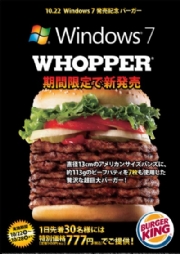
Behold the culinary crime that Microsoft is committing in Japan:

Microsoft is celebrating the release of Windows 7 in Japan with a Burger King promotion for the Windows 7 Whopper: Seven patties stacked on top of one another in one sandwich. Given that Microsoft has been criticized for releasing top-heavy, bloated operating systems, this could be one of its worst promotional ideas ever.

Windows_7_Whopper

The Windows 7 Whopper weighs in with about 1,000 calories, and likely packs enough cholesterol to require immediate surgery for anyone foolhardy enough to try eating one. It’s a full five inches thick, and costs the equivalent of $8.50.

« Newer PostsOlder Posts »

Powered by WordPress

