Quotulatiousness

August 4, 2017

The recent machine gun purchase is a great example of how broken our defence procurement system

Filed under: Cancon, Military, Weapons — Tags: , , , , — Nicholas @ 05:00

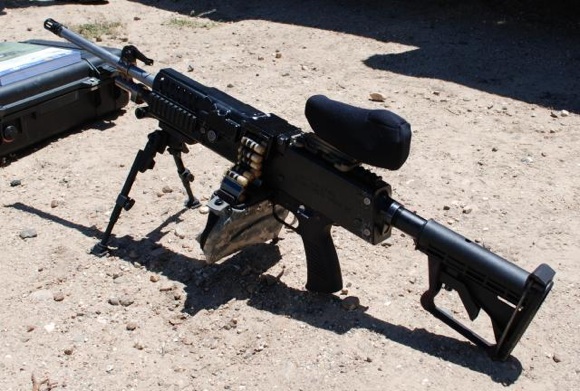
About a week ago, the Department of National Defence announced they were purchasing some new machine guns for the Canadian Army. The new weapon is an improved version of the C6 General Purpose Machine Gun (GPMG) currently in service. The Ottawa Citizen gave the basic information on the deal in this article:

Canadian C6 GPMG. (DND photo)

The Canadian government will purchase 1148 new C6A1 FLEX General Purpose Machine Guns from Colt Canada, Defence Minister Harjit Sajjan announced Wednesday.

The current C6 machine guns were procured over 30 years ago. Some have been removed from service due to wear and tear and others are reaching the end of their service life, according to the Canadian military.

The new C6A1 FLEX (flexible) is designed to be carried by soldiers or attached to vehicles such as the new Tactical Armoured Patrol Vehicle. The new machine gun will feature a durable polymer butt stock instead of the current wooden style, according to the Canadian Forces. Additionally, soldiers will be able to attach pointing devices and optical sighting systems to the new weapon to help increase their operational effectiveness.

Sounds good, right? Not so fast:

On the face of it this is a good news story. The C6, a 7.62-mm is a fully-automatic, air-cooled, gas- and spring-operated medium machine gun that is well liked by the troops of the many western nations which use some version of this weapon. Based on the Fabrique Nationale (FN) MAG it has been used by more than 80 countries, and is made under licence in several countries, most notably the USA where it is known as the M240. It is many ways the standard machine gun, used by all our allies.

A closer look suggests that this announcement reveals everything that is wrong with Canadian defence procurement.

For our $32.1 million we get 1148 new C6A1 machine guns (with cleaning and repair kits, spare parts and carrying slings), 13 jobs which it seems reasonable to assume are for the length of the contract, i.e. two years, and a production line including engineering validation and certifications. Or perhaps more accurately, Colt Canada gets a production line at the Colt Canada plant.

Even if we accept that the implied a cost of nearly $28,000 per weapon should be informed by the fact that about one-quarter of the contract cost goes toward setting up a production line it still means that each weapon is costing almost $21,000 each.

The price of the equivalent US weapon, the M240, is somewhere between $6,600 US and $9,200 US depending on which model is being purchased. This means that, at current exchange rates, if we were to purchase the weapons from FN’s U.S.plant they would cost us about $10,000 each, in Canadian dollars. This in turn suggests that we would save at least $12,628,000. If you assume that in this case we don’t have to buy Colt Canada a new production line it works out to a savings of almost $20 million dollars.

This is the real cost of those 13 jobs for 2 years, over $750,000 for each job per year.

One would think that jobs that cost taxpayers $750,000 per year would raise questions.

Questions like; do we need to make our own machine guns, especially when we consider that they are almost universally available from a number of our allies and that we have the proven ability to maintain them ourselves?
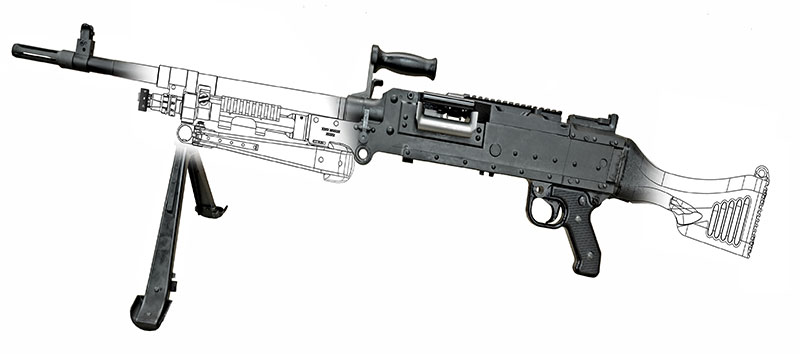
So, it’s not just that we can’t buy ships or fighter aircraft at a competitive price — because our politicians are addicted to using military spending for partisan purposes — we can’t even buy a slight variant on a bog-standard infantry support weapon without paying through the nose.

H/T to MILNEWS.ca for the link (perhaps we should consider changing that standard section heading from “What’s Canada Buying?” to “What’s Canada subsidizing in the form of procurement?” or “What’s Canada being robbed blind over now?”)

October 2, 2016

Indirect Machinegun-Fire – Welfare Facilities I OUT OF THE TRENCHES

Filed under: Europe, History, Military, Weapons, WW1 — Tags: , , — Nicholas @ 03:00

Published on 1 Oct 2016

In this slightly shorter episode, Indy talks about indirect machinegun-fire and welfare facilities for children.

December 14, 2015

The eternal “Ma Deuce”

Filed under: Military, USA, Weapons — Tags: , , , — Nicholas @ 02:00

Strategy Page on one of the longest-serving (and still serving) weapons in the US arsenal:

M2 machine gun (via Wikimedia)

M2 machine gun (via Wikimedia)

A U.S. Army facility that is upgrading older 12.7mm (.50 caliber) M2 noticed that a lot of the guns coming in were quite old. M2 production began in 1921 and some three million have been produced since then. No one every kept track of how long M2s lasted. That question was recently answered when an M2 came in with serial number 324, meaning it was produced during the first year and was 94 years old. The serial number was on the receiver, the heaviest component of the M2 (25.5 kg/55 pounds in the most common version) and the one component that rarely wears out. In contrast the barrel is worn out after about 3,000 rounds and most other components eventually need replacement because of wear or damage. But the receiver is quite a sturdy block of machined metal.

Unfortunately for 324 the extent of the latest M2 upgrades means that it is often considered cheaper to scrap pre-World War II M2s rather than perform a number of accumulated fixes and modifications. But since 324 is the oldest to show up so far it will be displayed as a museum piece.

The M2 has lasted so long because it proved to be the most reliable and durable machine-gun of any caliber ever produced. That durability meant receivers would, if they could avoid battle damage or accidents, serve on and on. The army is seeing proof of that as more and more quite ancient receivers come back for which are mandatory and army-wide upgrades. Because of thus a lot of weapons NCOs have been checking their inventories and as they did that the word began spreading on the Internet (even army armorers have their own online forums) that there were a lot of very old M2 receivers out there.

December 4, 2014

“Hiram Maxim’s business was secure”

Filed under: Africa, Britain, Military, Technology, Weapons — Tags: , , — Nicholas @ 00:04

Paul Richard Huard has another in his series of blog posts on the weapons of the 20th century:

During the early morning of Oct. 25, 1893, a column of 700 soldiers from the British South African Police camped in a defensive position next to the Shangani River.

While they slept, the Matabele king Lobengula ordered an attack on the column, sending a force of up to 6,000 men — some armed with spears, but many with Martini-Henry rifles.

Among its weapons, the column possessed several Maxim machine guns. Once a bugler sounded the alert, the Maxims spun into action — and the results were horrific.

The Maxim gunners mowed down more than 1,600 of the attacking Matabele tribesman. As for the British column, it suffered four casualties.

The British military not only measured the Maxim gun’s success by the number of Matabele killed in action. They could gauge the Maxim’s potential as a weapon of psychological warfare.

In the aftermath, several Matabele war leaders committed suicide either by hanging themselves or throwing themselves on their spears. That is how Earth-shattering a weapon the Maxim gun was.

“The round numbers are suspicious,” C.J. Chivers wrote in The Gun, his history of automatic weapons. “But the larger point is unmistakable. A few hundred men with a few Maxims had subdued a king and his army, and destroyed the enemy’s ranks. Hiram Maxim’s business was secure.”

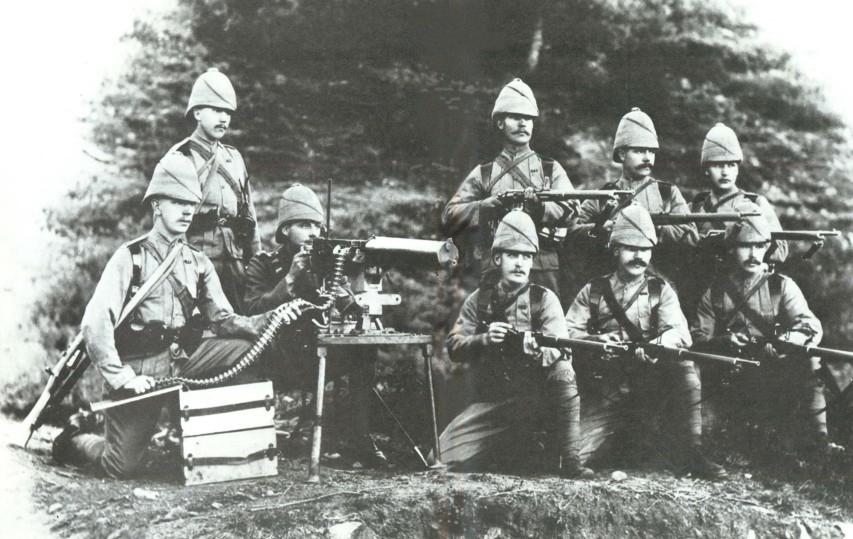
A British Maxim gun section that took part in the Chitral Relief Expedition of 1895. Public domain photo

A British Maxim gun section that took part in the Chitral Relief Expedition of 1895. Public domain photo

November 27, 2014

Hitler’s “buzz saw”, the MG42

Filed under: Europe, Germany, History, Military, Weapons, WW2 — Tags: , — Nicholas @ 00:03

In one of a series of posts on the weapons of the 20th century, Paul Richard Huard looks at the remarkable MG-42 used by German troops during the Second World War:

During World War II, American G.I.s called the German MG42 machine gun “Hitler’s buzz saw” because of the way it cut down troops in swaths.

The Soviet Red Army called it “the linoleum ripper” because of the unique tearing sound it made—a result of its extremely high rate of fire. The Germans called the MG42 Hitlersäge or “Hitler’s bone saw”—and built infantry tactics around squads of men armed with the weapon.

Many military historians argue that the Maschinengewehr 42 was the best general-purpose machine gun ever. It fired up to 1,800 rounds per minute in some versions. That’s nearly twice as fast as any automatic weapon fielded by any army in the world at the time.

MG42-1

“It sounded like a zipper,” Orville W. “Sonny” Martin, Jr., who was a second lieutenant with the U.S. Army’s 13th Armored Division, said in an oral history of infantry and armor operations in Europe. “It eats up a lot of ammunition and that makes for a logistical problem, but it eats up a lot of people, too.”

When the war began in 1939, the Germans had a solid, reliable general-purpose machine gun—the MG34. But it was expensive and difficult to manufacture.

The German high command wanted front-line troops to have more machine guns. That meant a weapon designed to deliver a high rate of fire like the MG34, but which was cheaper and quicker to produce.

Mauser-Werke developed a machine gun that fired a 7.92-millimeter Mauser cartridge fed into the gun from either a 50-round or 250-round belt. What’s more, the company manufactured the machine gun from stamped and pressed parts, welding the components together with a technique that reduced production time by 35 percent.

November 8, 2011

Every infantryman a machine-gunner

Filed under: Military, Technology, USA, Weapons — Tags: , , , — Nicholas @ 12:07

Lewis Page on the new lightweight ammunition the US Army is considering introducing:

The US Army has announced successful tests of a new, lightweight portable machine-gun which fires special plastic ammunition. The gun and ammo are so much lighter than current weapons and their brass-cased cartridges that some soldiers are suggesting that every infantryman could in future pack the sort of firepower reserved today for heavy-weapons specialists.

[. . .]

[M]ost soldiers are armed with assault rifles not intended to deliver sustained automatic fire and holding less ammo. These lighter weapons are handier for close-in fighting and permit other kit to be carried.

But US military boffins at the famous Picatinny Arsenal have been working on this situation for some time. Since ammo weight and bulk is much of the problem, they have come up with a new kind of ammunition: Cased Telescoped cartridges.

In a cased telescoped round, the bullet is no longer attached to the tip of a brass case full of propellant powder. The new case is shorter, fatter and made of plastic, so weighing substantially less, and the bullet is sunk into the middle of the propellant which makes the whole round shorter — it has been “telescoped”. A shorter round weighs less itself, and also means that the gun’s action, feed equipment etc is smaller and thus lighter as well. It’s a trick originally developed for tanks, to make the turret smaller and easier to protect.

According to the Picatinny scientists, their new LMG and a thousand rounds of its plastic-cased-telescoped ammo weigh no less than 20.4 pounds less than the current M249 (a version of which is also used by British troops) and a thousand ordinary 5.56mm brass cartridges. The new LMG shaves no less than 8.3 pounds off the 15.7-lb M249, coming in at just 7.4lb — actually lighter than a standard British SA80 assault rifle! This, perhaps, explains Specialist Smith’s opinion that it would be reasonable for all soldiers to carry such weapons, rather than just heavy-weapons specialists.

July 27, 2011

US Navy’s (small) death ray/machine gun mounts

Filed under: Military, Technology, USA, Weapons — Tags: , — Nicholas @ 07:36

Lewis Page reports on the latest bit of weaponry being added to US Navy ships:

US Navy warships will soon be equipped with fearful combination weapons mounts boasting both heavy machine-guns and high powered laser rayguns, it has been announced.

Manufacturer Boeing says it has inked a teaming agreement with the US operations of arms globo-mammoth BAE Systems to build the Mk 38 Mod 2 Tactical Laser System to naval requirements. We learn that the new raygun installation will be based on the existing Mk 38 Machine Gun System, a robotic gun turret whose primary punch is provided by the fearsome M242 Bushmaster Chain Gun, effectively a light auto-cannon.

[. . .]

We aren’t told the power level offered by the laser, which suggests that it isn’t very high: raygun projects always like to boast of any decent power level. The fact that the laser is small enough to be clipped onto an existing weapon also suggests light weight and limited puissance, as does the suggestion that it is an alternative to the Bushmaster rather than a replacement for it.

« Newer Posts

Powered by WordPress