Quotulatiousness

October 15, 2025

Hamburg votes to secede from industrial civilization

Despite my always plummetting hopes for Canada I have to admit that I do enjoy a little soupçon of schadenfreude with every new bit of evidence from eugyppius that Germany is determined to ostentatiously self-destruct even before the demented Dominion can:

Hamburg is German’s leading industrial city. Its companies add 20 billion Euros in gross value every year. Much of this economic output is related to Hamburg’s happy location on the Elbe and the fact that the city is home to Europe’s third-largest port. All of this has made Hamburg extremely prosperous, which prosperity has filled it with rafts of clueless virtue-signalling morons who have no idea how anything works, why they find Hamburg attractive in the first place or how their hip urban lifestyles are maintained.

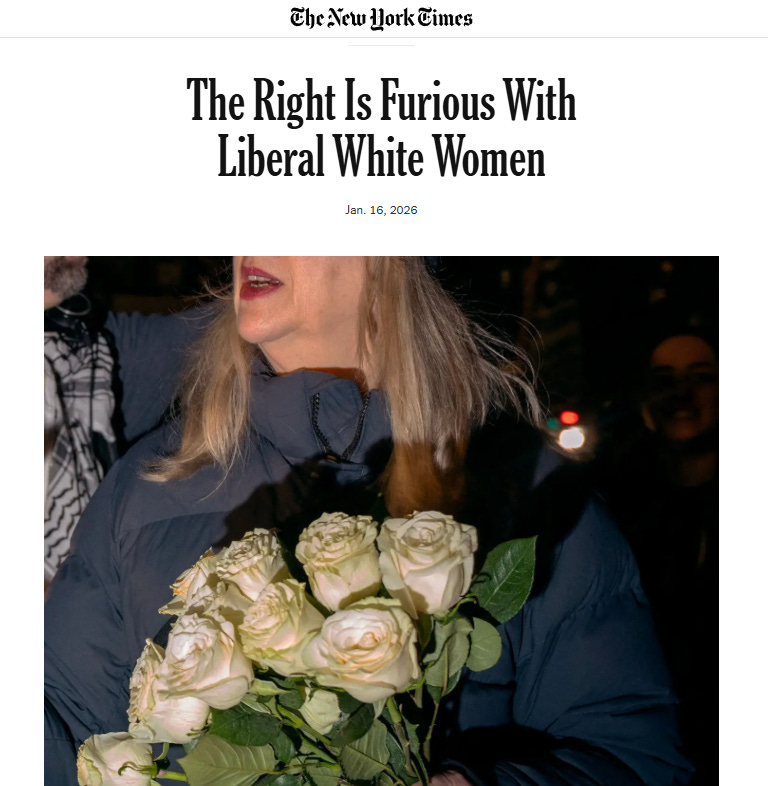
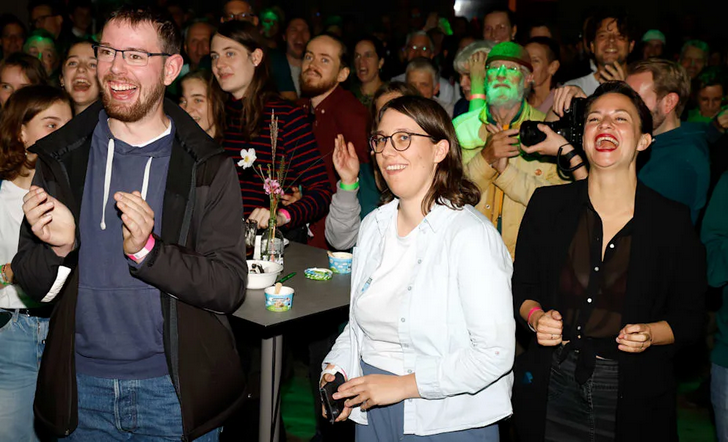
In this photo, published by BILD, you can see some of these unmitigated retards having a happy because they’ve just scored cheap virtue points by voting in their own personal energy apocalypse.

Photo from BILD via eugyppius

Specifically, these dumbasses are celebrating because their completely insane popular referendum passed with 53.2% of the vote on Sunday. This referendum, the so-called Zukunftsentscheid (“future decision”), binds the Free and Hanseatic City to achieving total carbon neutrality by 2040, five years earlier than the 2045 goal set by the almost equally insane Germany-wide Climate Protection Law as emended in 2021, which is in turn five years earlier than the 2050 goal established by the selfsame law as it originally passed the Bundestag in the year of the child-saint Greta Thunberg 2019.

Turnout was pretty low in Hamburg last Sunday, with less than 44% of eligible voters bothering to cast a ballot, most of them by mail. Thus just 23% of the most deranged Hamburgians could take their city hostage and commit its government to destroying all of its industry and most of its economic activity inside the next decade and a half. The biggest joke is that when Hamburg has finally achieved the sacred Net Zero, it will make absolutely zero net difference to anything. Hamburg is responsible for something 0.022% percent of CO2 emissions globally. The city is not even a rounding error.

The referendum was an initiative of Fridays for Future, but it gathered the support of various social and environmental organisations, among them Greenpeace, the union Verdi and even FC St. Pauli. It will successively cap annual CO2 emissions sector-by-sector, imposing a slow and relentless strangulation in turn on transit, households, commerce and industry.

September 30, 2025

“San Francisco [is] a sort of market-segmented scheme [extracting] the basic comforts of civilization and licensing them back as upgrades”

Filed under: Health, Politics, Quotations, USA — Tags: , , , , , , — Nicholas @ 03:00

On the social media site formerly known as Twitter, Devon Eriksen describes the very comfortable lives of the very wealthy, who can support any kind of luxury beliefs because they never have to face the consequences that “the poors” who ape them do:

Dear sir,

I am not a filthy poor, and therefore conditions on the street level in Portland do not matter to me.

I drive my Jaguar to nice restaurants, give it to the valet to park, then go inside and order a fancy treat. So long as the valet parks my car, and the waiter brings my fancy treat for me to consoome in peace, I am utterly unaffected by conditions ten blocks away.

While I am technically forced to acknowledge that other humans exist — otherwise who would park my car or prepare my fancy treat? — I am not actually forced to consider what their lives are like.

And if you try to force me to confront this, I will simply point out that you are a filthy poor, who is unable to live a lifestyle that insulates you from this sort of unpleasantness.

At which point I don’t have to pay attention to you, loser.

Okay, here’s what’s really going on.

At a recent gathering in San Francisco, I listened to the tech bros I was dining with and their complaints about spending a million dollars a year on security teams, and a thought occurred to me, which I shared with the congregation.

I observed that San Fransisco, and perhaps other cities as well, seemed to be a sort of market-segmented money extraction scheme whereby the basic comforts of civilization are systematically removed from the environment, and then licensed back as upgrades to those who can afford them.

In Tennessee, it doesn’t cost me a thing to not be murdered for what I write online. Sure, I have a metric fuckton of extremely high-powered weapons and the skills to use them, but let’s be honest … I own them on principle, not because I would be murdered without them.

In SF, saying right-of-center things online while not being murdered costs a million dollars a year.

It probably costs slightly less than that to have zero drugged-out and/or schizophrenic bums urinating on your porch, but again, in Tennessee, this is a free service that comes with the “Western Civilization” package.

Also, it doesn’t cost anything go to a drugstore where nothing is locked behind glass, and be told “have a nice day” by someone at the register who actually means it.

And I’m told there is some sort of mythical beast called “graffiti”, but I have to go online to find out what it looks like.

In short, the argument that “civilization is just fine because I can still buy my way out of trouble” doesn’t hold any water, because it ignores the fact that you have to buy your way out of trouble, because civilization is shrinking.

You can’t have civilization without ass-kickings.

And if you forget that, you start having to buy your way into ever more and more exclusive clubs where the uncivilized can’t afford to go.

Until they figure out that they don’t have to pay, they can just push their way past the doorman. At which point you must be prepared to kick ass again.

All civilization rests on pillars made of violence. You are in danger until the moment you understand this.

Chris Bray also responded to the Nicholas Kristof take:

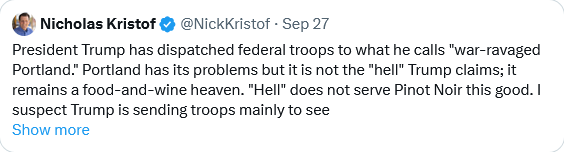
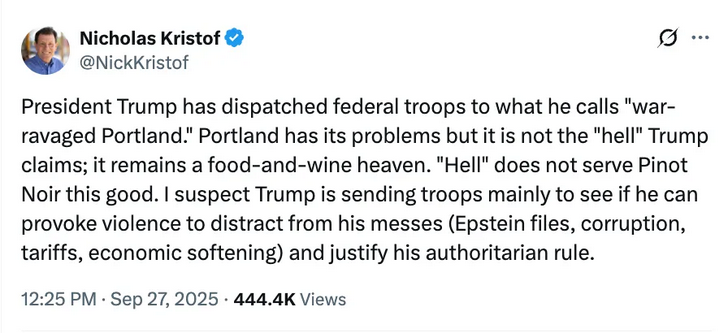
Now, here’s the hugely respectable New York Times columnist Nicholas Kristof, a very important Pulitzer Prize recipient, explaining from the heights of his journalistic perch what’s really happening in Portland:

This is as flawless a summary of the progressive cathedral classes as you could possibly manage: “‘Hell’ does not serve Pinot Noir this good”.

  1. Portland street journalist: Portland is a public graveyard
  2. Progressive New York Times columnist: Akshully, the Pinot Noir is exquisite

It’s time to shove these people onto a barge and tow them out to sea.

Like Karen Bass describing the open-air drug market of MacArthur Park as a sylvan paradise full of happy children and wonderful families having picnics, Oregon Governor Tina Kotek explained this week that Donald Trump is bizarrely intervening in a utopia, and for crying out loud look at this facial expression:

No one has ever been more lost than this. Your average good urban liberal is more insane than a psych ward full of psychotics. Akshully, the Pinot Noir is delightful. We are burdened with the existence of high-status people who have departed from earthly reality, and we can’t afford them.

Update, 1 October: Welcome, Instapundit readers! Please do have a look around at some of my other posts you may find of interest. I send out a daily summary of posts here through my Substackhttps://substack.com/@nicholasrusson that you can subscribe to if you’d like to be informed of new posts in the future.

June 27, 2025

The fading Boomer Laurentianus

Filed under: Cancon, Media, Politics — Tags: , , , , — Nicholas @ 03:00

Last week in The Critic, Charles Kirwin described the people who saddled us with three terms of Justin Trudeau and hope to continue their reign of error by supporting Mark Carney with his Europhile whims and intolerance for dissent:

Boomer Laurentianus is a Canadian subspecies of Boomerus Senectus, so named because he models himself on the so-called Laurentian Elite, Canada’s governing class that inhabit the “Laurentian corridor”, the narrow strip of land along the Saint Laurence river between Montreal and Toronto that, for a certain kind of Canadian, is the only bit of the country that matters.

In spirit, he is a child of the sixties and still believes he is a radical at heart. Despite this he expects to be treated with the deference reserved for those awarded the Victoria Cross, despite his closest experience to combat being glancing longingly at pictures of the cancelled Avro Arrow or campaigning to defend the local parking lot from being turned into affordable houses.

Like his British and American cousin, he supports progressive policies like safe supply of drugs, lenient sentences and bail conditions for criminals, and whatever economic policies keep his pension fund high and his property values increasing. Naturally, he lives in neighbourhoods untouched by the crime and addiction that are the direct result of the policies he supports.

It is important to note that while his modes of thinking and beliefs are those of the Laurentian Elite, his mind is shaped by the institutions of the Laurentian Elite: The Canada Council for the Arts, the Canadian Broadcasting Corporation, the Governor General’s Literary Award, various other high-minded organisations that form the intellectual life of Laurentian Canada, Boomerus Laurentianus is not necessarily “of” them.

Molson Canadian is the spirit of his patriotism. In 2000, Molson released a beer advertisement in which a typical Canadian played by actor Jeff Douglas shouts into a microphone to an audience of Americans, dismissing various Canadian stereotypes (we say aboot, drive dogsleds, are all lumberjacks and fur traders et cetera) and notes some of the differences that make Canada not the US. “I have a Prime Minister not a President … I believe in Peacekeeping not policing … I can proudly sew my country’s flag on my backpack while travelling”. The advertisement is something of a cult hit in Canada and has been parodied by just about everyone including William Shatner.

This one-minute advertisement swells at the heart of the Boomer Laurentianus view of his country. It is both superficial and, in places, factually incorrect (the equivalent of the US president is not the Prime Minister but the King or Queen of Canada). But he has built his entire sense of nationalism around myths such as peacekeeping or being liked by foreigners more than Americans. This last point is sacred to his sense of identity.

Boomerus Laurentianus exists in a superposition state usually reserved for Schrödinger’s cat wherein he is both completely American and not American at all. It was often claimed of Rhodesians that they were “More British than the British”. Boomer Laurentianus is more Yank than the Yanks. Despite his reverence for the CBC, he gets his recipes from the New York Times and his opinions from CNN. He watches American television, travels to the US frequently, may even own a second home there. He can almost convince himself that they are the same country, sometimes to the point of putting up signs supporting, Democratic political candidates, seemingly unaware that he cannot vote in foreign elections.

June 26, 2025

NYC doubles down on Luxury Beliefs

Filed under: Media, Politics, USA — Tags: , , , , , — Nicholas @ 05:00

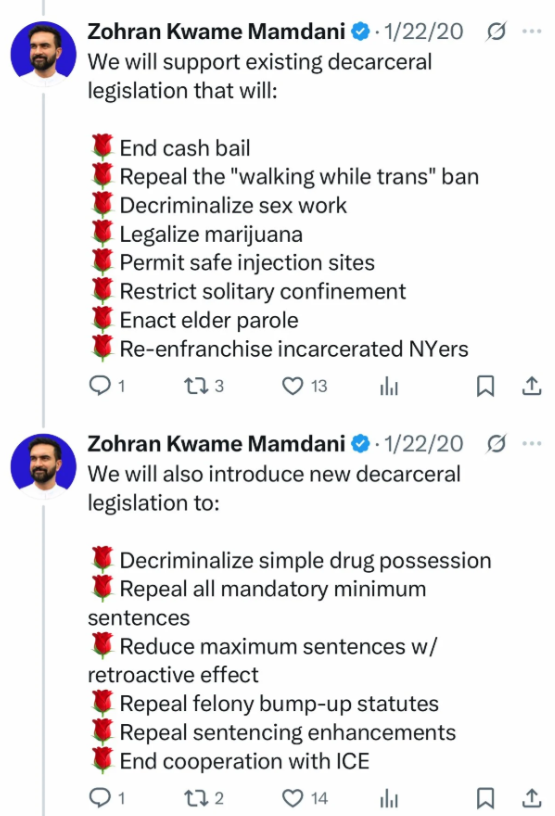
New York City voters appear to have selected the ultimate “luxury beliefs” candidate as the presumptive next mayor of NYC in Zohran Mamdani:

The luxury belief class has just done the equivalent of plucking a random grad student from an Ivy League Hamas encampment and nominating them for mayor.

Take the New York City subway early in the morning from the outer boroughs and you’ll find it packed with cleaners, nannies, restaurant staff, hotel workers and construction workers coming off the night shift. Some are heading home. Some are just starting their day. It’s “the help” arriving and departing.

Like many other large cities, New York runs on a two-tier system. There’s the professional class clustered in the centre, and there are the people who keep the centre running but can’t afford to live in it.

And so they must endure long rides on public transportation to get to work. They keep their heads down and ignore the trash, the smell, the homeless men passed out across the seats. Working-class commuters see the sprawled-out bodies and try to make it through the ride without being harassed or stepping in puddles of urine.

Many politicians and media outlets act like the public disorder problem is overblown. But fare evasion, open drug use and serious mental illness on the subway are still part of daily life.

It’s in this polarised environment that the mayoral candidate Zohran Mamdani has gained traction among the city’s richest voters. At only 33, Mamdani is one of the youngest people ever to run for mayor of America’s largest city. Mamdani, a self-proclaimed nepo baby who has spent four years as an Albany assemblyman and is described by The New York Times as a “a TikTok savant”, has virtually no experience for the job.

And yet, what’s really worrying about this candidate is that he’s a poster child for luxury beliefs.

“Luxury beliefs” — a term I coined years ago — means opinions that confer status on the upper class at little to no cost for them, while inflicting serious cost on the lower classes. And the very people who back Mamdani are the ones who most resemble him: affluent, overeducated, and eager to prove their virtue at someone else’s expense.

As is often true of those who embrace luxury beliefs, Mamdani purports to care most about the working class. He says he wants free buses, government-run grocery stores, and a freeze on rent increases.

But his platform would hurt the working classes a lot more than it would help them.

December 15, 2024

QotD: Elite luxury beliefs – cultivated non-disgust

Filed under: Cancon, Europe, Media, Politics, Quotations, USA — Tags: , , , , , — Nicholas @ 01:00

Then there is the acceptance of what can only be described as unconventional lifestyles. Gay rainbow gender-bending madness is one thing. It seems progressive. Sodomites used to get ten years of hard labour. Look how advanced we have become.

But now they’ve moved on to the kids. It is easy to believe a listless, drug-addled elite might indulge in sexual degeneracy just for the hell of it. But how do we explain kindergarten teachers teaching their pupils about pronouns? Doctors emotionally blackmailing parents by insisting that the alternative to mutilating their children is their suicides? Or civil servants quietly putting gender-neutral bathrooms in public spaces?

How do we explain any of this? How do we even explain the emergence of transgenderism at all? There have been transexuals and gender dysphorics throughout history. They were typically understood as an offshoot of homosexuality, the extreme end of the effeminacy spectrum, and a vanishingly small fraction of the population.

But the current contagion is unusual and is clearly artificial. Its scale can only be a result of active promotion. Much of that is accomplished via the media and fellow travellers who champion these activities. But it is helped along by a collection of other professionals, and any attempt to question it is met with energetic pushback.

It is apparent that much of this comes from on-high, a literal top-down initiative. In less than twenty years we have witnessed a journey that began with gay rights and now includes active promotion of sexual deviancy to children, none of it natural or wanted by the majority. There is lots of speculation as to why this may be, including the part it may play in a comprehensive depopulation agenda.

What is apparent is that the professional class who endorse and promote this perceive it as an exercise in tolerance.

The notion of tolerance has typically been invoked for the distasteful, a last line of defence when direct measures fail, not a behavioural response indicating sophistication.

We rely on tolerance for things we dislike but cannot avoid. We learn to tolerate a persistent whine from an air conditioning unit, a noisy neighbour, or a noxious smell. But our goal is always to remove the source of the problem. Tolerance is a stopgap only when more permanent solutions are absent.

Their belief that tolerance is a virtue is one of the greatest shortcomings of today’s chattering classes. It is exactly the kind of signal error that exemplifies the disconnect between globalist elites and their obedient cheerleaders. The mechanism here seems to be a kind of learned override to natural disgust or discomfort. When others then object to whatever letter they have just added to the LGBTQWERTY+ community on the basis that it can’t be healthy or normal to endorse this stuff, that learned response includes the flare of superiority at your obvious backwardness.

How satisfying it must feel to have your natural inclination toward superiority endorsed in this way. Like whole food vegans at a Medieval banquet, it must provide an irresistible sense of smugness to know that you are the one-eyed man in the rainbow-decked land of the blind, with the uneducated hopelessly lost in their backward understanding of the benefits of sexual liberation.

While elites and their public relations machine happily endorse this misplaced emphasis on tolerance, all evidence suggests the elites themselves are not tolerating anything, despite what their obedient minions may think. They really are indulging in the cocaine-fuelled all-star human sacrifice orgies for real because they are cosmically bored and rich.

They aren’t rising above intrinsic disgust responses, they have sexualized them. They seem to have fetishized everything we consider unacceptable. Trafficked kids, femboys, chicks with dicks, gangbangs, farmyard orgies, human sacrifice, the lot.

They may even experience a thrill in seeing just how far they can push public morality as many have suggested, and especially how far they can get otherwise normal middle-class people to champion deviancy and hedonism most cultures find distasteful enough to ban.

The excessive promotion of tolerance is a defence against unnatural practices bored elites are rumoured to engage in. The professional class, for all their faults, probably aren’t into human sacrifice or animal orgies. So their response is to elevate the importance of visible acceptance of alternative lifestyles, hence gay kids, castrated boys, invented genders and other absurdities they cannot possibly believe themselves, and all of it instantly conveyed to one’s peers with nothing more than a multicoloured flag.

To top it all when they see how normals react, those unmoved by inept calls to be more understanding about sexual abuse, when they see parents reach for the shotgun at the very idea of sexually mutilating children, they get to invoke the conjoined twin of their cultivated tolerance, namely artificial superiority. The deep belief that they see further than the yokels with their primitive instinct to actually protect the vulnerable and embrace some basic sense of public morality.

These absurd beliefs can be observed in our educated classes because they ostentatiously demonstrate tolerance and its newfound position as the supreme virtue of the post-Christian age, one of the most successful public relations campaigns ever run by elites.

Spaceman Spiff (guest-post) “Praying to Absent Gods”, Postcards from Barsoom, 2024-07-16.

September 13, 2024

QotD: Cargo cult thinking and status seeking

Filed under: Economics, Quotations — Tags: , , , , — Nicholas @ 01:00

The pioneering sociologist Thorstein Veblen’s Theory of the Leisure Class (1899) was the first systematic attempt to explain how status displays (e.g., conspicuous consumption) operate to communicate class membership among social elites. Most people never learn to think critically about such status-display behaviors, so that their emulation of the “elite” is thoughtless and unconscious. This behavior often takes the form of displaying symbols of wealth (e.g., designer-label clothing or luxury automobiles) as if mere possession of these symbols meant the same thing as actually being wealthy. Driving the same car or wearing the same clothing brands as a movie star, a software entrepreneur or a professional athlete is not the same as having millions of dollars in the bank, but we often see people who don’t seem to grasp this fact. The young guy with a $45,000-a-year job driving around in a new Cadillac Escalade wants to impress people by pretending to have wealth he doesn’t actually have. His luxury SUV is a status symbol, but the status he’s attempting to display is an illusion, if he’s leasing this vehicle for $1,800 a month (nearly half his annual income) while living with his mother. This is a cargo-cult type of behavior, and is in fact quite the opposite of behaviors that actually produce wealth. A young man who hopes to become wealthy would be best advised to live within his means, preferring to put money in the bank rather than engaging in ostentatious displays of a luxurious lifestyle. Nevertheless, we often see young people go deeply in debt to indulge their appetite for status symbols, and this cargo-cult mentality can also be witnessed in acts of criminal stupidity […]

Flashing actual stacks of money is the crudest possible status display, and I can 99.9% guarantee you that anyone who does something like this on social media is engaged in some kind of criminal behavior. People who obtain wealth by honest means are not prone to such shameless ostentation, and this kind of cargo-cult behavior exhibits a level of stupidity that is not usually compatible with economic success.

Robert Stacy McCain, “The Cargo Cult Mentality”, The Other McCain, 2019-12-20.

August 9, 2024

Domicidal maniacs in charge

Lorenzo Warby provides an oh-so-useful word to accurately capture what the diversity-at-all-costs elites running most western countries these days are actually up to:

Domicide is the destruction of home. It comes in the “hard” version — the physical destruction of houses and infrastructure.

Domicide also comes in a “soft” version — flooding localities with new people, separating people from, and otherwise degrading, their heritage. When folk say Britain is becoming “unrecognisable”, it is the domicidal effect of mass migration they are referring to.

The UK is suffering from a domicidal elite, one that uses mass migration to break up working-class communities; asymmetric multiculturalism to elevate incoming cultures over those of native English (the Celtic fringe get minority brownie points); favours non-“white” faces in advertising; asymmetric race-swapping in entertainment against the native English; denigration of British history as racist, white supremacist, imperialist, colonialist, etc.

Much of this is insulting virtue-signalling allied to, or presenting, cartoonish (simplified) and caricature (distorted) history. It all undermines social cohesion. But it is the use of migration policy as a systematic weapon against the resident working class which does the most damage. Though two-tier policing — obviously treating Muslims in particular with a deference not shown to the natives, especially when it comes to policing speech — is also highly corrosive of social cohesion.

Many working-class communities in Britain were already fairly dysfunctional — though the British state is not innocent in those dysfunctions1 — and sections of the British working class are very far from admirable. None of this justifies the use of mass migration to make things worse for such folk, however much it may help to explain the moralised class contempt that underlies so much of modern progressivism and modern managerialism.

To improve such things, to “level up”, requires a strong sense of how to create and maintain social order. Modern progressivism is strongly antipathetic to such understanding. To “level up” also requires a strong sense of custodianship, which managerialism typically lacks: particularly progressivist managerialism.

Indeed, modern feminist, progressivist, managerialism—in its lack of custodianship; lack of social solidarity;2 in its antipathy to taking the problems of social order seriously — is running the British state into the ground. The post-medieval British aristocratic and mercantile elite did a much better job of state management. But those elites had mechanisms — such as duelling, that forced men to defend their reputation at the risk of their life, and grand country houses, that turned into expensive investments in social isolation if you behaved badly — that selected for character.

Nowadays, the British elite only selects for capacity and even that is being degraded by DEI undermining the signals of competence. It turns out, over the longer term, character matters more than capacity. For capacity without character selects for manipulative, anti-social personalities that degrade institutions over time.


    1. For a particularly brutal depiction in fiction of the dysfunctional British welfare state — especially its school system — see Christopher Nuttall’s Mystic Albion series, especially the first book.

    2. Feminisation of institutions and discourse has tended to degrade social solidarity, see Benenson et al, 2009. The most conspicuous example of this in the UK is how uncouth it is in elite circles to mention the systematic rape and sexual exploitation of underage working class girls by overwhelmingly Muslim gangs.

July 18, 2024

An elite luxury belief – “Diversity Is Our Strength”

In a guest-post at Postcards from Barsoom, Spaceman Spiff lists some of the cargo cult notions that have captured the imagination of many “elites” in western nations, like “Diversity Is Our Strength“:

Multiculturalism is pursued in Western countries with a religious mania. It is difficult to imagine anything closer to a belief system for today’s upwardly mobile professional than advocating for diversity and inclusion.

Most of the world views ethnic and cultural mixing as a dangerous, civilization ending activity. A threat to be guarded against, not an opportunity to be embraced. This has been the conventional view throughout history in almost every society.

The modern Western formulation has challenged this. Mixing cultures, especially those hostile to assimilation, is not just to be tolerated but encouraged. Alien peoples must be sought out and imported to increase the ethnic and cultural mix. We must extend every courtesy to those fundamentally incompatible with us in customs and manners. The ultimate expression of this ambition is open borders, a concept viewed with deep hostility by almost all non-Western countries.

Whatever the origins of such policies, the implementers of these ideas are everywhere. They work in corporations, public sector bodies, and NGOs. We find them in Starbucks and Walmart. Diversity is everywhere even though it makes little sense as an end in itself.

How do we explain the enthusiasm with which middle managers and HR workers have embraced such a destructive idea, including its corporate version of job and education quotas?

Competency itself can be hard to find even in ideal conditions, so why hobble your chances like this? Why intentionally seek to create brittle heterogeneous environments that reduce productivity and increase strife?

The simple answer is that sophisticates don’t succumb to primitive notions like preferring their own. These are urges to be resisted, like hunger while dieting. Racism is old hat and any noticing of differences is racism. After all, our elites do not behave like this, so the goal is to be observably anti-racist, just like them.

Some look at our globalist elites and see them mixing with an international set. As they hobnob around the world they certainly socialize with foreigners. Indian elites, Arab elites, and Chinese elites all mix with their Western equivalents. We see them at events like Davos or the global climate change meetings. A multicoloured constellation of traitors from every country, all getting along with each other because they are nothing like their fellow countrymen, and everything like each other.

What the dullards in the corporate HR world miss is that this is not a celebration of diversity. Most of those elites are nearly identical. Many attended the same universities. All speak English, the international language. They have similar views, including contempt for their respective compatriots.

There is no diversity at the very top, just an elitist outlook most of them share, and contempt for the peasants who surround them. White, brown, or black, we all look the same from the cultural stratosphere. Cannon fodder for their Olympian ideas, but nothing more. The elite view of mass migration is indifference, not enthusiasm.

The street-level version takes the superficial aspects of this phenomenon and worships it as the end goal since the underlying homogeneity of the elites is largely absent. Their goal is not to seek out that which we have in common with others but the less sophisticated observation of what makes us different, what makes us more “diverse.”

The midrange talent in the West have therefore convinced themselves celebrating overt differences in the form of multiculturalism is modernity. It is the future promised by Star Trek and other communist dreams. Colour won’t matter, just like Martin Luther King promised, so long as we overlook the long predicted consequences of their dream, the lowered wages, the erosion of trust and the eventual polarization of competing groups within our own nations we once kept at bay with more considered immigration policies.

May 31, 2024

“You only support that because it’s in your self-interest to do so”

Filed under: Economics, Education, Liberty, Media, Politics — Tags: , , , , — Nicholas @ 04:00

Helen Dale considers the painful notion that political ideas that work for the “elite” (defined in various ways) may not work at all for people unlike members of any given “elite”:

When I reviewed Rob Henderson’s Troubled for Law & Liberty at Liberty Fund, I made this observation:

    The reality that classical liberalism — the closest to my own political views, I admit — has at least a whiff of the luxury belief around it stings. It’s discomforting to acknowledge that what goes by the name of paternalism has its own intellectual pedigree, while liberalism can be a system developed by the clever, for the clever. “Highly educated and affluent people are more economically conservative and socially liberal,” Henderson says. “This doesn’t make sense. The position is roughly that people shouldn’t have to adhere to norms and if/when they inevitably hurt themselves or others, then there should be no safety net available. It’s a luxury belief.”

[…]

Joseph Heath […] uses the phrase “self-control aristocracy” to describe those who really do benefit from maximal freedom. These are people who can make better choices for themselves than any authority could make on their behalf. When the state or large corporates boss them (us) around, they (we) get really bloody annoyed. They (we) know better!

Heath’s phrase is simply a layman’s term for the personality trait various formal tests measure, and which overlaps with executive function to a considerable but as yet unknown degree.

    Because I am self-conscious about my membership in the self-control aristocracy, I am acutely aware of the fact that, when I think about questions of “individual liberty” in society, I come to it with a particular set of class interests. That is because I stand to benefit much more from an expansion of the space of individual liberty than the average person does – because I have greater self-control. So I recognize that, while a 24-hour beer store would be great for me, it would be a mixed blessing for others […]

    What does this have to do with libertarianism? It is important because every academic proponent of libertarianism – understood loosely, as any doctrine that assigns individual liberty priority over other political values – is a member of the self-control aristocracy. As a result, they are advancing a political ideal that benefits themselves to a much greater extent than it benefits other people. In most cases, however, they do so naively, because they do not recognize themselves as members of an elite, socially-dominant group, that stands to benefit disproportionately. They think of liberty as something that creates an equal benefit for all.

My response to reading Professor Heath’s piece was simplicity itself: I feel seen. I’ve even done the night school thing while working full-time. I’ve written books and chosen to play sports that require a long time and lots of skill to master. I retired at 45.

Politically, I’m not a libertarian. Libertarianism is a distinctive and largely American ideology (as the recent and bonkers fracas at its US Convention indicates) with philosophically unusual deontological roots. I am, however, within the British and French tradition of classical liberalism (which does assign individual liberty priority over other political values). And like many classical liberals I’ve been blind to problems of laws and governance for people unlike me.

I disclose this because I’ve worked in policy development in both devolved and national parliaments. I’ve probably given politicians and civil servants alike dud advice. There is almost certainly a shit policy out there (in either Scotland or Australia) with my name on it. However, this mind-blindness doesn’t only apply to people who advocate libertarian politics. I think it applies to a significant number of political ideologies just as strongly as it does to libertarianism.

That is, the ideology serves the inherited personality traits of those who promote it. “You only support that because it’s in your self-interest to do so” always struck me as a genuinely mean criticism of people who were involved in politics and policy (I may have been one of those people, natch). The problem — as I’ve been forced to accept — is that it’s true.

February 6, 2024

The Sky People hold very different beliefs to those untouchable Dirt People

Filed under: Media, Politics, USA — Tags: , , , , , — Nicholas @ 03:00

Rob Henderson says that the gap is “Grand Canyon-sized” between ordinary Americans and the Ivy League grads who cluster at the top of every progressive organization:

55% of Ivy League graduates believe that the U.S. “provides too much individual freedom” compared with just 16% of ordinary U.S. voters.

Back in 2019, as I was developing what became the luxury beliefs framework, I read a recently issued chapter published by Cambridge University Press titled “Why Are Elites More Cosmopolitan than Masses?”

Authored by a team of social scientists, this 2019 paper reports stunning gaps in political views and outlooks between elites and ordinary people in various western countries.

In the introduction, they suggest that elite attitudes are expressions of cultural capital. That is, the large gap in views between elites and everyone results from elites drawing symbolic boundaries between themselves and the provincial masses.

Indeed, another report found that 65 percent of Americans believed that the most educated and successful people in America are more interested in serving themselves than in serving the common good. This view is held across the board — across age, gender, race, political party, and ideology.

The authors of the 2019 chapter write:

    Mastering intricacies of gender and race relations discourse and behavior has become a marker for belonging to the cosmopolitan class, in a similar way that tastes for classical music and art were markers of bourgeois culture in the 19th and 20th centuries.

Interestingly, the researchers find that social background and ideological affinities account for elite similarities more so than educational attainment. This might be one reason why, despite obtaining the same degrees from the same institutions as many elites, I still retain an outlook reflective of my provincial upbringing.

Following my experiences in the Los Angeles county foster system, my adoptive family and I settled in a dusty lower-class town in the northernmost region of California—a place just as provincial as any rundown neighborhood in flyover country—where I spent most of my youth.

The authors of the paper measured the opinions of elites (those holding the highest positions in each sector) across various fields including politics, finance, academia, and media, as well as the opinions of ordinary people.

Relative to the masses, elites are more likely to agree with statements such as “We should do everything possible to fight climate change, even if it slows economic growth.”

And elites are more in favor of allocating authority not to local or national governments, but to global organizational bodies (e.g., the U.N.).

The researchers also found that elites are significantly more pro-immigration, as measured by the extent to which they agreed with statements like “When jobs are scarce, employers should give priority to people of [this country.]”

I thought about those results for a long time. Especially as I came across another study indicating that educated people are more likely to express prejudice toward immigrants who are described as highly educated, relative to less educated, and are therefore seen as job competitors.

Among university students, attitudes toward immigrants were most negative when the immigrants had a university education, and most positive when the immigrants had little to no formal education. It’s nice for the educated class when immigrants provide cheap hired help and open interesting restaurants. They’re less excited when immigrants are competing with them for the same jobs. If thousands of people with bachelor’s and postgraduate degrees from, say, China and India, were unlawfully entering the U.S. each day, my guess is current elite attitudes around border security would be very different.

In a way, it’s rather reassuring that the Sky People are still demonstrably human, based on the change in opinions when it’s their ox being gored …

January 13, 2024

Troubled by Rob Henderson

Filed under: Books, USA — Tags: , , , , , — Nicholas @ 04:00

Stephanos Bibas reviews Rob Henderson’s autobiography Troubled: A Memoir of Foster Care, Family, and Social Class for the University of Chicago Law Review:

Life at the bottom is troubled. Charles Dickens, Victor Hugo, and many others have long shown us that. To understand criminal justice, education, and family law, we lawyers typically look to social scientists, and their external expertise does teach us much. But we often neglect lived experience. Occasionally, we should toggle from the dry regressions and clinical detachment of social science to the internal perspective and expertise of those who live through family breakup, foster care, disrupted schooling, drugs, and crime. And that is what Rob Henderson’s breakout memoir, Troubled, gives us: a window on troubled youth.1

Henderson, a brilliant young psychologist, illumines how harmful childhood instability is by reflecting on his own experience. He never knew his father, was abandoned by his drug-addicted mother, and bounced around foster care. After squandering much of his early education and drowning his rage in alcohol, drugs, fights, and vandalism, he managed to make his way through the Air Force to Yale and now Cambridge. But few of his friends escaped the wounds from their childhoods; many wound up unemployed, in prison, or dead. His eye is as keen as his intellect, recalling and reporting how adults in his life kept abandoning him and his fellow foster children and how they in turn acted out. As an outsider to the elites who dominate the Ivies, he also turns his critical eye on the groupthink and victimhood culture that is strongest among the most privileged. And building on literary historian Paul Fussell’s work, Henderson develops his own critique of the shibboleths that educated American elites use to set themselves—ourselves—apart while ignoring the harm to the rest of society.2

Henderson has much to teach us lawyers and legal scholars. He shows us how much we miss by focusing public policy on educational attainment and cost-benefit analysis, overlooking what is priceless: love and emotional attachment. The most important things in life can’t be quantified; at best, outcomes are mere proxies for them. We are more than our résumés! His account undermines our persistent habit of viewing humans as fully informed rational actors — a habit that makes much more sense in corporate law than in criminal law and the like. He showcases how poorly used adult autonomy harms children, leading to broken homes, drug addiction, numbness, and rage.

Lastly, Henderson critiques “luxury beliefs”, the term he coins for sociological opinions that are popular only among those who need not worry about their own survival. These beliefs are status signals to the educated elite who are not harmed by the fallout from any cultural shifts they might cause. But these beliefs corrode the social structures that children need to develop. (He could do more to develop the causal nexus to social harm, but his claims are still powerful.)

In short, Henderson’s memoir powerfully challenges prevalent views of education, family policy, and class. It shows how we hyperfocus on educational outcomes and other quantifiable goals at the expense of softer emotional goods. And it does it all in a plainspoken, understated voice that illustrates his points from his own lived experience and that of his buddies. Many will disagree with Henderson’s conclusions, of course, but scholars should grapple with his challenge.

Part I of this Review summarizes Henderson’s long journey from foster care to Yale. Part II canvasses his argument that adult instability breeds chaotic childhoods, leaving neglected kids to raise themselves in Hobbesian competition, impulsive indulgence, or reckless rage. Part III then develops Henderson’s signature concept of luxury beliefs and how nonjudgmentalism backfires on those at the bottom. Though one can quibble with some of his causal claims, his thrust is compelling. Finally, Part IV considers how Henderson’s account suggests reorienting some criminal justice, education, and family law reforms toward children’s need for stable structures to guide them.


    1. Rob Henderson, Troubled: A Memoir of Foster Care, Family, and Social Class (forthcoming 2024) (on file with publisher). All further citations to this work are by page number in parentheticals in the text.

    2. See generally Paul Fussell, Class: A Guide Through the American Status System (1983).

October 7, 2023

“Many people who hold ‘luxury beliefs’ … are oblivious to the consequences of their views”

Filed under: Media, Politics, USA — Tags: , , , , , — Nicholas @ 05:00

Rob Henderson, guest-posting at The Free Press, illustrates several recent examples of well-connected people holding what he coined as “luxury beliefs” being suddenly introduced to the real-world consequences of their beliefs:

Recently, two high-profile supporters of “justice reform” were murdered.

At 4 a.m. on Monday, Ryan Carson, a 32-year-old social justice and climate change activist, was walking with his girlfriend in Bedford–Stuyvesant, Brooklyn, when he was stabbed to death by a stranger. Only a few hours earlier in Philadelphia, activist and journalist Josh Kruger was shot and killed in his home.

And two Democratic lawmakers who voted to “redirect funding to community-based policing reforms” have been recent victims of violent crime.

On Monday night, blocks away from the Capitol in Washington, D.C., Congressman Henry Cuellar was carjacked by three armed men. (The lawmaker survived the incident unscathed.) In February, Angie Craig was attacked in an elevator at her apartment building in Capitol Hill. A homeless man demanded she allow him into her home to use the restroom, then he punched her and grabbed her around the neck. She escaped after throwing hot coffee on him.

Of course, these people did not deserve harm because of their support for soft-on-crime policies. But I’ve long argued that many people who hold “luxury beliefs” — ideas and opinions that confer status on the upper class, while often inflicting costs on the lower classes — are oblivious to the consequences of their views. Support for defunding the police is a classic example.

Luxury beliefs can stem from malice, good intentions, or outright naivete.

But the individuals who hold those beliefs, the people who wield the most influence in policy and culture, are often sheltered when their preferences are implemented.

Some online commenters have said that my luxury beliefs thesis is undermined by these tragic events, because the victims were affluent and influential — and they still suffered the consequences of their beliefs.

But the fact remains that poor people are far more likely to be victims of violent crime. For every upper-middle-class person killed, 20 poor people you never hear about are assaulted and murdered. You just never hear about them. They don’t get identified by name in the media. Their stories don’t get told.

August 22, 2023

“… the theatrics employed by Hitler and Mussolini just seemed too weird and downright ridiculous to the British”

In Spiked, Ralph Schoellhammer discusses some of the difficulties the Green Gestapo, er, I mean the likes of Extinction Rebellion and their mini-mes like Just Stop Oil have been encountering with the British public:

Roderick Spode, 7th Earl of Sidcup, leader of the “Saviours of Britain”, also known as the Black Shorts.
Still from Jeeves and Wooster (1990).

I have long been convinced that one of the reasons why fascism never had a chance in Britain was due to the predispositions of her people. If nothing else, the theatrics employed by Hitler and Mussolini just seemed too weird and downright ridiculous to the British.

PG Wodehouse captured this perfectly in an exchange between a British wannabe fascist, Roderick Spode, and Bertie Wooster: “The trouble with you, Spode, is that just because you have succeeded in inducing a handful of half-wits to disfigure the London scene by going about in black shorts, you think you’re someone.”

I don’t intend to liken fascists to environmentalists, but Brits have at least expressed a similar, visceral distaste for the theatrics of eco-activist groups in recent years. Marching in black “footer bags”, pretending to be the voice of the people, is just as ridiculous as holding up traffic in an orange “Just Stop Oil” t-shirt.

The environmental movement becomes more absurd by the day. The Guardian‘s George Monbiot, for instance, has just called for the reintroduction of deadly wolves and lynxes to Great Britain, in order to manage a surging deer population. One can only hope that this call to action will have about as much success as his campaign against meat, milk and eggs, which Monbiot is convinced are an “indulgence” humanity can no longer afford.

Sadly, the same is not true in Germany, where the elites are all too keen to humour even the most extreme climate fanatics. German discount supermarket Penny recently decided to increase the prices of its meat and dairy products, to include the environmental costs incurred in their production, as part of a week-long experiment. The price of frankfurter sausages rose from €3.19 to €6.01. The price of mozzarella rose by 74 per cent, to €1.55. And the price of fruit yoghurt rose by 31 per cent, from €1.19 to €1.56.

While the usual suspects in the establishment are clearly excited by this idea that in the future even shopping at a discount shop might become the preserve of the rich, average Germans are less pleased. Germany’s public broadcaster, WDR, asked Penny customers what they thought about the price-hike experiment. Due to a lack of enthusiasm from shoppers, WDR decided to have one of its employees cosplay as a happy shopper. That taxpayer-funded broadcasters now have to resort to outright fraud in order to drum up support for idiotic climate action tells you everything you need to know.

May 6, 2023

QotD: The luxury beliefs of the leisure class

Thorstein Veblen’s famous “leisure class” has evolved into the “luxury belief class”. Veblen, an economist and sociologist, made his observations about social class in the late nineteenth century. He compiled his observations in his classic work, The Theory of the Leisure Class. A key idea is that because we can’t be certain of the financial standing of other people, a good way to size up their means is to see whether they can afford to waste money on goods and leisure. This explains why status symbols are so often difficult to obtain and costly to purchase. These include goods such as delicate and restrictive clothing, like tuxedos and evening gowns, or expensive and time-consuming hobbies like golf or beagling. Such goods and leisurely activities could only be purchased or performed by those who did not live the life of a manual laborer and could spend time learning something with no practical utility. Veblen even goes so far as to say, “The chief use of servants is the evidence they afford of the master’s ability to pay.” For Veblen, butlers are status symbols, too.

[…]

Veblen proposed that the wealthy flaunt status symbols not because they are useful, but because they are so pricey or wasteful that only the wealthy can afford them. A couple of winters ago it was common to see students at Yale and Harvard wearing Canada Goose jackets. Is it necessary to spend $900 to stay warm in New England? No. But kids weren’t spending their parents’ money just for the warmth. They were spending the equivalent of the typical American’s weekly income ($865) for the logo. Likewise, are students spending $250,000 at prestigious universities for the education? Maybe. But they are also spending it for the logo.

This is not to say that elite colleges don’t educate their students, or that Canada Goose jackets don’t keep their wearers warm. But top universities are also crucial for inculcation into the luxury belief class. Take vocabulary. Your typical working-class American could not tell you what “heteronormative” or “cisgender” means. But if you visit Harvard, you’ll find plenty of rich 19-year-olds who will eagerly explain them to you. When someone uses the phrase “cultural appropriation”, what they are really saying is “I was educated at a top college”. Consider the Veblen quote, “Refined tastes, manners, habits of life are a useful evidence of gentility, because good breeding requires time, application and expense, and can therefore not be compassed by those whose time and energy are taken up with work.” Only the affluent can afford to learn strange vocabulary because ordinary people have real problems to worry about.

The chief purpose of luxury beliefs is to indicate evidence of the believer’s social class and education. Only academics educated at elite institutions could have conjured up a coherent and reasonable-sounding argument for why parents should not be allowed to raise their kids, and that we should hold baby lotteries instead. Then there are, of course, certain beliefs. When an affluent person advocates for drug legalization, or defunding the police, or open borders, or loose sexual norms, or white privilege, they are engaging in a status display. They are trying to tell you, “I am a member of the upper class”.

Affluent people promote open borders or the decriminalization of drugs because it advances their social standing, and because they know that the adoption of those policies will cost them less than others. The logic is akin to conspicuous consumption. If you have $50 and I have $5, you can burn $10 and I can’t. In this example, you, as a member of the upper class, have wealth, social connections, and other advantageous attributes, and I don’t. So you are in a better position to afford open borders or drug experimentation than me.

Or take polyamory. I recently had a revealing conversation with a student at an elite university. He said that when he sets his Tinder radius to 5 miles, about half of the women, mostly other students, said they were “polyamorous” in their bios. Then, when he extended the radius to 15 miles to include the rest of the city and its outskirts, about half of the women were single mothers. The costs created by the luxury beliefs of the former are bore by the latter. Polyamory is the latest expression of sexual freedom championed by the affluent. They are in a better position to manage the complications of novel relationship arrangements. And even if it fails, they have more financial capability, social capital, and time to recover if they fail. The less fortunate suffer the damage of the beliefs of the upper class.

Rob Henderson, “Thorstein Veblen’s Theory of the Leisure Class – An Update”, Rob Henderson’s Newsletter, 2023-01-29.

March 9, 2023

Then: “Never be the first to stop clapping”. Now: “In our culture of exhibitionism, silence is suspect”

Filed under: Britain, Politics — Tags: , , — Nicholas @ 04:00

Chris Bray cross-posted this article by Christopher Gage, who had a painful realization while waiting on hold for a human customer service rep at British Gas:

British Gas has traded the lovely Ludwig van (much too excellent for these advanced times) for a two-chord earwig we once glorified as polyphonic ringtones. Whilst captive to the receiver, British Gas snatches the opportunity to douse you, an innocent and increasingly frozen bystander, in the warm soup of its right-on philosophy.

British Gas is an inclusive company”, it purrs. “We believe all people, regardless of gender, ethnicity, or background, should be treated with dignity and respect.”

This divination, reader, was news to me. You see, I signed up to British Gas not for warm radiators and gas-lit stoves, but for the surreptitious fascism of a company with “British” in the name.

I assumed British Gas was firmly jackboots, shaved heads, and lumpy knuckles. On hold, I expected not a polyphonic ringtone but the greatest hits of Skrewdriver, with jaunty anthems such as “Keep Britain White” and “It’s All Because of The Jews”.

To my incomprehension, British Gas does not believe that Auschwitz was a holiday camp, nor, like Kanye West, that Hitler had his good points.

The horror. The horror.

Once you notice this culture of Obviousness, this modern theatre in which the captive audience is force-fed a diet of entirely humdrum beliefs shared by absolutely everyone save a few whack-jobs, you cannot unsee it.

A coffee shop I recently and regrettably frequented offered not only espresso and cortado and obscenely priced cheesecake but a syrupy treatise of that coffee shop’s founding beliefs. You’d think a coffee shop’s founding beliefs would be: “Buy coffee. Sell coffee.” No. This coffee shop was against all forms of discrimination.

Relentless is this modern culture of making the most obvious, universal statements and painting them as revolutionary.

When I decide I’d like gas piped into my home, or coffee piped into my stomach, my motivations hover around the middle of Maslow’s hierarchy of needs. Will this gas warm my home? Will this coffee induce a mild, somewhat enjoyable panic attack?

To reveal, like British Gas did, that one thinks all people should be treated with dignity and with respect is like revealing one doesn’t shit on a bus seat in full view of other passengers. That one is anti-shitting-in-public.

Much of the modern world is that episode of Seinfeld in which Kramer joins an AIDS march but refuses to wear the ribbon proclaiming his opposition to AIDS.

In our culture of exhibitionism, silence is suspect.

« Newer PostsOlder Posts »

Powered by WordPress