Quotulatiousness

August 5, 2013

Blundering into a “fragile country” can make things much worse

Filed under: Government, Middle East, USA — Tags: , , — Nicholas @ 00:01

Ted Galen Carpenter on a big blind spot in US policy:

U.S. officials too often succumb to the temptation to try to impose order and justice in unstable or misgoverned societies around the world. The temptation is understandable. It is hard to learn about — much less watch on the nightly news — brutality, bloodshed, and gross injustice and not want to do something about it. Some foreign policy intellectuals, including the new U.S. ambassador to the United Nations, Samantha Power, have become strident lobbyists for the notion of a “responsibility to protect” vulnerable populations.

But it is a temptation that wise policy makers should avoid. U.S. meddling has frequently caused already bad situations to deteriorate further — especially when Washington has based its humanitarian interventions on the false premise that the subject of our attentions is, or at least ought to be, a coherent nation state. As I point out in an article over at The National Interest, U.S. administrations have made that blunder in Bosnia, Iraq, Libya, and other places.

In many parts of the world, the Western concept of a nation state is quite weak, and the concepts of democracy and individual rights are even less developed. The primary loyalty of an inhabitant is likely to be to a clan, tribe, ethnic group or religion. U.S. officials appear to have difficulty grasping that point, and as a result, the United States barges into fragile societies, disrupting what modest order may exist. Washington’s military interventions flail about, shattering delicate political and social connections and disrupting domestic balances of power.

April 4, 2013

April 1st meets scientific illiteracy in Florida

Filed under: Humour, Media, USA — Tags: , , , — Nicholas @ 00:01

Did you know that there is dihydrogen monoxide streaming out of the water taps in Fort Myers, Florida? Apparently a lot of radio listeners thought this was a very bad thing:

Florida country radio morning-show hosts Val St. John and Scott Fish are currently serving indefinite suspensions and possibly worse over a successful April Fools’ Day prank. They told their listeners that “dihydrogen monoxide” was coming out of the taps throughout the Fort Myers area. Dihydrogen monoxide is water.

The popular deejays are mainly in all this trouble (potentially of a felony level) because their listeners panicked so much — about the molecular makeup of their drinking water, however unwittingly — that Lee County utility officials had to issue a county-wide statement calming the fears of chemistry challenged Floridians.

March 14, 2013

Google Reader to be scrapped

Filed under: Technology — Tags: , , , — Nicholas @ 08:23

I started using Google Reader about a year and a half ago. It quickly became an invaluable part of my online toolkit. Yesterday, Google announced that it was going to be dropping the service. Charles Stross posted this as his reaction to the awful news, and I feel very much the same way:

November 1, 2012

The art of (bad) customer service

Filed under: Business, Humour — Tags: , , — Nicholas @ 10:02

James Lileks had to do the leg work himself to track down a part to fix his stove. After finally getting it, he wanted to express his frustration to the company that sold the stove (but didn’t carry the replacement part he needed):

So. I called Centerpoint, asked to speak to a manager, and had a nice friendly conversation about the fact that I found the part with elementary googling, and I had to pay for it and wait to be reimbursed.

Manager: we have supply channels and have to set up payment contracts and we can’t find anything, and what’s more blah, blah, blah.

To which I said I understood, but the fact of that matter was: I found the part in seconds, which means someone entered the part number into your system, it came up null, and that was it. They’d done their job. They’d checked the box. Move on to the next. So what I get as a customer of your service is that you don’t really look for the part. You search one closet and call it quits. Apparently there’s no leeway for your people to look elsewhere.

She understood my dissatisfaction, of course, but

AAHOOHGA

NEVER “BUT” YOUR UNDERSTANDING OF MY DISSATISFACTION.

Lie to me. Lie to me over and over: I understand your dissatisfaction AND I will be adding this company to our database. I understand your dissatisfaction AND I will be sending my boss a letter about expanding our searches and allowing for more individual initiative on the part of the part-procuring people. I understand your dissatisfaction AND apologize you’ll have to carry a $476 charge on your card while we process your request. I don’t care if none of that’s true. Just say it.

I still think they’re going to try to wiggle out of this somehow. I think my wife was right: they don’t want to fix it. They don’t want to pay for it.

All it took for me to be that cynical was a manager invested too deeply in company policy. I would have trusted them more if they’d lied.

October 27, 2012

Chemophobia, “a fear so rampant that it has infected an entire generation of women”

Filed under: Environment, Health, Media — Tags: , , , — Nicholas @ 12:13

Margaret Wente in the Globe and Mail:

Ms. Williams is right that our bodies contain trace amounts of pretty much everything that’s in our environment. But toxicity is a matter of degree. And technology is so advanced that we can measure trace amounts in parts per trillion. As yet, research has found no trace of harm. For example, after a comprehensive review of environmental causes and risk factors for breast cancer, the U.S. Institute of Medicine found no conclusive link between any of these chemicals and an increased risk of breast cancer. According to Scientific American, “some research shows the toxic load in breast milk to be smaller than that in the air most city dwellers breathe inside their homes.”

[. . .]

This is not to say there’s no impact from environmental factors. But these effects are small and uncertain. To eliminate them all, we’d have to eliminate modernity and return to being hunter-gatherers again.

But I’m afraid chemophobia is here to stay. Fear sells. Fear of chemicals manufactured by rapacious, greedy, money-sucking capitalist enterprises sells even better. Fear is is the main product peddled by interest groups such as the Environmental Defence Fund, which has been quite successful at marketing the notion that invisible dangers lurk all around us. The media love this stuff because it makes for easy headlines: If your shampoo doesn’t kill you, your lipstick will! Fear is a staple of celebrity experts like Dr. Oz, who has advised readers to avoid toxic sales receipts from fast-food restaurants and gas stations.

Do you use a stupidly easy-to-guess password?

Filed under: Technology — Tags: , , , , — Nicholas @ 11:15

SplashData has released an updated list of the top 25 passwords gleaned by hackers from stolen password files:

# Password Change from 2011
1 password Unchanged
2 123456 Unchanged
3 12345678 Unchanged
4 abc123 Up 1
5 qwerty Down 1
6 monkey Unchanged
7 letmein Up 1
8 dragon Up 2
9 111111 Up 3
10 baseball Up 1
11 iloveyou Up 2
12 trustno1 Down 3
13 1234567 Down 6
14 sunshine Up 1
15 master Down 1
16 123123 Up 4
17 welcome New
18 shadow Up 1
19 ashley Down 3
20 football Up 5
21 jesus New
22 michael Up 2
23 ninja New
24 mustang New
25 password1 New

If you recognize any password on this list … do yourself a favour and change it to something not on the list, preferably using more characters (including upper and lower case letters, numbers, and symbols). And don’t use the same password on multiple sites! SplashData sells a password keeper application that is quite useful (I’ve been using it for years now), and is available for multiple platforms.

October 14, 2012

We’ve got to move these deer crossing signs to less heavily travelled roads!

Filed under: Humour, Media, USA — Tags: , , , — Nicholas @ 09:47

H/T to Jon, my former virtual landlord, who sent me the link to this item at Ace of Spades HQ, suggesting it was a former co-worker calling in.

October 9, 2012

Gewirtz: The Windows 8 user interface

Filed under: Business, Technology — Tags: , , , , , — Nicholas @ 09:19

David Gewirtz is unimpressed with the Windows 8 user interface. To understate the case a wee bit:

… And that’s why, in pure analytical terms, one has to wonder what went through the (fill-in-the-blank) (fill-in-the-blank) misguided brains of Microsoft’s managers, analysts, and strategists when they decided to ditch the Start menu.

I finally decided to load the preview edition of Windows 8 and use it. And, despite the operating itself being a marvel of engineering, ease of use, speed, and underlyng functionality — I’m forced to say that it’s unusable for desktops out of the box. Un-frakin’-usable.

[. . .]

Microsoft, on the other hand, has decided that — rather than make some very minor interface nods to the billion or so users it has — it’s going to force everyone to change how they use their machines.

This is not change in a good way. It’d be as if Ford decided to yank out the typical comfortable interior of a car, and replace it with a motorcycle seat, handlebars, and control interface. One day, grandma would get up to go to work, get in her trusty Ford (which she’s been happily driving for decades) — and not know how to do anything!

Worse, since the motorcycle UI isn’t designed for the inside of a car, using it there would suck. People have tried it, and it’s amusing as an exercise, but it doesn’t really work.

Windows 8’s change to the Start menu is not amusing as an exercise. It’s an insult to all the billions of Windows users the world wide.

Here’s the thing. You get into Windows and it’s Metro. You click the desktop tile because you have real work to do — and you’re stuck. How do you launch apps? There’s no launcher or Start menu. If you don’t know to click in the corner of the screen, you ain’t doin’ nothin’. There’s no hint, no cue, no application, no Start menu. There’s nothing there, there.

September 25, 2012

QotD: Replacement NFL referees

Filed under: Football, Humour, Quotations — Tags: , , , — Nicholas @ 10:30

The replacement officials are a mockery wrapped in a travesty, dunked in a vat of incompetence, glazed with WTF and set to the Benny Hill theme song.

Scott Feschuk, “In defence of the replacement officials (Kidding: they’re terrible)”, Maclean’s, 2012-09-25

September 8, 2012

QotD: The European Project

Like all people with bad habits, politicians and bureaucrats are infinitely inventive when it comes to rationalizing the European Project, though they’re inventive in nothing else. Without the Union, they say, there would be no peace; when it’s pointed out that the Union is the consequence of peace, not its cause, they say that no small country can survive on its own. When it is pointed out that Singapore, Switzerland, and Norway seem to have no difficulties in that regard, they say that pan-European regulations create economies of scale that promote productive efficiency. When it is pointed out that European productivity lags behind the rest of the world’s, they say that European social protections are more generous than anywhere else. If it is then noted that long-term unemployment rates in Europe are higher than elsewhere, another apology follows. The fact is that for European politicians and bureaucrats, the European Project is like God — good by definition, which means that they have subsequently to work out a theodicy to explain, or explain away, its manifest and manifold deficiencies.

[. . .]

The personal interests of European politicians and bureaucrats, with their grossly inflated, tax-free salaries, are perfectly obvious. For politicians who have fallen out of favor at home, or grown bored with the political process, Brussels acts as a vast and luxurious retirement home, with the additional gratification of the retention of power. The name of a man such as European Council president Herman Van Rompuy, whose charisma makes Hillary Clinton look like Mata Hari, would, without the existence of the European Union, have reached most of the continent’s newspapers only if he had paid for a classified advertisement in them. Instead of which, he bestrides the European stage if not like a colossus exactly, at least like the spread of fungus on a damp wall.

Corporate interests, ever anxious to suppress competition, approve of European Union regulations because they render next to impossible the entry of competitors into any market in which they already enjoy a dominant position, while also allowing them to extend their domination into new markets. That is why the CAC40 of today (the index of the largest 40 companies on the French stock exchange) will have more or less the same names 100 years hence.

More interestingly, perhaps, Hannan explains the European Union’s corruption of so-called civil society. Suppose you have an association for the protection of hedgehogs because you love hedgehogs. The European Union then offers your association money to expand its activities, which of course it accepts. The Union then proposes a measure allegedly for the protection of hedgehogs, but actually intended to promote a large agrarian or industrial interest over a small one, first asking the association’s opinion about the proposed measure. Naturally, your association supports the Union because it has become dependent on the Union’s subsidy. The Union then claims that it enjoys the support of those who want to protect hedgehogs. The best description of this process is fascist corporatism, which so far (and it is of course a crucial difference) lacks the paramilitary and repressive paraphernalia of real fascism.

Theodore Dalrymple, “Rejecting the European Project”, City Journal, 2012-09-07

September 4, 2012

US Army’s JTRS program a poster child for development failure

Filed under: Bureaucracy, Military, Technology, USA — Tags: , , , , — Nicholas @ 09:35

Strategy Page has the details:

It’s been eleven months now since the U.S. Army cancelled its 15 year effort to develop the JTRS (Joint Tactical Radio System). This program cost over $6 billion and has been a major embarrassment for the U.S. Department of Defense. Actually, JTRS still exists, on paper, but its goal, to provide better combat radios, has been accomplished by adopting civilian radios that do what the troops needed done and calling it JTRS. In the time the army spent working on JTRS some $11 billion was spent on buying more radios using existing designs, and a lot of off-the-shelf equipment incorporating stuff JTRS was supposed to do.

JTRS was yet another example of a military development project that got distracted, and bloated, trying to please everyone. There was, in a word, no focus. There’s been a lot of this in the last decade. That’s what killed the Comanche light attack helicopter, the Crusader self-propelled howitzer, FCS (Future Combat System), the Seawolf SSN, the DDG-1000 destroyer, B-2 bomber, F-22 fighters and several military space satellite projects. In all cases some of the technology developed was put to use in cheaper systems and sometimes a few of the cancelled systems were built (three Seawolfs, three DDG-1000s, 21 B-2s and 187 F-22s). These cancellations and cutbacks saved over half a trillion dollars. That goes a long way towards paying for projects that were not cancelled and are nearly half a trillion dollars over budget. But overall these failures were expensive and embarrassing.

JTRS, however, was the poster child of what usually goes wrong and how it impacts the combat troops. After all, radios are something personnel in all services use a lot. The main problem with JTRS was that the troops needed digital (for computer stuff) and analog (traditional radio) communications in one box and it had to be programmable, in order to handle new applications and the need to communicate with other radio types. That’s what JTRS was supposed to do but it never happened. The procurement bureaucracy and government contractors consumed over six billion dollars but never quite got anything useful out the door.

July 12, 2012

Säkerhetsbloggen does some preliminary analysis of Yahoo’s 453,000 leaked passwords

Filed under: Technology — Tags: , , , , , — Nicholas @ 10:01

As we’ve noticed before, there are lots of really, really bad passwords in use:

Recently, Ars Technica reported about a leak by “D33ds Company” of more than 450.000 plain-text accounts from a Yahoo service, which is suspected to be Yahoo Voice.

Since all the accounts are in plain-text, anyone with an account present in the leak which also has the same password on other sites (e-mail, Facebook, Twitter, etc), should assume that someone has accessed their account.

[. . .]

Total entries = 442773
Total unique entries = 342478

Top 10 passwords
123456 = 1666 (0.38%)
password = 780 (0.18%)
welcome = 436 (0.1%)
ninja = 333 (0.08%)
abc123 = 250 (0.06%)
123456789 = 222 (0.05%)
12345678 = 208 (0.05%)
sunshine = 205 (0.05%)
princess = 202 (0.05%)
qwerty = 172 (0.04%)

Other bits of password-related idiocy are here.

June 28, 2012

Duleep Allirajah: “Penalties. Again. Jesus, it’s like bloody Groundhog Day.”

Filed under: Britain, Europe, Soccer — Tags: , , , — Nicholas @ 09:16

More cogitation on England’s inglorious record of penalty kick performance:

Why do England always lose on penalties? It’s like one of those big ontological questions which children ask — like ‘Why is the sky blue?’ — which invariably stump parents. These are self-evident truths, but we struggle to explain them. The players practice spot-kicks regularly. The goalkeepers meticulously study the penalty traits of their opponents. And yet we always, always bottle it. Why? Roy Hodgson was at a loss to explain what went wrong. ‘I don’t know how to answer why we cannot win penalties shootouts. It can go either way. It is a difficult one. Anyone can win’, he said. ‘I think penalties is always down to luck. It is a lottery. It is just the way it goes in football.’

It’s an old cliché that penalties are a lottery. It also happens to be nonsense, as I’ve argued before. Sure, luck plays a part. But, ultimately, penalty shootouts are tests of psychological strength. They are won and lost in the mind. It’s all about keeping focused, banishing the doubts and holding one’s nerve under extreme pressure. Easier said than done, of course, but successive penalty shootout defeats are imprinted on our sporting psyche. The inevitability of failure has become a myth that all of us — footballers included — have come to believe. Did you see the terror in Ashley Young’s face as he was about to take his ill-fated kick? The ghosts of all those missed penalties had returned to haunt him.

Invariably, a motley crew of psychologists, positive-thinking gurus and snake-oil sellers will be forming a queue outside FA headquarters, offering cures for the English penalty curse. I think there’s a simpler solution. Let’s campaign for spot kicks to be scrapped. We should use whatever arguments we think might work. I’d play the inclusion card. Penalty kicks clearly discriminate against the mentally frail. The English, who suffer from a collective, penalty-induced trauma, will always get a raw deal. How can that be fair? If FIFA wants a truly level playing field, the answer is to get rid of the pseudo-lottery of spot kicks. What we need is a proper lottery. We don’t want skill or nerve to play any part. Tossing a coin, rolling dice, drawing straws, a game of scissor-paper-stone — anything is better than a shootout. Come on Mr Blatter, give us chokers a chance.

June 18, 2012

Legal pratfalls ensue

Filed under: Law, Liberty, Media, USA — Tags: , , , , , — Nicholas @ 09:33

Scott H. Greenfield at the Simple Justice blog on how the legal equivalent of “two 12-year-olds rolling in the mud” morphed into a lawyer beclowning himself in an epic fashion:

But Matthew Inman, who does the Oatmeal, put the lawyer Charles Carreon’s letter demanding $20k on the web, with his own special touches, in a masterful response, one aspect of which was that rather than succumb to Carreon’s demand, he would raise some money for charity.

[. . .]

Three things to note: First, Carreon started suit in his own name, not that of his client, which suggest that this is for the wrong done him by the mean children of the internet. Second, he’s sued not only Inman, apparently for “incitement to cyber-vandalism,” but the Indiegogo, which handles charitable collections, as well as the two charities to whom Inman’s collection goes.

This is nuts. For a fellow who foolishly stepped in shit, he’s doubled quadrupled down. My guess is that he’s included the charities as stakeholders or beneficiaries of Inman’s actions, and wants the money collected to go to him rather than to fighting cancer or saving bears. He wants money collected to fight cancer to go to him instead. It’s unthinkable [that] anyone could do such a thing.

April 16, 2012

“This sort of investment pays for itself ten-fold over a very short period of time”

Filed under: Economics, Government, Technology, USA — Tags: , , , , , — Nicholas @ 10:16

You see? This is what’s wrong with private enterprise, especially in California. Those wimps aren’t willing to invest in something that will “pay for itself” ten times over in a “very short period of time”. That’s why all the greatest economic advances have come from over-aged students, business council speechifiers, bureaucrats, and career apparatchiks!

If you believe calling your opponents names is a sign that you have lost the argument, then this new high-speed rail commercial from the California Alliance for Jobs — in which unexpectedly macho proponents of the $41 billion, $110 billion, $98.5 billion, $68.4 billion high-speed rail project deride skeptics as “wimps” — is pretty much the end of the line […]

What reveals the intellectual bankruptcy of the high-speed rail project is not the insults but that what is supposed to be a rousing propaganda piece comes off like an orientation video for new hires at a failing company.

The video’s cast includes hacks respected citizens from Operating Engineers Local 3, including Alliance for Jobs Executive Director Jim Earp, along with leaders from what’s usually referred to as the “business community” whose skill sets cluster around serving on business councils rather than doing any actual business. There’s also a career apparatchik and the founder of the “I Will Ride” Student Coalition, who is apparently a UC Merced senior but looks at least a decade too old.

[. . .]

Again, why not just claim the Fresno-Bakersfield line will end up carrying 38 million people, the entire population of California, every day? It would be no less accurate than the current claims, which have been made with no data on ticket costs, no comparative studies of existing bullet-train ridership, or anything else that can reasonably pass for due diligence.

Oh, and nobody actually knows where the bullet train will go to or from. (Past, present and possibly future candidates include Corcoran, Borden, Fresno, Anaheim, Los Angeles, San Francisco, and some guy named Dave’s rec room.) You wouldn’t build a patio with the amount of planning that’s gone into the high-speed rail project.

To put the headline into a bit of perspective, note that only one high speed rail line in the world is profitable. This is an old hobby horse of mine and I’ve posted about High Speed Railways a few times before.

Update: And to answer the question about why parts of Europe, Japan, and China have high speed rail systems and neither Canada nor the United States do, here’s a brief overview I wrote last year:

The best place to build a high speed rail system for the US would be the Boston-New York-Washington corridor (aka “Bosnywash”, for the assumed urban agglomeration that would occur as the cities reach toward one another). It has the necessary population density to potentially turn an HSR system into a practical, possibly even profitable, part of the transportation solution. The problem is that without an enormous eminent domain land-grab to cheat every land-owner of the fair value of their property, it just can’t be done. Buying enough contiguous sections of land to connect these cities would be so expensive that scrapping and replacing the entire navy every year would be a bargain in comparison.

The American railway system is built around freight: passenger traffic is a tiny sliver of the whole picture. Ordinary passenger trains cause traffic and scheduling difficulties because they travel at higher speeds, but require more frequent stops than freight trains, and their schedules have to be adjusted to passenger needs (passenger traffic peaks early to mid-morning and early to mid-evening). The frequency of passenger trains can “crowd out” the freight traffic the railway actually earns money on.

Most railway companies prefer to avoid having the complications of carrying passengers at all — that’s why Amtrak (and VIA Rail in Canada) was set up in the first place, to take the burden of money-losing passenger services off the shoulders of deeply indebted railways. Even after the new entity lopped off huge numbers of passenger trains from its schedule, it couldn’t turn a profit on the scaled-down services it was offering.

Ordinary passenger trains can, at a stretch, share rail with freight traffic, but high speed trains cannot. At higher speeds, the actual construction of the track has to change to deal with the physical problem of safely guiding the fast passenger trains along the rail. Signalling must also change to suit the far-higher speeds — and the matching far-longer safe braking distances. High speed rail lines cannot be interrupted with grade crossings, for the safety of passengers and bystanders, so additional bridges and tunnels must be built to avoid bringing road vehicles and pedestrians too close to the trains.

In other words, a high speed railway line is far from being just a faster version of what we already have: it would have to be built separately, to much higher standards of construction.

Getting back to the California HSR line; it goes from A to B on this map:
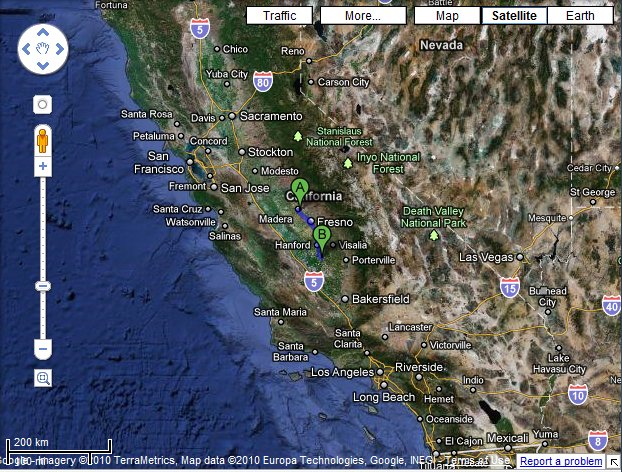
Okay, you think, at least Fresno will get some snazzy slick rail service . . . except this section will be built but not operated until further connecting sections are built . . . at a later date. Maybe. It will be the track, including elevated sections through Fresno, and the physical right-of-way, but no electrical system to power the trains; but that’s fine, because the budget doesn’t include any actual trains.


« Newer PostsOlder Posts »

Powered by WordPress

