
Quotulatiousness

February 25, 2026

Sensitive scientists skulk off to the “I❤️Science” clubhouse of Bluesky to lick their wounds

Filed under: Media, Politics, Science, USA — Tags: , , — Nicholas @ 05:00

Since the social media site formerly known as Twitter stopped being a purely leftist echo chamger — although some now claim it’s gone all the way to being a rightist echo chamber — a large number of scientists have chosen to relocate their social media participation to a site much more along the lines of pre-Elon Twitter:

Image from Science Is Not The Answer

Ressentiment and hurt feelings over lose of prestige has hit many academic scientists hard. The ebbing away of respect and deference was not something they prepared for. They were taught, all through life, that these things would be theirs in abundance, got free by flashing their degree. Only now there is often laughter instead of applause.

They should have seen it coming. Decades of predicting every single thing, with no exceptions, would worsen because of “climate change”, the idea that treating delusions by making all agree with the delusions, and by chemically and surgically altering the delusional, the hersterical overblown false cries of “Follow the Science!” in the covid panic, and the endless stream of nonsense of every stripe passed off in the name of science, all of which were funded by you, has whittled down to next to nothing the goodwill scientists earned over the years by inventing such modern miracles as chemical, biological and nuclear weapons and multiverses.

That’s my little joke. But it’s clear many scientists are running away from criticism, which is hurtful. Few enjoy being questioned, and almost none take well the abuse hurled on social media. Scientists want a return of the reflexive polite submissiveness (“Back off, man, I’m a scientist”), and many are coming to realize they aren’t going to get it. Not online, anyway.

Which is a long-winded introduction to the peer-reviewed paper — whose existence proves our thesis — “Scientists no Longer Find Twitter Professionally Useful, and have Switched to Bluesky” by DS Shiffman and J Wester in Integrative and Comparative Biology, a journal whose name would have you guess is about integrative and comparative biology, and not tittle tattle gathered, in the manner of cheap journalism, using surveys answered by those who can’t find an excuse not to answer. But the name lies. For that is exactly what this paper is.

The Synopsis, with my emphasis:

    Social media has become widely used by the scientific community for a variety of professional uses, including networking and public outreach. For the past decade, Twitter has been a primary home of scientists on social media. In recent years, new leadership at Twitter has made substantive changes that have resulted in increases in the prevalence of pseudoscience, conspiracy theory, and harassment on the platform, causing many scientists to seek alternatives. Bluesky has been suggested as a good alternative to Twitter, but the phenomenon of academics switching social media platforms has not previously been studied. Here we report on the results of a survey distributed to scientists on Twitter and Bluesky (n = 813). Results overwhelmingly confirm that changes to Twitter have made the social media platform no longer professionally useful or pleasant, and that many scientists have abandoned it in favor of Bluesky. Results show that for every reported professional benefit that scientists once gained from Twitter, scientists can now gain that benefit more effectively on Bluesky than on Twitter.

The reason this topic has not been “studied” is because, as is obvious, it is not worth studying. Asking why a handful of scientists (willing to answer) which social media platform they prefer barely counts as news. What is interesting, though, is that academic scientists have joined the Cult of the Victim.

Huh. Who knew that calculating degrees of butthurt was now an academic speciality?
The Korean War Week 88: Riot or Revolution? – February 24, 1952

Filed under: China, History, Military, USA — Tags: , , , , , , , — Nicholas @ 04:00

The Korean War by Indy Neidell
Published 24 Feb 2026

The tensions at Koje-do POW camp explode this week, ending in heavy bloodshed as UN forces desperately try to wrestle control of the situation. Changes will need to be made to counter the growing threat of disorder, and fast. Elsewhere, the Communist forces are on the attack this week, both in the field and through diplomatic channels, as a naval invasion of Yang-do launches and accusations of biological weapons ramp up.

00:00 Intro
00:44 Recap
01:13 Compound 62
04:44 Yang-do Island
07:45 Biological Warfare
09:55 Supervisory Committee
12:22 Notes
13:16 Summary
13:27 Conclusion
14:13 Call to Action
(more…)

“Allyness” in the British military

Filed under: Britain, Military — Tags: , , , — Nicholas @ 03:00

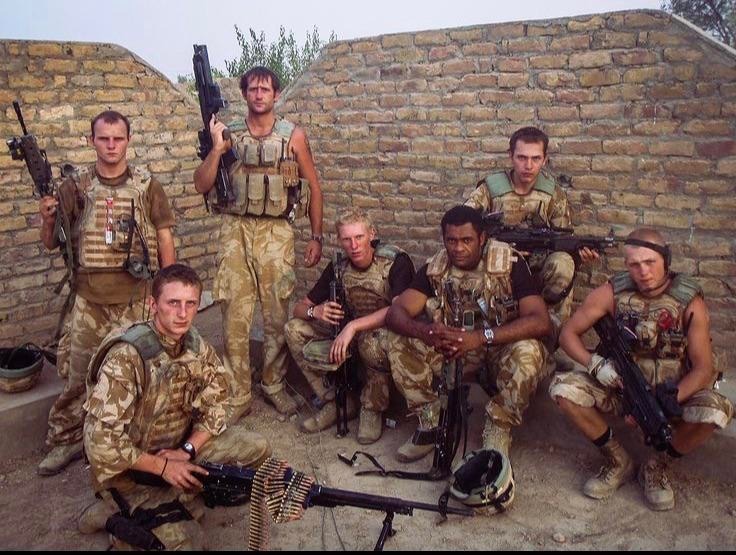
I suspect anyone who has spent time in uniform out in the field (peacetime or wartime) would recognize these traits, but so far as I know only the British army and Royal Marines have a specific term for it:

(British troops in Afghanistan, 2008, looking very ‘ally’)
Photo and caption from Combat Threads

Professor Andrew Groves is one of the few true academic experts on menswear. In fact, it was his work as the Director of the Westminster Menswear Archive that inspired me to pursue my Costume Studies MA. Recently, he has started a weekly Substack that is well worth checking out. Last week, he wrote an essay on “Ally“, a British military slang term. What exactly “Ally” is can be hard to nail down, as it has no comparable terms in the US military or civilian cultures. Broadly, it can be described as a language of visual signifiers that denote a soldier as “having been there”, or at the very least, wanting to come across that way, usually by modifying pieces of kit, or wearing it in a particular fashion.

As Groves puts it, “The quiet discipline of looking ready. It is a system that emerges precisely when regulation lags and consequences move faster than command … Allyness was awarded horizontally, not issued from above. It was recognition from peers who knew what to look for.” Groves continues:

    That recognition lived in detail, but it was never a checklist. Allyness was built through small, cumulative acts, field-smart adjustments passed down through units, not rulebooks: cutting down webbing to reduce snagging, taping over buckles to kill shine, shaping berets tight to the temple, sewing in map pockets, blacking out brass, marking kit discreetly. None of this was required. All of it mattered, because it signalled experience rather than purchase.

While the origins of “ally” definitely had roots in field-wise functionality and competence (the widespread adoption of Bundeswehr boots by British Paras or the “norgi” baselayer adopted by RM Commandos come to mind), by the time the GWOT generation were forming their own sense of “allyness”, much had devolved to style. I am going to quote from Simon Akam’s wonderful book The Changing of the Guard: The British Army Since 9/11, on the evolution of “ally” in the 21st Century:

    “Ally” is rifle magazines taped together — it draws inspiration from films as well as finding exhibition through the same medium. Ally is beards. Ally is non-regulation scarves and shemagh cloths. Ally is belts of 7.62mm link machine-gun ammunition draped over shirtless muscled torsos. Ally is liberal use of sniper tape on bits of kit, scrim netting pulled taut over the issued helmet, or “hero sleeves” — sleeves rolled only halfway up the forearm. A strong influence, ironically given the outcome of that conflict, is Vietnam … Of course, the two quantities of violence and ally are entwined. Fighting is ally. It seeps into Iraq, too: Major Stuart Nicholson, a Fusiliers officer serving on an exchange post with the Anglians in Basra in 2006, sees one sub-unit who keep one set of totemic combats [field uniform] to wear every time they go out on patrol, regardless of how dirty and disgusting they become. Nicholson catches one of this crew deliberately driving a Warrior armoured vehicle over a helmet cover to make it look already battered.

Later in the book, Akam recounts the “ally” origins of the British Army’s adoption of a Crye designed variant MultiCam (named Operation Peacock). The need for a new camouflage pattern was practical: British troops in Afghanistan found their DPM uniforms coming up short, and it was also based on seeing American SOF using MultiCam. I think that best illustrates the push and pull of what makes something “ally”. Some “allyness” traits can be seen as battlewise modifications to equipment, like taping down loose straps or added helmet scrim to help break up the silhouette, while others can be affectations that soldiers think look cool. And often, a bit of both.

Like anything to do with the infantry, of course, it can be taken too far and rather than improving effectiveness in the field, it can lead in very unwelcome directions:

These kinds of regulation-flouting practices can be interpreted as signs of a breakdown in unit discipline, which, in turn, can lead to more serious issues. It isn’t exactly “broken windows” theory for military units, but it also kind of is. It’s why, when Akam tells a story of an American officer who visited a British base in Afghanistan in 2006 and remarked that the British soldiers “look like our army at the end of Vietnam”, It was not meant as a compliment. Elsewhere, the desire to be “ally” led to armored vehicles flying English flags (despite its local connotations to the Crusades being an issue) and SS decals on other vehicles. “Allyness” can be a sign of the unit culture going rogue.

The result was a crackdown on the excesses of “allyness”. As Akam writes, “the ally clampdown is also a knee-jerk response to a realisation that something had got out of control. Some elements of ally survive, in particular the Paras’ interest in taping up bits of their gear. That is harder to stamp down on.”

Bommarito: America’s First Toggle-Locked Battle Rifle

Filed under: History, Military, USA, Weapons, WW1 — Tags: , , , — Nicholas @ 02:00

Forgotten Weapons
Published 1 Oct 2025

Designed by Giuseppe Bommarito, this was one of the many independent rifle designs submitted to the US War Department in the 1910s hoping for military adoption. It is a short recoil operated, toggle-locked system chambered for .30-06 and using detachable 20-round magazines. It was tested (without much success) at Springfield and remained in development until 1918.

See a more complete article including original disassembly photos here:
https://www.forgottenweapons.com/m1-g…

Thanks to the Springfield Armory National Historic Site for giving me access to this truly unique specimen from their reference collection to film for you! Don’t miss the chance to visit the museum there if you have a day free in Springfield, Massachusetts:
https://www.nps.gov/spar/index.htm
(more…)

QotD: The notion of “history”

“History” is itself a fairly recent phenomenon, historically speaking. As far as we can tell, all the preliterate civilizations, and a lot of the literate ones, lived in what amounted to an endless now. I find [Julian] Jaynes’s ideas [in his book The Origins of Consciousness in the Breakdown of the Bicameral Mind] very helpful in this regard, but we don’t need him for this, because whatever the explanation, it’s an obvious fact of historiography (“the history of History”; the study of the writing of History). Herodotus and Thucydides were more or less contemporaries, but what a difference in their work! Herodotus’s “history” was a collection of anecdotes; Thucydides focused on people and their motivations; but both of them wrote in the 400s BC — that is, 2500 years ago.

We are closer in time to them than they were to the men who built the Pyramids — by a long shot — and think about that for a second. That’s the vast scope of merely literate human history. Human settlement itself goes back at least another 6,000 years before that, and probably a lot longer.

So far as we can tell, well into historical time men had no real conception of “the past”. Even those men who had recently died weren’t really gone, and again I find Jaynes useful here, but he’s not necessary; it’s obvious by funeral customs alone. They had a basic notion of change, but it was by definition cyclical — the sun rises and sets, the moon goes through its phases, the stars move, the seasons change, but always in an ordered procession. What once was will always return; what is will pass away, but always to return again.

Linear time — the sense of time as a stream, rather than a cycle; the idea that the “past” forecloses possibilities that will never return — only shows up comparatively late in literate history. Hesiod wrote somewhere between 750 and 650 BC; his was the first work to describe a Golden Age as something that might’ve actually existed (as opposed to the Flood narratives of the ancient Middle East).

Note that this is not yet History — that would have to wait another 300 years or so. Whereas a Thucydides could say, with every freshman that has ever taken a history class, that “We study the past so that we don’t make the same mistakes”, that would’ve been meaningless to Hesiod — we can’t imitate the men of the Golden Age, because they were a different species of man.

Note also that Thucydides could say “Don’t make the mistakes of the past” because “the past” he was describing was “the past” of currently living men — he was himself a participant in the events he was describing “historically”.

The notion that the Golden Age could return, or a new era begin, within the lifetime of a living man is newer still. That’s the eschaton proper, and for our purposes it’s explicitly Christian — that is, it’s at most 2000 years old. Christ explicitly promised that some of the men in the crowd at his execution would live to see the end of the world (hence the fun medieval tradition of the Wandering Jew). And since that didn’t happen, you get the old-school, capital-G Gnostics, who interpreted that failure to mean that it was up to us to bring about our own salvation via secret knowledge …

… or, in Europe starting about 1000 AD, you get the notion that it’s up to us to somehow force Jesus to return by killing off all the sinners. I can’t recommend enough Norman Cohn’s classic study The Pursuit of the Millennium if you want the gory details. Cohn served with the American forces denazifying Europe, so he has some interesting speculations along Vogelin’s lines, but for our purposes it doesn’t matter. All we need to do is note that this was in many ways The Last Idea.

Severian, “The Ghosts”, Founding Questions, 2022-05-17.

Powered by WordPress



