
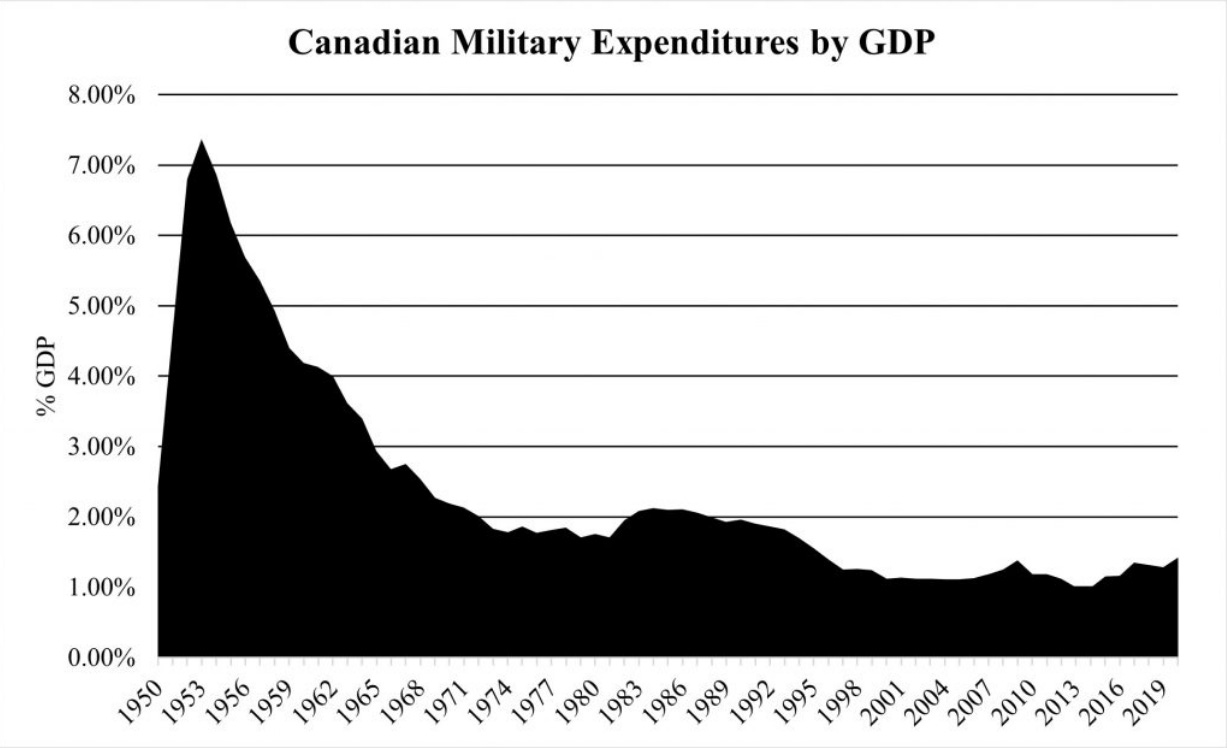
Canada’s military was not always a punchline. At the end of World War II Canada had the world’s third-largest navy, complete with our own aircraft carrier, and over a million men under arms. Since then military spending has steadily declined, from a high of around 7% of GDP in the early 50s to around 1% today, where it’s hovered since the end of the Cold War.
Canada is protected to its east and west by the Atlantic and Pacific oceans, both of which are patrolled by the powerful navy of the friendly superpower to the south, the only country with which Canada shares a land border, which we have long bragged is the longest undefended frontier in the world. Our only other neighbouring country is Russia, and while Russia is a decidedly unfriendly superpower, in practice Canada’s populated south is separated from the Russian Federation by thousands of kilometres of howling arctic wastes which provide an even better natural defence than the oceans.
Cozy and secure in our continental cocoon, Canada has allowed its military to atrophy into a vestigial appendage akin to the stubby wings of flightless birds on isolated Pacific islands, useful only for emotive displays. So far as the Liberal Party is concerned, “emotive display” is, indeed, the only real purpose of the military. Ever since Lester B. Pearson1 was awarded the Nobel Peace Prize for inventing the concept of “peacekeeping” to de-escalate the Suez Crisis (thereby helping to drive the final nail into the coffin of the British Empire), the Canadian military’s primary purpose has been to conduct third-world relief missions. Peacekeeping carries no particular benefit to Canada, but it is of great benefit to politicians, who get to preen in front of the camera as important humanitarian statesmen. The purpose of the Canadian military isn’t to win wars, to defend the country, or to conquer distant lands: it’s to make Liberal Party politicians feel good about themselves.
When the CAF fails to live up to its making-liberals-feel-good mission, Canada’s liberal establishment reacts like a frustrated child taking out her vindictive cruelty by throwing her dolls against the wall. The Somalia Affair is probably the best example of this dynamic. The Canadian Airborne Regiment, an elite commando unit whose core competencies were jumping out of airplanes to break things and kill people, was deployed in Somalia with the contradictory goal of keeping a non-existent peace, a mission to which they were singularly ill-suited. Somalis being Somalis, the Airborne base was immediately subjected to continuous infiltration and theft. A handful of the violent lunatics in the regiment reacted by capturing thieves and torturing them to death, which they had the poor sense to document with photographic evidence; later, photographs emerged of one of the airborne troopers wearing a moustache man t-shirt while raising his arm at a prohibited angle, which wasn’t criminal exactly but was very bad PR. Instead of punishing the guilty troops individually, for instance with field courts martial followed by summary hanging, the Liberal Party flew into a rage and disbanded the regiment for having committed the unforgivable sin of making them look bad. This dragged on in the media for years, sullying the honour of not only the Airborne Regiment but of the entire military. The Somalia affair unfolded over thirty years ago, but the liberal establishment holds it over the heads of the CAF to this day.
In addition to providing politicians with regular hits of the pleasantly addictive buzz of telescopic philanthropy, peacekeeping also has the great advantage of being cheap. Not only does peacekeeping not require all that many troops, you don’t even need tanks, fighter jets, destroyers, or aircraft carriers to distribute aid packages to refugees. Therefore the Canadian military essentially does not have these things. The CAF has a grand total of 112 forty-six-year-old Leopard II main battle tanks (of which roughly half are down for maintenance at any given time), a whole 138 forty-two-year-old CF-18 Hornet fighter jets (of which 89 are operational), twelve Halifax class frigates (of which about half are in drydock at any given time), an intimidating four Victoria class diesel-electric submarines (which are forty-five years old, and all but one of which is out of commission), and zero bombers, zero attack helicopters, zero destroyers, zero troop transports, zero battleships, and zero aircraft carriers. The pathetic size of the Royal Canadian Navy is particularly embarrassing given that Canada has the longest coastline in the world, at 243,042 kilometres, essentially all of which Ottawa expects Washington to defend on its behalf. Airlift capacity is so limited that the CAF essentially cannot deploy overseas without allied logistical assistance.
By contrast with its decrepit armaments, the CAF has 145 generals: it has more generals than it does tanks. This top-heavy general staff is only about a third the size of the US military’s, despite the American military being 20x larger by personnel and 32x larger by budget.
From the perspective of the Laurentian elite, a weak military is actually a political advantage. If Canada effectively does not have the ability to project military force, Ottawa can simply plead lack of capacity when America asks for assistance. It enables Canada to duck out of involvement in America’s various imperial wars, letting Washington shoulder the burden of the Pax Americana while chirping from the sidelines about how the big bad bible-thumbing American bully is so mean, and how peaceful, ethical, liberal, humanitarian Canada is so nice because Canada spends its money on healthcare instead of bombs. It isn’t a morally superior position, of course: it’s simply shameless dependence and shameful parasitism.
John Carter, “The Canadian Political Class is Ideologically Incapable of Rebuilding the Military”, Postcards From Barsoom, 2025-11-13.
- The man who, as prime minister, replaced the red ensign’s ethnic heraldry with the maple leaf’s corporate logo.
February 14, 2026
QotD: Canada and its military – a history of neglect
Comments Off on QotD: Canada and its military – a history of neglect
No Comments
No comments yet.
RSS feed for comments on this post.
Sorry, the comment form is closed at this time.


