
When I first heard about California’s proposed “Billionaire Tax” I thought it was a joke — nobody could be that economically illiterate. But I was wrong and the state really does seem to want to make their state economy a new case study in economics courses of the future. J.D. Tuccille explains why the tax, if implemented, is likely to impact a lot more folks who don’t rank as plutocrats:

California’s potential adoption of a one-time 5 percent “billionaire tax” on the net worth of high-value individuals is already sending wealthy residents fleeing for the exits. By one estimate, at least a trillion dollars has moved beyond the reach of state officials. But a new analysis says the tax may be even more onerous than advertised. Californians may need to get used to the sight of moving vans leaving the state.
Give Us 5 Percent of Everything You Own
Sponsored by a chapter of the Service Employees International Union, the proposed billionaire tax is set to appear as an initiative on the California ballot in November. According to the summary approved by state Attorney General Rob Bonta, the measure “imposes one-time tax of up to 5% on taxpayers and trusts with covered assets valued over $1 billion; covered assets include businesses, securities, art, collectibles, and intellectual property, but exclude real property and some pensions and retirement accounts”. If passed, the tax would apply to people resident in California as of January 1, 2026 — a retroactive element bound to be challenged in court.
[…]
Five Percent Understates the Pain
“The 2026 Billionaire Tax Act, a California ballot initiative, would ostensibly impose a one-time tax of 5 percent on the net worth of the state’s billionaires,” notes Jared Walczak for the Tax Foundation. “Due, however, to aggressive design choices and possible drafting errors, the actual rate on taxpayers’ net worth could be dramatically higher. One particularly momentous policy choice has the potential to strip the founders of some of the world’s largest companies of their controlling interests and force them to sell off a significant portion of their shares.”
According to Walczak, there are many ways in which the initiative creates situations under which “tax liability would be vastly more than 5 percent of net worth”. He focuses on six of them: valuations based on voting interests; assessment rules that can overvalue privately held businesses; excessive underpayment penalties that encourage overvaluing privately held businesses; anti-avoidance rules that tax more than the amount of transfers; provisions on spousal assets and debt to relatives that would tax nonresidents’ assets; and deferrals that would tax wealth that no longer exists.
As an example, Walczak points to the initiative’s means for valuing voting shares that aren’t publicly traded. DoorDash founder Tony Xu owns 2.6 percent of the company but controls 57.6 percent of voting rights. The initiative specifies, “the percentage of the business entity owned by the taxpayer shall be presumed to be not less than the taxpayer’s percentage of the overall voting or other direct control rights.”
That means Xu could be taxed on his voting rights rather than his economic stake in the company. That turns a $2.41 billion ownership interest into a $4.17 billion tax liability. It could force the conversion of voting shares to common stock for sale (subject to capital gains tax), and loss of control of the company.
The other provisions examined by Walczak also impose potential tax liabilities far beyond the 5 percent claimed by the initiative’s sponsors.
Charles Fain Lehman explains that the proposed tax will end up making everyone in California worse off:
… If you pick up all of Google’s employees and put them in Texas — where some of California’s billionaires might look to relocate — then one might assume they would be just as productive.
That would be a reason for non-Californians to be relatively sanguine about the wealth tax’s effects. Yes, it will be bad for California fiscally. But the titans of technology and entertainment can just set up shop in a red state and continue their work unabated.
But what if cities themselves have some additive effect? What if there’s something special about Los Angeles or San Francisco per se? What if the specific concentration of human capital in a specific place yields more than the output you’d expect if you put that same capital in a different place?
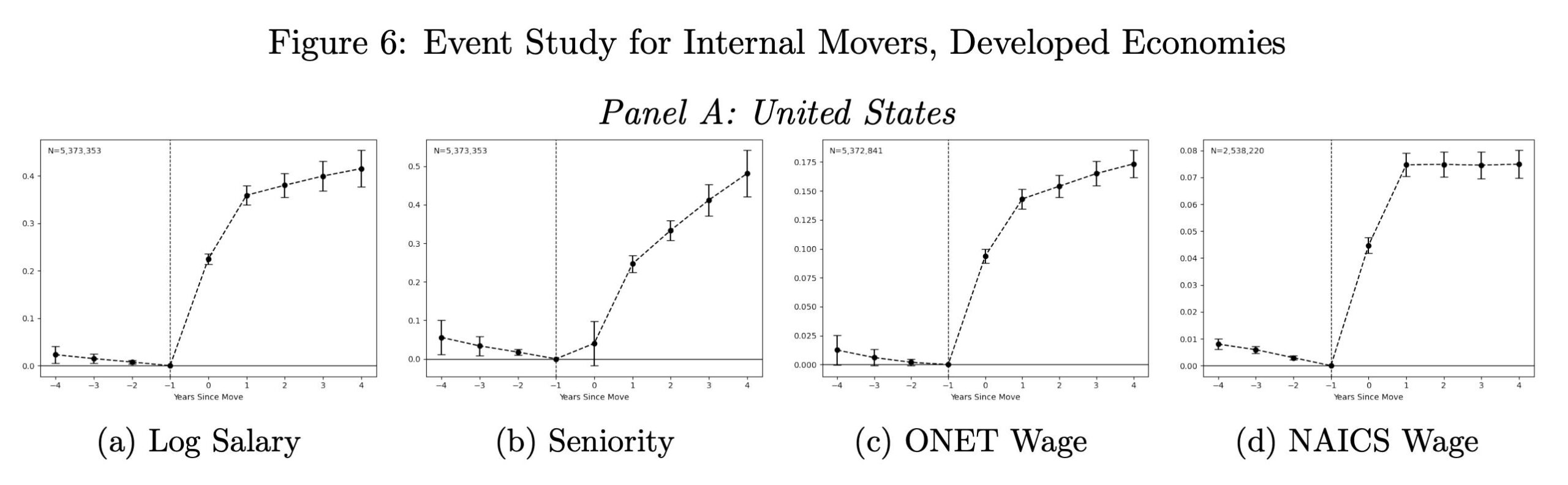
Source: Bhalothia et al, fig. 6.
As it turns out, that’s exactly what happens. Take recent research from economists at UC San Diego and Northwestern University. They use data on over 500 million LinkedIn users across 220,000 cities worldwide to ask how moving from one city to another affects an employee’s wages (a measure of their productivity). Because they observe the same people moving multiple times, they can disentangle the effects on wages of moving to a given city from the qualities of the people moving between cities.
The results are remarkable. The authors estimate that 93 percent of global wage variation is attributable to city effects, rather than to the qualities of workers themselves. That effect shrinks when you’re talking about movement within the developed world — someone moving from Bangalore to San Francisco gets a bigger wage bump than someone moving from Omaha to San Francisco, for example. But even looking at movers within their own developed country, cities explain something like 30 to 50 percent of the variance in wages.
In other words: it’s not just that people with better skills move to otherwise more desirable cities. Cities themselves make people worth more — meaning that they also increase total productivity and output, and therefore make the economy stronger.
How can it be that where you work is so important for how much you produce? The basic answer is what economists call agglomeration effects, the gains that come when firms cluster together. Agglomeration effects come, in general, from lowered barriers to exchange — of material goods, but also of ideas. Lots of start-up founders move to San Francisco because that’s where they can meet other start-up founders, and be on “the cutting edge” of what’s happening in their field. That’s only possible in a specific physical place.
Even if you put all the start-up founders in the same new part of Texas, moreover, they would still be worse off. Agglomeration economies come also from local culture and supportive industry infrastructure. Los Angeles as a city is built to support entertainers; San Francisco is built to support programmers. If you move those industries to Miami or Austin, neither city will be able to offer the same amenities — which is why both have struggled in their efforts to replace their Californian counterparts.
In other words: if California’s major industries leave California, they can’t be rebuilt somewhere else. Dismantle Silicon Valley, and you can’t just put it back together in Miami. We’ll still have technology companies, sure. But all else equal, they will be less productive than they would have been if they had stayed put. And we’ll all pay the price.



Hi Nicholas,
Love reading what you put together every day.
The study you cite above appears to have some problems. I am no scientist, so perhaps I am missing something.
During Covid, many people left the Bay Area (where I was born, raised, and still live 60 years later) for cheaper to live places. What did companies do, or try to do, in response? Lower the pay of workers who left the Bay Area because it was cheaper to live just about anywhere else.
So if TX is cheaper to live, you can pay the same person, or people with similar skills, less. Pay alone does not tell the full story.
Comment by James — January 22, 2026 @ 17:19
Thanks, James. Pay alone rarely explains this sort of thing. Employees, of course, would be happy to get the same pay after relocating to a cheaper area to live, yet for some reason companies aren’t always onboard with that. I’ve worked for a company based in California and others in a few other tech hubs in the US. In most of those cases, the multiple locations came about after take-overs and mergers rather than the original company establishing distant offices from its base. I think this is more true for tech firms than it would be for manufacturing or service companies who would need to optimize their facilities to supply issues and cost of transportation or for economy of providing their services to clients. Modern communications technology reduces a lot of the cost and friction of working with remote offices (but not all of it!), but it introduces other forms of inter-personal friction, based on my own experiences of working with folks in different countries (or even just different time zones in the same country).
Comment by Nicholas — January 23, 2026 @ 16:41
Forgot to comment on the wealth tax.
It will make the ballot, for sure, unless the SEIU decides to yank it for some reason.
Will it pass? If Newsom stays on the “against” side, that should hurt its chances. If he flips to “for” you can take it to the bank on it passing, IMHO.
Secondly, do I care if my home state wants to shoot itself in the head (this is way beyond shooting feet)? No, I will possibly die from laughing, though.
If it hurts California, it will probably be a net positive for most of the rest of the country. I realize it will undoubtedly have negative consequences, but I think California has way too much power, so I am ok with all the negatives.
Comment by James — January 22, 2026 @ 17:28