
It’s no secret that the publishing industry has changed substantially — and from most readers’ point of view, for the worse — but when did it happen, and why? Ted Gioia points to the mid-1990s in New York City:
Everybody can see there’s a crisis in New York publishing. Even the hot new books feel lukewarm. Writers win the Pulitzer Prize and sell just few hundred copies. The big publishers rely on 50 or 100 proven authors — everything else is just window dressing or the back catalog.
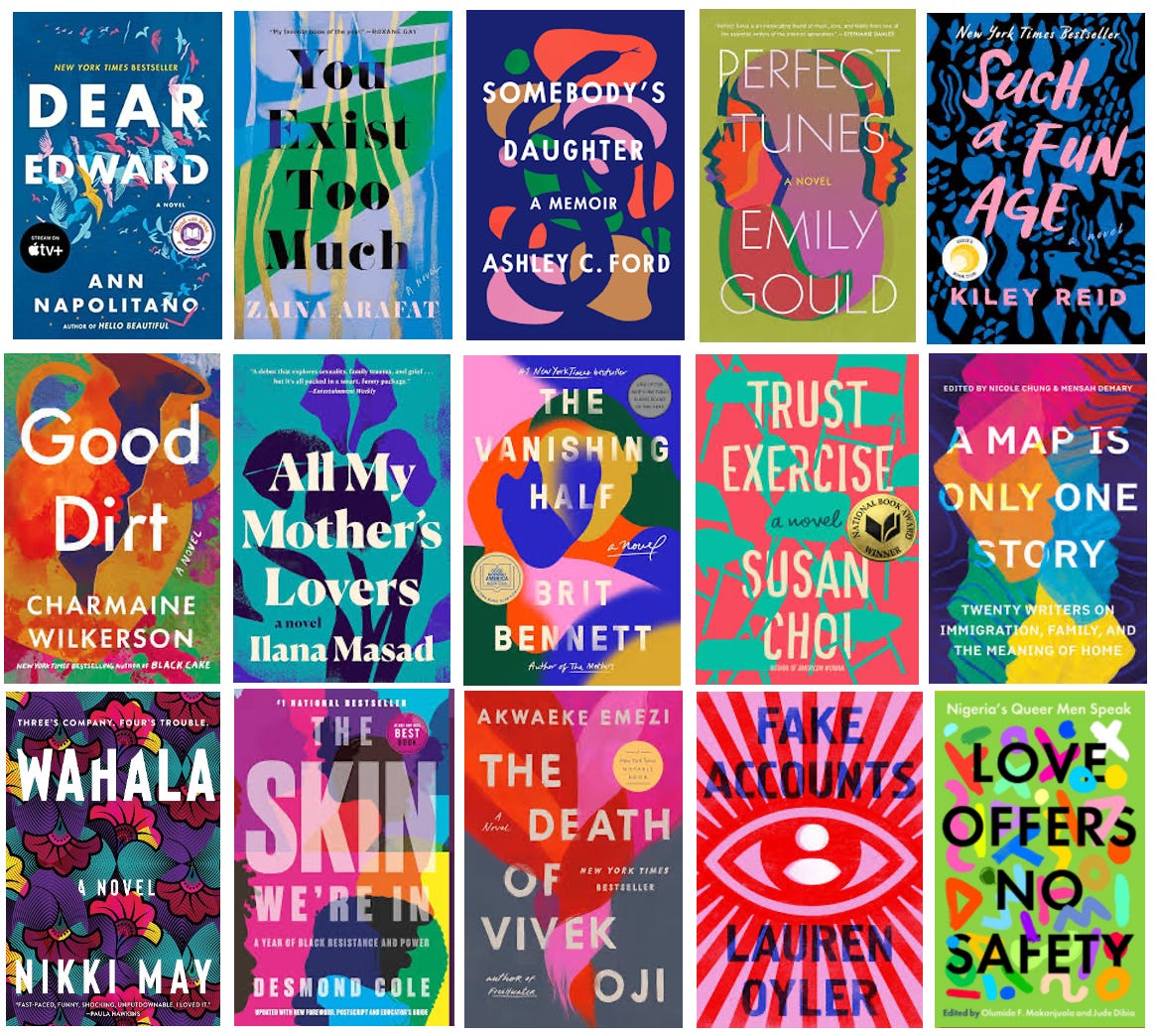
You can tell how stagnant things have become from the lookalike covers. I walk into a bookstore and every title I see is like this.
They must have fired the design team and replaced it with a lazy bot. You get big fonts, random shapes, and garish colors — again and again and again. Every cover looks like it was made with a circus clown’s makeup kit.
My wife is in a book club. If I didn’t know better, I’d think they read the same book every month. It’s those same goofy colors and shapes on every one.
Of course, you can’t judge a book by its cover. But if you read enough new releases, you get the same sense of familiarity from the stories. The publishers keep returning to proven formulas — which they keep flogging long after they’ve stopped working.
And that was a long time ago.
It’s not just publishing. A similar stagnancy has settled in at the big movie studios and record labels. Nobody wants to take a risk — but (as I’ve learned through painful personal experience) that’s often the riskiest move of them all. Live by the formula, and you die by the formula.
How did we end up here?
It’s hard to pick a day when the publishing industry made its deal with the devil. But an anecdote recently shared by Steve Wasserman is as good a place to begin as any.
He’s describing a lunch with his boss at Random House in the fall of 1995. Wasserman is one of the smartest editors I’ve ever met, and possesses both shrewd judgment and impeccable tastes. So he showed up at that lunch with a solid track record.
But it wasn’t good enough. The publishing industry was now learning a new kind of math. Steve’s boss explained the numbers:
Osnos waited until dessert to deliver the bad news … First printings of ten thousand copies were killing us. It was our obligation to find books that could command first printings of forty, fifty, even sixty thousand copies. Only then could profits be had that were large enough to feed the behemoth — or more precisely, the more refined and compelling tastes — that modern mainstream publishing demanded.
Wasserman countered with infallible logic:
I pointed out, if such a principle were raised to the level of dogma, none of the several books that were then keeping Random House fiscally afloat — Paul Kennedy’s The Rise and Fall of the Great Powers, John Berendt’s Midnight in the Garden of Good and Evil (eventually spending a record two hundred and sixteen weeks on the bestseller list, and adapted into a film by Clint Eastwood), and Joe Klein’s Primary Colors (published anonymously and made into a movie by Mike Nichols in 1998) — would ever have been acquired. None had been expected to be a bestseller, and each had started out with a ten-thousand copy first printing.
But it was a hopeless cause. And I know because I’ve had similar conversations with editors. And my experience matches Wasserman’s — something changed in the late 1990s.
The old system offered more variety. It took greater risks. It didn’t rely so much on formulas. So it could surprise you.
In a post about the jinned-up anger about CEO pay versus average worker pay, Tim Worstall briefly touches on the plight of writers:
Or even more fun perhaps.
In 2006, median author earnings were £12,330. In 2022, the median has fallen to £7,000, a drop of 33.2% based on reported figures, or 60.2% when adjusted for inflation.
That’s median earnings so 50% of all authors earn less than £7,000. And note this is only among those taking it seriously enough to join the Society of Authors (a number which does not include me). Even at my level of scribbling 5x to 10x, depends upon the year, of those median earnings can be gained.
But top level authors, well, they do earn rather more. No, not thinking of the JK Rowling level of global superstardom. But it would astonish me if Owen Jones is earning less than 50x those median earnings (yes, Guardian column, books, Patreon, YouTube and whatever, £350k would be my lower guess).
Writers display that similar sort of income disparity and range, no? Because we’re not about to suggest that Owen is top rank earning now, are we, even if it is a damn good income there.
Which shows us what is wrong with the Cardiganista’s1 initial calculation. They’re pointing only to the incomes of the very tippy toppy of the income distribution for that job. If we apply the same sort of reasoning to writers or footie players (and it’ll be the same for actors and all sorts of other peeps) we find very similar distributions.
- They all seem to be Guardian retirees and their byline pictures have them wearing cardigans — or did — therefore …


