
Quotulatiousness

January 3, 2026

America’s secret UBI programs

Filed under: Bureaucracy, Government, Media, Politics, USA — Tags: , , , , — Nicholas @ 09:28

On his Substack, Glenn Reynolds puts the Somali daycare scandal into its proper perspective: it’s not old-fashioned graft but something far bigger and far more destructive to the pillars of western society:

The explosive unveiling of the wildly extensive Somali-run daycare scams in Minnesota has drawn attention to a huge shadow economy, and not just in Minnesota. America, it turns out, is full of people, companies, and organizations that basically live off of fraud. We’re not talking old-fashioned waste, like $600 hammers or $1200 toilet seats. We’re talking about entities whose sole reason for existence consists of being a conduit for taxpayer money to flow directly to the people controlling them, with some of the proceeds being diverted to politicians and political organizations.

People are noticing.

This reverses an old joke told by my Nigerian relatives. A Nigerian visits his rich relative in the United States and is awed by the penthouse apartment, the limo, the private jet and so forth. “How did you make so much money?” he asks. The relative points out the window. “See that bridge? 15%. See that shopping mall? 15%. See that train station? 15%.”

The visitor, inspired, returns home to Nigeria and becomes fabulously wealthy. His rich cousin from America visits and says “How did you make so much money so fast?”

“You see that bridge over there?”

“Nope,” responds the confused relative. The Nigerian cousin points at himself and says “One hundred percent!

Well, this joke has now been turned around. Leaving aside that we don’t really even build train stations, bridges, or even shopping malls in this country anymore, now it’s America where people are pocketing one hundred percent and not even trying to actually deliver any goods or services. That the people doing this are mostly Africans only adds to the irony.

But what happened?

Well, several things. At base, people defraud the government for the same reason that dogs lick themselves — because they can. One of the things you find in these programs is that there are virtually no controls to ensure that the recipients of the money are legitimate, that the money is spent as promised — in essence, that the bridges get built. (Or, in the case of California, the high speed rail lines.) That lack of controls, of course, is no accident. The systems are designed to promote fraud and to make it hard to catch or punish.

Second, the culture is weaker. In a high trust society, people get angry when there is fraud and move to punish and ostracize the perpetrators. In a low-trust society, people expect it.

Older generations of politicians used to engage more in what George Washington “Boss” Plunkitt called “honest graft”. He defined honest graft as legally exploiting insider knowledge and opportunities from one’s position for personal financial gain, while also benefiting the public or party. A classic example he gave was learning about upcoming public projects (like a new park or bridge) and buying nearby land cheaply before the plans became public, then selling it at a profit to the city. He famously summarized it as: “I seen my opportunities and I took ’em,” comparing it to savvy stock trading on Wall Street. In contrast, dishonest graft involved outright illegal acts, such as blackmail, embezzlement, or extortion (e.g., shaking down gamblers or saloon keepers).

God knows what he would have said about simply taking money for nothing. Would his reaction have been horror? Or admiration?

Is The Matrix a Right-Wing Story?

Filed under: Media, Politics — Tags: , , — Nicholas @ 04:00

Feral Historian
Published 2 Jan 2026

This is gonna be one of those crazy comment feed vids … The film has made its mark on American political discourse, not only with the adopting of some of its terminology but with opposing sides claiming the story as their own. The Matrix resonates for reasons far beyond authorial intent or individual pieces of inspiration, it has transcended that. And yet, as much as it resonates with the Right, perhaps it shouldn’t when we get to the core of it.

This one really has to be considered in its entirety. Trying to argue about individual sentences in isolation on this one is to miss the point entirely.
(more…)

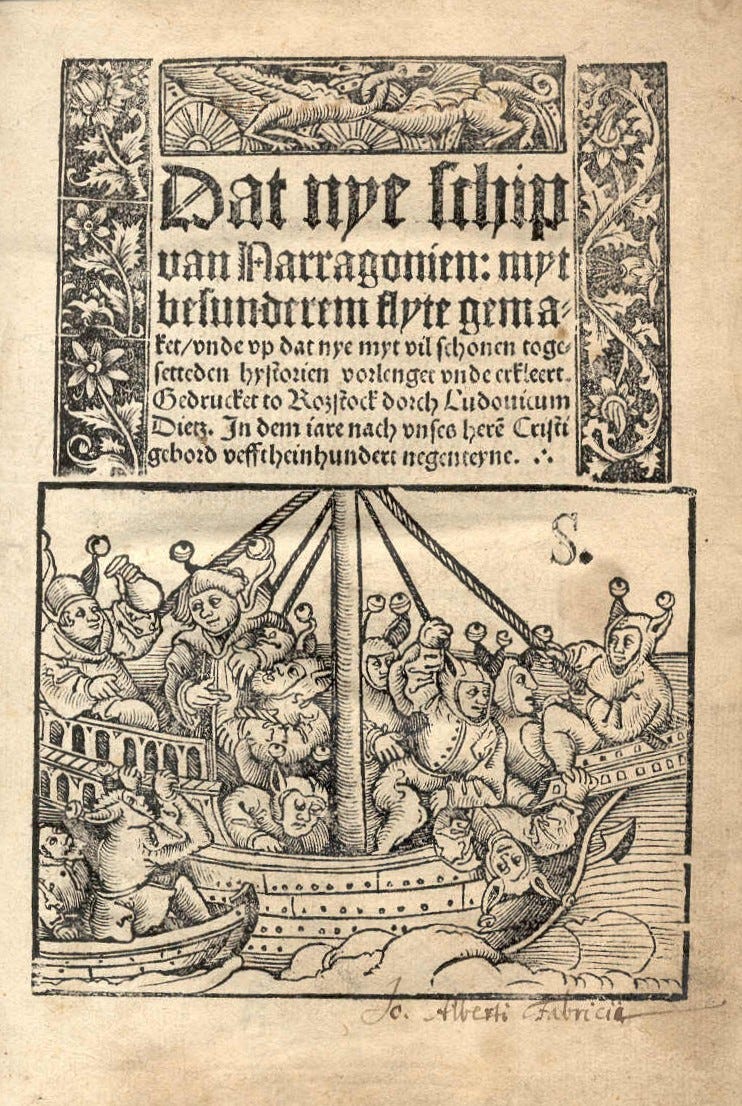
Britain’s government – a modern-day Ship of Fools

Filed under: Britain, France, Government, History, Military, Russia — Tags: , , , — Nicholas @ 03:00

On his Substack, Dr. Robert Lyman takes a break from discussing events in India and Burma during the Second World War to consider the current British government:

The 1519 title page of Sebastian Brant‘s 1494 satirical book Ship of Fools

I began life as a medievalist and often find myself instinctively going back to old texts when contemplating today’s problems. I have been forced to think much in recent days about the incompetence of our current governing class in respect of their understanding of defence and its value. More especially, their failure to understand how to use the military instruments of defence to uphold our national interest. The Ship of Fools, which first appeared in Plato’s Republic but was resurrected in Europe in the late 1400s as a metaphor for desperately poor leadership, is the perfect allegory for me. It tells a simple story that resonates with thoughtful people in every age who look on in wonderment at the idiots governing them. The story is of a ship with a crew who talk (and drink) a lot, but with their cloth ears make all the wrong decisions. The result is chaos. In the 1480s the ship in question was the Church of Rome, but the allegory is easily transportable to Britain in the early days of 2026. What on earth is going on in defence in the UK as we enter 2026? I can only surmise that in the UK at least, we are in a ship governed by fools.

I was going to start this piece by complaining that our government simply doesn’t understand Clausewitz, but I thought that this might be a little too obtuse for most politicians. But one of Clausewitz’s points about the use of military power is pertinent to our age. When Napoleon invaded Russia in 1812 he did so not because he had an existential hatred of Slavs, or of the Tsar. Indeed, Napoleon and Tsar Alexander I had a remarkably friendly relationship. He did it because the practice of friendly diplomacy between the two leaders had failed. Napoleon had attempted to persuade the Tsar to refuse the British trading rights in Russia’s ports. Alexander I had demurred, so Napoleon considered that the only thing left to him in his tool kit of levers to persuade Alexander to change his mind, was force. So, he marched on Moscow. We know the story and its outcome well, so I won’t rehearse it now. Using this as an example, Clausewitz was simply saying that in the hurly burly of diplomacy, war is one of the tools available to a national leader to persuade an opponent to change course. Hence, we get the oft misquoted Clausewitzian maxim that “War is the continuation of policy with other means”.

Clausewitz was correct, of course. Yet we in Britain have forgotten this, if politicians over the past three decades have really understood it. Since 1990 I am not sure we’ve had any politicians who’ve truly understood it, despite the fine words we get from successive Secretaries of State about the first priority of government being to protect its citizens, etc. This, without action to demonstrate any understanding of how to achieve the protection of our citizens, is merely St Paul’s clanging cymbal. Put frankly, we no longer have an Army, Navy or Air Force able seriously to achieve any form of influence on the European stage — let alone deter an enemy or fight a serious war — and the state of the Continuous At Sea Deterrent (CASD) is abysmal I’m told, though you wouldn’t know this from the hollow rhetoric regularly emanating from No 10. We are deluding ourselves if we think we can exercise real influence in Europe or anywhere else for that matter if we don’t have the practical means to do so.

The truth is that the cupboard is bare.

How have we got to where we are? The primary reason over the years has been the saving of money for politicians who have simply not valued investment in the hard practice of defence, unless it is in a shipyard in their constituency. The end of the Iron Curtain in 1989/90 meant, to many people in the corridors of power, that we no longer needed to bear the burden of spending 5% of GDP on defence.

But a second problem is only becoming clear to me. I hope I am wrong, but I can only conclude that we now have a government that actively hates the idea of defence, and while it will never admit it, is determined to remove it as one of its levers or instruments of power. I came across this in a meeting recently. Why do we need defence, the argument seemed to go, when we should be encouraging the international community to regulate itself by means of adherence to international laws and norms of behaviour? Should not our effort as a country be in building up these international systems and structures of law and governance (many based on the United Nations as an idea and a regulator) and rely on these to reduce the potentiality for war? Surely, building up arms simply makes war more likely, not less?

Update, 4 January: Welcome, Instapundit readers! Please do have a look around at some of my other posts you may find of interest. I send out a daily summary of posts here through my Substackhttps://substack.com/@nicholasrusson that you can subscribe to if you’d like to be informed of new posts in the future.

Penelope vs Clytemnestra in Greek Mythology

Filed under: Books, Greece, History — Tags: , , , , — Nicholas @ 02:00

MoAn Inc.
Published 10 Sept 2025

I’m trying out shorter videos on the channel, so this is a very basic breakdown explanation. Clytemnestra and Penelope are polar opposites, and their characters bookend The Odyssey. One is seen as the best wife, one is seen as the worst. They’re supposed to be compared and contrasted in this way: Agamemnon’s homecoming to Mycenae is a warning to Odysseus about what could potentially go very, very wrong with his own return to Ithaca. There are so many fascinating ways to dissect these two women, so please don’t take this as a be-all-end-all!

Voice of Erica Stevenson, host of MoAn Inc.
(more…)

QotD: “Fumbling towards bicameralism”

Filed under: Health, Media, Politics, Quotations, USA — Tags: , , , — Nicholas @ 01:00

“Fumbling towards bicameralism” also seems to explain one of the Left’s other signature pathologies: Their ability to “lie” to themselves, and I’m going to have to stop putting stuff in quotation marks lest I destroy my keyboard, but here again “lie” is far too weak a word. Leftist self-deception is so total, we unicameral folks can’t grasp it. They know, right? On some deep down fundamental level? If only because it’s impossible — damn it, impossible — that they don’t know. How can they keep fucking up so egregiously, in exactly the same way, every single goddamn time, and learn nothing?

And yet, “self-deception” shouldn’t be possible. How can you lie to your self? It raises all kinds of heavy epistemological issues, explored in a fun little book called Self-Deception by philosopher Herbert Fingarette. As I recall (it has been years since I’ve read it), Fingarette ends up advancing a kind of split-consciousness theory, too, as the only internally consistent one. How could it be otherwise? The “liar’s paradox” is a fun little game to play in the first class meeting of Logic 101, but nobody can really live that way … and yet we do deceive ourselves, all the time, and no one more than SJWs, whose lives indeed seem to be nothing but “self-deception.”

Bicamerality explains that. The “god” that lives in the smartphone says X today, so X it is. That same “god” says not-X tomorrow, so now it’s not-X! It’s not self-contradiction, it’s not self-deception, for the simple reason that there’s no real “self” at all.

Finally, it explains what might be the most frustrating thing about the Left, the thing that’s likely to end in a nuke or two here before too long: Their utter inability to see the glaringly obvious consequences of their actions. Those of us who tend to see “Leftism” as a big conspiracy love to point out that if they, the Left, were just stupid (childish, contrarian, herd animals, whatever), cold impersonal chance alone would guarantee that at least some of their fuckups would benefit us at least some of the time. Much like The Media’s “retractions” and “admissions” and so on, the “mistakes” always always always go in only one direction … ergo, they’re not mistakes.

That’s the reef on which we “emergent behavior” types always crash. To me, “emergent behavior” still seems like the best explanation … but however the behavior emerges, it’s always retarded. They’ve never made a non-stupid decision, not once, and it’s always stupid in exactly the same way. I remember waking up one morning to the sound of something crashing into my bedroom window. I figured it was a bird, which happens all the time, and it was … except that it kept happening, monotonously, every fifteen seconds or so. I got up to look, and here was a robin, smashing itself into the glass over and over and over again. It was early spring — mating season — and this stupid robin had mistaken its own reflection for a rival. I must’ve watched this bird slam himself into the glass for ten minutes, “attacking” his “rival”, before he knocked himself out cold …

That’s how the Left do. Always. They simply can’t learn, and they can’t change their pattern. The only explanation for that, therefore, must be that it’s programmed. Literally. Zero consciousness involved. They do what they do because they literally cannot do otherwise. Their “god” has put “rage” into their thumos. Just as Achilles would’ve literally jumped off a cliff had his “god” told him to, so the Left does … well, pretty much everything their teevee tells them to.

Needless to say, this has some important implications for practical action. How does one “get inside that OODA loop”, as the keyboard commandos like to say? In the land of the utterly unconscious, the one-brained man is king …

Severian, “Striving Towards Bicamerality”, Founding Questions, 2022-03-20.

Update, 4 January: Welcome, Instapundit readers! Please do have a look around at some of my other posts you may find of interest. I send out a daily summary of posts here through my Substackhttps://substack.com/@nicholasrusson that you can subscribe to if you’d like to be informed of new posts in the future.

Powered by WordPress



