Quotulatiousness

December 5, 2025

“I can stop [buying books] anytime. It’s not an addiction!”

Filed under: Books — Tags: , — Nicholas @ 05:00

In The Freeman, Nichole James resists the notion that her bookbuying habit is an addiction (because she could stop anytime she wants, unlike addicts who clearly can’t ever stop):
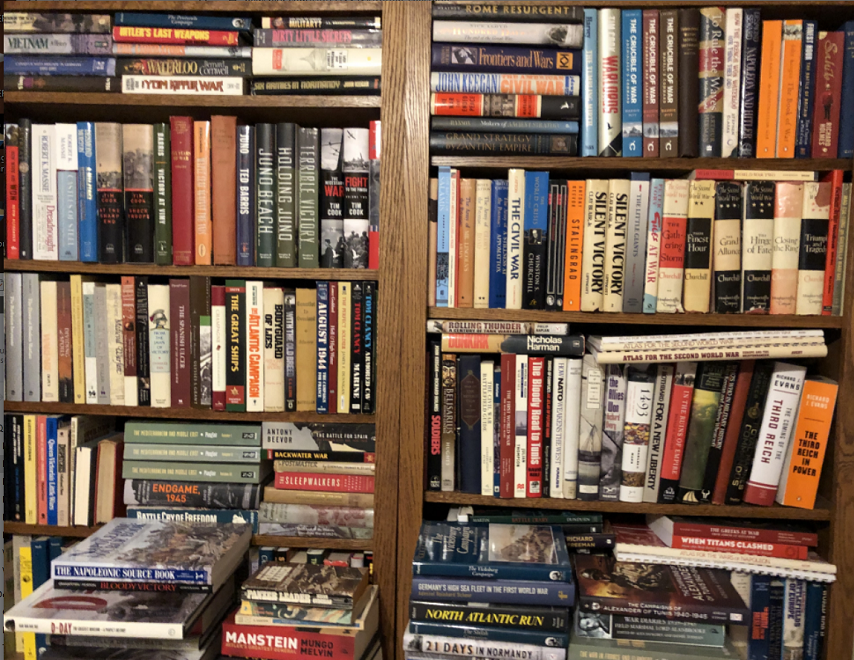
A small portion of my own book hoard. These shelves at least have a bit of commonality to them, unlike a lot of other shelves I could share.

There are people who collect sensible things, like pensions or matching dining chairs. Then there are people like me, who collect books and then build new shelves to hold the books, then buy more books to fill the shelves, then realize the house is now 70% paper.

I have always loved books. The magical lands they open up, the lives you try on for a few hundred pages. Places you cannot reach with a passport and an airline ticket. Narnia, Hogwarts, Mordor, and the parts of Sydney where even Google Maps looks nervous. The whole lot. Some people fall in love with the smell. Others with the weight of someone’s thoughts in their hands. I fall in love with all of that and then apparently forget that my house has finite wall space.

Which is why, as I call the carpenter for “just one more bookshelf”, a tiny voice in my head wonders if this is still charming or if I now qualify for some kind of diagnosis.

As it turns out, I might. The diagnosis even has a very fancy Greek name: bibliomania.

Back in the 19th century, an English cleric called Thomas Frognall Dibdin wrote a whole book called Bibliomania, or, Book Madness. He gleefully catalogued the symptoms of the afflicted: obsession with first editions, uncut pages, vellum, rare bindings, and the sort of Moroccan leather that smells faintly of money and self-satisfaction. It was a time when collectors bid like lunatics at auctions, paid “fancy prices”, and were generally regarded as slightly cracked.

That was then. Now, we call it a “TBR pile” — To-Be-Read.

Today, psychologists define bibliomania as a type of compulsive buying disorder. The warning signs are sobering. You buy more books than you can possibly read. You feel out of control. You get into financial trouble. You feel guilty. Your loved ones begin sentences with “Do you really need …?” and gesture helplessly at the tottering stack of paperbacks by the bed.

I recognize a few of these symptoms. I have definitely skipped a meal to afford a hardback. I have walked into a bookshop to “just browse” and come out clutching a small tower and a freshly re-mortgaged soul. There are hardbacks I have moved house with three times that I haven’t yet opened. They look at me accusingly whenever I walk past, like neglected gym memberships in dust jackets.

But here is where I part ways with the diagnosticians and join the Church of Umberto Eco.

Eco, the Italian novelist and semiotician with the beard of a wizard and the library of a dragon, reportedly owned around 50,000 books. He did not consider this a problem. He considered it a system. He said it was foolish to think you have to read every book you buy, just as it would be foolish to insist you must use every screwdriver before you are allowed to own another one.

Books, in his view, are like medicine. You keep a lot in the cabinet. Most of the time they sit there harmlessly. Then one day, in some dark night of the soul or slow Wednesday in July, you need the exact one that will fix you. So you reach into your “medicine cupboard” and pull out the right book for that moment. Which, he argued, is exactly why you should always have more than you need.

This is the philosophy I am choosing to live by, rather than the one that suggests I should be monitored by a spending app and gently reintroduced to the public library.
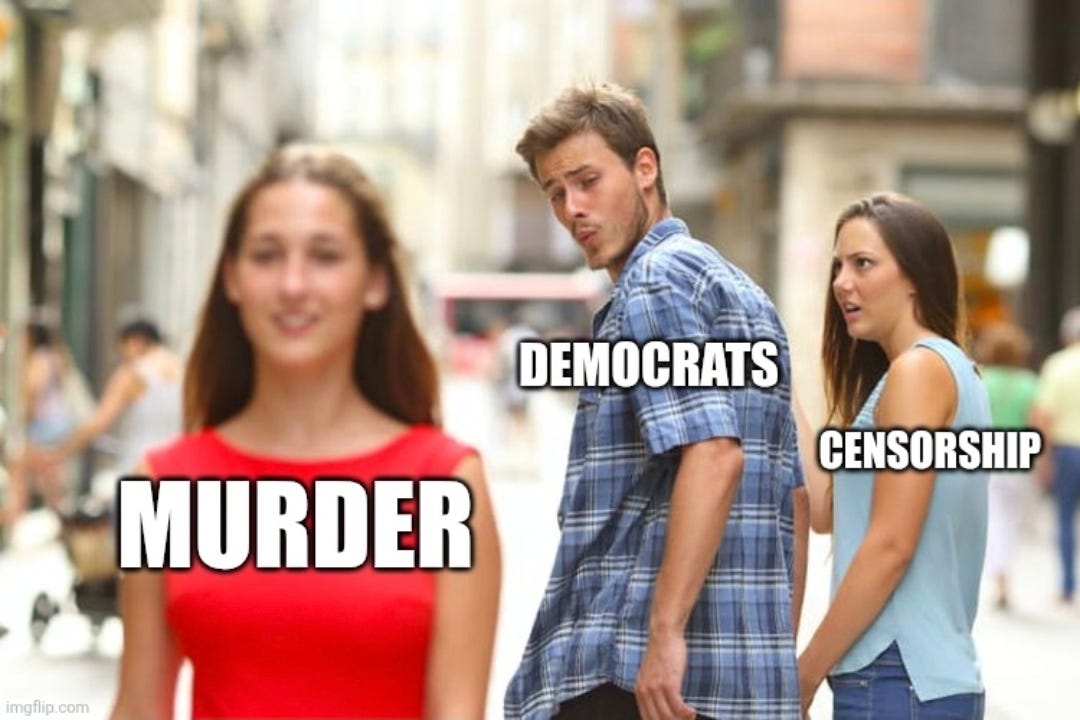

Censorship and “cancel culture” are symptoms of a cultural sickness

Filed under: Liberty, Media, Politics, Religion — Tags: , , , — Nicholas @ 04:00

A guest post at Woke Watch Canada by C.C. Harvey lays out the evidence that our culture — and most of the western world — is struggling with a spiritual sickness and that arbitrary cancellations and formal censorship of dissenting views are symptoms of that ailment:

When a society begins to suppress intellectual and spiritual searching and dreaming — by punishing speech, regulating thought, discouraging questions, denying the existence of spiritual reality — it is not only a political decline, but a sign of deep unwellness.

Where populations lose respect for liberty of conscience, inquiry, and discourse, society becomes nasty and brutish. Truth-seeking, spiritual health, and peace are inexorably linked. Across formerly open, stable, safe western societies, censorship and repression have been rising as safety, cohesion, and quality of civic life decline.

We must resist cancel culture and speech codes for the following reasons:

  1. Suppressing Truth-Seeking Violates a Fundamental Human Impulse
  2. Across religious and knowledge traditions, truth-seeking is expressed as a moral duty. When authorities obstruct honest questioning, they interfere with something built into the human spirit.

  3. Fear Becomes the Organizing Principle
  4. Where dissent is forbidden, fear takes the place of reason. Fear diminishes moral clarity, discourages integrity, and pushes people toward silence rather than responsibility. A fearful society cannot become a virtuous society.

  5. Conscience Is Treated as a Threat Instead of a Gift
  6. In every major tradition — religious or philosophical — conscience is seen as a source of moral insight. When institutions punish people for following their conscience, they reveal a belief that the individual soul has no intrinsic worth, only value as a compliant unit.

  7. Dialogue Is Replaced With Dogma
  8. Healthy societies debate, persuade, and refine ideas through open conversation. Unhealthy ones replace discussion with mandatory narratives and speech codes. Leaders who fear questions fear the truth those questions might uncover. Dogma can be secular or religious. It is ideologically rigid, generally not truth-seeking.

  9. Collective Identity Replaces Individual Worth
  10. Authoritarian systems elevate the group above the person: the party, the ideology, the movement, the “community”. When people are valued only as members of a group rather than as individuals, conscience becomes irrelevant and conformity becomes the main civic expectation. This is materialism, and denial of spiritual reality.

  11. Repentance and Correction Become Impossible
  12. A culture that silences criticism cannot correct its own errors. Without the freedom to point out problems, there can be no course correction, no growth, and no accountability. Mistakes multiply because they are protected by enforced silence.

  13. The Vulnerable Are Punished First
  14. Censorship and ideological enforcement nearly always fall hardest on those with the least power — dissidents, researchers, students, teachers, and ordinary citizens. When moral pressure is used to intimidate rather than uplift, society reveals a deeply inverted understanding of justice.

  15. Curiosity and Creativity Decline
  16. When questions become dangerous, people stop asking. When our human body, spirit, and intellect work in tandem without fear, we are capable of incredible scientific, artistic, and intellectual discovery and achievement. A society that punishes inquiry slowly starves itself of spirit in the form of innovation and insight.

  17. Tribal Narratives Replace Shared Reality
  18. When open debate disappears, competing ideological factions manufacture their own “truths”. Without a shared standard for evidence or meaning, society fragments into groups that can no longer communicate across boundaries. This is a recipe for distrust, polarization, and alienation … in dogmatically religious societies: a recipe for holy war and violent oppression.

  19. A Culture That Punishes Dissent Is Living by Avoidance, Not Truth
  20. Suppressing dissent is always a sign that an ideology cannot withstand scrutiny. Societies that silence critics pretend confidence but are insecure. The greater the fear of open conversation, diverse thought, and public debate, the greater the underlying instability and spiritual decay.

  21. Each Soul’s Journey Is Sacred — And Faith Must Be Chosen, Not Forced
  22. Across traditions, genuine belief is understood as something voluntary:

    • Love and faith cannot be coerced.
    • Insight cannot be mandated.
    • Moral understanding cannot be imposed through fear.

A society that tries to control belief tries to destroy the inner space where thought, reflection, and integrity develop. Coerced belief is not belief; it is compliance. An individual’s free relationship with God is sacred. No human rightfully owns another’s body, mind, or soul.

Update, 7 December: Welcome, Instapundit readers! Please do have a look around at some of my other posts you may find of interest. I send out a daily summary of posts here through my Substackhttps://substack.com/@nicholasrusson that you can subscribe to if you’d like to be informed of new posts in the future.

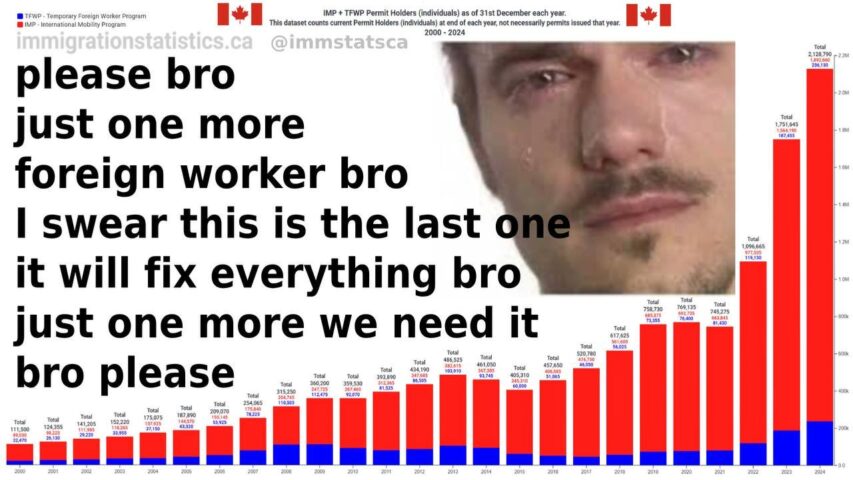
Abolish the Temporary Foreign Worker program

Filed under: Business, Cancon, Food, India — Tags: , , , — Nicholas @ 03:00

The CBC presented a sob story about a restaurant owner in Lloydminster who had to reject over a hundred job applicants because they couldn’t cook Indian food to her satisfaction. I’m no great cook, but there are about a dozen Indian dishes I make regularly that are, in my opinion, nearly as good as I can get from any of our local Indian restaurants. I’ve never been trained in cooking and I don’t have access to all the ingredients, but I do well enough. I’m sure that with some training and access to a proper restaurant kitchen I could do much better … as could a lot of those rejected job applicants, I bet.

Ms. Garner added the next day:

The more I think about this story the more preposterous the assumption behind it becomes — that no one out of the 100 applicants the owner rejected could be taught to cook at this place.

Yet the article essentially accepts this preposterousness as fact.

Abolish the TFW program.

As Fortissax responded:

Star Wars and Aliens: A Look at Interstellar Communications

Filed under: Media, Technology — Tags: , , , — Nicholas @ 02:00

Feral Historian
Published 2 Feb 2024

I’ve said before that Star Wars originally appears to not have real-time interstellar communications. Many have disputed that, with several good points. Here I finally explain my reasoning with a solution that fits everything we observe in the film without requiring convoluted excuses for why they have to fly an Astromech droid around. Think of this as off-week bonus content.

00:00 Intro
00:53 Taking It Seriously
02:10 Dantooine
03:43 They Tell Two Ships …
06:56 Is the Falcon Really that Fast?
07:50 Delegation

🔹 Patreon | patreon.com/FeralHistorian
🔹 Ko-Fi | ko-fi.com/feralhistorian

QotD: The Anglosphere

Filed under: Britain, Europe, Politics, Quotations, USA — Tags: , , — Nicholas @ 01:00

Contemplating the riots/demonstrations of the weekend (statues defaced and pulled down, police officers assaulted, social distancing ignored, etc) I ask myself about the extraordinary power of events a thousand-plus miles away in the US to excite supposedly “spontaneous” reactions here in the UK. And yet if, say, French police get all heavy with yellow-jacket protesters, I don’t recall marches of demonstrators in front of the French embassy. Or nor do I see this if or when there are problems in Germany, Italy or Spain (racism is a thing in these countries, after all).

Ironically – and this must drive those of a pro-EU frame of mind nuts – it is still North America, with its rawer culture and politics, its legal similarities to the UK (for good and for ill) that resonates, even in the minds (for want of a better noun) of the sort of folk going on BLM demos. What goes on in France, Germany or Italy tends not to have the same grip on the mind. The Atlantic is wide and the Channel is narrow, but in every other sense, it is the other way around. To that extent, then, the Anglosphere lives, even in the hearts and minds of the far Left.

Johnathan Pearce, “The Anglosphere and our present discontents”, Samizdata, 2020-06-08.

Powered by WordPress